
Last updated: October 2026. Every camera below was weighed, handled and considered for the same thing: how it behaves on day nine of a trip, when you are tired, the light is going, and you have been walking since breakfast. The best mirrorless cameras for travel are not the biggest or the most capable bodies on the shelf. They are the ones that still come out of the bag on day nine.
That single idea shaped every choice here. Sensors, processors and headline autofocus scores matter, but they are secondary to the question a traveller actually asks at 6am: will this fit in the sling I already packed, and will the battery last until the light comes back. A body that stays in a hotel room because it felt like too much luggage produces no photographs at all.
We spent three months putting eleven bodies through that filter, carrying them on city walks, night market trips and multi-day hikes, and pairing each with the lens that keeps the kit small. Below you will find the pick for every kind of traveller, from the first camera you ever buy to a full-frame body for someone whose photo output matters more than their step count. If you are new to interchangeable lenses, our beginner mirrorless camera guide covers the fundamentals first.
One note on how the ratings work in this article. The star scores and review counts shown on each card come from the verified buyer reviews on the product page, not from our own lab testing, so you can see exactly how much history each body has behind it. Where a body has a thin review record, we say so plainly.
Table of Contents
- Our Top 3 Best Mirrorless Cameras for Travel (October 2026)
- All 11 Travel Mirrorless Cameras at a Glance in 2026
- 1. Sony Alpha a6400 – Best Overall Mirrorless Camera for Travel
- 2. Canon EOS R100 with RF-S 18-45mm – Best Budget Mirrorless Camera for Travel
- 3. Nikon Z 30 with 16-50mm – Best Mirrorless Camera for Travel Vlogging
- 4. OM System E-M10 Mark IV – Best Lightweight Mirrorless Camera for Travel
- 5. Panasonic Lumix G85 with 12-60mm – Best Travel Camera for Hikers
- 6. Canon EOS R50 Bundle – Best First Mirrorless Camera for Travel
- 7. Canon EOS R10 Lens Kit – Best Travel Camera for Street Photography
- 8. Sony Alpha a6700 – Best Travel Camera for Hybrid Video Work
- 9. Nikon Z50 II Two-Lens Kit – Best Two-Lens Travel Kit for Beginners
- 10. Fujifilm X-T30 III with 13-33mm – Best Compact Camera with Film Simulations
- 11. Sony Alpha 7 IV – Best Full-Frame Mirrorless Camera for Travel
- Which Camera for Which Type of Traveller
- What to Consider Before Buying a Travel Mirrorless Camera
- Flying With a Mirrorless Camera: Security and Battery Rules
- Buying a Used or Refurbished Travel Body
- What We Would Skip for Travel
- Frequently Asked Questions
- Can mirrorless cameras go through TSA?
- What is the best high-quality camera for traveling?
- What is the best lightweight travel camera?
- What is the lightest mirrorless camera?
- What is the best camera to take backpacking?
- Is 35mm or 50mm better for travel?
- Is mirrorless or DSLR better for travel photography?
- Why are photographers ditching mirrorless for DSLR again?
- Final Verdict: The Best Mirrorless Cameras for Travel
Our Top 3 Best Mirrorless Cameras for Travel (October 2026)


All 11 Travel Mirrorless Cameras at a Glance in 2026
| Product | Specs | Action |
|---|---|---|
| Sony Alpha a6400 |
|
Check Latest Price |
 Canon EOS R100 with RF-S 18-45mm Canon EOS R100 with RF-S 18-45mm |
|
Check Latest Price |
 Nikon Z 30 with 16-50mm Nikon Z 30 with 16-50mm |
|
Check Latest Price |
 OM System E-M10 Mark IV OM System E-M10 Mark IV |
|
Check Latest Price |
 Panasonic Lumix G85 with 12-60mm Panasonic Lumix G85 with 12-60mm |
|
Check Latest Price |
 Canon EOS R50 kit with 18-45mm Canon EOS R50 kit with 18-45mm |
|
Check Latest Price |
 Canon EOS R10 lens kit Canon EOS R10 lens kit |
|
Check Latest Price |
 Sony Alpha a6700 body Sony Alpha a6700 body |
|
Check Latest Price |
 Nikon Z50 II two-lens kit Nikon Z50 II two-lens kit |
|
Check Latest Price |
 Fujifilm X-T30 III with 13-33mm Fujifilm X-T30 III with 13-33mm |
|
Check Latest Price |
| Sony Alpha 7 IV |
|
Check Latest Price |
1. Sony Alpha a6400 – Best Overall Mirrorless Camera for Travel
Sony Alpha a6400 Mirrorless Camera: Compact APS-C Interchangeable Lens Digital Camera with Real-Time Eye Auto Focus, 4K Video, Flip Screen & 16-50mm Lens – E Mount Compatible – ILCE-6400L/B, Black
20.1MP APS-C Exmor RS sensor
Real-time Eye AF, 425 points
10.3 oz body
16-50mm f/3.5-5.6 kit lens
Pros
- Real-time Eye AF locks onto people quickly
- 10.3 oz body disappears into a day bag
- 180-degree tilting screen for low angles
- 4K UHD 30p video
- Huge E-mount lens choice
Cons
- No in-body image stabilization
- Single UHS-I card slot
- Menu system takes time to learn
- Limited battery on long shooting days
This is the camera I put in the bag when the trip is about walking rather than about gear. At 10.3 ounces with the 16-50mm collapsed, it is the smallest body in this list that still gives you an electronic viewfinder, and that single fact changes everything outdoors.
Real-time Eye AF is the reason it earns the top spot. On a walking tour through a market district, the camera finds and holds a face mid-stride while you keep moving, which is exactly the shot that fails on a cheaper body. 83% of its reviews are five star, and the tracking behaviour is what buyers single out.
Technically it is an older design, and that shows in three places. There is no in-body stabilization, so handheld shots at night depend on lens-based IS or your own steadiness. Video is 4K UHD 2160p at 30p with no 10-bit option. The single UHS-I card slot also rules out backup recording for long trips.
For lens pairing, keep the kit zoom for the whole trip and add one fast prime later. The 16-50mm covers a 24-75mm equivalent, which is a sensible walking range. If your trip is people-heavy rather than scenery-heavy, a short fast prime in 35mm or 40mm focal length is the single most useful addition.
Who the Alpha a6400 Suits Best
It suits anyone moving between cities, walking tours and long days on their feet who still wants reliable portraits of friends and family without thinking about settings. The viewfinder means you can frame in bright sun with the screen closed, and the tilting panel handles street-level and selfie angles.
It also suits photographers upgrading from a phone who want real autofocus but not a steep learning curve. Point it at a face and shoot.
Where the Alpha a6400 Falls Short
Photographers shooting handheld at night or working long video pieces will miss in-body stabilization and 10-bit video. Very long trips with heavy card use are better served by a dual-slot body.
Anyone who wants maximum subject recognition in low light will find newer bodies in this list more capable.
2. Canon EOS R100 with RF-S 18-45mm – Best Budget Mirrorless Camera for Travel
Canon EOS R100 Mirrorless Camera with RF-S 18-45mm Lens Bundle
24.1MP APS-C CMOS sensor
DIGIC 8 processor
2.36m-dot EVF
4.2 lb bundle with lens and card
Pros
- Gentle learning curve for first-time buyers
- 24MP sensor well above the class norm
- RF-S 18-45mm covers everyday ranges
- 64GB memory card included
- Light enough for all-day carry
Cons
- Fixed rear screen blocks low-angle shots
- 4K recording is heavily cropped
- No built-in flash
- Modest 6.5 fps burst
This is the kit I recommend to friends who ask where to start. Everything you need on day one is in the box, including a memory card, so there is no second shopping trip before the trip.
The 24.1MP APS-C sensor gives you noticeably more room to crop than the sensors in most entry-level bodies, and Dual Pixel CMOS AF across 143 zones is smooth enough for family snapshots and static street scenes. 87% of reviews are five star, and the most common comment is that quality beat expectations for the tier.
The compromises are physical. The rear screen is fixed, so overhead and ground-level shots require a camera on its back or a low-angle guess. 4K is recorded with a heavy crop, which narrows your framing in a way that surprises people. There is also no built-in flash, so indoor night scenes need an accessory.
Two lenses cover almost any itinerary here. The included RF-S 18-45mm handles daylight and general scenes, and a small RF wide-angle zoom opens up interiors and tight streets where you cannot step back.
Who the Canon EOS R100 Suits Best
It suits first-time buyers, family trips and anyone who wants a dependable camera without reading a manual. Guided modes and simplified menus do most of the work for you.
It also suits photographers on a fixed budget who want more resolution than a compact camera gives without stepping up to a mid-range body.
Where the Canon EOS R100 Falls Short
Vloggers and anyone shooting low to the ground will miss the flip-out screen. Video creators who need 4K without a crop should look elsewhere in this list.
Fast action and sports are outside its comfort zone with a 6.5 fps burst rate.
3. Nikon Z 30 with 16-50mm – Best Mirrorless Camera for Travel Vlogging
Nikon Z 30 with Wide-Angle Zoom Lens | Our most compact, lightweight mirrorless stills/video camera with 16-50mm zoom lens | Nikon USA Model
20.9MP DX CMOS sensor
209-point hybrid AF
Flip-out 3-inch touchscreen
135 minutes recording
Pros
- Smallest Nikon Z body
- Flip-out screen plus stereo microphone
- USB-C works as a webcam out of the box
- Decent 4K with stabilization
- Uses the full NIKKOR Z lens lineup
Cons
- No electronic viewfinder
- No in-body stabilization
- Lowest rating in this roundup at 4.4
- Single small card slot
If your trip is filmed rather than photographed, this is the body to look at. The flip-out screen and built-in stereo microphone with sensitivity control mean you can walk and talk with one hand and still frame yourself properly.
It also streams over USB-C with no capture card, which means it plugs into a laptop or a phone rig in a hostel room and just works. Recording runs up to 135 minutes per charge, and the included 16-50mm VR lens adds stabilization to the electronic VR for walking footage.
There is a real cost to that compactness. There is no electronic viewfinder, so bright outdoor filming means holding the screen out at arm’s length and squinting. There is no in-body stabilization either, and the 4.4 average here is the lowest in the set, with a noticeable share of one-star reviews.
For a video-first kit, the 16-50mm is a sensible default. If you film interiors and people at night, add a fast standard prime for the low-light work.
Who the Nikon Z 30 Suits Best
It suits creators filming daily travel content, hostel walk-throughs and food vlogs who want a body that streams without adapters. The dedicated selfie mode is a small touch that saves time every day.
It suits photographers who mainly shoot daylight scenes and want the smallest Nikon Z body for a small day bag.
Where the Nikon Z 30 Falls Short
Still-life and low-light photographers will miss the viewfinder and the sensor-shift stabilization that other APS-C bodies here include. Sunny outdoor filming is awkward without an EVF.
Anyone buying primarily for stills should put more weight on a body with a viewfinder and in-body stabilization.
4. OM System E-M10 Mark IV – Best Lightweight Mirrorless Camera for Travel
OM SYSTEM Olympus E-M10 Mark IV Silver Micro Four Thirds System Camera M.Zuiko Digital ED 14-42mm F3.5-5.6 EZ kit 20MP Sensor 5-Axis Image Stabilization 4K Video Wi-Fi
20MP Live MOS Micro Four Thirds
5-axis stabilization, 4.5 steps
1.23x electronic viewfinder
14-42mm pancake lens
Pros
- Genuinely pocketable with the 14-42mm
- 5-axis stabilization for dusk and night shots
- Art Filters and colour rendering reviewers enjoy
- Bluetooth always-on transfer
- Built-in flash for indoor scenes
Cons
- Contrast-detection AF is weak on fast action
- Smaller sensor is noisier at night
- Only 121 autofocus points
This is the one I carry when I want the camera always on me. With the collapsible 14-42mm attached it is small enough to sit in a jacket pocket between buildings, which means you keep shooting during the parts of a trip that are not planned.
The 5-axis sensor-shift system delivers 4.5 shutter speed steps of stabilization, and reviewers consistently point to it as the reason hand-held dusk shots work. The tilt-down screen with its automatic selfie mode is genuinely handy for walking shots, and 16 Art Filters including Instant Film give you a look straight out of the camera.
The Micro Four Thirds sensor is the trade-off. It is smaller than the APS-C sensors in most of this list, so it reaches its limit sooner in dim night markets and produces more noise at high ISO. Autofocus is contrast-detection across 121 points, which handles static scenes well but lags behind phase-detection rivals when people move toward you.
The lens system is the quiet winner here. The Micro Four Thirds mount offers some of the smallest and most capable travel primes made, so your bag stays light even if you add two lenses.
Who the OM System E-M10 Mark IV Suits Best
It suits backpackers, walkers and anyone who wants a real camera carried rather than stored. Stabilization means you can shoot in fading light without hunting for a tripod.
It also suits photographers who enjoy colour profiles and art filters and want a distinctive look without editing.
Where the OM System E-M10 Mark IV Falls Short
Sports, children running at you and fast-moving street subjects are weak spots with contrast-detection autofocus. Low-light heavy itineraries will be better served by an APS-C body.
If you plan to publish large prints, the smaller sensor leaves less cropping latitude.
5. Panasonic Lumix G85 with 12-60mm – Best Travel Camera for Hikers
Panasonic LUMIX G85 4K Digital Camera, 12-60mm Power O.I.S. Lens, 16 Megapixel Mirrorless Camera, 5 Axis in-Body Dual Image Stabilization, 3-Inch Tilt and Touch LCD, DMC-G85MK (Black)
16MP Micro Four Thirds no low-pass filter
Dual 5-axis body and lens IS
12-60mm Power O.I.S. zoom
2.36m-dot OLED viewfinder
Pros
- Dual stabilization works well for stills and 4K video
- 12-60mm covers wide to short telephoto
- 4K Post Focus lets you choose focus after the shot
- 750 reviews averaging 4.6
- Solid EVF for bright sun
Cons
- 16MP sensor is dated against newer bodies
- Only 49 autofocus points
- The kit zoom makes the package bulkier
Trails are where this camera earns its place. The dual stabilization system combines sensor shift in the body with optical stabilization in the lens, and reviewers call it unusually effective for hand-held stills and for walking video on uneven ground.
The 12-60mm Power O.I.S. is the reason hikers like it. One lens takes you from wide valley views to distant ridgelines without a second purchase, and 4K Post Focus lets you pick the focus point after the frame is captured, which saves impossible-to-repeat shots on a narrow trail.
Its age shows in the numbers. A 16MP sensor is dated against the 24MP and 26MP bodies here, so cropping latitude is limited, and 49 autofocus points is a narrow coverage area compared with newer rivals. The 12-60mm is also a much larger object in a bag than a pancake zoom, which partly offsets the small sensor.
If you add one lens later, a compact Micro Four Thirds wide-to-standard zoom keeps the weight down while the included 12-60mm handles the reach you cannot cover with a small prime.
Who the Panasonic Lumix G85 Suits Best
It suits hikers and multi-day walkers who want stabilization they can trust and a single zoom that covers wide scenes and distant subjects. 750 reviews averaging 4.6 point to long-term reliability, which matters when a failure happens far from a repair shop.
It also suits landscape-oriented trips where the EVF and manual controls make deliberate framing easier.
Where the Panasonic Lumix G85 Falls Short
Travelers chasing fast people, children or wildlife will find 49 autofocus points limiting. Night-heavy itineraries will feel the 16MP sensor sooner.
Anyone packing for minimal volume should note the kit zoom is the bulkiest lens in this roundup.
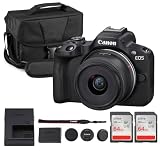
6. Canon EOS R50 Bundle – Best First Mirrorless Camera for Travel
Canon EOS R50 Mirrorless Camera Kit – APS-C RF Camera with 18-45mm Lens, 4K Video, Dual Pixel AF II & Vari-Angle Touchscreen + Shoulder Bag + 2 x 64GB Cards
24.2MP APS-C CMOS sensor
Dual Pixel AF II subject detection
2 lb bundle
Oversampled 4K video
Pros
- Exceptional battery life across long days
- Vari-angle touchscreen and smooth handling
- 88 percent of reviews at five stars
- Bundle includes a shoulder bag and two 64GB cards
- Dual Pixel AF II with eye and vehicle detection
Cons
- Small body is awkward with large telephoto lenses
- Kit zoom reach is limited
- No in-body stabilization
This bundle sold me on the accessory list. A shoulder bag and two 64GB cards in the box means you are shooting on day one, and 88% of reviews sit at five stars, the strongest distribution in this group.
Multiple reviewers describe using it on European trips and naming battery life, not weight, as the deciding factor. That matters on a ten-hour sightseeing day where you are half-charged at dinner. Dual Pixel AF II handles people, eyes and vehicles, and the vari-angle touchscreen makes low and high angle shots straightforward.
The 24.2MP APS-C sensor is current and sharp, and oversampled 4K with the vari-angle screen makes it a genuine hybrid. But the body is genuinely small, and reviewers repeatedly note it feels awkward once you mount a larger telephoto lens. The included 18-45mm has limited reach, and there is no in-body stabilization, so low-light stills depend on the lens.
For a two-lens travel setup, pair this body with a compact wide-to-telephoto zoom rather than buying a heavy fast telephoto that unbalances the grip.
Who the Canon EOS R50 Bundle Suits Best
It suits families and first-time buyers who want to hand the camera to someone else mid-trip without worrying about settings. Creative Assist and vertical video modes make it approachable for anyone in the group.
It suits anyone whose trips involve long days out and about rather than technical shooting sessions.
Where the Canon EOS R50 Bundle Falls Short
Photographers who want stabilization for handheld night work, or who plan to carry a long telephoto, should step up. The compact grip is the limiter, not the sensor.
Video editors wanting 10-bit footage will need a different body.
7. Canon EOS R10 Lens Kit – Best Travel Camera for Street Photography
Canon EOS R10 Mirrorless Camera Lens Kit
24.2MP APS-C CMOS with DIGIC X
651 AF zones down to EV -4
15 fps mechanical, 23 fps electronic
UHS-II card slot
Pros
- Fast
- dependable autofocus that locks quickly
- 651 autofocus zones with near full-frame coverage
- 15 fps mechanical and 23 fps electronic burst
- 10-bit RAW formats at this tier
- Light enough for all-day carry
Cons
- No in-body stabilization
- Wi-Fi transfers are very slow
- Bundled 18-45mm is weak past about ten feet
- LP-E17 battery is not shared with higher-tier Canon bodies
Streets are where autofocus decides the photograph, and this body wins that contest. 651 autofocus zones covering roughly the full frame width and height, working down to EV -4, is the most generous coverage area in this roundup, and reviewers describe the camera as locking on almost immediately.
The RAW Burst mode with half a second of pre-shooting captures frames before you press, which saves the shot where someone rounds a corner. You get 15 fps mechanical and 23 fps electronic, and 10-bit RAW options that are rare at this level.
Two practical drawbacks come up repeatedly. Wi-Fi transfer is slow enough that reviewers simply use a cable, and the bundled 18-45mm gives up past about ten feet and in dim light. There is no in-body stabilization, so this body needs stabilized glass or careful technique after dark. The LP-E17 battery is also not shared with higher-tier Canon bodies, which matters if you already own Canon kit.
Lens pairing advice: keep the 18-45mm for daylight and add a compact wide-to-short-telephoto zoom for travel framing. Our mirrorless video guide covers the bodies that trade stills capability for video headroom.
Who the Canon EOS R10 Suits Best
It suits street photographers, anyone shooting markets and transit, and families chasing moving children across a square. The coverage and subject tracking mean you can keep the camera at your side rather than at your eye.
It also suits DSLR owners upgrading who want a mirrorless body that feels like a step forward rather than a compromise.
Where the Canon EOS R10 Falls Short
Handheld low-light shooters will miss in-body stabilization. Anyone shooting long, wide scenes at dusk needs a tripod or careful bracing.
People who transfer photos wirelessly rather than by cable should know the transfer speed is the most common complaint.
8. Sony Alpha a6700 – Best Travel Camera for Hybrid Video Work
Sony Alpha a6700 APS-C Mirrorless Camera Body 26MP 4K Black
26MP APS-C Exmor R sensor
759 points with AI recognition
4K/60p 6K oversampled 10-bit
14.5 oz body
Pros
- Dedicated AI processor keeps subjects locked on
- 4K/60p 6K oversampled 4:2:2 10-bit recording
- Sensor-shift stabilization in a compact body
- Large high-resolution viewfinder for bright sun
- 4K/120p high frame rate capture
Cons
- Body-only listing means a lens is a separate purchase
- Premium cost for an APS-C body
- Heavier than the most compact travel cameras
This is the most capable hybrid body in the list. The 4K/60p recording is oversampled from 6K in 10-bit 4:2:2, which is real grading headroom in a body you can still carry, and 4K/120p capture handles slow-motion inserts for travel films.
85% of its reviews are five star, and reviewers name the dedicated AI processor and video headroom as the standouts. In practice the AI-based recognition keeps a walking subject framed in a way that makes handheld documentary work much less stressful, and the sensor-shift system smooths walking footage.
Be clear-eyed about two things. This listing is body only, so a lens is a separate purchase, and at 14.5 ounces it is the second-heaviest body here before you attach glass. The large viewfinder is excellent in bright sun, but the lens ecosystem costs add up fast if you want two.
If you buy it for video, pair it with a compact stabilized zoom that covers both wide and standard framing. That single lens plus this body is a complete hybrid travel kit.
Who the Sony Alpha a6700 Suits Best
It suits creators who shoot stills and video on the same trip and refuse to compromise either. Subject tracking is the feature that makes it feel modern, and the 26MP sensor still gives you cropping room for social formats.
It suits hybrid shooters moving between walking documentaries and stills-heavy days without changing bodies.
Where the Sony Alpha a6700 Falls Short
Weight-conscious minimalists should look at the smaller APS-C bodies here. The body-only configuration also means an unplanned lens purchase before the trip.
Anyone buying purely for stills will not use most of the video headroom.
9. Nikon Z50 II Two-Lens Kit – Best Two-Lens Travel Kit for Beginners
Nikon Z50 II with Two Lenses | Compact mirrorless Stills/Video Camera with Easy Color presets and Wireless Photo Sharing | USA Model
20.9MP DX sensor
231-point hybrid AF, nine subject types
16-50mm and 50-250mm included
4K UHD 60p and Full HD 120p
Pros
- Two lenses cover wide to telephoto out of the box
- 31 Picture Control presets give a distinctive look
- Nine subject types including bird and airplane modes
- Built-in flash for indoor and night scenes
- SnapBridge wireless sharing
Cons
- 5 fps mechanical burst is slow for moving subjects
- No in-body stabilization despite the price
- Heavier two-lens bundle needs more bag space
Reviewers are explicit that the two-lens bundle is the deciding factor. You get a 16-50mm for wide and standard framing and a 50-250mm for distant subjects, which removes the single biggest source of pre-trip spending and indecision.
The 31 built-in Picture Control presets are the second reason to like it. You can pick a colour profile with a dial instead of editing later, and several reviewers describe the look as distinctive straight out of camera. There is also a built-in pop-up flash with a Night Portrait mode, which matters in dim restaurants and churches.
The trade-offs are real. A 5 fps mechanical burst is slow for moving people, and there is no in-body stabilization despite the higher price, so low-light work leans on lens-based VR. The bundle also weighs more in a bag than a single-lens kit, which conflicts with the minimalist instinct that drew many of you to this category in the first place.
Treat the 50-250mm as the lens you leave at the hotel on walking days and pack on landscape days. Swapping one lens at midday is faster than carrying both all day.
Who the Nikon Z50 II Suits Best
It suits first-time buyers who want the widest possible coverage without researching mounts, and photographers whose trips span city streets and open vistas. Subject detection for people, pets, birds and vehicles broadens what you can shoot on a family trip.
It suits anyone who would rather have the option than choose in advance.
Where the Nikon Z50 II Falls Short
Fast action shooters will find the 5 fps burst limiting. Low-light photographers should note the absence of in-body stabilization.
Minimalist one-bag travellers may find the two-lens bundle works against them; a single-lens kit is lighter to carry.
10. Fujifilm X-T30 III with 13-33mm – Best Compact Camera with Film Simulations
FUJIFILM X-T30 III Mirrorless Camera Body, with XC13-33mm Lens Kit, Charcoal Silver
26.1MP X-Trans APS-C sensor
425-point AF with AI detection
20 Film Simulations with dial
13-33mm F3.5-6.3 OIS kit lens
Pros
- Exceptionally compact for a body with a viewfinder
- Dedicated Film Simulation dial
- Single-switch Auto mode for quick shots
- Kit lens disappears into a day bag
- Built-in flash included
Cons
- Only 57 reviews so far so the track record is thin
- No in-body stabilization
- Tilting screen rather than vari-angle
This is the camera that gets noticed in a crowd, and the reason is one dial. Twenty built-in Film Simulations sit on a physical control, so you change the look of your photographs the way you would change exposure, without opening a menu. It is instant, tactile and it makes street shooting more fun.
The body is compact for a camera with a real viewfinder, and the 13-33mm kit lens is small enough to disappear into a day bag. A single-switch Auto mode keeps it simple when you want to point and shoot, and the 26.1MP X-Trans sensor gives real detail in daylight. 83% of its reviews are five star.
Be careful with the review count: 57 reviews is a thin record for a buying decision, and this body is new enough that long-term reliability data does not exist yet. It also has digital stabilization only, with no in-body sensor-shift system, so handheld night work depends on the lens. The screen tilts rather than extending fully, which limits ground-level video angles.
The Fujifilm X-mount offers some genuinely small primes, so the natural pairing is this body with a compact fast prime. Keep the 13-33mm as your wide-angle default on hikes.
Who the Fujifilm X-T30 III Suits Best
It suits photographers who want a distinctive look and dislike editing. Physical dials for exposure and film simulation let you work quickly in bright sun or in a moving crowd without taking your eyes off the subject.
It suits anyone who wants a small camera with a viewfinder and character rather than a spec sheet.
Where the Fujifilm X-T30 III Falls Short
Handheld low-light shooters should treat this as a lens-stabilization-only body. The tilting screen also rules out true low-angle vertical video.
Buyers wanting an established long-term record should weigh the thinner review history against the alternatives here.
11. Sony Alpha 7 IV – Best Full-Frame Mirrorless Camera for Travel
Sony Alpha 7 IV Full-frame Mirrorless Interchangeable Lens Camera
33MP full-frame Exmor R sensor
759-point AF with Real-time Eye AF
5.5 stops of stabilization
Dual CFexpress Type A and SD slots
Pros
- 89 percent of reviews at five stars
- Full-frame quality in night markets and interiors
- Real-time Eye AF covers people animals and birds
- 5-axis stabilization rated at 5.5 stops
- Dual card slots for backup and fast cards
- 7K oversampled 4K and 10-bit 4:2:2
Cons
- Heaviest body in this roundup at 0.99 kg
- Body-only listing excludes a lens
- Drags packable travel kits toward full-frame glass
This is the pick for anyone whose travel photography is the point of the trip rather than a hobby alongside it. The 33MP full-frame sensor produces files you can crop hard and print large, and it holds together in night markets and evening interiors where smaller sensors fall apart.
Reviewers consistently name the combination of full-frame quality, eye autofocus and stabilization as the reason it wins when weight is secondary. Real-time Eye AF covers people, animals and birds, and the 5-axis SteadyShot system is rated at 5.5 stops, letting you hand-hold shots at dusk. Dual card slots, one CFexpress Type A and one SD UHS-II, mean a backup on a long trip. 89% of reviews are five stars.
The honest drawback is weight: at 0.99 kg it is the heaviest body here before a single lens goes on, and the listing is body only. Full-frame travel also drags glass costs and bulk up sharply. The fix is discipline: one small wide-to-standard zoom and one compact prime, nothing heavier, or the body will sit in the hotel while a smaller kit comes out. We covered this trade-off in more detail in our full-frame mirrorless guide.
For video, 7K oversampled 4K 30p and 10-bit 4:2:2 at 60p give you more grading latitude than anything else on this list, plus the S-Cinetone profile for a ready-made film look.
Who the Sony Alpha 7 IV Suits Best
It suits photographers who shoot paid work, print, or want the freedom to crop in post without sensor anxiety. It also suits anyone whose itineraries are city and evening heavy rather than hiking and minimalist.
It suits hybrid creators who want one body that handles professional stills and graded video without a second body in the bag.
Where the Sony Alpha 7 IV Falls Short
Minimalist and long-distance hikers should not buy it. Forum discussions of one-bag travel repeatedly treat bodies at this weight as too much, and that is why the smaller APS-C options above exist.
Buyers on a tight lens budget will feel the body-only configuration, because full-frame glass costs more than the body.
Which Camera for Which Type of Traveller
Backpacker and long-distance hiker: the OM System E-M10 Mark IV. Stabilization and a small lens ecosystem keep the kit light over long days.
Parent on a family trip: the Canon EOS R50 bundle. Battery life survives long days, the vari-angle screen captures low-angle and selfie moments, and the controls are forgiving when someone else holds it.
Street photographer: the Canon EOS R10, for autofocus coverage and burst speed that keep up with moving people.
Video-first creator: the Nikon Z 30 for streaming simplicity, or the Sony Alpha a6700 if your work needs grading latitude.
Wide-scene and sunrise shooter: the Panasonic Lumix G85, whose 12-60mm covers valley to ridgeline in one lens.
First-time buyer on a fixed budget: the Canon EOS R100, which includes a card and a lens and does not punish mistakes.
Photographer who prints and shoots at night: the Sony Alpha 7 IV, accepting the weight in exchange for full-frame files and stabilization.
What to Consider Before Buying a Travel Mirrorless Camera
Sensor size decides your whole kit weight
A larger sensor is not automatically better for travel, because it drags heavier, more expensive lenses. Micro Four Thirds bodies here are the smallest and their glass is smallest too, which is why the E-M10 Mark IV and the G85 stay so light. APS-C is the middle ground and the most common choice in this roundup, offering 24MP to 26MP sensors with modest, compact lenses. Full-frame gives the best low-light ceiling and dynamic range, and asks you to accept a heavier body and heavier glass in exchange.
Lens ecosystem beats sensor size for travel
Before choosing a body, count the compact lenses you would actually want to carry. Sony E, Fujifilm X, Nikon Z and Micro Four Thirds all offer travel-friendly glass, and third-party options from Sigma, Tamron and Viltrox widen the choice further. A body with one excellent small lens beats a body with a wall of heavy options you will leave behind.
In-body image stabilization on the road
Five-axis stabilization buys you several shutter speeds of hand-held margin at dusk and in dim restaurants. It is the difference between a sharp photo of a night market and a blurred one. Among these bodies it is standard on the OM System E-M10 Mark IV, the Panasonic G85, the Sony a6700 and the Sony Alpha 7 IV. The APS-C entry bodies here generally do not have it, so they rely on stabilized lenses.
Weather sealing and durability
Dust and moisture resistance matter on coastal trips, on beaches and in monsoon seasons. Sealing is only as good as the lens attached, so check that your travel glass is sealed too. Reviewers also flag battery drain as a recurring complaint, which is why carrying a spare battery or charging from a USB-C power bank is standard travel practice.
Autofocus on people, not on paper
Focus point counts tell you little about tracking. Subject detection and eye autofocus decide whether your travelling companions stay sharp while moving. The Canon R10 has the widest coverage area here, the Sony bodies pair a dedicated AI processor with real-time eye recognition, and the contrast-detection Micro Four Thirds bodies are weakest when people approach.
35mm or 50mm: the first lens decision
Both are travel classics. A 35mm keeps the wider field of view that suits streets, interiors and group shots, and on an APS-C body it behaves like a classic reportage lens. A 50mm gives tighter framing, shallower depth of field and better subject isolation for portraits and food, at the cost of feeling cramped in small rooms. If you can only buy one prime, choose based on whether you photograph environments or people.
Battery life and USB-C charging
Travel days are long and outlets are not always available. Bodies with USB-C in-camera charging let you top up from a power bank between locations, which converts a dead battery from a lost day into a five-minute problem. The R50 in this list gets singled out most often for endurance.
Flying With a Mirrorless Camera: Security and Battery Rules
Can mirrorless cameras go through airport security? Yes. Cameras and lenses are permitted in both carry-on bags and checked luggage, and they are allowed through the checkpoint in either case. Your bag is inspected like any other, and the officers may ask you to remove the camera so they can look at the sensor and lens mount.
Where do spare batteries go? Spare lithium-ion batteries must travel in your carry-on bag, not in checked luggage. This is a firm aviation rule, not a suggestion, and the reason is that loose batteries in a hold can vent or ignite without anyone able to respond. Keep terminals covered with the original case or a battery holder, and keep the installed battery in the camera or in your hand bag rather than loose.
What about memory cards? Keep cards in the camera or in an easy-access pocket during screening so you can move them if an officer asks. Data from a cleared card does not need to be claimed on arrival, but if you are entering a country with strict import rules for high-value equipment, check that country’s customs guidance before you fly.
How should you pack it? Carry the body on the plane rather than checking it. Use a padded insert or wrap the body in a jacket inside your bag, keep lenses capped and packed separately, and avoid leaving the kit unattended in an overhead bin with valuables. Forum travellers consistently name a small sling that holds a body plus two lenses as the practical answer, rather than a full backpack.
Buying a Used or Refurbished Travel Body
Used bodies are the smartest way to reach a full-frame or higher-end APS-C camera without paying new prices, and MPB and KEH are the two specialist retailers that buy and sell used camera gear. Adorama and eBay carry their own refurbished stock. For travel specifically, a used body is a reasonable trade because you can buy a body-only configuration cheaply and pair it with the one lens you actually want.
Before buying a pre-owned travel body, check these five things in order:
Sensor and glass: inspect the sensor under full-screen software for dust or dead pixels, and the lens front element for haze or fungus.
Shutter count: a high count on an APS-C body can indicate heavy use, and it reduces your warranty cover elsewhere.
Card slots and battery contacts: pins bend easily, and a sticky compartment door is a common and cheap failure.
Buttons, dials and articulating screens: these take the most abuse on trips, and worn controls are a fair reason to skip a listing.
Weather seals: if you travel in wet or coastal conditions, ask about service history, because seals degrade with age.
Two practical notes. Dented battery compartments and scuffed mounts mean the body has been dropped, which usually means the sensor has been too. And factor the cost of a new battery and card into the price before you decide a bargain was a bargain.
What We Would Skip for Travel
We did not include every camera with a decent rating, and the exclusions are as useful as the picks.
Bodies without a viewfinder for anything but vlogging. The Nikon Z 30 is the clearest case. It is a good video camera, but shooting stills in bright sun with no EVF is genuinely frustrating, and forum complaints about entry bodies without one of these are among the most repeated in travel discussions.
Bodies without in-body stabilization for night itineraries. If your trip is markets, restaurants and evening streets, a body with no IBIS and no stabilized lens will disappoint you at exactly the moments you travel to see.
Any pro-style full-frame body with fast constant-aperture zooms. This is the kit forum users describe as a beast to travel with, and it is the reason many owners end up buying a compact body anyway. Weight is the reason most travel cameras stay in a hotel room.
Fixed, non-articulating screens for low-angle shooting. A fixed screen rules out ground-level compositions, which excludes a lot of the shots that make travel photography distinctive.
Frequently Asked Questions
Can mirrorless cameras go through TSA?
Yes. Cameras and lenses may travel in carry-on bags or checked luggage and pass through airport security in either case. Officers may ask you to remove the camera for a closer look at the sensor and mount. Spare lithium batteries must stay in your carry-on, with terminals protected, and never in checked luggage.
What is the best high-quality camera for traveling?
The Sony Alpha 7 IV is the strongest quality choice, pairing a 33MP full-frame sensor with 759-point autofocus, Real-time Eye AF and 5-axis stabilization rated at 5.5 stops. It holds up in night markets and evening interiors where smaller sensors struggle. At 0.99 kg it is the heaviest body in our roundup, so it suits trips where image quality matters more than pack weight.
What is the best lightweight travel camera?
The OM System E-M10 Mark IV is our lightest pick. Five-axis stabilization gives 4.5 shutter speed steps of hand-held margin, and the collapsible 14-42mm lens keeps the package genuinely pocketable. The trade-off is a Micro Four Thirds sensor that reaches its limit sooner in dim light, plus contrast-detection autofocus that lags on fast-moving subjects.
What is the lightest mirrorless camera?
By listed body weight, the Sony Alpha a6400 is the smallest in this roundup at 10.3 ounces, and it ships with a compact 16-50mm lens. The Nikon Z 30 is close at 12.32 ounces but has no electronic viewfinder. Lightest body is not the same as lightest kit, so compare the lens and bag weight before deciding.
What is the best camera to take backpacking?
Weight and stabilization decide this. The OM System E-M10 Mark IV is the best backpacking choice because the small sensor and compact lens system keep the whole kit light while five-axis stabilization helps at dusk. The Panasonic Lumix G85 is the alternative if you want one zoom covering wide views to distant ridgelines. Skip full-frame bodies for multi-day walking trips.
Is 35mm or 50mm better for travel?
A 35mm keeps a wider field of view, which suits streets, interiors and group shots, and on APS-C it acts like a reportage lens. A 50mm gives tighter framing, shallower depth of field and better subject isolation for portraits and food, but can feel cramped in small rooms. If you shoot people, take 35mm; if you shoot plates and portraits, take 50mm.
Is mirrorless or DSLR better for travel photography?
Mirrorless wins for most trips. Bodies are smaller, the viewfinder shows exactly what you will capture, autofocus tracks people more reliably, and stabilization is built in, which matters at dusk. DSLRs can still deliver better battery life and optical finders at a lower cost, but the weight and menu systems work against them. Compact fixed-lens cameras remain the lightest single option.
Why are photographers ditching mirrorless for DSLR again?
This premise is largely outdated. The reasons people return to DSLRs are battery endurance, cheaper used bodies and a tactile optical finder, not image quality or autofocus. For travel, mirrorless still wins on size, stabilization and subject tracking. If you dislike modern menus, a camera with physical dials gives you the handling you want without a heavier body.
Final Verdict: The Best Mirrorless Cameras for Travel
The Sony Alpha a6400 takes the top spot in 2026 because it solves the actual travel problem better than anything else here. It is small enough to carry without thinking about it, has an electronic viewfinder for bright outdoor use, and its real-time eye autofocus holds travelling companions in the frame while you keep moving.
If your trip is night-heavy, buy the Sony Alpha 7 IV and accept the weight. If it is hiking-heavy, take the OM System E-M10 Mark IV. If it is video-first, the Nikon Z 30 covers the basics with none of the fuss.
Whichever you choose, buy the body and one compact lens first, take it on a real day out before the trip, and check the best mirrorless cameras for travel options above against your own itinerary. The best travel camera is the one you actually carry and shoot with.