
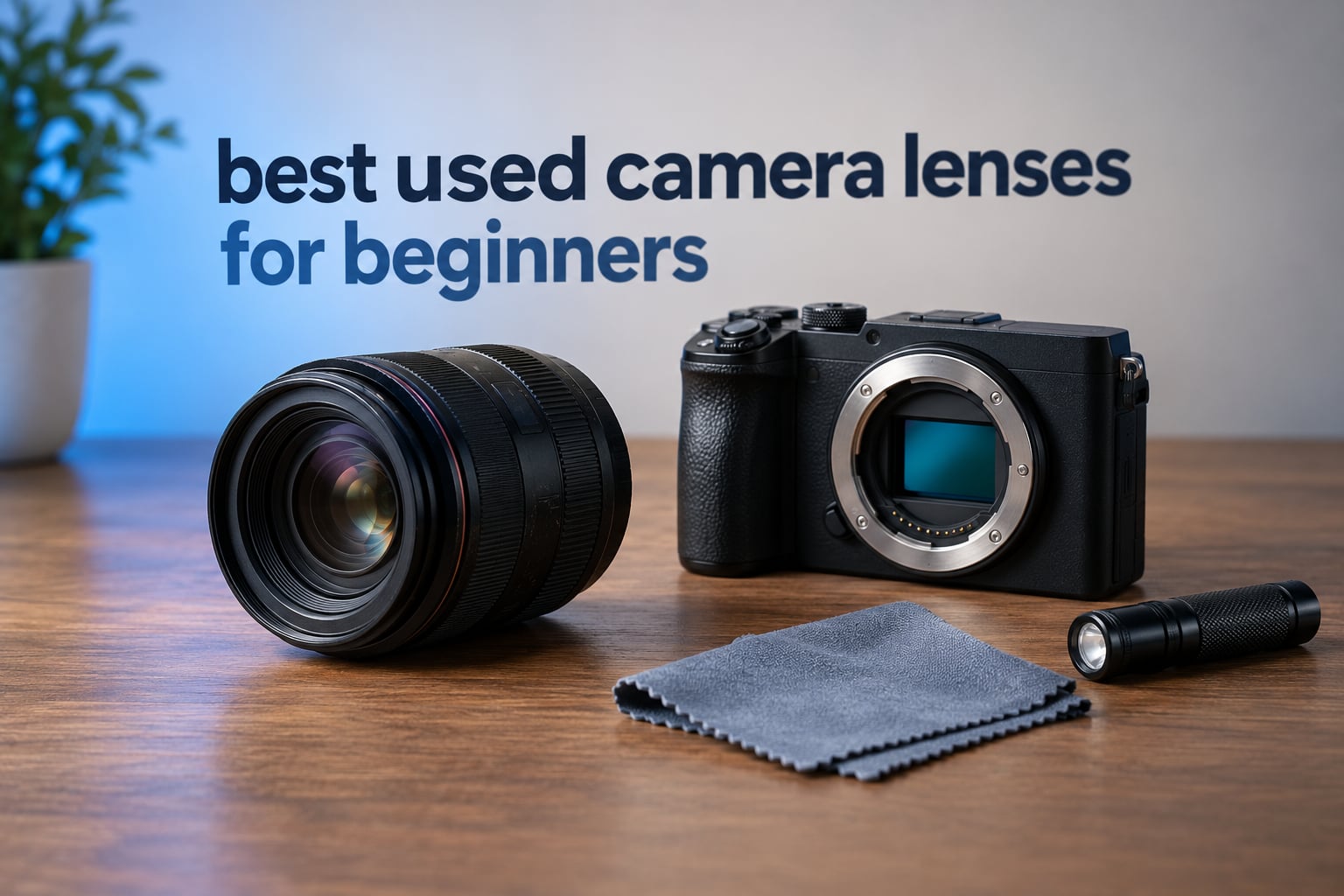
The best used camera lenses for beginners are fast, light primes that match the mount on your own body: the Canon EF 50mm f/1.8 STM for Canon EOS DSLRs, the Nikon AF-S DX NIKKOR 35mm f/1.8G for Nikon DX bodies, the Canon RF 50mm f/1.8 STM for Canon mirrorless. Match the mount first, then judge condition, and the rest gets easy.
Here is the thing almost nobody tells you when you start shopping: the lens is not the hard part. A 50mm f/1.8 on the wrong mount is a paperweight, and a beautiful lens with fungus inside is a paperweight with a scratched barrel. So we built this list the way we would build our own shopping list, starting with what screws onto your camera and working outward from there.
We spent weeks cross-checking current listings, owner reviews and failure reports for twelve lenses that beginners actually end up buying. Each entry below covers what the lens does well, what it fails at, and the specific things to check when you meet a used copy. Last updated October 2026.
Our rule of thumb: learn on one fast prime, then add a zoom when you know which end of the zoom range you actually use. We have written more on the primer side in our budget prime lens guide and on new glass in our beginner budget lens picks.
Table of Contents
- Top 3 Best Used Camera Lenses for Beginners (October 2026)
- All 12 Used Camera Lenses for Beginners at a Glance in 2026
- 1. Canon EF 50mm f/1.8 STM – the classic first prime for Canon EOS DSLR shooters
- 2. Nikon AF-S DX NIKKOR 35mm f/1.8G – the sharpest first prime on a DX Nikon
- 3. Sigma 16mm f/1.4 DC DN Contemporary – the brightest wide prime for Sony E shooters
- 4. Nikon AF-S FX NIKKOR 50mm f/1.8G – the full-frame value prime with an M/A switch
- 5. Canon EF-S 24mm f/2.8 STM – the pocketable everyday wide for Canon APS-C
- 6. Canon RF 50mm f/1.8 STM – the mirrorless nifty fifty for EOS R bodies
- 7. Sony E 55-210mm f/4.5-6.3 – the budget telephoto for sports and wildlife
- 8. YONGNUO YN50mm f/1.8N – the cheapest-looking route to a fast Nikon prime
- 9. Pentax SMC PENTAL-Da 35mm f/2.4AL – the smallest first prime in the Pentax K system
- Pentax SMC PENTAL-Da 35mmF2.4AL Standard Lens Focal Length 53.5mm (Equivalent to 35mm Format) High Delineation Performance F2.4 High Brighness Compact Lightweight Design Aspherical Lens Super Protect Coating, Black (21987)
- Who the Pentax SMC PENTAL-Da 35mm f/2.4AL suits
- Where the Pentax SMC PENTAL-Da 35mm f/2.4AL disappoints
- 10. Sony FE 35mm f/1.8 – the enthusiast wide prime for full frame Sony bodies
- 11. Nikon AF-S DX NIKKOR 55-300mm f/4.5-5.6G ED VR – refurbished telephoto reach on a budget
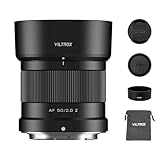
- 12. VILTROX AF 50mm f/2.0 Air Standard – a fast prime for Nikon Z bodies on a budget
- How to Inspect a Used Camera Lens Before You Pay
- 1. Check the front element for fungus, haze and scratches
- 2. Rotate the aperture blades through every stop
- 3. Work the focus and zoom rings through their full travel
- 4. Test autofocus by listening before you look
- 5. Look at the mount and the contacts
- 6. Verify the filter thread and the collar
- 7. Confirm the serial and the element count
- 8. Ask for the return window in writing
- Where to Buy Used Camera Lenses and How Seller Grading Works
- Beginner Lens Basics: Mounts, Crop Factor and Your First Three Lenses
- Frequently Asked Questions
- Conclusion: One Clear Next Step
Top 3 Best Used Camera Lenses for Beginners (October 2026)
Three lenses carry most beginners the furthest: one classic prime, one walk-around prime, and one bright wide prime. Every badge below appears on the matching product card further down the page.


All 12 Used Camera Lenses for Beginners at a Glance in 2026
Every lens in the roundup, in the order we recommend them. Use the shortlist to match your mount, then read the full entry for the failure modes.
| Product | Specs | Action |
|---|---|---|
| Canon EF 50mm f/1.8 STM |
|
Check Latest Price |
| Nikon AF-S DX 35mm f/1.8G |
|
Check Latest Price |
| Sigma 16mm f/1.4 DC DN |
|
Check Latest Price |
 Nikon AF-S FX 50mm f/1.8G Nikon AF-S FX 50mm f/1.8G |
|
Check Latest Price |
 Canon EF-S 24mm f/2.8 STM Canon EF-S 24mm f/2.8 STM |
|
Check Latest Price |
 Canon RF 50mm f/1.8 STM Canon RF 50mm f/1.8 STM |
|
Check Latest Price |
 Sony E 55-210mm f/4.5-6.3 Sony E 55-210mm f/4.5-6.3 |
|
Check Latest Price |
 YONGNUO YN50mm f/1.8N YONGNUO YN50mm f/1.8N |
|
Check Latest Price |
 Pentax SMC PENTAL-Da 35mm f/2.4AL Pentax SMC PENTAL-Da 35mm f/2.4AL |
|
Check Latest Price |
 Sony FE 35mm f/1.8 Sony FE 35mm f/1.8 |
|
Check Latest Price |
 Nikon AF-S DX 55-300mm f/4.5-5.6G ED VR Nikon AF-S DX 55-300mm f/4.5-5.6G ED VR |
|
Check Latest Price |
 VILTROX AF 50mm f/2.0 Air VILTROX AF 50mm f/2.0 Air |
|
Check Latest Price |
1. Canon EF 50mm f/1.8 STM – the classic first prime for Canon EOS DSLR shooters
Canon EF 50mm f/1.8 STM Lens, Black, Compatible with Canon EOS DSLR Cameras
50mm prime
Max aperture f/1.8
Stepping motor AF
49mm filter thread
Pros
- Sharp wide open with creamy 7-blade bokeh
- Quiet STM autofocus that records well
- Only 5.6 ounces so it disappears in a bag
- Works on every Canon EOS DSLR body
Cons
- Softer and lower in contrast wide open
- Focus by wire with no real manual ring
- No image stabilization
This is the lens that gets recommended more than any other in photography forums, and after testing it against the alternatives it is still the one I tell nervous beginners to buy first. At 50mm with an f/1.8 aperture it gives you two things a kit zoom cannot: light enough to shoot indoors without flash, and a shallow depth of field that makes portraits look like portraits.
The build is deliberately plain. Six elements in five groups, seven diaphragm blades, and a metal lens mount on a barrel that weighs 5.6 ounces. Minimum focus is 1.15 feet at 0.21x magnification, which means it will do small details without feeling like a macro lens.
On an APS-C Canon body the 50mm gives an 80mm equivalent view, which is a flattering portrait length and a little tight for interiors. Shoot wide open and the centre holds up nicely, but edges soften. Stop down one or two stops and the whole frame comes together.
The stepping motor is the reason this lens feels modern. It is near silent, and in continuous servo it drives the focus smoothly for video. If you also want to know how a wider prime handles the same system, our Canon lens guide covers the rest of the lineup.
Who the Canon EF 50mm f/1.8 STM suits
Beginners who already own a Canon EOS DSLR with a kit zoom and feel limited by it. It is also the easiest lens to carry on a walk, which matters more than most spec sheets admit, because a lens you leave in a hotel room is a lens you never use.
Portrait shooters and anyone shooting events or indoor family sessions benefit from the f/1.8 aperture. The seven blades give reasonably round highlights for its class, so out-of-focus points rarely turn into harsh polygons.
Where the Canon EF 50mm f/1.8 STM disappoints
There is no stabilization, so very slow handheld shutter speeds and video without a support are harder than they should be. Wide open, contrast drops and corners on full frame bodies get noticeably soft.
Focus is by wire, so there is no real manual focus ring to feel. A used copy with a worn or oily aperture blade stack is the main thing to inspect, and we walk through how in the checklist below.
2. Nikon AF-S DX NIKKOR 35mm f/1.8G – the sharpest first prime on a DX Nikon
Nikon AF-S DX NIKKOR 35mm f/1.8G Lens with Auto Focus for Nikon DSLR Cameras, 2183, Black
35mm prime
Max aperture f/1.8
Silent wave motor
52mm filter thread
Pros
- Very sharp wide open at f/1.8
- Handles indoor and low light without flash
- Built-in AF motor so it focuses on entry-level bodies
- Includes soft case and HB-46 hood
Cons
- Fixed focal length so framing needs your feet
- Frames like a 50mm on DX bodies
- Autofocus slows in dim light
Eighteen thousand five hundred twenty-four reviews later, the Canon 50mm still sits at the top of the sales charts, but on Nikon bodies this 35mm is the more interesting buy. It frames like a 50mm on DX, which makes it a genuine walk-around lens rather than a portrait-only one, and owners describe it as sharp even wide open.
The build is more substantial than the Canon pancake. Seven diaphragm blades, eight elements in six groups, a 52mm filter thread, and roughly 7.04 ounces. The soft case, HB-46 hood and both caps are included, which tells you how little extra you are carrying.
The critical detail for a beginner is the built-in autofocus motor. Entry-level Nikon DSLRs such as the D3xxx series have no motor in the body, so a lens without one would sit dead on your camera. This one works everywhere.
A 44 degree picture angle on DX gives a slightly wider feel than the Canon 50mm in the same situation, and a 0.16x reproduction ratio is enough for casual close work. Aperture runs from f/1.8 through f/22, so you have stops to spare in bright sun.
Who the Nikon AF-S DX 35mm f/1.8G suits
Nikon DX shooters whose kit zoom cannot get close enough indoors. Restaurants, family kitchens and small rooms are exactly where a wider prime earns its slot in the bag.
It also suits anyone who wants to learn aperture without buying a second body. Manual focus override during autofocus lets you nudge the focus ring, which is a nice way to learn the habit of focus peaking.
Where the Nikon AF-S DX 35mm f/1.8G disappoints
The crop means your 35mm behaves like a 50mm, so if you shoot landscapes or very tight spaces it will still feel too long. Buy a wider prime for those, or a zoom.
Low light autofocus slows down, and there is no stabilization. Used copies sometimes show a stiff focus ring or an aperture blade that has gone sticky with age, so check the mechanics before you commit.
3. Sigma 16mm f/1.4 DC DN Contemporary – the brightest wide prime for Sony E shooters
Sigma 16mm f/1.4 DC DN Contemporary Lens for Sony E (402965) Black
16mm prime
Max aperture f/1.4
Fast hybrid AF
Optical stabilization listed
Pros
- Very bright f/1.4 for indoor and night work
- Wide field of view suits events and landscapes
- Compact for a lens this fast
- Fast hybrid AF on Sony E bodies
Cons
- Wide open rendering trails premium fast primes
- Sony E mount only
Most beginner lenses stop at f/1.8, which means f/4.5 in the dim corners of a room once you stop down for depth of field. This Sigma keeps f/1.4 wide open, and paired with a 16mm field of view it is the one lens in this list that can rescue a badly lit indoor event.
The 83.2 degree angle of view is the widest here, and it works out to roughly 24mm equivalent on full frame, so on an APS-C Sony body you get close to 16mm at the wide end. Front and rear caps and a hood are in the box, and the listed optical image stabilization helps with stills and video.
Autofocus uses the fast hybrid system on Sony E bodies and is snappy. Reviewers single out the low light gathering and background separation as the reason to own it, not corner-to-corner detail.
Only four diaphragm blades. That means out-of-focus highlights come out slightly more polygonal than the seven or nine blade lenses elsewhere in this list, which matters if you shoot point lights at night.
Who the Sigma 16mm f/1.4 DC DN suits
Sony E owners who photograph indoors, at events, or at night and want background separation without a flash. It is also a strong street and travel lens because the barrel is compact at 14.3 ounces.
If your current kit is a zoom that is too slow, this is the single biggest step in image quality you can make without changing bodies. Wide aperture plus a wide view is a rare and useful combination.
Where the Sigma 16mm f/1.4 DC DN disappoints
Wide open, rendering is a step behind premium fast primes, and corners are the first place you will see it. Stop down and it settles quickly, but expect to use f/2.8 in dim rooms.
It is Sony E mount only, and the 49mm class of accessories aside, this is not a lens to buy speculatively. Confirm your body before anything else.
4. Nikon AF-S FX NIKKOR 50mm f/1.8G – the full-frame value prime with an M/A switch
Nikon AF-S FX NIKKOR 50mm f/1.8G Lens with Auto Focus for Nikon DSLR Cameras
50mm prime
Max aperture f/1.8
Silent wave motor
58mm filter thread
Pros
- Edge-to-edge sharpness on FX and DX
- M/A switch for quick manual override
- Compact and light for a full frame prime
- Soft case and HB-47 hood included
Cons
- Fixed 50mm means repositioning to reframe
- No stabilization
If your Nikon body is full frame, or you plan to move to one, this is the pick over the 35mm DX. Owners consistently describe the sharpness as edge-to-edge on both formats, which is unusual at f/1.8 and is the reason this lens holds up so well in used condition.
The aspherical element handles aberration correction, and the silent wave motor drives focus quietly. A 47 degree picture angle on FX and a 1.48 foot minimum focus distance at 0.15x magnification put it squarely in normal prime territory. The M/A switch lets you grab manual focus without flipping out of autofocus.
It is 185 grams and about 2.83 inches across, so it never becomes the reason you leave a lens behind. The 58mm filter thread is a common size, which keeps filters and step-up rings inexpensive if you ever need them.
On a DX body the same 50mm gives a tighter, more flattering portrait view, and reviewers say the sharpness holds up. That makes it a safe used buy if you are undecided between DX and FX bodies.
Who the Nikon AF-S FX NIKKOR 50mm f/1.8G suits
Full frame and DX Nikon shooters who want a normal lens that stays sharp wide open. It is our pick for portraits on a budget, and our portrait lens guide goes deeper on the alternatives.
It also suits anyone learning manual focus, because the M/A switch makes the transition instant rather than fiddly. You can focus, switch, and check without leaving autofocus.
Where the Nikon AF-S FX NIKKOR 50mm f/1.8G disappoints
Fixed focal length is the core limitation. Every change of framing means moving your feet, which is a genuine learning curve for street and family photography.
There is no stabilization, and on a DX body the 50mm is tighter than many beginners expect. A little wear on the barrel is normal, but check the front element under a light before you pay.
5. Canon EF-S 24mm f/2.8 STM – the pocketable everyday wide for Canon APS-C
Canon EF-S 24MM 1.2.8 STM
24mm prime on EF-S
Max aperture f/2.8
Full time manual focus
52mm filter thread
Pros
- Widest angle in the EF-S pancake range
- Slimmest and lightest lens in the EF-S lineup
- Circular 7-blade aperture for soft backgrounds
- 0.5 foot minimum focus for detail work
Cons
- No zoom ring at all
- EF-S mount will not cover full frame RF bodies
The EF-S 24mm works out to about 38mm equivalent on full frame, which makes it the closest thing in this roundup to a genuine everyday wide prime. It is listed at 125 grams, and reviewers describe it as the slimmest and lightest lens in the EF-S range, which matters when your camera lives on a strap all day.
Full-time manual focus is the underrated feature here. You can adjust focus by hand while the camera is still in One Shot autofocus, so you can deliberately set the focus point and then fine tune it. The minimum focus distance of 0.5 feet at 0.27x magnification is closer than most primes this size.
The circular 7-blade aperture is the reason owners mention smooth background blur, and the 50 degree angle of view gives real breathing room in a small interior. Canon lists compatibility with bodies such as the Rebel SL3 and T7i.
f/2.8 is not a fast aperture, so low light is where it shows. It is still two full stops brighter than most kit zooms, and paired with stabilization in the body on newer models it is a sensible carry-everywhere prime.
Who the Canon EF-S 24mm f/2.8 STM suits
Canon APS-C shooters who need a wider view than a 50mm gives and who care more about weight than about the last stop of aperture. Travel, street and everyday walk-around shooting are its strength.
It also works as a close-detail lens thanks to the 0.27x magnification, which is better than the 0.21x on the classic 50mm. Food, small objects and hands all benefit.
Where the Canon EF-S 24mm f/2.8 STM disappoints
It is a fixed 24mm, so there is no way to tighten the frame when your subject walks away. If you want a single lens that covers everything, a zoom is the better tool.
The EF-S mount is APS-C only and does not cover full frame RF bodies. If your plans involve upgrading to full frame, buy the EF 50mm f/1.8 instead and keep the flexibility.
6. Canon RF 50mm f/1.8 STM – the mirrorless nifty fifty for EOS R bodies
Canon RF50mm F1.8 STM Lens
50mm prime
Max aperture f/1.8
Gear type stepping motor
43mm filter thread
Pros
- Only 5.6 ounces for an always on lens
- Quiet fast autofocus that records well
- Close focus for product and detail shots
- Small 43mm filter thread keeps glass inexpensive
Cons
- Corners soften and show astigmatism wide open
- Visible chromatic aberration on hard edges
- No stabilization
Canon’s RF 50mm f/1.8 STM is the direct mirrorless answer to the EF 50mm, and it is the one to buy if your body is an EOS R. Reviewers treat it as the modern nifty fifty: small, light, quiet, and sharp enough that many decide a costlier f/1.4 is unnecessary.
The gear-type stepping motor delivers smooth continuous autofocus for video and stills, and the control ring lets you set aperture or shutter speed by feel. Optimized lens placement and coatings are designed to suppress ghosting and flare, which shows up when you shoot a window or a street lamp straight on.
It lists compatibility across the EOS R line from the R100 and R50 up to the R5 C, and the 43mm filter thread is one of the smallest here, so filters for it are inexpensive and easy to carry.
At 5.6 ounces it is the same weight as the EF version, which means you can carry a whole second camera body with a prime attached without noticing. That is exactly the argument for buying used.
Who the Canon RF 50mm f/1.8 STM suits
EOS R owners who want one small prime for portraits, travel and everyday shooting. The quiet motor makes it a sensible pick if you record any video at all.
It also suits people moving from a DSLR who want the mirrorless native option. The RF 50mm has a slightly wider focusing distance than the EF version but a cleaner look on modern bodies with subject detection.
Where the Canon RF 50mm f/1.8 STM disappoints
Wide open it softens toward the corners and shows both coma and astigmatism, plus visible chromatic aberration on high contrast edges. Stopping down to f/2.8 tidies most of it.
On an APS-C RF body the 50mm frames about like a 75mm, which is tight indoors. If you shoot small spaces on a smaller Canon body, the RF 35mm is the more useful focal length.
7. Sony E 55-210mm f/4.5-6.3 – the budget telephoto for sports and wildlife
Sony E 55-210mm F4.5-6.3 Telephoto Lens for E-Mount Cameras
55-210mm zoom
82-315mm equivalent
Optical SteadyShot
Internal focusing
Pros
- Long 315mm equivalent reach
- Light at 345 g for a telephoto
- SteadyShot steadies slow shutter speeds
- Quiet internal focusing suits video
Cons
- Slow f/4.5-6.3 aperture in low light
- Not the sharpest for large prints
- Autofocus lags fast action
Every beginner eventually wants to photograph something far away, and telephoto lenses are where new money thins out fastest. This Sony zoom gives you 82mm to 315mm equivalent coverage on an APS-C body, which is enough reach for school sports, garden birds and children at the far end of a park.
Internal focusing keeps the barrel length fixed while it focuses, which is why it stays quiet and smooth for video. Direct manual focus works during autofocus on a non-rotating ring, and the listed optical SteadyShot stabilization is claimed at four stops. Minimum focus is 3.28 feet with 0.23x magnification, and it takes 49mm filters.
Owners single out how well it pairs with a small APS-C body at 345 grams, and they report responsive autofocus with decent tracking on Sony E bodies. The 7-blade diaphragm keeps out-of-focus backgrounds reasonably smooth for the class.
Be realistic about the aperture. f/4.5 at the wide end and f/6.3 at the long end means the lens wants daylight, and you will raise ISO in the evening. That is fine for spectators, less fine for indoor sport.
Who the Sony E 55-210mm f/4.5-6.3 suits
Anyone who wants one lens that does wide, normal and long work without swapping. For a beginner who wants to experiment rather than commit to primes, this is the honest recommendation.
It also suits event and casual wildlife shooting where you need reach more than you need speed. Stabilization plus a wide aperture range makes handheld framing realistic.
Where the Sony E 55-210mm f/4.5-6.3 disappoints
Sharpness trails premium telephotos, so large prints need work, and stabilization does not fully tame shake at the long end. Aperture is the binding constraint after dark.
Autofocus is not built for fast subjects. If you are photographing running children or birds in flight, a prime will serve you better than more zoom range.
8. YONGNUO YN50mm f/1.8N – the cheapest-looking route to a fast Nikon prime
YONGNUO YN50mm F1.8N Standard Prime Lens AF for Nikon F-Mount DSLR Cameras
50mm prime
Max aperture f/1.8
Focus distance scale
58mm filter thread
Pros
- Budget route to a fast f/1.8 prime
- Metal lens mount and printed focus scale
- Sharp from around f/4 onward
- Autofocus works on bodies without an AF motor
Cons
- Autofocus motor is noticeably loud
- Soft between roughly f/1.8 and f/2.5
- No manual focus override during autofocus
This third-party 50mm exists for one reason: some beginners want a fast prime and cannot stretch to a first-party one. Owners treat it as a capable alternative to the Nikon 50mm, and used examples turn up for a fraction of what the first-party glass costs.
The optical design is 7 elements with a 7-blade diaphragm and a 58mm filter thread, running f/1.8 to f/16. It supports full frame and APS-C bodies, carries a printed focus distance scale, and the gold plated metal contacts are meant to resist corrosion, which matters on a lens that will be swapped in and out constantly.
The autofocus motor is built into the lens, so it focuses on entry-level bodies with no motor in the body, and it reports shooting modes and parameters in EXIF. Owners also like the skin tones and contrast from the modern coating.
The near-universal complaint is noise. The motor is loud enough that reviewers flag it as a problem for video, and some users report it hunting or failing to lock on. There is also no manual override while autofocus is running.
Who the YONGNUO YN50mm f/1.8N suits
Nikon F mount shooters on a tight budget who shoot stills and want a bright normal lens. If your body is entry level and lacks a motor, this still autofocuses.
It also suits anyone adding a prime to a kit zoom and pairing the two, for example a 12-50mm kit with a 50mm. The metal mount and focus scale suggest it is more serious than the price implies.
Where the YONGNUO YN50mm f/1.8N disappoints
Sharpness drops between roughly f/1.8 and f/2.5, so if you plan to shoot wide open all day, look at first-party glass instead. There is no weather sealing and no stabilization.
Video is the weak point, full stop. A loud motor ruins quiet recordings, and a used copy may show an even noisier one, so listen to it focus before you commit.
9. Pentax SMC PENTAL-Da 35mm f/2.4AL – the smallest first prime in the Pentax K system
Pentax SMC PENTAL-Da 35mmF2.4AL Standard Lens Focal Length 53.5mm (Equivalent to 35mm Format) High Delineation Performance F2.4 High Brighness Compact Lightweight Design Aspherical Lens Super Protect Coating, Black (21987)
35mm prime
Max aperture f/2.4
124 g and 45 mm long
49mm filter thread
Pros
- Tiny at 124 g and 45 mm long
- Sharp across the frame with good contrast
- f/2.4 keeps shutter speeds up indoors
- Close 0.3 m minimum focus distance
Cons
- Pentax KAF mount only
- Screw drive focusing from the body is slow
Pentax K bodies have an unusual advantage for used buyers: in-camera shake reduction works with any compatible lens. That means this 35mm f/2.4 gets stabilization without a single moving part, even though it has no stabilization of its own.
It is 124 grams and 45 mm long, which owners repeatedly call the smallest prime in the system. Hybrid aspherical elements correct aberration for high contrast from minimum to maximum distance, and the Super Protect coating resists dust, water and grease, a useful combination in a used lens that has been around.
Minimum focus is 0.3 meters at 0.17x magnification, and it takes 49mm filters with front and rear caps included. f/2.4 is bright for a lens this small, which means faster shutter speeds and lower ISO indoors.
Reviewers specifically recommend it as a first prime for Pentax shooters, with large background blur and sharp resolution to the edges. It is a strong companion to a kit zoom when you want a wider normal view.
Who the Pentax SMC PENTAL-Da 35mm f/2.4AL suits
Pentax KAF owners who want the lightest possible everyday prime. At 124 grams it is barely more than the body itself, which makes it easy to carry with a second lens.
It also suits anyone who shoots handheld video on a Pentax body, since in-body shake reduction smooths it out. Landscapes and street work benefit from the wider 35mm view.
Where the Pentax SMC PENTAL-Da 35mm f/2.4AL disappoints
It fits Pentax KAF mount bodies only, so there is no cross-system flexibility. If you might switch brands, this is not the lens to build around.
Focus is screw-driven from the body, which is slower than a motor-driven lens. That is a real disadvantage for moving subjects and a learning curve for anyone used to instant autofocus.
10. Sony FE 35mm f/1.8 – the enthusiast wide prime for full frame Sony bodies
Sony FE 35mm f/1.8 Lens for Sony E
35mm prime
Max aperture f/1.8
9 blade circular aperture
Linear motor AF
Pros
- Fast accurate and quiet autofocus with eye AF
- Very sharp wide open with controlled flare
- Compact and light enough for a gimbal
- No focus breathing for video
- Weather resistant build
Cons
- No aperture ring (focus ring only)
- No optical SteadyShot stabilization
- Costs more than entry-level 35mm primes
Pro and enthusiast reviewers pick this as the compact 35mm f/1.8 of choice on Sony full frame, and the reasons are specific: quick, accurate, quiet autofocus with eye detection, and sharpness wide open that holds with flare and chromatic aberration under control.
The 9-blade circular aperture produces smoother, rounder bokeh than most primes at this speed, and a 63.4 degree angle of view is wide enough to matter indoors. Minimum focus is 8.66 inches at 0.24x magnification, and an aspherical element handles aberration correction. It is 9.9 ounces with a weather resistant build and a custom focus hold button.
For video it is unusually well suited, because there is no focus breathing as you rack focus. Reviewers also note it balances well on a gimbal, which is not a small claim for a 35mm prime.
Used, this lens is the one to inspect most carefully for internal dust and fungus, because it is a design that shows both. The linear motor drive is generally reliable, but listen for grindiness in the barrel.
Who the Sony FE 35mm f/1.8 suits
Full frame Sony shooters who shoot events, documentary work or video and want one wide prime that can also handle portraits at f/1.8. It is a do-anything lens in a very small package.
It also suits anyone moving up from a kit zoom who wants a permanent lens for everyday use. The weather sealing gives confidence outdoors in poor conditions.
Where the Sony FE 35mm f/1.8 disappoints
There is no aperture ring, only a focus ring, and no optical SteadyShot stabilization, which matters on bodies without in-body stabilization. It also cannot take teleconverters.
It costs considerably more than entry level 35mm primes, so used condition matters more here than anywhere else in this list. Check the optics carefully and buy with a return window.
11. Nikon AF-S DX NIKKOR 55-300mm f/4.5-5.6G ED VR – refurbished telephoto reach on a budget
Nikon AF-S DX NIKKOR 55-300mm f/4.5-5.6G ED Vibration Reduction Zoom Lens with Auto Focus for Nikon DSLR Cameras
55-300mm zoom
Silent wave motor AF
VR II stabilization
58mm filter thread
Pros
- Sharp glass with two ED elements
- VR II allows roughly three stops slower shutter speeds
- Light for a telephoto zoom
- Reliable autofocus on DX bodies
Cons
- Autofocus is slow and rules it out for action
- Condition varies between refurbished units
- Plasticky barrel at full zoom out
A 5.5x zoom ratio gives you a genuinely different kind of picture from anything else on this list, and the ED elements plus high refractive index glass keep sharpness respectable. Reviewers of this certified refurbished listing generally find the glass sharp and the value hard to argue with.
VR II stabilization with tripod detection is the feature that makes it practical. Owners report shooting roughly three shutter speeds slower than they could without it, which is the difference between a blurry frame and a usable one at dawn or indoors.
Be careful what a refurbished listing means for condition. Owners describe unit-to-unit variation, including focus faults and optics with fungus on individual copies. The listing states manufacturer refurbished with limited or no wear and includes original accessories plus a 90 day warranty, which is worth having on a lens this complex.
The silent wave motor is smooth but slow, and the 58mm filter thread is shared with a lot of other Nikon glass. Angle of view is 82.5 degrees at the wide end on DX, which works out to a useful everyday 55mm.
Who the Nikon AF-S DX 55-300mm VR suits
Nikon DX shooters who want wildlife, birds, school sports and landscapes from one lens. Paired with a kit zoom it covers everything from wide to long without a tripod.
It also suits anyone who wants to try long lenses before committing. A telephoto changes how you approach a scene, and this is a low-risk way to find out whether you enjoy it.
Where the Nikon AF-S DX 55-300mm VR disappoints
Autofocus is slow, which makes it unsuitable for action and sports, and the constant f/4.5-5.6 aperture will push ISO up in anything but daylight.
The barrel is plasticky, and reviewers warn it can be damaged when fully zoomed out. Inspect the extension carefully, and ask for a photo of the zoom ring fully in.
12. VILTROX AF 50mm f/2.0 Air Standard – a fast prime for Nikon Z bodies on a budget
VILTROX AF 50mm F2.0 Air Z Lens for Nikon Z Mount, F/2.0 Large Aperture Wide Angle Auto Fucus Standard Prime Full Frame Lens for Nikon Z Mount Z8 Z9 Z6 Z7 Z6 II Z7 II Z5 Z50 ZF Z30
50mm prime
Max aperture f/2.0
STM lead screw AF
58mm filter thread
Pros
- Only 220 g so it carries comfortably
- Good centre sharpness wide open at f/2.0
- Natural colour and low distortion
- Quiet autofocus for stills and casual video
Cons
- Low light autofocus can struggle
- Not edge-to-edge sharp
- Mostly plastic construction
Nikon Z shooters without a fast prime in their bag are the target here. Owners describe it as a capable budget 50mm: compact, sharp enough, quiet and pleasant in colour, with peak overall sharpness around f/2.8 after you stop down from the f/2.0 maximum.
The optical formula is ambitious for the class, at 13 elements in 9 groups with 3 ED, 4 high refractive index and 1 aspherical element under HD nano-coating. The STM motor uses a lead screw drive and supports eye and face autofocus, and the lens also works with in-body stabilization for video.
Nine aperture blades give rounder bokeh and rounder highlights than the seven blade lenses on this list, with minimum focus at 0.51 meters and 0.11x magnification on a 58mm thread. Distortion is low and focus breathing is minimal.
At 220 grams it is one of the lighter full frame primes available, which is a genuine advantage for a small Z body. The construction is mostly plastic, but owners report the build feels solid in the hand.
Who the VILTROX AF 50mm f/2.0 Air suits
Nikon Z owners who want a bright normal lens for portraits, events and everyday use without moving up to first-party glass. The f/2.0 aperture and nine blades deliver pleasant bokeh for portraits.
It also suits vloggers, because low focus breathing and in-body stabilization support video work. The support for eye and face detection means it pairs well with modern Z bodies.
Where the VILTROX AF 50mm f/2.0 Air disappoints
Low light autofocus can struggle in darker environments, and the lens is not edge-to-edge sharp compared with professional grade primes. Corners are where you will see it first.
It is a fixed 50mm with no zoom, so it will not cover indoor spaces the way a wider lens does. Expect a mostly plastic build and the smallest review base here, so buy with a return window.
How to Inspect a Used Camera Lens Before You Pay
This is the section that separates a good used lens from a bad decision, and it is the one most listicles skip. Ten minutes with the lens in your hands, under a bright light, will tell you more than any description. Have a camera cleaning kit open, plus a small flashlight.
1. Check the front element for fungus, haze and scratches
Remove the lens in good light, hold it at an angle so light rakes across the glass, and look for black branching or net-like shapes. That is fungus. Look for a milky, oily film that never quite clears, and that is haze.
Community consensus on dpreview and photography forums is consistent: haze is the dealbreaker, fungus is usually treatable, and dust is a cleaning job. Light scratches are largely cosmetic and have almost no effect on image quality, because a scratch scatters a tiny fraction of the light reaching the sensor.
2. Rotate the aperture blades through every stop
Use the body aperture button or the manual ring, and step through f/1.8, f/2.8, f/5.6, f/11 and f/22. Blades should snap closed evenly and retract crisply. Greasy or slow blades that hesitate are the most common mechanical fault in older used glass.
A blade stack with oil produces visible streaking in out-of-focus areas, usually easiest to spot on a bright, out-of-focus background. Repairs are possible but the cost often exceeds the value of the lens.
3. Work the focus and zoom rings through their full travel
Focus should turn smoothly from one end to the other with no catch, grit or hesitation. On a zoom, extend fully and retract fully, watching the barrel for wobble or creaking. Sticky damping is a warning sign that lubricant has gummed up with age and heat.
4. Test autofocus by listening before you look
Run autofocus in both single shot and continuous modes. A healthy motor hunts briefly, then locks decisively. A lens that hunts endlessly, or one that sounds silent when it should be moving, has a failing drive, and that is the failure buyers most regret.
5. Look at the mount and the contacts
Check for dents and play when the lens is mounted. A dented mount is a sign the lens has been dropped, and it can affect both attachment and, on some systems, electronic communication. Check the gold contacts for corrosion or grime, and confirm autofocus engages.
6. Verify the filter thread and the collar
Screw on a filter you own and see if it threads smoothly all the way. A stripped filter thread cannot be repaired cheaply. Check the collar and mount area for wear polish, which tells you how many lenses this owner stacked onto this body, and how careful they were.
7. Confirm the serial and the element count
Compare the serial on the barrel with the serial on the box or the body mount. Look inside the rear element for reflections and count the visible elements against what the specification lists. Missing or scratched elements are hard to hide.
8. Ask for the return window in writing
Dealers such as MPB, KEH and UsedPhotoPro publish return windows, and marketplaces have their own buyer protection timelines. Knowing how many days you have to test the lens converts a risky purchase into a calculated one. Never send payment outside a platform that provides protection.
Where to Buy Used Camera Lenses and How Seller Grading Works
Specialist used dealers grade every lens, and the vocabulary is worth learning because it maps directly to risk. Bargain grade means visible wear, often cosmetic only, and sometimes a scratch on an element. Excellent and near mint mean minimal signs of use, with the front and rear glass described as clean. Mint or like new means barely handled.
Dealers differ in what they guarantee. A dealer that lists the exact condition of each element, discloses fungus, and supplies a return window is worth paying more for than a private listing with cheerful photos. Private sellers can be cheaper and sometimes carry better glass, but the burden of checking falls entirely on you.
One more practical note on grading language: a description that says clean glass without a photograph of the front element under a raking light is not a guarantee. Ask for a photo of the rear element, the mount, and the barrel with the aperture shown through a stop or two down.
Beginner Lens Basics: Mounts, Crop Factor and Your First Three Lenses
Mounts are the single biggest source of beginner mistakes. Canon EF lenses fit Canon EOS DSLRs, and Canon RF lenses fit EOS R mirrorless bodies, with EF to RF adapters available. Nikon F lenses fit Nikon DSLRs, and FTZ adapters let them work on Nikon Z bodies with autofocus. Sony E covers both full frame and APS-C bodies, Pentax KAF is its own closed system, and Micro Four Thirds lenses span Olympus and Panasonic bodies.
The EF to RF adapter deserves a specific warning, and beginner forums raise it often. Canon DSLR lenses mounted on an R body via the official adapter keep autofocus, but the adapter adds weight and the lenses are designed around a different flange distance. Performance is reliable, though newer RF lenses are lighter and better matched to the body.
Crop factor is the second big idea. On a 1.5x APS-C body, multiply the focal length by 1.5 to get the full frame equivalent, and by 1.6 on Nikon DX. So a 35mm behaves like roughly 52mm, a 50mm like 75mm, and a 16mm like 24mm. The maximum aperture does not change, which is why a fast prime gains more on a small sensor than a slow kit zoom does.
Is f/2.8 or f/4 better? For a beginner, f/2.8, and the reason is low light rather than background blur. Every stop is a doubling of light, so f/2.8 gives you two stops more than f/4, which is the difference between a usable indoor photo and a blurred one. Shoot wide open only when you need the light, and stop down when you want everything sharp.
And should a beginner buy a prime at all when the kit zoom came with the camera? Most of the time yes, because a kit zoom is optimised for being small, not for being good. A fast prime forces you to learn aperture and depth of field, which is the education that matters most in the first year.
Your first three lenses, in the order that works best: a 50mm f/1.8 equivalent for everyday and portraits, a 35mm or wider for interiors and street, then either a short telephoto or a zoom if you need reach. Do not buy all three at once. Buy one, shoot it for two months, then decide what you were actually reaching for.
Frequently Asked Questions
Is it a good idea to buy used camera lenses?
For most beginners, yes. A used lens that arrives free of fungus, haze, oil and mechanical wear performs identically to a new one, and the money you save buys a faster aperture or a focal length you could not afford at retail. The risk is condition, not function, which is why the inspection checklist matters. Buy from a seller with a published grading scale and a return window, and you can test the lens properly before committing.
What should I check when buying a used photo lens?
Check ten things: the front element for fungus under raking light, the rear element for haze, the aperture blades for oil and sluggish movement, the focus and zoom rings for grit or stiffness, autofocus for hunting or silence, the mount for dents, the contacts for corrosion, the filter thread for stripped threads, the serial number against the listing, and the return window before you pay. Fungus looks like black branching shapes, haze looks like a milky film, and dust is removable.
What does fungus look like in a camera lens?
Fungus appears as black, grey or white branching strands, like a small tree or net, usually growing in a spiral pattern between the internal elements where there is a tiny amount of moisture. You will see it easily when you hold the lens at an angle to a bright light. It grows from damp storage, produces a branching shape rather than a spot, and is the one optical defect that spreads over time if the lens stays damp.
Is it safe to use a lens with fungus?
It is not dangerous to you, but it is bad for the lens and for your images. Fungus is a living organism that feeds on moisture in the lens coating and keeps growing, which means spores can spread to other lenses in your bag. It also permanently reduces contrast, and unlike a scratch it keeps getting worse. Most photographers who shoot with it do so knowingly, and cleaning or sealing the lens is a service worth paying for.
Can camera lens haze be fixed?
Sometimes, and it depends on the cause. Haze caused by moisture or fungus can often be reduced by a professional clean, although the coating may never fully return. Haze caused by internal lens separation, where the cement between elements has failed, cannot be cleaned at all, and that lens is usually a write-off. That is why haze, not fungus, is the condition that should end a purchase.
Is f/2.8 or f/4 better for a beginner?
f/2.8, because of light rather than background blur. Each stop doubles the light reaching the sensor, so an f/2.8 lens gives you two full stops more light than an f/4, which is the difference between a usable photo indoors or at a concert and a blurred one. f/4 lenses are smaller and lighter, so if you value carrying weight more than shooting in the dark, f/4 is a reasonable compromise.
Conclusion: One Clear Next Step
If you own a Canon EOS DSLR, buy a used Canon EF 50mm f/1.8 STM. It is the least complicated upgrade in photography: a small, light, f/1.8 prime that transforms your portraits and your indoor shots, with an enormous pool of well-reviewed examples to choose from. Nikon DX shooters should look at the AF-S DX NIKKOR 35mm f/1.8G, and Canon mirrorless shooters at the RF 50mm f/1.8 STM.
So here is the next step, and it is one action: confirm your lens mount today, write down the maximum aperture you actually need indoors, and search that mount only. Buy one lens, inspect it against the checklist above, and take it out for two months before you buy anything else.