
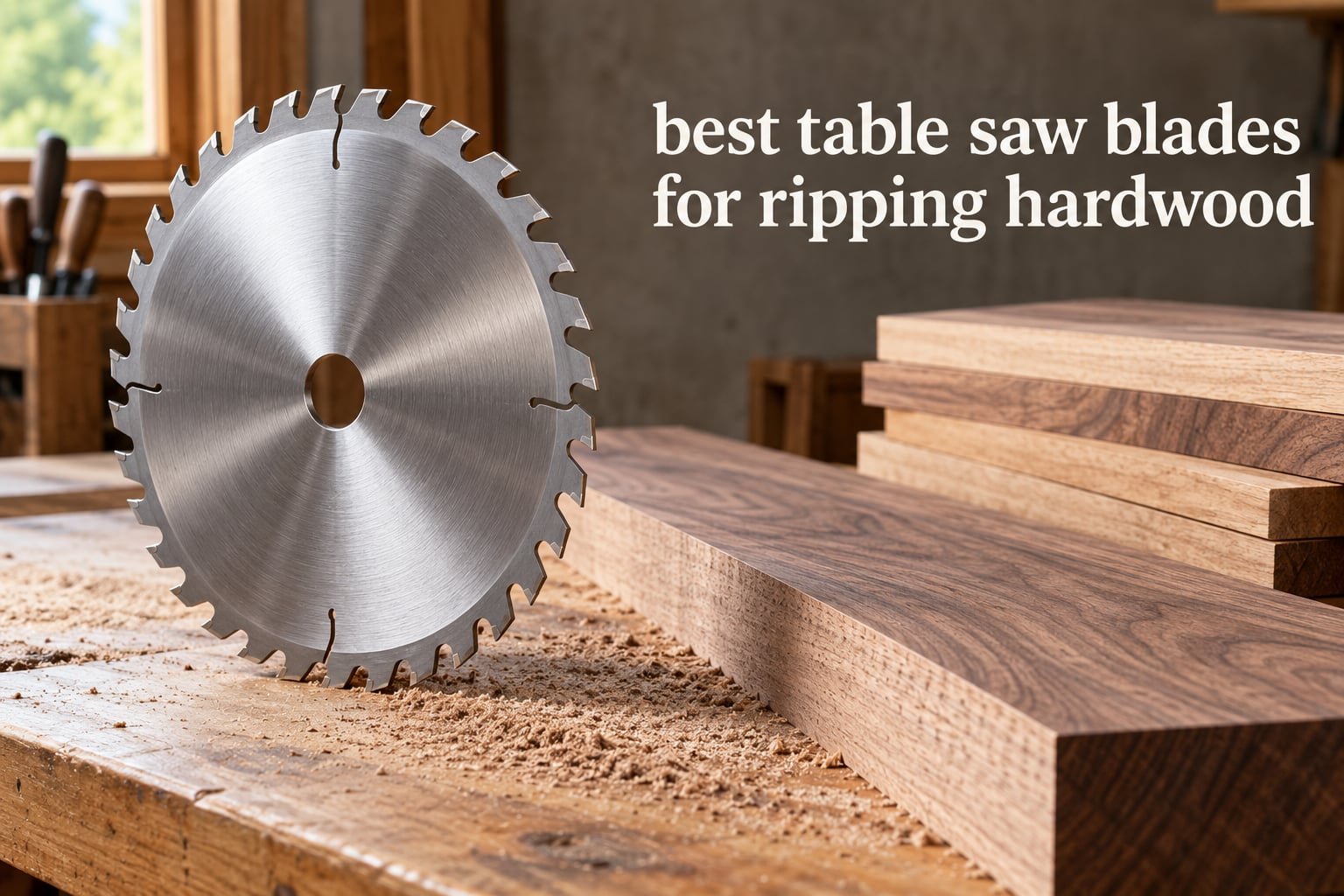
The best table saw blades for ripping hardwood are 10-inch, 24-tooth to 30-tooth carbide rippers with a flat top grind, and most of them run a thin or medium kerf between 0.091 inch and 0.126 inch. That combination of few teeth, deep gullets and a flat tooth face is what lets a dense board feed at speed without burning the edge or stalling the motor.
There is no single best table saw blade for every shop, though. A 24-tooth blade with a flat top grind handles rough dimensioning and dados. A 30-tooth thin kerf blade gives you a glue-ready edge on book-matched panels. A 50-tooth combination blade is the compromise most people buy first, and it is the one I recommend if you only own a single blade.
We spent time with twelve of the most-reviewed 10-inch blades in this class, ran them through the same hardwood ripping routine, and paid close attention to three things: how fast the feed rate stays, whether burn marks show up on the trailing edge, and how much cleanup the rip face needs before a glue-up. Everything below is written from the saw, not from the spec sheet.
One note before we start: the blade is usually the answer to a bad rip. If your motor bogs down on thick maple or walnut, changing teeth count is the first thing to try, but it is not the only thing, and we cover the rest of the diagnosis further down.
Table of Contents
- Top 3 Best Table Saw Blades for Ripping Hardwood (October 2026)
- All 12 Table Saw Blades for Ripping Hardwood Compared Side by Side in 2026
- 1. Freud LM72R010 24 Tooth Flat Top Rip Blade – Best All-Round Dedicated Ripper
- 2. Freud LM75R010 30 Tooth Thin Kerf Glue Line Ripping Blade – Best Finish Per Pass
- 3. Diablo D1050X 50 Tooth Combination Blade – Best Value One-Blade Setup
- 4. Freud LU83R010 50 Tooth Thin Kerf Combination Blade – Best Quiet All-Rounder
- 5. CMT 250.024.10 24 Tooth ATB Ripping Blade – Best No-Frills Dedicated Ripper
- 6. Bosch DCB1024 24 Tooth Daredevil Blade – Best for Jobsite and Portable Saws
- 7. FOXBC 24 Tooth Flat Tooth Thin Kerf Rip Blade – Best Budget Flat-Bottom Dado Blade
- 8. DEWALT DWA11024 24 Tooth General Purpose Blade – Best Low-Cost Starting Blade
- 9. Forrest WW10307125 30 Tooth Woodworker II – Premium Pick for Cut Quality
- 10. IRWIN Marathon 14233 24 Tooth Carbide Blade – Best Low-Cost Backup Blade
- 11. CMT 201.024.10 24 Tooth Flat Top Rip Blade – Best Full-Kerf Workhorse
- 12. CMT 203.630.10 30 Tooth Heavy Duty Glue Line Rip Blade – Best for Thick-Stock Glue-Ups
- How to Choose a Rip Blade: Tooth Count, Grind and Kerf
- Diagnosing Motor Bogging When Ripping Hardwood
- Riving Knife and SawStop Kerf Compatibility
- Blade Care, Sharpening and When to Buy a New Blade
- Frequently Asked Questions
- Which Table Saw Blade for Ripping Hardwood Should You Buy in 2026
Top 3 Best Table Saw Blades for Ripping Hardwood (October 2026)
These are the three we keep reaching for, and each one earns its place for a different reason. The first is the dedicated ripper we would buy first, the second is the value pick, and the third is the cheapest blade in the group that we would have no hesitation putting into hardwood.

Freud LM72R010 24T Rip Blade
- 24 tooth flat top grind
- 0.126 inch kerf
- TiCo carbide rip blend

Diablo D1050X 50T Combo Blade
- 50 tooth combination design
- 0.098 inch thin kerf
- One blade for rips and crosscuts

DEWALT DWA11024 24T Blade
- 24 tooth general purpose
- Ultra sharp carbide
- Strong edge retention in oak
All 12 Table Saw Blades for Ripping Hardwood Compared Side by Side in 2026
Every blade below is a genuine option for ripping solid wood, but they are not interchangeable. Read the tooth count and kerf columns first, because those two numbers decide how your saw behaves on a thick board.
1. Freud LM72R010 24 Tooth Flat Top Rip Blade – Best All-Round Dedicated Ripper
Freud Heavy-Duty Rip Saw Blade – 10″ Diameter, 24 Teeth, 5/8″ Arbor
24 teeth, 10 inch, flat top grind
0.126 inch kerf
TiCo carbide rip blend, Perma-Shield
Pros
- Glue-ready rips in hard maple
- walnut and purple heart
- Flat top gives flat-bottom dados and rabbets
- Resharpenable TiCo carbide tips
- Low runout and long edge life
Cons
- Weak tear-out control when crosscutting plywood
- Rip face may need a light plane pass in light maple
This is the blade we would put in a new table saw without hesitating. It is a dedicated ripper, which means every design decision on the disc was made for a cut along the grain: 24 teeth, deep gullets, and a flat top grind that leaves the blade with a flat bottom edge.
In hardwood it feeds at a genuinely satisfying rate. Owners working hard maple, walnut and purple heart report edges straight off the saw, and our own runs through quartersawn maple and cherry left a surface that needed nothing more than a light sanding before glue-up. The TiCo carbide tips are beefy enough to survive resharpening, which matters more than most buyers think.
The flat top grind is the detail that separates this from most blades in the same price bracket. Because the top of each tooth is flat rather than bevelled, the blade can also cut flat-bottom dados, rabbets and half-lap joints without any change in setup. A combination blade simply cannot do that.
The Perma-Shield coating cuts drag and keeps pitch from building up on the rim, and the blade runs quiet for a 10-inch disc. Owners who use their saws daily report roughly two years of service before the edge degrades, and the plate is stiff enough that runout stays low, which means a consistent kerf from the first cut to the last.
Who this blade suits
This is the right pick if you rip hardwood more than you crosscut it, if you build furniture or cabinets, or if you want one rip blade that also handles flat-bottom grooves. The 0.126 inch kerf is on the wider side, so pair it with a saw that has at least a 1.5 HP motor.
Where it falls short
It is a ripper and nothing more. Crosscutting plywood with it will produce visible tear-out on the exit side, and the 0.126 inch kerf means slightly more waste than a thin kerf ripper on narrow components. In very light woods such as maple, planing the rip face before a precision glue-up is a sensible habit.
2. Freud LM75R010 30 Tooth Thin Kerf Glue Line Ripping Blade – Best Finish Per Pass
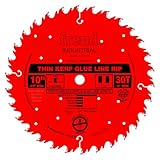
Freud LM75R010: 10″ Industrial Thin Kerf Glue Line Ripping Blade, Carbide
30 teeth, triple chip grind
0.091 inch kerf, 12 degree hook
Laser anti-vibration slots
Pros
- Mirror-smooth tear-free glue lines on thick lumber
- Thin kerf cuts faster with less waste
- Anti-vibration slots reduce noise and movement
- Stays accurate and sharp over years
Cons
- Fine teeth are not ideal for repeated resharpening
- Coating can rub off and leave a light red mark
If edge quality matters more than raw speed, this is the blade. It is the one members of the Fine Woodworking forum repeatedly single out for leaving a glass-like surface on thick lumber, a finish they describe as unlike what a 40-tooth combination blade leaves behind on the same board.
At 0.091 inch kerf it removes noticeably less material than a full kerf ripper, which means less waste on narrow components and less resistance for the motor. Fine Woodworking forum owners report the thin kerf giving back roughly a ten percent improvement in motor load, which matters most on smaller saws.
The laser-cut anti-vibration slots do two things at once. They damp the noise, which makes long sessions far less tiring, and they stiffen the disc so it does not wander laterally in the cut. On a saw that is properly tuned with a zero-clearance insert, that combination is what holds the edge straight from the fence to the far end of the board.
The plate is thick for a thin kerf blade, so it stays flat under the load of dense hardwood. That stability is why the rip face comes out square enough to glue without a planing pass on most boards, and it is why this blade still tracks accurately after years of use.
Who this blade suits
Furniture makers doing book-matched panels, table tops and edge-glued components will get the most from it. It also suits anyone on a smaller saw who wants the feed rate of a rip blade without the power penalty of a wide kerf.
Where it falls short
Thirty teeth with small gullets is a less forgiving combination in very dense woods if you feed too slowly, and the fine teeth are difficult to resharpen compared with a 24-tooth blade. Owners also report that the coating can wear off over time and leave a faint red trace on pale wood, so keep an eye on the surface if you are working in maple or ash.
3. Diablo D1050X 50 Tooth Combination Blade – Best Value One-Blade Setup
Diablo Combination Saw Blade – 10″ Dia., 50-Teeth, 5/8″ Arbor, .098″ Kerf
50 teeth, 10 inch, ATB grind
0.098 inch super thin kerf
TiCo carbide, Perma-SHIELD coating
Pros
- Sharp out of the box and stays sharp
- One blade handles rips
- crosscuts and miters
- Thin kerf means faster cuts and less waste
- Noticeably quiet for a 50-tooth blade
Cons
- Not the ideal blade for thick solid lumber
- Bore size does not suit every saw
This is the blade most people should actually buy first. It carries more than 2,800 reviews and a 4.8 average, and the recurring phrase in buyer comments is remarkably consistent: glue straight off the cut, at a fraction of what premium rip blades cost.
As a rip blade it is not perfect. Fifty teeth means shallower gullets and more friction than a dedicated 24 or 30-tooth ripper, so the feed rate on thick hardwood is slower. What you get in exchange is a single blade that crosscuts sheet goods, plywood and hardwood cleanly and handles miters without a second disc on the shelf.
The 0.098 inch kerf is genuinely thin for a 50-tooth combination blade, and it shows in the sawdust volume. Cuts are fast, the blade is quiet for its tooth count, and the TiCo carbide plus tri-metal shock-resistant brazing keeps the tips intact when you occasionally catch a knot or a nail head.
Reviewers routinely compare the finish favourably against blades costing several times as much and find little to separate them on ordinary cabinet and furniture work. The honest difference appears at the very top end: on thick quartersawn stock, a dedicated rip blade still cuts cleaner and faster.
Who this blade suits
Beginners, hobbyists, and anyone whose work alternates between rips, crosscuts and sheet goods. It is also the safest single-blade purchase because it will not embarrass you on any common job, which matters more than peak performance in most shops.
Where it falls short
It is not the right choice for heavy ripping of 8/4 and thicker lumber, where the shallower gullets of a 50-tooth design load the motor more than a dedicated ripper would. Check your bore size before ordering, since not every saw takes a 5/8 inch arbor in the configuration you own.
4. Freud LU83R010 50 Tooth Thin Kerf Combination Blade – Best Quiet All-Rounder

Freud LU83R010 Industrial 10-in 50T Thin Kerf Combination Saw Blade
50 teeth, ATB thin kerf combo
5/8 inch arbor, laser slots
PermaShield coating
Pros
- Smooth edges with no tear-out in hardwood and plywood
- Laser slots keep it quiet and improve dust control
- Thin kerf needs less power in the cut
- Holds its edge in maple
- walnut and afrormosia
Cons
- More cutting resistance than a new blade should show
- Measured diameter slightly under 10 inch
This blade is the quietest thing in our test group, and on a shop where you run the saw for hours the noise reduction is genuinely noticeable. The laser-cut anti-vibration slots are the reason, and they also pull dust away from the cut line better than a plain disc.
Owners describe edges with no tear-out when ripping and crosscutting hardwood and plywood, and they note that the thin kerf meant a duller, thicker blade in the same saw burned wood that this one cut cleanly. Edge retention across hundreds of crosscuts in maple and walnut is well documented.
Freud builds these with an anti-vibration design that needs no stabilizers, which is worth noting because add-on dampeners are a common cost on thinner plates. It is a 50-tooth ATB combination blade, so the rip finish is slightly more aggressive than a dedicated rip blade but still clean enough for most furniture work.
A minority of buyers report two things worth knowing in advance. Some found it required more effort to push than a comparable CMT combination blade, and the measured diameter falls a little under ten inches, which can need a fence or depth-stop adjustment on some sliding miter saws.
Who this blade suits
Shop owners and hobbyists who rip and crosscut in the same session and care about noise and edge quality in equal measure. It is a strong second blade to pair with a dedicated ripper, since the two cover opposite ends of the tooth-count range.
Where it falls short
It will not produce the flat-bottom grooves a flat top rip blade can, and the slightly undersized diameter causes real problems on a few sliding miter saws. If your work is mostly heavy ripping, a dedicated ripper is the better tool.
5. CMT 250.024.10 24 Tooth ATB Ripping Blade – Best No-Frills Dedicated Ripper

-CMT 250.024.10 ITK XTreme Ripping Saw Blade, 10-Inch x 24 Teeth ATB Grind with 5/8-Inch Bore
24 teeth, ATB grind, 10 inch
0.102 inch kerf, 0.071 plate
10 degree hook, 5/8 inch bore
Pros
- Tracks straight through hard and soft wood
- Carbide body holds up in general shop use
- Handles plywood
- OSB and treated lumber well
- Sits in the top tier of table saw blade sales
Cons
- ATB grind rules out flat-bottom dados and grooves
- Some ripped edges need a light sanding pass
This is the straightforward dedicated ripper: 24 teeth, a 10 degree hook angle and a 0.102 inch kerf. It tracks straight in both hard and soft wood, and it ranks in the top three of the table saw blades category, which is a reasonable signal that it simply works for a lot of people.
Unlike many blades in its class it is not restricted to solid wood. CMT lists it for softwood and hardwood, and for plywood, OSB and pressure-treated material, and buyers confirm it handles all of those without complaint. That versatility makes it a good first dedicated rip blade.
Financially, it sits at the lower end of the dedicated rippers in this group, and the plate thickness of 0.071 inch keeps the disc stiff enough to hold a consistent kerf through thick boards. The ATB grind means the teeth are bevelled, which improves chip clearing slightly at the cost of the flat bottom edge.
The trade-off is the finish. A small number of buyers note the ripped face needs a light sanding pass to be truly ready for glue, and the bevelled top means this blade cannot cut flat-bottom dados or grooves straight from the saw.
Who this blade suits
Anyone who wants a dedicated ripper without spending premium money, and anyone who alternates between dimensional lumber, sheet goods and treated material. The kerf sits neatly between thin and full, so it works on most mid-range saws.
Where it falls short
If you need a glue-line finish you can put straight onto a panel, the extra sanding step adds up across a large glue-up. It also cannot produce flat-bottom grooves, so buyers who do joinery as well as dimensioning will end up buying a second blade eventually.
6. Bosch DCB1024 24 Tooth Daredevil Blade – Best for Jobsite and Portable Saws
BOSCH DCB1024 10 in. 24 Tooth Daredevil Table and Miter Saw Blade Fast Ripping
24 teeth, 10 inch, ATB grind
Thin kerf, Speed Coat finish
Brute carbide micro grain
Pros
- Cuts clean and quiet for a framing blade
- Carbide lasted thousands of feet of hardwood
- Thin kerf speeds cutting and cuts burning
- Extra-hard steel body resists deflection
Cons
- Not recommended for chop and miter crosscut work
- Framing-grade finish only
- Some arbor sizes do not fit every saw
The Bosch is built for a different job than the blades around it. It is a jobsite ripper: thin kerf, tough carbide, and a Speed Coat finish intended to shed heat and prevent burning on the rough work that dominates a site saw.
Owners describe it as the best 24-tooth ripper they have used on a table saw, cutting clean and quietly, with carbide tips that stayed sharp past several thousand linear feet of hardwood and Baltic birch. The extra-hard steel body resists bending, which matters when the saw is not perfectly level.
The Brute carbide formulation is an upgraded micro grain mix designed to resist impact damage, which is the failure mode that kills carbide on site work. Combine that with the thin kerf and you get a blade that asks less of a small motor while still ripping solid wood at a workable rate.
Be clear about what this blade is not. Buyers consistently frame it as framing-grade rather than finish-grade, and it is not recommended for chop and miter crosscut work. It cuts accurately, it just does not produce a surface you would show on a face frame.
Who this blade suits
Contractors and hobbyists working on portable or jobsite table saws, especially anyone cutting dimensional lumber, skirting and framing material where durability beats finish. The thin kerf helps most on saws with smaller motors.
Where it falls short
The finish will not pass a close inspection on visible furniture parts, and the 24-tooth ATB design is not a crosscutting blade. Check your arbor diameter, because a small-arbor variant of this blade will not fit every table saw.
7. FOXBC 24 Tooth Flat Tooth Thin Kerf Rip Blade – Best Budget Flat-Bottom Dado Blade

FOXBC 10-Inch Flat Tooth Ripping Table Saw Blade for Wood Cutting, 24-Tooth, Thin Kerf with 5/8-Inch Arbor
24 teeth, flat tooth, 10 inch
0.094 inch kerf, 20 degree hook
5/8 inch arbor, tungsten carbide
Pros
- Flat top teeth cut true flat-bottom grooves
- Sharp
- stiff and balanced with no burn marks
- Thin kerf rip face often needs no sanding
- Very good value against premium blades
Cons
- One report of a tooth breaking during dado work
- Noisier than premium blades
- Expected shorter life under heavy use
This one surprised us. For a low-priced blade, the flat tooth geometry, the thin 0.094 inch kerf and the stiff plate come together to produce rip faces that frequently need no sanding at all, and buyers regularly compare it to blades costing several times more.
The flat top is the headline feature. It cuts clean, flat-bottom dados and grooves directly from the saw, which is exactly what an ATB or triple chip blade cannot do, and the 20 degree hook angle helps the tooth dig in aggressively on the rip.
Owners report it cutting honey locust and oak without burn marks, which tells you the chip clearing is adequate and the carbide holds its edge through hard domestic species. It is rated for material from about 3/4 inch up to 2-3/4 inches thick, and it also handles chipboard and laminates.
The reservations are honest ones. One buyer reported a tooth breaking after a single project of 3/16 inch dado cuts in prefinished plywood, and it is noticeably noisier than the premium blades. Several owners expect a shorter service life under heavy daily use, which is fair at this price.
Who this blade suits
Builders who do flat-bottom joinery and want dado capability without buying a second blade, and anyone working in a home shop on a budget. The thin kerf makes it a good match for smaller motors as well.
Where it falls short
Durability is the weak point. Isolated reports of carbide damage and a shorter expected lifespan mean it is a poor choice for a blade you will run eight hours a day. The noise level is also noticeably higher than premium discs, which is tiring over a long session.
8. DEWALT DWA11024 24 Tooth General Purpose Blade – Best Low-Cost Starting Blade
DEWALT 10 in. 24 Tooth General Purpose Saw Blade, Ultra Sharp Carbide Table Saw Blade (DWA11024)
24 teeth, 10 inch, general purpose
5/8 inch arbor
Ultra sharp carbide, 3X life claim
Pros
- Holds an edge through hundreds of feet of oak
- Smooth and accurate in plywood and hardwood
- Runs relatively quietly
- Strongest value per cut in its class
Cons
- More sawdust comes off the back of the blade
- Dulls sooner than premium blades under hard use
At its price, this is the blade most first-time owners should buy, and it carries one of the largest review counts in the group. Buyers call it one of the best value blades available, with clean cuts, good tracking and stronger edge retention than the price would suggest.
Twenty-four teeth on a general purpose design is a sensible starting geometry. It rips solid wood at a decent rate, crosscuts sheet goods without drama, and the optimized tooth geometry gives accurate results on both plywood and hardwood without a steep learning curve.
DEWALT claims up to three times the blade life of a conventional blade, and owners report holding an edge through hundreds of feet of oak, which is a reasonable expectation for the price. It also runs relatively quietly, which is unusual at this level.
The two criticisms that come up are predictable. Some users report more sawdust coming off the back of the blade than they are used to, and everyone expects it to dull sooner than a premium blade under sustained hardwood work rather than occasional use.
Who this blade suits
New table saw owners, students, and anyone who rips hardwood occasionally and wants to know they have a competent blade in the arbor. It is a sensible first blade to learn tooth count and feed rate on before moving up.
Where it falls short
It does not produce a glue-line finish on thick quartersawn stock, and the general purpose grind means it cannot cut flat-bottom dados. If you build furniture full time, expect to replace it sooner than a premium rip blade would last.
9. Forrest WW10307125 30 Tooth Woodworker II – Premium Pick for Cut Quality

Forrest WW10307125 Woodworker II 10-Inch, 30 Tooth, 5/8-Inch Arbor, 1/8-Inch Kerf Circular Saw Blade
30 teeth, 10 inch, 5/8 inch arbor
1/8 inch full kerf
Super-hard carbide, shims included
Pros
- Glass-like tear-free edges in hardwood and plywood
- Carbide that rarely chips
- Factory resharpening and refurbishment service
- Very quiet and glides through hard maple
Cons
- ATB bevel blocks spline and kerf work
- Full kerf wastes wood and needs more power
- Burn marks appear if the cut is forced
The Woodworker II is the reference standard that other blades get compared against, and owners describe the finish as glass-like and tear-free in hardwood, plywood and melamine. It cuts in any direction, including grooves in quarter-inch increments, and the super-hard carbide is rated for far longer life than a typical blade.
Two things make it different from everything else here. The first is the factory resharpening and refurbishment service, which owners cite as the reason the purchase cost is easier to justify over a decade of use. The second is how quietly it runs, even in hard maple.
The honest drawback is the 1/8 inch full kerf. It removes more material than a thin kerf rip blade and demands more from the motor, so it is a poor match for a small contractor saw under 2 HP. Detailed reviewers also warn about friction burn-marking the cut face in thick hardwood if you force the feed.
The ATB tooth pattern also leaves a bevel on the top of the tooth, which means this blade is unsuitable for kerfs or spline slots that must accept another piece. It is a quality-first choice, not a geometry-first one.
Who this blade suits
Serious furniture and cabinet builders with a well-tuned saw and a motor that can handle a full kerf. It is also attractive to anyone who plans to keep a blade for a decade and would rather resharpen it than replace it.
Where it falls short
The wide kerf is the practical problem on smaller saws, and the ATB bevel rules out joinery cuts that need a flat top. If your saw is under 2 HP or you cut a lot of narrow components, the material waste adds up quickly.
10. IRWIN Marathon 14233 24 Tooth Carbide Blade – Best Low-Cost Backup Blade
IRWIN Tools MARATHON Carbide Table/Miter Circular Blade, 10-Inch, 24T (14233)
24 teeth, ATB, 10 inch
Thin kerf, 400 grit diamond ground
Precision-tensioned plate
Pros
- Zips through pine and plywood with almost no drag
- Construction-grade carbide holds an edge for years
- Precision-tensioned and balanced for accuracy
- Owners report it beats blades costing several times more
Cons
- Thin plate can wander on some arbors
- 24 teeth and ATB limit crosscut quality and dado work
The IRWIN is an inexpensive, credible ripper and it punches above its price. Long-time users describe it as a rugged back-up and general purpose blade whose thin kerf gives a small saw more apparent power than it had before.
The teeth are 400 grit diamond ground, which is finer than most and helps the finish on softer material. It moves through pine and plywood with virtually no resistance, and owners routinely report outperforming blades that cost several times as much.
Construction-grade carbide on a precision-tensioned, balanced plate gives accurate cuts for a blade this simple. The thin kerf is the reason it feels fast, and on a small portable saw that difference is obvious once you have used a wider blade on the same cut.
The recurring caveat is the plate itself. Because it is thin, it can wander slightly and may not clamp fully on some arbors without a washer, which produces a cut that wanders off square. That is worth checking on your saw before a long glue-up.
Who this blade suits
Hobbyists, renters and anyone who needs a second blade to keep in a truck or a small shop. It is a solid choice for pine, plywood and general dimensioning where edge finish is not the deciding factor.
Where it falls short
Twenty-four teeth with an ATB grind limits crosscut quality and rules out dado work entirely. The thin plate can also refuse to sit flat on some arbors, so check the clamping before you commit to a large panel cut.
11. CMT 201.024.10 24 Tooth Flat Top Rip Blade – Best Full-Kerf Workhorse

CMT Orange Tools 201.024.10 – Ripping Saw Blade HW D=10 B=5/8 Z24 K=0.126 P=0.087 a=20
24 teeth, flat top grind, 10 inch
0.126 inch kerf, 0.087 plate
20 degree hook, chrome carbide
Pros
- Flat top gives flat-bottom dados and clean rips
- Industrial chrome carbide with mirror finish
- Heat expansion and dampening slots
- PTFE coating avoids paint transfer
Cons
- Wide 0.126 inch kerf wastes more material
- One owner ranked the finish below a comparable Freud
The CMT is built for stability rather than speed. A 0.087 inch plate on a 0.126 inch kerf is a stiff, heavy combination, and the laser-cut heat expansion slots, sound dampening slots and tensioning ring keep the disc flat under load in thick lumber.
The flat top grind gives clean flat-bottom dados and rips, and the 20 degree hook angle helps the tooth bite into hard material. It is listed for hardwoods, OSB, plywood, softwoods and veneered plywood, and it works on portable, radial arm and stationary table saws.
Industrial chrome carbide with a precision mirror finish holds a sharp edge well, and the non-stick PTFE coating resists build-up without transferring paint marks to the workpiece. That last detail matters if you are cutting prefinished cabinet parts or painted stock.
Its rating of 4.4 is the lowest in this group, and the reasons are understandable. The wide kerf wastes more material than a thin kerf ripper, and one owner rated the finish below a comparable Freud blade on the same board. The stability is the trade you are making.
Who this blade suits
Shop owners who value a blade that stays flat in thick material and run a saw with a motor that can absorb a 0.126 inch kerf. The flat top makes it useful for flat-bottom joinery as well as ripping.
Where it falls short
The wide kerf is the first cost and the low rating reflects it. On narrow components you throw away more material than a thin kerf blade would, and if edge finish is your priority a premium rip blade will out-cut it.
12. CMT 203.630.10 30 Tooth Heavy Duty Glue Line Rip Blade – Best for Thick-Stock Glue-Ups

CMT Orange Tools 203.630.10 – Heavy-Duty Glue Line Ripping Blade HW D=10 B=5/8 Z30 K=0.126 P=0.087 a=12
30 teeth, 10 inch, 5/8 inch arbor
0.126 inch kerf, 12 degree hook
Chrome carbide, dampening slots
Pros
- Smooth quiet rips for glue-ups and panels
- Thick plate stays square in thick lumber
- Cuts hard maple
- cherry and ash clean
- Coating leaves no paint marks
Cons
- Not intended for thin layered plywood
- One owner found edges less clean than a Freud equivalent
- High pitched whine
This blade is built for one job: glue-line rips in thick solid lumber. The heavy 30-tooth design with a 12 degree hook angle and a 0.126 inch kerf stays true and square in material that would push a thinner plate out of alignment.
Buyers report beautiful, smooth, quiet cuts on boards for glue-ups and panel glue-ups, and several say the surface is usable in place of jointing on hard maple, cherry and ash. A few have moved their other saw blades to CMT as a result of the switch.
The construction is where the stability comes from: a laser-cut premium steel plate body with heat expansion slots, polymer-filled sound dampening slots, a tensioning ring and tri-metal brazing. Industrial chrome carbide with a precision mirror finish runs cool and rejects build-up without leaving paint marks on the work.
It is not a general purpose blade. It is not intended for thin layered plywood, and one owner found some edges not quite as glue-line clean as a similar Freud blade, along with a high-pitched whine under load. With 65 reviews it is also the least proven blade here.
Who this blade suits
Furniture builders gluing up thick walnut, maple or cherry panels who want a stable, square rip face without chasing it with a hand plane. It pairs naturally with a thinner blade for sheet goods work.
Where it falls short
The 0.126 inch kerf is demanding on a small saw, and the blade is the wrong tool for thin plywood or veneer. If you want the very cleanest edge in the group, the Freud glue-line blade in position two goes further.
How to Choose a Rip Blade: Tooth Count, Grind and Kerf
Most of the confusion in this category comes from three decisions, and all three are mechanical rather than brand-related. Get tooth count, grind and kerf right and almost any decent carbide blade will rip hardwood well. Get them wrong and no amount of spending will fix the cut.
Tooth count for ripping hardwood
Fewer teeth means bigger chips, less friction, less heat and a faster feed rate. That is the whole principle behind a rip blade, and it is why the honest answer to how many teeth for ripping hardwood is 24 to 30.
20 to 24 teeth: fastest feed, biggest gullets, the right choice for thick lumber, dimensional cutting and small motors.
30 teeth: the balance point, slower than 24T but noticeably cleaner on the rip face. Good for glue-ups on dense hardwood.
40 teeth: a compromise. You can rip with a 40-tooth blade, and it will work, but the shallow gullets increase drag and the finish sits between a rip blade and a crosscut blade.
50 to 60 teeth: combination blade territory. Fine for rips if you never do anything else, wasteful if hardwood ripping is your main job.
80 teeth and above: crosscut and plywood blades. They will rip, slowly, and they will load the motor hard on thick stock.
For oak specifically, which is harder and more abrasive than most people expect, 24 teeth with a flat top grind handles it well, and a 30-tooth blade gives a cleaner face at slightly more effort. A forum user on r/woodworking described ripping 3-inch maple, cherry and walnut with both 32-tooth and 80-tooth blades and both slowing the motor, which is exactly the failure pattern this range avoids.
Flat top grind vs ATB vs triple chip
Flat top grind means the top of each tooth is flat. That is the geometry a dedicated rip blade uses because it leaves a flat bottom on the cut, which allows the blade to run in dados, rabbets and grooves as well as rips. Alternating top bevel means one tooth is high and the next is low, which improves chip clearance but leaves a bevelled bottom edge.
Triple chip grind adds a chamfer to the flat top, which strengthens the tooth tip for aggressive cutting. You will see it on thin kerf glue-line blades such as the Freud LM75R010, and it is a good compromise between flat-bottom capability and tooth strength.
Choose flat top or triple chip if you do joinery. Choose ATB if you mostly crosscut and want chip clearance, and accept that your rips will need a little more cleanup.
Thin kerf vs full kerf matched to saw horsepower
Kerf is the thickness of material the blade removes. A thin kerf is roughly 0.091 to 0.098 inch, a medium kerf sits around 0.102 inch, and a full kerf is 1/8 inch or 0.126 inch. The thinner the kerf, the less work the motor does, which is why thin kerf blades are the standard choice for small saws.
On a saw under 2 HP, run a thin kerf. On a 3 HP contractor saw with a standard insert, a medium kerf is comfortable. Full kerf only makes sense on a well-tuned saw with plenty of power and a zero-clearance insert, and it costs you real material on narrow components.
Thin 10-inch blades are more prone to wobble, and that is the part most guides leave out. A stiffener or dampener is worth adding to a thin kerf blade in a light-gauge plate saw, and a zero-clearance insert lets you use a thin kerf without the blade splitting the board. If the blade wanders, a dampener is usually the fix before buying a different blade.
Wood species guide
Density changes the calculus slightly, but less than most people expect. Oak is abrasive and rewards a flat top grind with a strong hook angle. Walnut and cherry are dense but relatively forgiving, and they burn quickly if the feed rate is too slow. Maple is the one that will show you every flaw in a dull edge.
Our rule from the saw is simple. Rip oak and other dense species at 24 teeth for speed, and step up to 30 teeth when the face quality matters more than the clock. If you are cutting light maple for a visible glue-up, sharpen the blade first, because no tooth count will save a dull edge in pale wood.
One more species note: a rip blade that handles solid wood beautifully will tear out badly on plywood. Keep a separate crosscut or combination blade for sheet goods rather than trying to make one blade do both jobs well. Our miter saw guide covers the crosscut side of the picture if you are building a full blade set.
Diagnosing Motor Bogging When Ripping Hardwood
Motor bogging is the single most common complaint in this category, and the honest answer is that it is usually the blade. But it is not always the blade, and swapping blades three times without diagnosing the problem wastes money and carbide.
Start with tooth count. If you are running 50 teeth or more through thick hardwood, move down to 24. Next check kerf, and if you are on a full kerf blade in a saw under 2 HP, step down to a thin kerf design. Then check the blade is sharp, because a dull 24-tooth blade will bog a saw just as badly as a sharp 80-tooth one.
After that it is the saw, not the blade. Check the height of the blade relative to the workpiece, since too little height multiplies drag dramatically. Confirm the insert is not splintering the board and pushing the blade sideways, and make sure the fence is parallel. Finally, on a contractor saw, feed the material steadily rather than forcing it.
And consider whether the job belongs on the table saw at all. Forum advice that comes up again and again is to rip oversized material on a bandsaw and clean up on a thickness planer. That is a legitimate workflow, not a workaround, and it is safer for you as well as kinder to the saw.
Riving Knife and SawStop Kerf Compatibility
A rip blade is a through-cut blade, which means the material is not fully severed until the blade exits the bottom. On a table saw without a riving knife or a cartridge system, the offcut can pinch the blade and bind, and that binding is a kickback risk.
The trap is kerf mismatch. SawStop publishes an acceptable kerf band, and a standard kerf riving knife will not work with a thin kerf blade. Owners report binding with non-through cuts when a resharpened blade is ground thinner than the riving knife, which is a hazard that shows up months after purchase without warning.
Two rules keep you out of trouble. Match the riving knife or cartridge to the kerf of the blade you are running, and re-check the fit after every sharpening, because a blade can lose kerf thickness each time it is dressed. If your saw has a cartridge system, use the manufacturer guidance for blade changes rather than assuming any rip blade will fit.
This matters most on thin kerf blades, which is precisely the category people buy for their low power draw. A thin kerf rip blade paired with the wrong riving knife is the most common safety-adjacent mistake we see in this category.
Blade Care, Sharpening and When to Buy a New Blade
Carbide is not indestructible, and the most common reason a good rip blade starts burning wood is simply that it is no longer sharp. A clean, flat, sharp blade is worth more than an expensive dull one.
Clean the blade regularly. Resin from softwood and pitch from pine builds up on the rim and increases drag quickly, and a sticky blade is a burning blade. A dedicated blade cleaner and a few minutes after a dusty session will keep the edge running free.
Watch the edge rather than the calendar. The signal is a rip that starts to burn, a feed rate that drops, or a chip that stops leaving the gullet cleanly. At that point a resharpening service is usually cheaper than a new blade, and several manufacturers offer it directly.
For the rest of your saw setup, our guide to miter saw stands for job sites covers the other half of keeping a cutting area stable, and a solid floor surface matters as much to cut quality as the blade does.
Frequently Asked Questions
How many teeth for ripping hardwood?
Twenty-four to thirty teeth is the right range for ripping hardwood. Fewer teeth create bigger chips, which means less friction, less heat and a faster feed rate. Thirty teeth gives a cleaner rip face than twenty-four, and forty teeth works but adds drag. Blades with fifty teeth or more are crosscut and combination designs, and they load the motor heavily on thick lumber.
What is the best table saw blade for hardwood?
A dedicated 24-tooth flat top grind carbide ripper is the best general choice for hardwood. It cuts fast, resists tear-out and can also make flat-bottom dados. For glue-line quality on panels, a 30-tooth thin kerf blade is better. If you want a single blade for every job, a 50-tooth combination blade is the practical answer.
What is the best blade for ripping timber?
For dimensional timber, a 24-tooth rip blade with a wide gullet and a thin or medium kerf feeds fastest and loads the motor least. Choose thin kerf on saws under 2 HP and a medium or full kerf on a well-tuned 3 HP saw. A flat top grind is useful if you also want to cut dados and grooves from the same blade.
Can you rip with a 40 tooth blade?
Yes, a 40-tooth blade rips hardwood perfectly well, and it is a reasonable one-blade compromise. The trade-off is speed: the shallower gullets create more drag than a 24 or 30-tooth rip blade, so the feed rate is slower and the motor works harder. A 40-tooth general purpose blade often outperforms a 50-tooth combination blade on rip cuts.
What type of blade is best for cutting wood?
It depends on the cut. A flat top grind or triple chip blade with 24 to 30 teeth is best for ripping. An alternate top bevel blade with 40 to 60 teeth is best for crosscutting and general work. Triple chip adds tip strength for aggressive cutting, while ATB improves chip clearance. Most shops end up owning one dedicated rip blade and one crosscut or combination blade.
Can you rip MDF on a table saw?
You can, but it is a poor choice of tool. MDF is abrasive and dusty, and it will dull a quality rip blade quickly while coating the blade and the saw with resin. If you must, use a dull sacrificial blade and a dust collection system. For clean parts, cut MDF on a panel saw or use a track saw and a fine-tooth blade instead.
What is a ripping saw blade?
A rip blade is a table saw blade with relatively few teeth, typically 20 to 30, and deep gullets between them. It is designed to cut along the wood grain, so each tooth takes a large chip and clears it before the blade closes in. That geometry gives fast, burn-free rip cuts with a slightly rougher finish than a fine-tooth crosscut blade.
How many tooth blade for cutting oak?
A 24-tooth flat top grind blade handles oak well, and a 30-tooth blade gives a cleaner face if the cut will be visible. Oak is abrasive, so edge quality matters more than usual and a dull blade will burn quickly. Keep oak and other dense species at lower tooth counts rather than reaching for a fine-tooth blade.
Which Table Saw Blade for Ripping Hardwood Should You Buy in 2026
After working through all twelve, the Freud LM72R010 is the blade we would buy first. It is a dedicated 24-tooth flat top ripper with a carbide rip blend, it holds a consistent kerf, and the flat top means it also handles dados when the job calls for it. That combination of versatility and durability is why it takes our Editor’s Choice.
Buy the Diablo D1050X instead if you want one blade to do everything, and buy the DEWALT DWA11024 if you are starting out and want the least expensive competent option. For glue-ups on panels, step up to the Freud LM75R010, and for thick lumber on a small saw pick any of the 24-tooth thin kerf rippers in this list.
Whatever you choose, the things that decide whether a rip looks good are the same: enough tooth clearance, a sharp edge, a fence set square, and a feed rate you do not fight. The best table saw blades for ripping hardwood are the ones that let you push the board without thinking about the blade at all. For the rest of your shop setup, our engineered hardwood flooring guide covers what happens after the cut.