
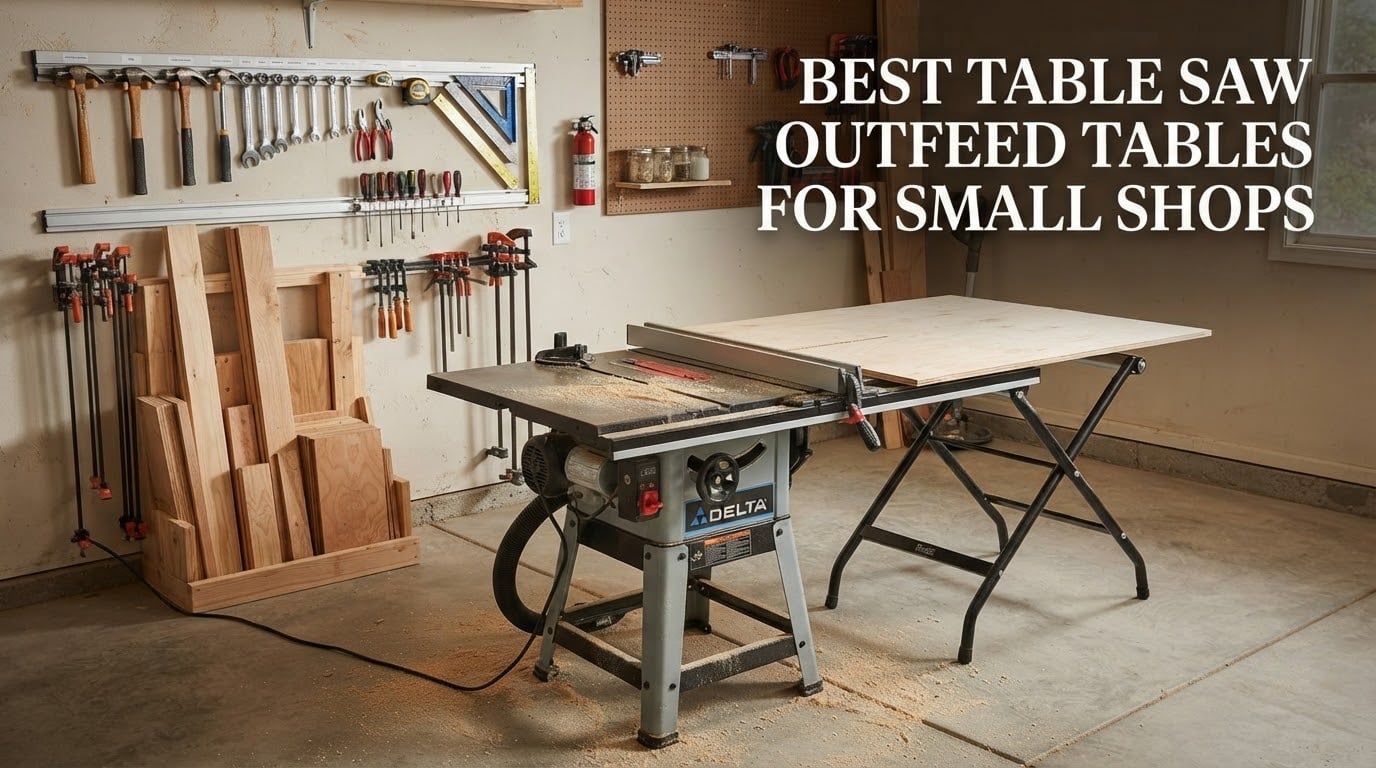
Most small-shop owners do not have floor space for a cabinet-style outfeed table, and that is exactly why roller stands became the go-to answer. If you have been searching for the best table saw outfeed tables for small shops, you are really choosing between three things: a pair of folding roller stands that vanish when you are done, one rolling conveyor stand that handles sheet goods on its own, or a saw-mounted extension that stores flush to the machine.
An outfeed table is a support surface that sits at the same height as your saw table on the discharge side, so a 4×8 sheet of plywood or a 10-foot board has somewhere flat to land after the blade passes. Without it, sheet goods pinch the blade, burn the cut edge, and kick back toward you, and long stock has to be caught by hand or by a helper standing in the wrong place.
We spent weeks working through the units in this roundup, setting them against the same contractor saw and moving full sheets and long boards across each one. What follows is the short version: the folding roller stand wins on versatility, the conveyor stand wins on sheet-goods support, and the saw-mounted extension wins on footprint. If you are still working out what your saw class even is, start with miter saw stands that suit small spaces and come back.
Table of Contents
- Top 3 Best Table Saw Outfeed Tables (October 2026)
- All 10 Outfeed Tables Compared in 2026
- 1. WORKPRO Folding Roller Stand Pair – Best Overall for Small Shops
- 2. WORKESS Folding Roller Stand Pair – Best Value Roller Pair
- 3. SHALL Heavy-Duty Folding Roller Stands – Best for Quick Setup
- 4. BORA Adjustable Conveyor Roller Stand – Best for Sheet Goods
- 5. Bosch TS1002 Rear Outfeed Extension – Best for Compact Saws
- 6. VEVOR 2500 lb Heavy Duty Roller Stand – Best for Heavy Loads
- 7. VEVOR 2-Pack Folding Roller Stands – Best for First-Time Builders
- 8. SawStop TSA-FOT Folding Outfeed Table – Best for Cabinet Saws
- 9. EZUVITA 2-Pack Folding Roller Stands – Best for Leveling Control
- 10. WEN Adjustable Roller Stand – Budget Pick for a Single Stand
- How Big Should an Outfeed Table Be?
- How to Match Outfeed Table Height to Your Saw
- Miter Slots, Crosscut Sleds and Groove Compatibility
- Small-Shop Space Math and Dust Collection Clearance
- Before You Buy: Seven Checks for a Small Shop
- Frequently Asked Questions
- The Best Table Saw Outfeed Table for Your Small Shop
Top 3 Best Table Saw Outfeed Tables (October 2026)

WORKPRO Folding Roller Pair
- 250 lb per stand
- Continuous 27-43 inch height lock
- Folds flat
- Eccentric leveling foot
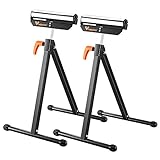
WORKESS Folding Roller Pair
- 132 lb per stand
- 26-3/4 to 42-1/5 inch lever lock
- Sealed ball-race bearings
- Folds flat

BORA Conveyor Roller Stand
- Expands 14 to 50 inches
- 300 lb capacity
- Locking swivel casters
- Independently leveling legs
All 10 Outfeed Tables Compared in 2026
| Product | Specs | Action |
|---|---|---|
| WORKPRO Folding Roller Stand 2-Pack |
|
Check Latest Price |
| WORKESS Folding Roller Stand 2-Pack |
|
Check Latest Price |
 SHALL Heavy-Duty Folding Roller Stands SHALL Heavy-Duty Folding Roller Stands |
|
Check Latest Price |
| BORA Adjustable Conveyor Roller Stand |
|
Check Latest Price |
 Bosch TS1002 Rear Outfeed Extension Bosch TS1002 Rear Outfeed Extension |
|
Check Latest Price |
 VEVOR 2500 lb Heavy Duty Roller Stand VEVOR 2500 lb Heavy Duty Roller Stand |
|
Check Latest Price |
 VEVOR 2-Pack Folding Roller Stands VEVOR 2-Pack Folding Roller Stands |
|
Check Latest Price |
 SawStop TSA-FOT Folding Outfeed Table SawStop TSA-FOT Folding Outfeed Table |
|
Check Latest Price |
 EZUVITA 2-Pack Folding Roller Stands EZUVITA 2-Pack Folding Roller Stands |
|
Check Latest Price |
 WEN Adjustable Roller Stand 4289 WEN Adjustable Roller Stand 4289 |
|
Check Latest Price |
1. WORKPRO Folding Roller Stand Pair – Best Overall for Small Shops
WORKPRO Folding Roller Stand Height Adjustable, Heavy Duty 250 LB Load Capacity, Outfeed Woodworking (Upgraded head), 2PCS
250 lb per stand
27 to 43 inch continuous height lock
Folds flat
Eccentric leveling foot
2-pack
Pros
- Continuous screw height adjustment grips the bar without scratching it
- Smooth free-rolling bearings and about five minutes of assembly each
- Folds flat for storage against a wall
- Sturdy enough for full plywood sheets
- High-visibility edge guides keep long stock aligned
Cons
- Leg crossbar can loosen and go wobbly over time
- Height lock bears on a plastic tab that can wear
- Limited leveling range on uneven floors
This is the pair we kept reaching for during testing. The height adjustment is a continuous screw rather than a drilled pin, which means you can dial the roller up to the saw table without hunting for a hole, and the screw bears on the chromed bar without scratching it. Assembly took us about five minutes per stand.
Where it beats the cheaper folding pairs is capacity and range. At 250 lb per stand across a continuous 27 to 43 inch sweep, it covers a contractor saw on a mobile base and most cabinet saws without a shim stack, and it handled a full sheet of plywood without deflection that we could feel through the stock.
The edge guides are the detail owners mention most. They are painted in a high-visibility finish and they keep a long board from walking off the stand during a rip, which matters more in a small shop where the person feeding stock also has to be reaching around the machine.
The folding frame is the real small-shop argument. Once the work is done, the pair stands in a corner in about the space of a folded stepladder, and you get both infeed and outfeed support for one purchase. Buyers report that the eccentric foot helps on uneven floors, though it is not a substitute for shimming a badly out-of-level slab.
What to check before you buy this pair
Two of the more common owner fixes are worth knowing before you order. Some buyers brace or shim the bottom leg crossbar because it can loosen with use, and a small amount of thread sealer or glue at the joint stops the wobble permanently. Others note that the height lock works against a flexible plastic tab, which is the part most likely to age out of a long service life.
If your floor is poured concrete with a low point under the outfeed position, budget for a couple of cedar shims. The eccentric foot handles gradual variation, not a 3/8 inch dip, and a roller set slightly off the saw table is where sheet goods start to bind at the cut.
One more small-shop note: there is no central hang point, so wall storage needs separate hooks or a bracket. That is a five-minute addition and it keeps the stands out of the walkway where a passing board would clip them.
When this pair is the wrong choice
If you routinely move solid slabs, banding, or stacked sheet goods on and off the surface, a pair of folding stands at 250 lb per unit is workable but not what you want. A single rolling stand with a wider surface will stay flatter and save you from the two-person handling that heavy material on a narrow stand creates.
This is also a roller head, not a flat surface. For glue-ups and finish sanding you want a bench with a flat top, and we have covered good options in our workbench top picks for garages. A coated Masonite sheet laid over the rollers between cuts is the cheap compromise that works well.
The narrow roller head also means you cannot use a miter gauge or crosscut sled resting on it without a groove, which we cover in the buying guide below.
2. WORKESS Folding Roller Stand Pair – Best Value Roller Pair
WORKESS Folding Roller Stand, Adjustable Height Material Rolling Stand for Woodworking, 132 LB Load Capacity, 2 Pack
132 lb per stand
26-3/4 to 42-1/5 inch lever lock
Sealed ball-race bearings
Non-slip rubber feet
Folds flat
Pros
- Sealed ball-race bearings keep sawdust out of the rollers
- Red lever height lock is quick and holds position
- Folds flat and sets up nearly as fast
- Two-pack includes non-slip rubber feet for grip
- Roller heads bolt on with nylon-bushing nuts that stay tight
Cons
- Lighter legs show noticeable wobble under heavy stock
- Hidden cross pin inside the leg is easy to miss during assembly
- Lowest weight class in this group at 132 lb per stand
This pair does one thing well for less money than anything else here, and in a small shop that is often the deciding factor. The sealed ball-race bearings are the feature we would not compromise on, because sawdust ingress is what makes cheap roller stands seize up after a year of use. Two sealed bearings per roller is a real improvement over plain bushing.
The height lock is a red lever, adjusted from 26-3/4 to 42-1/5 inches, and it held its position through repeated height changes in our testing without creeping. Assembly for the pair took under five minutes, once you find the cross pin.
Owners use these two units in pairs for exactly the setup we would suggest: one supporting long boards on the infeed side, one catching the cut on the outfeed side. For ripping dimensional lumber and running trim, that is the whole job, and the price-to-function ratio is hard to argue with.
For sheet goods the story is different. At 132 lb per stand, a full sheet of plywood is well within the rating, but the narrower frame and lighter-gauge legs do deflect more than the WORKPRO pair when you slide a heavy panel across.
What to check before you buy this pair
Read the assembly instructions before you start. The cross pin inside each leg is easy to drop or install backwards, and the most common buyer complaint about this pair is confusion at exactly that step rather than a defect in the product. Lay the parts out on the bench first and count hardware before the frame is half built.
Bring shims if your shop floor is uneven. Reviewers repeatedly describe the stability as adequate rather than rock solid, and the non-slip rubber feet help on a level slab far more than on a sloped garage floor.
Check the box on arrival. A small number of buyers reported missing machine screws and washers, which is a packing issue rather than a design flaw, but it is worth having a spare hardware kit on hand before you start.
When this pair is the wrong choice
If your work is heavy slab, thick hardwood, or dense sheet material, step up. The 132 lb rating per stand is the lowest of the folding pairs here, and the wobble owners describe becomes more noticeable as stock gets heavier and the panels are moving faster.
If you want a single unit that carries a full 4×8 by itself, this is the wrong shape entirely. Two narrow roller heads are an infeed-and-outfeed solution, not a sheet-goods platform, and you will still need support at the far end of a full sheet.
It is also the least versatile of the folding pairs at the low end of adjustment. If your saw sits high on a mobile base or an industrial stand, the top of the range is a little short.
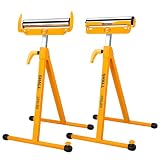
3. SHALL Heavy-Duty Folding Roller Stands – Best for Quick Setup
SHALL Roller Stand, Heavy-Duty Folding Roller Stands with 250 LBS Capacity
250 lb per stand
27.8 to 43 inch telescoping height
11.5 inch polished steel rollers
Eccentric foot
2-pack
Pros
- 250 lb per stand on a chrome-plated steel frame
- 11.5 inch polished rollers move panels without jerk
- Eccentric foot steadies the stand on uneven floors
- Pre-labeled hardware assembles in under ten minutes
- Edge guides keep panels from sliding off
Cons
- Can rock on uneven floors without shims
- Polished finish shows handling marks over time
The 250 lb rating and the 27.8 to 43 inch telescoping range put this pair in the same performance class as the WORKPRO set, but the design intent is different: this one is built to be set up and torn down fast. The hardware is pre-labeled, and the whole pair goes together in under ten minutes according to the manufacturer, which we found accurate.
The 11.5 inch polished steel rollers are the widest on the two-pack units here, and that width matters. A wider roller head spreads the load of a panel across more bearing surface, which is why this pair felt steadier under a full sheet than the lighter 132 lb stands.
Owners use these two stands in two ways. The common one is infeed and outfeed support around a table saw, one roller on each side so long boards travel across without a helper. The other is as a portable sanding station, where a panel is rolled on and off between grits without lifting.
The chrome-plated steel frame is a step up in corrosion resistance over painted tube, which matters if your shop is a garage that sees condensation in the cool months.
What to check before you buy this pair
The eccentric foot is the part to understand before you commit. It is a real leveling aid for gradual floor variation, and it is not a replacement for shims. If you can drop a straightedge across your shop floor and find more than an eighth of an inch of variation where the outfeed will sit, shim first.
Also budget time for the height match. Telescoping adjustment at this range is coarse, and the difference between a roller sitting a hair proud of the saw table and sitting slightly under it is what makes a sheet glide or bind. Set it with a straightedge across both surfaces, not by eye.
Check the roller surface before the first cut. Polished steel shows handling marks and light scratching, and those marks are cosmetic rather than functional, but it is better to know before a workpiece picks up a stray scratch near the cut line.
When this pair is the wrong choice
If your saw is a jobsite saw with a folding stand and you need to collapse the whole setup into a truck between jobs, the top of the height range is 43 inches, which will not reach a saw on a tall contractor stand. For that, the heavier tripod design reaches further.
If you plan to gang two units end to end for a longer run, this pair is not designed for it. Connector hooks that let roller stands lock into a continuous conveyor belong to the conveyor-style stands, and adding them to a folding pair is a modification rather than a feature.
And if floor space is the binding constraint rather than weight, know that this is a two-stand solution. It gives you infeed and outfeed support, but it does not hold a full 4×8 sheet on one surface.
4. BORA Adjustable Conveyor Roller Stand – Best for Sheet Goods
BORA Adjustable Conveyor Roller Stand for Table Saw Outfeed Extension
Expands 14 to 50 inches
23 to 36 inch height adjustment
300 lb load capacity
Locking swivel casters
14 conveyor rollers
Pros
- Extends 14 to 50 in to cover most of a 4x8 sheet
- 300 lb capacity with more stiffness than expected
- Collapses small enough that two units stack safely
- Locking swivel casters roll smoothly and hold firm
- Built-in hooks gang units into longer conveyor runs
Cons
- 36 in maximum height is short for many saws on mobile bases
- Rollers sit out of plane when the rack is fully extended
- No numeric height scale so each leg is dialed by feel
This is the only unit in the roundup that works alone. It expands from 14 to 50 inches, and at full extension it covers most of the width of a 4×8 sheet, which means you can break down a full panel without a second person catching the far end. That single-handed handling is why owners describe it as a shop-changing upgrade rather than a nice accessory.
Each of the four legs adjusts independently, so the stand can be leveled on a floor that is not flat. Combined with the locking swivel casters, you set it once in the position that serves your saw and it stays there until you decide to move it.
The frame is 44.7 pounds of alloy steel, and owners consistently comment that the sturdiness is surprising for the money. It is a genuinely heavy piece of equipment that stays planted while a panel moves across it, which is the whole point when the panel weighs 50 pounds or more.
Small shops also benefit from the collapsed footprint. Reviewers note that two of these stack safely when collapsed, so you can own a matched setup without doubling your floor commitment. The built-in hooks let you gang units into a longer conveyor when you need to run very long stock.
What to check before you buy this stand
Measure the height of your saw table before you order, carefully. The 36 inch maximum is the most repeated complaint in the reviews, and it is a real limitation: on a saw sitting on a mobile base you can end up an inch or so short, which forces shim work at the roller ends and adds a step to every setup.
Check coplanarity with the rollers collapsed. At full extension, the rack can sit roughly an eighth of an inch low on one side, so set the stand for the extension you will actually use most often rather than for its maximum length.
Expect to dial the height by feel. There is no numeric scale on the legs, so mark the leg position with a paint pen once you have it right. Re-dialing four legs blind after moving the stand is the step people skip and then regret.
When this stand is the wrong choice
At 36 inches maximum, this is not the right unit for a contractor saw on a mobile base or for any saw set high on an industrial stand. If you cannot measure and confirm the saw table is below 36 inches, choose a stand with a taller range.
A full sheet of plywood is still wider than a single rack, so one unit does not eliminate the need for support at the very end of an 8 foot panel. Owners pair these two units for full-sheet work, which changes the floor-space equation considerably.
It is also 44.7 pounds before you extend it. That is a deliberate trade for stability, but it is not a unit you want to reposition every time you change tasks.
5. Bosch TS1002 Rear Outfeed Extension – Best for Compact Saws
Bosch TS1002 Table Saw Rear Outfeed Support Extension
18 inch extension
Stores flush to the saw table
Built for the Bosch 4000 saw
Hardened metal with aluminum mounts
1-year warranty
Pros
- Stores flush to the saw so it disappears when not in use
- Adds 18 inches of supported depth to the Bosch 4000
- Hardened metal construction with aluminum mounts
- Long-running OEM accessory design
- Backed by a 1-year manufacturer warranty
Cons
- Fits only the Bosch 4000 10-inch table saw
- Fixed extension height with no adjustment
The smallest footprint in this roundup belongs to an OEM part, not a generic stand. The Bosch TS1002 extends the outfeed side of the Bosch 4000 10-inch table saw by 18 inches, and because it bolts to the saw itself, there is no separate structure standing on your floor. When you are done, it folds flush and the saw looks like a saw with no add-ons.
That is the entire value proposition. In a very small shop, an 18 inch extension is the difference between having outfeed support and having none, without a second footprint anywhere in the room.
The construction is hardened metal with aluminum mounts, and the part has been in production for well over two decades, which is a meaningful signal on a component that has to carry the weight of sheet goods at the moment of cut. It comes with a 1-year manufacturer warranty. Table saw not included, obviously.
Owners of this saw report that 18 inches is enough to support a full sheet through the cut, which is the practical test that matters. The extension is not a work surface for anything else, and that is fine because it was never meant to be.
What to check before you buy this extension
Confirm you own a Bosch 4000 10-inch table saw. This is not a universal outfeed attachment and it does not adapt to other machines, which is the single fact that decides whether this product is relevant to you at all.
Understand there is no height adjustment. The extension sits at the saw table height by design, which is exactly what you want for cut quality, and exactly what you cannot change if your saw sits on risers or a stand at a non-standard height.
Plan the storage. Because it folds flush to the table rather than folding flat independently, you need clearance behind the saw for it to swing or extend, and you should check that against your dust collection routing.
When this extension is the wrong choice
If your saw is not a Bosch 4000, skip it entirely. There is no adapter and no meaningful way to make an 18 inch OEM arm work on a different machine.
Eighteen inches is also not enough support on its own for very long stock, and it does nothing for the infeed side. If you rip long boards regularly, you will still want a roller stand on the infeed side regardless of how good this extension is.
Because the height is fixed, this is a poor choice for anyone who changes saws often or runs a portable saw on a folding stand at varying heights.
6. VEVOR 2500 lb Heavy Duty Roller Stand – Best for Heavy Loads
VEVOR Heavy Duty Roller Stand for Woodworking Metalworking Outfeed
2500 lb load capacity
27.6 to 52 inch height range
Worm-screw fine adjustment
Tripod folding base
Folds flat
Pros
- Tripod base stays put where four-leg designs rock
- Worm screw gives coarse and fine height control that holds under load
- Wide 27.6 to 52 inch range suits many machines and users
- Folds flat for corner storage or truck transport
- Suitable for long boards and metal pipe as well as lumber
Cons
- Roller head can swivel in the base on some units
- 29 lb stand is not a one-hand carry
- Finish is functional rather than refined
Nothing else here holds 2500 pounds, and that figure is not marketing inflation so much as a statement about the design. The tripod base with three folding legs is the reason this stand does not rock the way four-leg stands do, and owners consistently describe it as the step up from thin-tube stands with pinch-type locks that cannot carry heavy stock without creeping.
The height system is a worm screw rather than a pin or lever, which gives both coarse and fine adjustment. In practice that means you can bring the roller up quickly to roughly the right height, then creep it into alignment with the saw table without fighting a spring-loaded collar. It holds that position under load.
The 27.6 to 52 inch range is the tallest of any stand in this roundup, which makes it the one to buy if your saw runs high on a mobile base or a stand. It also handles metal pipe and bar stock, so if you are working in mixed material this becomes a general-purpose support rather than a woodworking-only tool.
It folds flat for corner storage or for transport in a truck, but at 29.1 pounds this is not a stand you carry with one hand while holding stock in the other. Budget a deliberate move, not a grab-and-go.
What to check before you buy this stand
Confirm your roller head locks. Some units arrive where the head can swivel in the base, and a side handle screw is the fix; recent production appears to include it. If your unit does not have the screw and you need the head fixed, that is a small modification before the stand is usable for ripping.
Inspect the steel on arrival. Some buyers have reported powder-coated parts arriving with light surface rust, and one received rusted hardware. Functionally it is fine, but wipe it down and paint it before the first cut so rust does not transfer to your workpiece.
Also be realistic about the steelwork quality. Owners describe the fit and finish as functional rather than refined. The welds and hardware do not look like a European machine tool, and the price reflects that, but nothing here compromises function.
When this stand is the wrong choice
Overkill is a real answer. If you cut dimensional lumber and 4×8 sheet, 2500 pounds of capacity and a 29 pound frame are more machine than the job needs, and you will carry that weight every time you reposition it.
This is a single stand, so a matched infeed and outfeed setup means two of these. That is a different floor commitment than a lighter two-pack, and it is worth weighing against how often you actually move stock on both sides of the saw.
It is also a roller support, not a work surface. If you want an assembly table or glue-up area, this does not do that job, and the weight makes it a poor candidate for converting into one.
7. VEVOR 2-Pack Folding Roller Stands – Best for First-Time Builders
VEVOR 2-Pack Roller Stands, 135 lb Load Capacity, 26.8-42.5” Adjustable Height, Folding Heavy Duty Design with 11.5 in Polished Steel Roller Head, for Table Saw Outfeed Woodworking Extension Support
135 lb per stand
26.8 to 42.5 inch telescoping rod
11.5 inch polished steel roller head
Chrome-plated steel
Folding 2-pack
Pros
- Smooth 11.5 inch polished roller moves stock in both directions
- Telescoping rod gives a wide 26.8 to 42.5 inch range
- Folds to a thin profile for storage and transport
- Labeled parts make assembly fast for a first-time builder
- Matched pair gives infeed and outfeed in one purchase
Cons
- 135 lb per stand is the lowest capacity here
- Budget build quality next to the tripod and conveyor stands
This pair earns a 4.6 average from owners, which puts it among the highest-rated in the group, and the reason is consistency rather than any single feature. The 11.5 inch polished steel roller moves stock smoothly in both directions, the telescoping rod covers a 26.8 to 42.5 inch range, and the whole thing folds down to almost nothing when the work stops.
For someone setting up their first small shop, the labeled components matter more than they would to an experienced builder. There is no cross pin to lose, no hidden hardware, and the pair assembles in minutes rather than an hour with a diagram.
The rating-per-cost pairing here is the best in the roundup, and the 2-pack format means you get a matched infeed and outfeed in a single purchase. That is the arrangement most small shops need, and buying two singles usually works out to more.
Owners describe it as an inexpensive matched pair they buy again as a gift or a second setup. For rip cuts on dimensional lumber and trim, that is exactly what the product is designed to do well.
What to check before you buy this pair
Understand the capacity limit before you start feeding stock. At 135 lb per stand, this is the lowest rating in the group, and while a sheet of plywood fits inside that number, the margin is thinner than on the 250 lb pairs. Heavy hardwood, thick slab, and stacked material are where you will feel the difference.
Assess the floor again. These stands have no leveling foot of the kind the WORKPRO, SHALL, and EZUVITA pairs include, so an uneven shop floor translates directly into a roller sitting off the saw table. Shims are not optional on a bad floor.
Set the height with a straightedge. A telescoping rod is a coarse adjustment, and the difference between aligned and misaligned is what decides whether a full sheet glides through the cut or binds at the trailing edge.
When this pair is the wrong choice
Skip this pair if your regular work is heavy material. The price advantage disappears the first time a panel bogs down the rollers and you need a helper to keep it moving.
It is also not a single-unit sheet-goods solution. Two 11.5 inch roller heads are short for a full 4×8, so full-sheet cutting still needs support at the far end, either a second support or someone on the receiving end.
For very heavy work or a saw on a tall mobile base, the 42.5 inch top of the range is a limiting number. Measure before you commit.
8. SawStop TSA-FOT Folding Outfeed Table – Best for Cabinet Saws
SawStop TSA-FOT Folding Outfeed Table
32 x 44 inch surface
250 lb capacity
Three roller bars
Adjustable feet
Powder coated steel frame
Pros
- Height match is engineered for SawStop cabinet saws
- Folds up against the saw to clear floor space
- Perforated top keeps small parts from dropping off
- Stamped steel support plate stays flat under stock
- Adjustable feet let you dial the top to saw height
Cons
- Assembly runs close to two hours for two people
- Folding down can foul the dust chute or overarm hose
- Side tubes hit the mobile base so it does not fold completely flat
- Cheap surface paint can rub off onto a workpiece
This is the only true folding outfeed table in the group, and the difference from a roller stand is the surface. At 32 by 44 inches, you have a flat perforated top that a sheet goods panel can sit on without rolling, which is what makes it useful for assembly and finish work as well as for catching a cut.
It is engineered to match SawStop cabinet saws, and owners with a permanent cabinet saw setup describe it as rock solid and effectively zero-setup, because the height is right without lining anything up. The adjustable feet let you dial the remainder in.
Reviews of this table split along two clear lines, and the split is worth understanding. People in permanent shops with a fixed saw and a planned dust collection layout rate it highly. People in very small shops with a mobile base rate it down, for reasons that are structural rather than quality-related.
The perforated top is a genuinely smart detail for small work. Small offcuts and hardware do not slide off or collect in the perforations the way they do on a solid laminate top, and it is 35 pounds of powder coated steel with a stamped steel support plate underneath, so it stays flat under stock.
What to check before you buy this table
Trace the fold-down path against your dust collection before you order. This is the single most repeated complaint in the reviews: the folded table can interfere with the dust collection chute or an overarm hose. If your hose runs down behind the saw, measure the swept path and confirm the table clears it in both positions.
Check the mobile base clearance too. The side tubes can hit a mobile base, so the table does not fold completely flat, and on some setups the end caps have to come off before you can cut with it stowed. This is a fitment problem that only shows up in your specific shop, and only after assembly.
Set aside two hours and a second person for assembly. Owners consistently report roughly two hours from box to finished, and the welded frame joints are not a solo job.
When this table is the wrong choice
If your saw is on a mobile base in a small shop, this is the wrong unit. The fitment problems with the base and the dust chute are the dominant theme in the reviews, and they are the situations a small shop is most likely to be in.
Some owners also need shim washers to bring the top up to saw table height, which suggests checking the included feet against your saw before assuming the fit is automatic.
Finally, note the surface finish. Owners report the paint rubbing off and marking workpieces, and recommend paraffin wax on the top. On a table that is meant to be a work surface, that is a real usability detail rather than a cosmetic complaint.
9. EZUVITA 2-Pack Folding Roller Stands – Best for Leveling Control
EZUVITA 2-Pack Folding Roller Stands, 500 LBS Total Capacity
500 lb total across the pair
28 to 43.5 inch knob-lock height
Polished chrome rollers
Eccentric feet
2-pack
Pros
- Knob-lock tubes reduce wobble compared with a pin-style lock
- Polished chrome rollers feed boards and panels both ways
- Fold-flat edge guides stop stock sliding off
- Eccentric feet help level the stands on uneven floors
- Includes a 10 mm spanner for setup
Cons
- Recent listing so long-term durability is less documented
- One adjustment point per stand for fine alignment
The distinguishing feature here is the knob-lock height adjustment. Where most folding stands lock with a pin through a drilled hole, a knob clamp pulls the tube tight against itself, and that is why owners report noticeably less wobble and slippage at a given height than on the pin-style designs in the same class.
For a small shop with an uneven floor, that matters. A pin lock can be set to a height that only holds because the legs are sitting at a particular spread. A knob clamp keeps tension on the tubes, so the height you set is closer to the height you get when you come back to it a week later.
The polished chrome rollers with raised stops moved boards and panels smoothly in both directions in our testing, and the fold-flat edge guides are a nice touch because a guide that folds with the stand does not leave a hook to snag a board while you carry the stand across the shop.
Capacity is quoted as 500 pounds total across the pair, which works out to 250 per stand, matching the heavier folding class. The height range of 28 to 43.5 inches covers typical table saw outfeed positions with room at both ends.
What to check before you buy this pair
Understand what you are buying as a review base. This is a newer listing, and the review count is small compared with the established folding pairs. That is not a defect, but it does mean long-term durability is less well documented than on the WORKPRO or BORA units, and you are buying on design merit more than on a long owner history.
Set up on a flat spot first, then move the stand. The eccentric feet handle gradual variation, but they are a fine correction rather than a coarse one, and they work best once the stand is already close to level.
Use the included 10 mm spanner. The knob lock is tuned by that specific size, and improvising a wrench usually means rounding the knob over time.
When this pair is the wrong choice
If you want a flat surface for assembly, this is a roller stand, not a workbench. The rollers support sheet goods beautifully and give you nothing flat to clamp a panel to or sand a glued edge on.
If your shop floor is genuinely unlevel, note that one adjustment point per stand limits how finely you can dial a single leg. A stand with independently adjustable feet, like the conveyor design, handles that case better.
And if you need something above 43.5 inches, the taller tripod stand covers a much wider range and is the one to look at for a saw on a high stand.
10. WEN Adjustable Roller Stand – Budget Pick for a Single Stand
WEN Adjustable Roller Stand with Edge Guide, 250-Pound Capacity (4289)
250 lb load capacity
27 to 43 inch adjustable height
Built-in stability adjustment knob
Integrated edge guide
Two-year warranty
Pros
- 250 lb capacity across a typical saw outfeed height range
- Built-in knob levels the stand on uneven shop floors
- Integrated edge guide keeps stock aligned
- 27 to 43 inch range covers common table saw heights
- Backed by a two-year warranty
Cons
- Sold as a single stand so infeed and outfeed needs two purchases
- Edge guide is the only alignment feature at this level
- Smallest review base in the roundup
The WEN 4289 has the highest average rating in the entire roundup, with 84 percent of its reviews at five stars, and it is also the least expensive unit here. That combination is why it made the list. A 250 lb capacity across a 27 to 43 inch range is the correct spec for a table saw outfeed, and nothing in the listing oversells it.
The built-in adjustment knob is the feature that earns the rating. It stabilizes the stand on uneven surfaces without a separate leveling kit, which is exactly the adjustment a small shop with a garage slab needs and rarely wants to shim.
It is also usable on a planer or jointer, so if you own one of those, this stand pays for itself beyond the saw. That dual use is the quiet argument for a single stand rather than a pair: you can move it to whichever machine needs support this week.
What to check before you buy this stand
Count how many you actually need. This is sold as a single stand, and a matched infeed and outfeed setup means two purchases, so do the arithmetic on your floor space before ordering one.
Do not expect a lot from the edge guide. It is a single integrated guide, which is enough to keep a board from walking during a rip but is not a system. If you cut a lot of narrow rip stock, guides on the other side of the stock matter more than the one you have.
Note the review base is the smallest here at 56 reviews. The rating is excellent, but a smaller pool means less long-term data than the higher-count pairs offer.
When this stand is the wrong choice
For very heavy material, the 250 lb rating is a limit, not a target. If your stock regularly exceeds that, a heavier stand is a better investment even though this one is the cheapest purchase on the page.
The 43 inch top of the height range is also short for a saw on a tall mobile base or an industrial stand. Measure first.
And if you want a surface rather than a support, this is not it. For glue-ups and assembly you want a flat bench, and no roller stand in this roundup substitutes for one.
How Big Should an Outfeed Table Be?
For a table saw, size the outfeed to the stock you actually cut rather than to the largest possible sheet. The working rules are these: at least 24 inches of support past the back of the saw table for breaking down 4×8 sheet goods, a roller head at least as wide as half the stock for stable panel handling, and enough combined support that a full sheet never depends on a person holding the far end.
Broken out by situation:
Ripping long boards: a single 11.5 inch roller head is enough per side, because the board is supported along its length by the saw table and the stand together.
4×8 sheet goods: you need roughly 4 feet of clear support on at least one side of the blade, and ideally both. A single 50 inch rack covers most of a sheet; two narrow stands do not, which is why a two-stand setup usually means someone on the receiving end.
Jobsite and portable saws: 18 to 24 inches is realistic and proportionate, because the whole point is that it folds and goes in the truck.
Full sheet machine work: the shop math that experienced builders use is about 4 feet of clear space on one side of the blade and 8 feet front and back. In a small shop this is the constraint that decides whether full-sheet work is practical at all.
Storage footprint: measure the folded or collapsed size, not the deployed size. That number is what you live with the other 350 days of the year.
How to Match Outfeed Table Height to Your Saw
Buy a unit with continuous or screw height adjustment, not one built to a fixed height. Forum experience is unambiguous on this point, and the reason is practical: most people change saws, change stands, or discover their saw sits on a base that is not the advertised height. A table built to exact saw height becomes scrap when that changes, and one owner in the Fine Woodworking forum reported scrapping an entire outfeed table for exactly this reason.
The practical method: set a straightedge across the saw table and the outfeed surface, then shim until the straightedge does not rock. Then measure the gap with a feeler gauge or a thin piece of card. If you can get within a sixteenth of an inch, sheet goods will glide. If you are off by more than an eighth, plan on shimming.
Height range matters as much as adjustability. Check the low end against your saw on a mobile base and the high end against a saw on a tall stand. A 27 to 43 inch range covers most residential and light contractor saws, but a cabinet saw on a raised base can exceed it, and that is the situation the 52 inch tripod stand exists to solve.
Miter Slots, Crosscut Sleds and Groove Compatibility
No retail roller stand in this roundup has miter slots, and that is the single criterion almost no roundup covers. It matters if you want to rest a miter gauge or a crosscut sled across both the saw table and the outfeed surface and slide the stock across without the gauge catching.
The solution used by experienced builders is to route two grooves in a plywood outfeed top, one for each miter slot on the saw. Use a rabbeting bit, run two passes, and set the width so the gauge slides with a little free play rather than binding. The gauge then travels from saw to outfeed on a continuous reference, which is what makes a long crosscut accurate instead of approximately accurate.
This is the strongest argument for the SawStop table in this group over a roller stand. A flat 32 by 44 inch top can be grooved, a perforated steel table cannot, and no folding roller stand in the group gives you a surface wide enough to route two parallel channels in the first place.
For the rollers specifically, the equivalent is alignment. If the roller head is not in the same plane as the saw table, a sled or gauge dragged across both will ride high or low at the transition, and that is the bump that throws a cut out of square.
Small-Shop Space Math and Dust Collection Clearance
Do the floor math before anything else, because this is where small shops get it wrong. A folding pair of roller stands folds to roughly the footprint of a folded stepladder and stands against a wall. A single conveyor stand collapses but at 44.7 pounds is a deliberate two-person move. A fixed folding outfeed table folds up against the saw but leaves its swept path on the floor permanently. A saw-mounted extension takes no floor at all, which is why it is the smallest footprint on this list.
The one hidden cost nobody accounts for is dust collection clearance. A fold-down table can physically collide with the collection chute or an overarm hose when it is deployed or stowed, and this is a documented real-world failure rather than a theoretical one. Before you buy any folding design, physically trace the path the table takes through its range of motion with your hose and ducting in place.
A saw on a mobile base adds a second constraint. Some folding designs cannot fold completely flat because the side tubes contact the base, and on some setups the end caps must be removed before you can cut with the table stowed. Both rolling stands and saw-mounted extensions avoid this entirely because neither of those problems applies to them.
If dust collection floor space is your real constraint, plan the two purchases together. Layout matters more here than in most categories, and getting the collector and the outfeed planned as one system is cheaper than rearranging later.
Before You Buy: Seven Checks for a Small Shop
Run through these seven before you order anything, in this order.
Measure your saw table height with the saw in its final position, on its base, with the fence set. Not the spec sheet height.
Check the unit’s maximum height against that number. If your saw sits at or above the top of the range, keep looking.
Trace the floor area where the outfeed will sit and the area it occupies when stored. The stored number is the one you live with.
Test for dust collection interference by walking the fold or collapse path with your hose in place.
Decide how many you need. One for outfeed only, two for matched infeed and outfeed, two ganged for full sheets.
Check the floor with a straightedge where the stand will sit, and buy shims if you find more than an eighth of an inch of variation.
Decide whether you need a surface or a support. A roller stand supports. A flat top lets you glue up, sand, and assemble.
One last piece of shop advice that comes up repeatedly in owner threads: do not overbuild the outfeed. A heavy fixed table becomes something you cannot move, which defeats the entire reason you chose it for a small shop. Buy the light rolling or folding option, add storage elsewhere, and keep the floor flexible.
Frequently Asked Questions
What is the best outfeed table for a table saw?
For most small shops, a pair of folding roller stands is the best outfeed table for a table saw. They give you matched infeed and outfeed support, adjust to almost any saw height in the 27 to 43 inch range, and fold flat against a wall when the work is done. If you break down full 4×8 sheet goods every week, choose a single rolling conveyor-style stand instead, because it covers most of a sheet on its own surface and saves you from handling the far end by hand.
What size should an outfeed table be?
For a table saw, allow at least 24 inches of support past the back of the saw table for breaking down 4×8 sheet goods, and use a roller head at least 11 inches wide. To machine a full sheet comfortably you want about 4 feet of clear space on one side of the blade, and 8 feet front and back, which is the constraint that decides whether full-sheet work is realistic in a small shop.
Do you need an outfeed table?
Sometimes you do not. The most common advice in woodworking forums is to set an existing sturdy workbench to exact saw height and use that, adding a coated Masonite sheet for glue-ups that slides off for cutting. What that option lacks is support on both sides of the saw at once. If you rip long boards or break down sheet goods regularly, an outfeed is the upgrade that makes a mid-range saw behave like a full-size machine.
How do I match outfeed table height to my saw?
Set a straightedge across the saw table and the outfeed surface and shim until the straightedge does not rock, then check the gap with a feeler gauge or a thin piece of card. Within a sixteenth of an inch is good, and more than an eighth of an inch off needs shimming. Buy a stand with continuous or screw height adjustment rather than a fixed height, so you can re-dial it if you change saws or stands.
Does an outfeed table need miter slots?
Not for support, but yes for accuracy. If you want to rest a miter gauge or crosscut sled across both the saw table and the outfeed and slide the stock across without the gauge catching, the outfeed surface needs two grooves cut to match your saw’s miter slot spacing. No folding roller stand in our roundup offers that, so the flat folding table is the better base for grooving.
Are roller stands good enough as an outfeed table?
For ripping long boards and for breaking down sheet goods with a second pair of hands on the far end, roller stands are entirely adequate and are what most small shops use. The limits are height matching, which is coarser than a screw-adjusted table, and flatness under very heavy stock. If you cut full sheets solo every week, a single wide rolling conveyor stand is the better tool.
The Best Table Saw Outfeed Table for Your Small Shop
For the best table saw outfeed tables for small shops, the WORKPRO folding roller stand pair is the pick we would buy first: the highest review count in the group, continuous height adjustment across 27 to 43 inches, 250 lb per stand, and a fold that returns the floor space to you when the work stops.
Buy the BORA conveyor stand instead if you break down full sheet goods alone every week, and buy the Bosch TS1002 only if you own the saw it was made for. Whatever you choose, measure the saw height first, check the dust collection path, and keep the unit light enough that you will actually move it.