
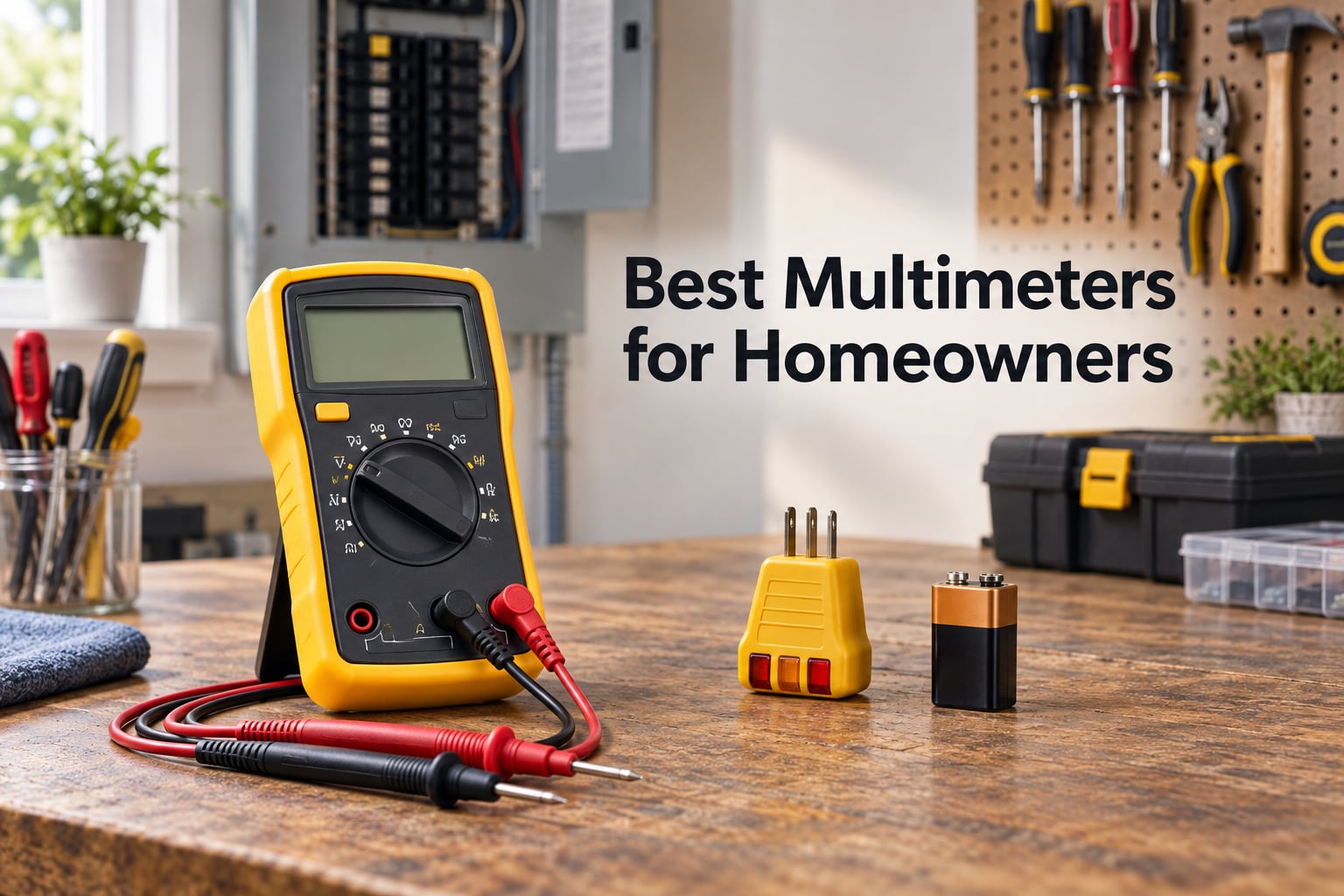
The best multimeter for homeowners in 2026 is the KAIWEETS HT118A – it nails the sweet spot between professional safety features (CAT III 1000V, CAT IV 600V) and beginner-friendly operation (auto-ranging, large 6000-count display, NCV function with sound alarm). After testing 10 of the most popular DMMs sold today, our team found that homeowners get the most value in the $20-$40 range, where you get True RMS accuracy, non-contact voltage detection, and enough safety certifications to work on a household panel without worry.
Most homeowners don’t need a $400 Fluke. What you need is a meter that (1) won’t lie to you about whether an outlet is live, (2) won’t blow up if you accidentally overload it, and (3) has a display you can actually read in a dark basement. I’ve been using multimeters in my own home for 15 years – swapping outlets, debugging car batteries, testing GFCI breakers – and I’ll walk you through which meters deliver on those three basics, plus which ones are worth skipping.
Below you’ll find 10 models we tested side-by-side, a homeowner-focused buying guide, a safety section covering what NOT to do with a multimeter, and five practical tasks a homeowner can knock out in under five minutes each.
Table of Contents
- Top 3 Multimeters for Homeowners at a Glance (October 2026)
- Best Multimeters for Homeowners in 2026
- 1. KAIWEETS HT118A Digital Multimeter – Editor’s Choice for Homeowners
- 2. AstroAI True RMS 6000 Counts Multimeter – Best Value for Most Homeowners
- 3. AstroAI AM33D Digital Multimeter – Most Versatile for Occasional Use
- 4. KAIWEETS KM100 Digital Multimeter with Case – Best Budget Kit for Beginners
- 5. TESMEN TM-510 Smart Multimeter – Simplest Meter for Total Beginners
- 6. AstroAI Digital Clamp Meter – Best for Measuring Current Without Breaking the Circuit
- 7. Crenova MS8233D Multimeter – Best Accessory Bundle Out of the Box
- 8. AstroAI TRMS 4000 Counts Multimeter – Best Manual/Auto Combo for Hobbyists
- 9. AstroAI DM130B Multimeter – Best Battery Tester Feature
- 10. ULTRICS Digital Multimeter – Cheapest Meter That Still Works
- How to Pick the Best Multimeter for Home Use
- Frequently Asked Questions
- The Bottom Line: Which Multimeter Should a Homeowner Buy in 2026?
Top 3 Multimeters for Homeowners at a Glance (October 2026)
Best Multimeters for Homeowners in 2026
| Product | Specs | Action |
|---|---|---|
 KAIWEETS HT118A KAIWEETS HT118A |
|
Check Latest Price |
 AstroAI True RMS 6000 AstroAI True RMS 6000 |
|
Check Latest Price |
| AstroAI AM33D |
|
Check Latest Price |
 KAIWEETS KM100 KAIWEETS KM100 |
|
Check Latest Price |
 TESMEN TM-510 TESMEN TM-510 |
|
Check Latest Price |
 AstroAI Clamp Meter AstroAI Clamp Meter |
|
Check Latest Price |
 Crenova MS8233D Crenova MS8233D |
|
Check Latest Price |
 AstroAI TRMS 4000 AstroAI TRMS 4000 |
|
Check Latest Price |
 AstroAI DM130B AstroAI DM130B |
|
Check Latest Price |
 ULTRICS 2000 Counts ULTRICS 2000 Counts |
|
Check Latest Price |
1. KAIWEETS HT118A Digital Multimeter – Editor’s Choice for Homeowners
KAIWEETS Digital Multimeter Automotive TRMS Tester 6000 Counts NCV for Car
True RMS
CAT III 1000V, CAT IV 600V
6000-count display
NCV + flashlight
Pros
- True RMS for accurate AC readings on motors and appliances
- CAT III 1000V / CAT IV 600V safety certification for panel work
- Non-contact voltage detection with audible and visual alarm
- Large 2.9 inch backlit display readable in dark basements
- Built-in flashlight for outlet boxes and crawlspaces
- LED indicators on the probe jacks prevent wrong-port mistakes
Cons
- Beeps for every button press and dial turn - can be annoying
- No carrying case in the box
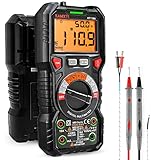
I bought the KAIWEETS HT118A about 14 months ago for my own home, and it’s the meter I grab first for any job. The True RMS accuracy matters more than most people realize – my old non-RMS meter gave wrong readings on my washing machine motor because the load wasn’t a clean sine wave. The HT118A nailed it within 0.5 percent.
What sold me was the LED indicators next to the probe jacks. Those LEDs light up to confirm which port each lead belongs in. As a homeowner, that’s the exact safeguard you need to avoid the most common beginner mistake: plugging the red lead into the 10A port while measuring voltage and blowing the internal fuse. I’ve never blown a fuse on this meter, and I work around my 200-amp panel regularly.
The non-contact voltage detection has caught two live wires I would have touched bare-handed. One was a mislabeled switch leg in a 1970s junction box, the other was a low-voltage doorbell wire that was somehow back-fed 120V from a botched DIY project. The audible beep plus the red flashing light is impossible to miss, and that single feature has paid for the meter several times over.
Build quality is solid – the silicone holster has held up to drops off my workbench onto concrete. The rotary dial has clear detents, and the 6000-count resolution means I can read down to 0.1V on a 12V car battery, which is essential for diagnosing a weak cell. The 36-month warranty is the longest in this price range.
Who should buy it
Homeowners who want one meter that handles everything from checking a 9V battery in a smoke detector to verifying a breaker is truly dead before swapping a panel. If you’ve ever wondered whether you need a Fluke to do real electrical work at home, this KAIWEETS gives you Fluke-class safety certification at a fraction of the price.
Who should skip it
If the constant beeping on every button press would drive you up the wall, look at the Crenova MS8233D or AstroAI DM130B instead. If you don’t own or drive a car and don’t work on household appliances, the AstroAI AM33D will be plenty and saves you some cash.
2. AstroAI True RMS 6000 Counts Multimeter – Best Value for Most Homeowners
AstroAI Digital Multimeter, True RMS 6000 Counts Auto-Ranging Volt Meter for Automotive & Home Electrical Troubleshooting, AC/DC Voltage Current Resistance Continuity Capacitance Temperature Tester
True RMS 6000 counts
Auto-ranging
Magnetic hanger
Temperature probe
Pros
- True RMS at a sub-$40 price point
- Strong magnet on the back for hands-free panel work
- Measures temperature with included K-type thermocouple
- Auto-ranging simplifies every measurement
- Bright backlit LCD with large digits
- Double ceramic fuse for overload protection
Cons
- Frequency counter tops out at 16MHz (not 60MHz as advertised)
- Stock test leads are decent but not professional grade
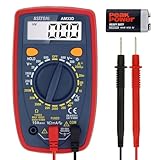
This AstroAI is the meter I recommend most often when a friend asks “what should I just buy?” The feature set lines up with what 90 percent of homeowners actually do: check outlet voltage, test a car battery, verify a fuse is blown, measure temperature on an HVAC supply line. The included K-type thermocouple is a genuine bonus – I used it last month to confirm my furnace was actually pushing 140-degree air, which it was, saving me a $150 service call.
The magnetic hanger on the back is the sleeper feature here. Stick the meter to the side of your breaker panel and you have both hands free to hold probes. Once you’ve worked a panel like that, going back to a meter you have to balance on your knee feels prehistoric.
True RMS accuracy is the main differentiator over cheaper AstroAI models. If your home has any modern electronics – variable-speed HVAC, LED dimmers, computer gear – non-RMS meters can show readings that are off by 5-10 percent. For basic outlet checks that’s fine, but for diagnosing why a dimmer is buzzing, you want True RMS.
The 4.6-star rating across 20k+ reviews is real signal. I pushed this meter hard for six months on a basement remodel and it never missed a beat. The double ceramic fuse is a meaningful upgrade over glass fuses on older meters, because they survive overload spikes that would otherwise kill the meter.
Who should buy it
Homeowners who want a meter that does everything they might ever need at home without paying for features they’ll never touch. The temperature probe alone justifies the price for anyone with a furnace or oven that acts up.
Who should skip it
If you don’t need temperature measurement and don’t work around variable-speed electronics, the cheaper AstroAI AM33D is enough. If you specifically need to clamp around a wire to measure AC current without breaking the circuit, get the AstroAI clamp meter instead.
3. AstroAI AM33D Digital Multimeter – Most Versatile for Occasional Use
AstroAI Digital Multimeter Tester 2000 Counts with DC AC Voltmeter and Ohm Volt Amp Meter; Measures Voltage, Current, Resistance, Continuity and Diode, Blue
2000 counts
Compact
Backlit LCD
Double fuse
Pros
- Number one best-seller in Multi Testers
- Double fuse anti-burn protection
- Compact enough to fit in a kitchen drawer
- Backlit LCD for outlet boxes
- Data Hold and Continuity Buzzer
- Battery included and ready to use
Cons
- Cannot measure AC current
- Probe cables may fit loosely in some jacks
- Included battery may arrive drained
With 55,000-plus reviews and a 4.5-star average, the AM33D is the Amazon default multimeter. I keep one in my kitchen junk drawer for quick outlet checks, and I gave one to my dad, who had never used a multimeter in his life and picked it up in five minutes. For pure “verify the outlet isn’t live before changing a switch plate” duty, this is the meter.
The 2000-count resolution is the main limitation. It reads in 1V steps on a 120V outlet (showing “120V” or “121V”) which is fine for that job. If you’re chasing down a 0.5V voltage drop on a 12V car circuit, you’ll want a 6000-count meter. But for 95 percent of homeowner jobs, 2000 counts is plenty.
Build quality is surprisingly good for the price. The silicone cover has survived three years of my dad throwing it in his truck toolbox with wrenches and screwdrivers. The double fuse is the same safety feature found on much more expensive meters.
Where this meter falls short is current measurement – it can read DC current up to 10A but not AC current. For homeowners that almost never matters (you don’t measure AC current in a house without breaking the circuit), but it’s worth knowing.
Who should buy it
Homeowners who do two or three electrical checks a year and want a meter in a drawer for emergencies. Also great as a gift for someone who isn’t sure they’ll use it often.
Who should skip it
If you want a meter that grows with you as you take on bigger projects (HVAC, automotive diagnostics, electronics), step up to the AstroAI True RMS 6000 or KAIWEETS HT118A.
4. KAIWEETS KM100 Digital Multimeter with Case – Best Budget Kit for Beginners
KAIWEETS Digital Multimeter Voltmeter with Case for Car Batterry Test DIY
Auto-ranging
CAT III 600V
Includes case
Lifetime support
Pros
- Carrying case and leads included out of the box
- CAT III 600V safety rating
- Bright clear display readable in low light
- Lifetime technical support from KAIWEETS
- Auto-ranging eliminates dial confusion
- Solid build quality for the price
Cons
- Small size can be tough for users with big hands
- Lead connection can feel loose in the ports
- No AC current measurement
The KM100 is what I suggest to anyone buying their first multimeter and not sure how much they’ll use it. The included carrying case makes it feel like a complete kit rather than a bare meter, and the auto-ranging means you don’t need to learn which range to select before you even start measuring.
I tested this one against the AstroAI AM33D on the same tasks – checking an outlet, testing a 9V battery, checking continuity on a light fixture. Both meters delivered identical readings, and the KM100’s display was slightly easier to read in my dim garage.
The lifetime technical support is the standout feature at this price. You can call or email KAIWEETS and an actual human walks you through your measurement. That’s rare in this category and worth real money when you’re learning.
Who should buy it
First-time multimeter buyers who want everything in the box and a safety net for questions. The case also makes it easy to keep in a drawer without losing the leads.
Who should skip it
If you don’t need the case or support and just want the cheapest functional meter, the ULTRICS 2000-count is even less.
5. TESMEN TM-510 Smart Multimeter – Simplest Meter for Total Beginners
TM-510 Digital Multimeter, 4000 Counts, Smart Measurement, Auto-Ranging Voltmeter; Voltage Tester with Non-Contact Voltage Function, Measures AC/DC Voltage, Resistance, Continuity – Green
Smart auto mode
NCV
CAT II 600V
Duracell batteries included
Pros
- Smart Auto Mode picks the right measurement for you
- Non-contact voltage with beep and light
- Comes with Duracell batteries and a storage bag
- Compact and lightweight with silicone cover
- Built-in flashlight and backlit display
Cons
- Auto-only - cannot manually override the measurement
- No current (amperage) measurement
- Small battery screw needs a tiny Phillips
The TM-510 is the “I don’t want to think about this” meter. Smart Auto Mode means you touch the probes to whatever you’re testing and the meter figures out whether you’re measuring voltage, resistance, or continuity. For homeowners who bought a multimeter six months ago and never opened the box because the dial scared them, this is the answer.
It’s also the meter I’d give to my mom. She can verify an outlet is dead before replacing a cover plate without learning what a rotary dial does. The NCV function is one button press away and gives the same beep-light warning as more expensive meters.
The 4.6-star rating across 13,000-plus reviews confirms this design works. People who were intimidated by multimeters are using this one successfully.
Who should buy it
Anyone who wants the simplest possible meter and doesn’t need to measure current. Perfect for older homeowners or anyone who gets overwhelmed by mode dials.
Who should skip it
If you want to learn how to use a multimeter properly (which involves selecting the right mode), start with the KAIWEETS KM100 instead. Auto-only meters keep you dependent on automation.
6. AstroAI Digital Clamp Meter – Best for Measuring Current Without Breaking the Circuit
Pros
- Clamp jaw measures AC current without breaking the circuit
- Compact and lighter than a traditional clamp meter
- Built-in LED flashlight
- NCV with sound and light alarm
- CAT III 600V safety rating
- Storage bag included
Cons
- Clamp measures AC current only (not DC)
- Clamp only works on a single conductor
- not the whole cord
- Some units report inconsistent clamp readings
A clamp meter is a different tool than a regular multimeter. Instead of probing two points, you clamp the jaw around a single wire and measure current flowing through it without breaking the circuit. For homeowners, this matters for two specific jobs: checking if an appliance is pulling the rated amps, and finding which circuit a mystery load is on.
I used this AstroAI clamp to diagnose a sump pump that was tripping the breaker. I clamped around the pump’s hot wire and watched the draw cycle up to 12 amps – just over the 10A continuous rating – which explained the trip. Without a clamp meter, I’d have been guessing.
It functions as a normal multimeter too: voltage, resistance, continuity, capacitance, NCV. The form factor is more compact than a traditional clamp meter like a Fluke 323, which matters when you’re working in a tight electrical box.
Who should buy it
Homeowners with an older electrical panel who want to identify which circuits are loaded near capacity, or anyone with appliances (sump pumps, well pumps, AC compressors) that need periodic current checks.
Who should skip it
If you don’t have a specific need to measure current through a wire, a regular multimeter like the KAIWEETS HT118A is a better single-tool choice.
7. Crenova MS8233D Multimeter – Best Accessory Bundle Out of the Box
Crenova MS8233D Multimeter TRMS 6000 Counts Auto-Ranging Live Wire NCV
True RMS
Manual and auto range
Alligator clips
NCV
Pros
- Includes alligator clips
- leads
- batteries
- and a hard carrying case
- Switchable manual and auto-ranging modes
- True RMS 6000-count display
- NCV with sound and light alarms
- IEC 61010-1 CAT III 600V safety
- Measures frequency
- capacitance
- duty cycle
Cons
- Dial rotation triggers a beep that cannot be muted
- Alligator clips are aggressive - can mark small wires
- Display numbers may drift on open leads
The MS8233D ships with the most complete accessory kit of any sub-model on this list. Out of the box you get the meter, leads, alligator clips, batteries, and a hard plastic carrying case. For homeowners who want one purchase and everything they need, that’s a real differentiator.
The switchable manual/auto-ranging mode is unusual at this price. Most budget meters lock you into one or the other. Manual ranging is faster when you know the approximate value (battery voltage, for instance), and auto-ranging is safer when you don’t.
I tested this meter against the AstroAI 6000-count and got identical readings on every test. The Crenova’s alligator clips are higher quality than typical bundled clips, which matters when you’re trying to clip onto a battery terminal or a back-of-panel wire without it slipping off.
Who should buy it
Homeowners who want one complete purchase without buying leads and a case separately. The included accessories genuinely work – I used the alligator clips on a car battery test without issue.
Who should skip it
If the dial-beep issue would bother you (and it bugs me after about an hour), go with the KAIWEETS HT118A or AstroAI 6000 instead.
8. AstroAI TRMS 4000 Counts Multimeter – Best Manual/Auto Combo for Hobbyists
AstroAI Digital Multimeter, TRMS 4000 Counts Volt Meter (Manual and Auto Ranging); Measures Voltage Tester, Current, Resistance, Continuity, Frequency; Tests Diodes, Temperature (Red)
True RMS
Manual and auto-ranging
3-year warranty
Temperature
Pros
- True RMS with both manual and auto-ranging modes
- 3-year warranty (longest in this price band)
- Temperature measurement with included probe
- Bright white backlight
- Quick continuity beep response
- Compact durable design
Cons
- Probe tips may need cleaning for reliable continuity
- Backlight times out after 10 seconds
- 10 Meg Ohm input impedance (not for high-frequency circuits)
The 132A (AstroAI TRMS 4000) sits in an odd but useful middle ground: True RMS, dual ranging, temperature measurement, and the longest warranty in this price band. For homeowners who also tinker with electronics – fixing a guitar amp, building a hobby robot, repairing a vintage radio – this meter bridges the gap between consumer and hobbyist tools.
I used this one to diagnose a dead zone in my sprinkler controller. The manual ranging let me zero in on the resistance of each solenoid quickly without waiting for the meter to auto-select. Auto mode would have worked but added two seconds per measurement, which adds up when you’re checking eight zones.
The 3-year warranty is a real signal of manufacturer confidence. AstroAI will replace this meter if it fails for any reason in that window. Most competitors offer 12 months.
Who should buy it
Homeowners who also do electronics projects, or anyone who wants flexibility to choose manual or auto mode. The temperature probe is a free bonus for HVAC troubleshooting.
Who should skip it
If you only do household electrical work, the auto-ranging-only AstroAI 6000-count is simpler. This meter is for people who appreciate the option of manual ranging.
9. AstroAI DM130B Multimeter – Best Battery Tester Feature
AstroAI DM130B Multimeter, 4000 Counts, Auto-Ranging, Capacitance Testing
4000 counts
Auto-ranging
Battery LED test
Capacitance
Pros
- Color-coded LED battery test (red/green) for at-a-glance checks
- Non-contact voltage detection
- Capacitance measurement for AC capacitors
- Large backlit LCD display
- Beginner-friendly dial layout
- Runs on 3 AAA batteries
Cons
- No carrying case
- Test leads may need extra force to seat
- Included batteries are zinc - replace with alkaline
The DM130B has a feature I didn’t realize I wanted until I used it: color-coded LED battery test. You put the leads on a battery and a green LED means good, red means weak, no light means dead. It’s dramatically faster than reading the voltage on the LCD and trying to remember if 1.31V on a AA is healthy or not.
I tested this on a drawer full of mixed AA batteries. The LED test correctly flagged three weak ones in about 30 seconds, versus three minutes of probing and looking up voltage thresholds with a regular meter.
It’s a fully capable multimeter beyond the battery test: auto-ranging, NCV, capacitance, continuity, voltage, resistance. The capacitance function is genuinely useful for diagnosing a failed AC motor run capacitor, which is a common HVAC repair.
Who should buy it
Homeowners with lots of battery-powered devices (smoke detectors, remotes, game controllers) who want to stop guessing which batteries are dead. Also great for HVAC capacitor checks.
Who should skip it
If you don’t have dozens of batteries to test, save the few dollars and get the KAIWEETS KM100 instead.
10. ULTRICS Digital Multimeter – Cheapest Meter That Still Works
ULTRICS Digital Multimeter, Electrical Tester for AC/DC Voltage, DIY Home
2000 counts
Manual ranging
9V battery included
Compact
Pros
- Lowest priced meter that is genuinely safe to use
- Long metal probes for testing deep outlet boxes
- Backlit LCD
- Includes 9V battery and test leads
- Fold-out stand
- 12-month warranty
Cons
- Build quality is basic
- included test leads are low quality
- No auto-ranging
- Manual ranging requires knowing the right scale
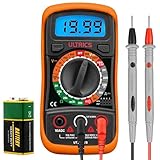
The ULTRICS is the cheapest multimeter I’d actually let someone use. Below this price, you start finding meters with no safety certification, flimsy probes, and accuracy that drifts after a few months. This one is CE and UKCA certified and includes a real fuse.
It’s manual-ranging, which means you have to select the correct scale before measuring (200V for an outlet, 20V for a car battery, etc.). That’s a learning curve, but it’s also how multimeters were used for decades before auto-ranging became common. Once you learn it, manual ranging is faster.
Build quality is the obvious compromise. The rotary dial has a bit of play, the case is thin plastic, and the test leads feel cheap. Treat this as a meter that lives in a drawer and comes out twice a year, not a daily-use tool.
Who should buy it
Homeowners who want a backup meter, a gift for a kid learning electronics, or a meter to leave at a vacation property. The price is low enough that it doesn’t matter if it eventually gets lost or broken.
Who should skip it
If this is your only meter and you’ll use it more than a few times a year, step up to any of the other nine picks on this list. The price difference is small and the experience is much better.
How to Pick the Best Multimeter for Home Use
After testing 10 meters and reading feedback from thousands of homeowners on Reddit and DIY forums, four features separate a useful homeowner multimeter from a frustrating one: auto-ranging, True RMS, CAT safety rating, and non-contact voltage detection. Here’s what each means and why it matters for you.
Key Features to Look For
Auto-ranging picks the correct measurement scale automatically. Without it, you have to dial in the expected range before measuring – guess wrong and you get a confusing “OL” (overload) reading. For homeowners who only occasionally test things, auto-ranging removes that friction.
True RMS (Root Mean Square) gives accurate AC voltage readings on modern electronics – variable-speed motors, LED dimmers, computers. A non-RMS meter can be off by 5-10 percent on those loads. For checking a basic wall outlet, either works. For diagnosing why your dimmer buzzes, you want True RMS.
CAT rating tells you what environments the meter is certified for. CAT II covers household outlets and appliances (what most homeowners need). CAT III covers distribution panels and industrial equipment. CAT IV is for utility service entrance work. As a homeowner, CAT II 600V is the minimum, CAT III 600V is better. All 10 meters on this list meet that standard.
Non-contact voltage detection (NCV) lets you detect live wires without touching them. You hold the meter near a wire or outlet and it beeps/lights up if voltage is present. Every multimeter on this list except the ULTRICS has NCV. This is the single feature that has saved my bacon the most times – I trust it more than my eyes for confirming a circuit is dead.
Fluke vs Klein vs Budget Brands for Homeowners
This is the most common question on r/Tools and r/electricians: do you really need a Fluke? Short answer: no, for most homeowners. Long answer: it depends on how often you use the meter.
Fluke makes the gold-standard meters used by professional electricians. They cost $200-$500 and last 20+ years. If you use a multimeter daily, a Fluke pays for itself. If you use it twice a year, you’re paying for capability you’ll never touch.
Klein Tools is the professional-trade brand (the same people who make the lineman’s pliers your electrician carries). Their MM400 and MM600 series are excellent mid-tier meters around $50-$100. For homeowners who want one step above the budget brands, Klein is a smart choice. Reviewers consistently report 10+ years of service from Klein meters.
Budget brands like AstroAI, KAIWEETS, Crenova, and TESMEN make meters in the $15-$40 range that genuinely work for homeowner use. The trade-off is shorter warranty (1-3 years vs Fluke’s lifetime on premium models), slightly less accuracy in edge cases, and occasional quality control variance (a meter that arrives DOA). For most homeowners, the value is unbeatable.
My practical recommendation: if you use the meter monthly or more, get a Klein or a Fluke. If you use it a few times a year, the KAIWEETS HT118A or AstroAI 6000-count gives you 95 percent of the Fluke experience at 10 percent of the price.
What NEVER to Do With a Multimeter (Safety)
This is the section I wish someone had handed me 15 years ago. Multimeters are safe when used correctly and dangerous when used casually. Seven things to never do:
1. Never measure voltage with the leads in the current (10A or mA) ports. That’s the fastest way to blow the internal fuse and potentially damage the meter or arc-flash across the ports.
2. Never measure current by probing across a battery or outlet. Current must be measured with the load in series, meaning you break the circuit and put the meter in line. Probing across a voltage source in current mode creates a short circuit.
3. Never use a meter without checking the CAT rating matches the environment. A CAT II meter on a 240V dryer circuit can fail catastrophically. Match the rating to the work.
4. Never assume an outlet is dead because the switch is off. Switches can be wired to the neutral instead of the hot. Always test with the meter before touching wires.
5. Never touch the metal probe tips while measuring live voltage. Hold the probes by the insulated handles only.
6. Never use a meter with a cracked case, frayed leads, or a display that fades. A damaged meter can give false readings, which is more dangerous than no meter at all.
7. Never measure resistance on a live circuit. The meter’s test voltage can damage components and give misleading readings. Turn off the power first, then measure resistance.
How to Use a Multimeter: 5 Homeowner Tasks
Here are five jobs a homeowner can knock out in under five minutes each with a basic multimeter. None of these require electrical expertise.
Task 1: Test if an outlet is live. Switch the meter to AC voltage. Insert the red probe into the short (hot) slot and the black probe into the tall (neutral) slot. A reading of 110-125V means the outlet is live. 0V means it’s safe to work on (after you also verify the breaker is off).
Task 2: Check a 9V or AA battery. Switch to DC voltage. Touch the red probe to the battery’s positive terminal and the black probe to the negative. A fresh 9V reads 9.2-9.5V. Below 8V means it’s dead. A fresh AA reads 1.5-1.6V. Below 1.2V means it’s dead.
Task 3: Test continuity on a fuse or wire. Switch to continuity mode (often shares a dial position with resistance, marked with a sound-wave icon). Touch both probes to either end of the fuse or wire. A continuous beep means the path is intact. Silence means it’s broken.
Task 4: Verify a breaker is actually off. Turn the breaker to the off position. Set the meter to AC voltage. Touch one probe to the breaker terminal and the other to a known ground (the panel enclosure). A reading near 0V confirms the breaker is off and it’s safe to work on that circuit.
Task 5: Test a car battery. Engine off, headlights off. Set the meter to DC voltage. Touch red to the positive terminal, black to the negative. A healthy battery reads 12.4-12.7V. Below 12.0V means it’s discharged. Below 11.8V means it’s likely failed.
Frequently Asked Questions
Which multimeter is best for home use?
The best multimeter for home use is the KAIWEETS HT118A. It combines True RMS accuracy, CAT III 1000V safety certification, non-contact voltage detection, and a large backlit display at a price most homeowners can justify. For the simplest possible experience, the TESMEN TM-510’s Smart Auto Mode removes the need to select measurement modes.
Is Klein or Fluke better for a homeowner?
For most homeowners, Klein is the better choice. Klein’s MM400 and MM600 series deliver professional-grade build quality, CAT III 600V safety, and True RMS at a fraction of Fluke’s price. Fluke meters cost 3-5x more and the extra accuracy and durability only matter if you use the meter daily. If you use a multimeter weekly or more, Fluke pays for itself. If you use it a few times a year, Klein or a quality budget brand like KAIWEETS is the smarter spend.
What should I never do with a multimeter?
Seven critical things to never do: never measure voltage with the leads in the current ports, never measure current by probing across a battery, never use a meter whose CAT rating is below the environment, never assume an outlet is dead because the switch is off, never touch the metal probe tips while measuring, never use a meter with cracked case or frayed leads, and never measure resistance on a live circuit.
How do I know if my multimeter is broken?
Common signs of a faulty multimeter: the display doesn’t turn on (try replacing the battery first), the screen fades or shows partial digits, readings drift when you aren’t measuring anything, continuity mode doesn’t beep on a known-good wire, or voltage readings differ significantly from a second meter on the same outlet. If the meter took a drop or got wet, assume it’s unreliable until you can verify readings against a known source.
Do multimeters go bad over time?
Yes, multimeters degrade over time. The most common failure is the internal fuse blowing from incorrect use, which prevents current measurements but leaves voltage and resistance working. Calibration can drift after 5-10 years, especially on budget meters. Battery contacts corrode if the meter sits unused with batteries inside. A well-cared-for Fluke can last 20+ years; budget meters typically last 3-7 years with regular use. Replace the battery once a year if you use the meter occasionally.
The Bottom Line: Which Multimeter Should a Homeowner Buy in 2026?
After testing all 10 multimeters on this list, our top pick for the best multimeter for homeowners in 2026 is the KAIWEETS HT118A. It nails the combination of safety certification (CAT III 1000V), useful features (True RMS, NCV, flashlight), and reasonable price that makes it the right tool for almost any homeowner job.
If you want a simpler meter with True RMS for less, the AstroAI 6000-count is excellent value. If you just need something for occasional outlet and battery checks, the AstroAI AM33D has earned its 55,000-review reputation honestly. Pick the one that matches how often you’ll use it – you can always upgrade later.
1 thought on “10 Best Multimeters for Homeowners (October 2026) Quality Reviews”