
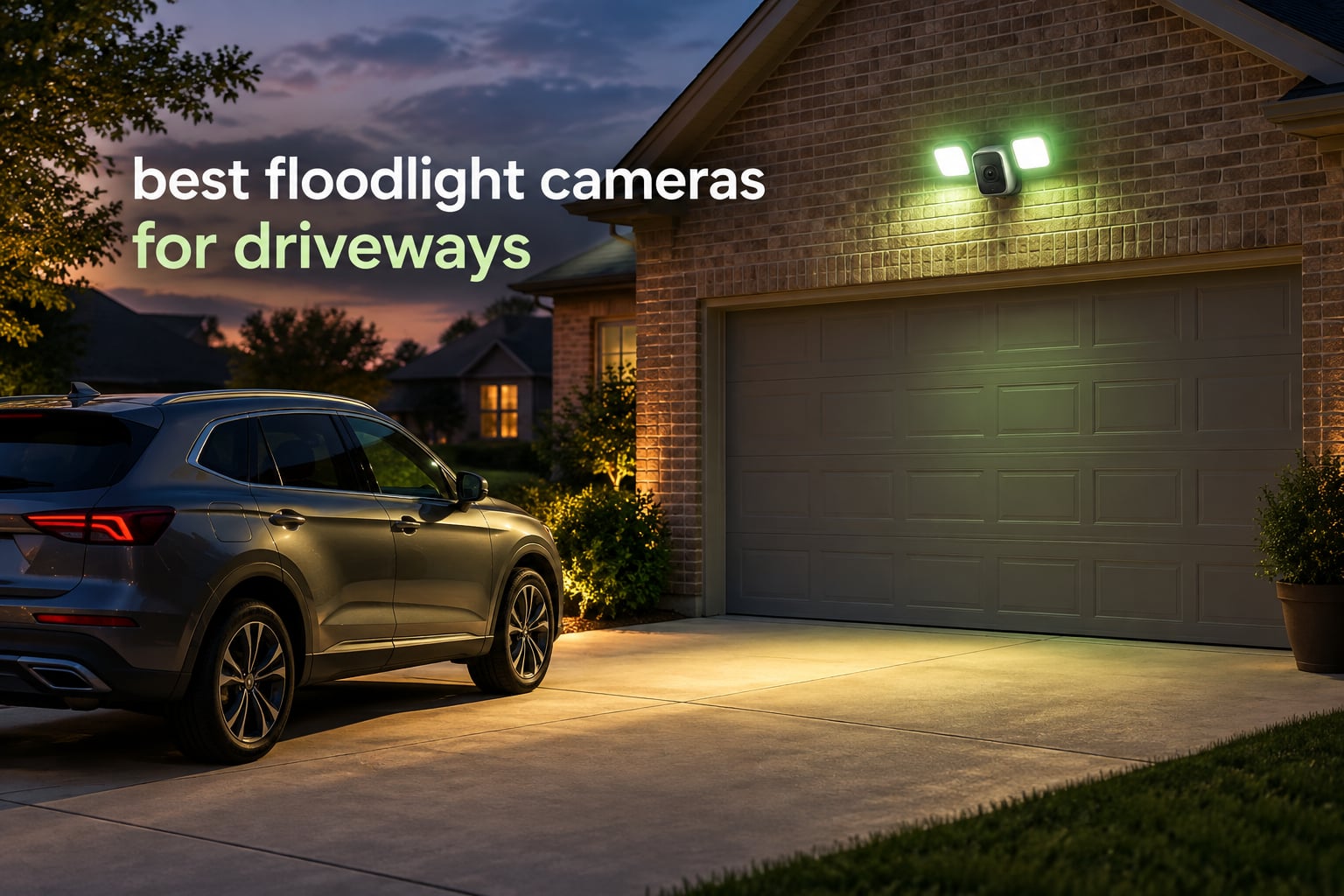
A floodlight camera is an outdoor security camera with LED floodlights built into the same housing. A motion sensor triggers the lights, the camera records, and you get an alert on your phone. That combination is why the best floodlight cameras for driveways have become the default choice for anyone replacing a driveway light fixture: one box, one power source, and both lighting and surveillance handled at the same time.
Driveways are harder to cover than front porches. The approach is long, often unlit until you hit a switch inside, and the spot where you most want a camera is frequently the spot with no power at it. Fixed wide lenses leave the far end dark, and bright lights aimed the wrong way wash out a neighbour’s bedroom window. We spent weeks comparing 12 of the leading models against exactly those problems rather than against a generic spec sheet.
Our best overall pick is the Ring Floodlight Cam Wired Plus, which pairs 2000 lumens of motion-activated light with 1080p video, a 105dB siren, and customisable motion zones at a build quality the driveway punishes less than anything else here. If you have no power at the mounting point, read the installation section before you buy anything, because that single fact eliminates half this list.
Table of Contents
- Top 3 Picks for Driveway Security in 2026
- Best Floodlight Cameras for Driveways at a Glance in 2026
- 1. Ring Floodlight Cam Wired Plus: Best Overall for Driveways
- 2. Blink Wired Floodlight Camera: Best Value at 2600 Lumens
- 3. Ring Floodlight Cam Wired Pro: Best 2K Upgrade
- 4. WYZE Floodlight Camera v2: Best 2800-Lumen Output with Local Storage
- 5. Blink Outdoor 4 Floodlight Camera: Best Battery Install
- 6. eufy Floodlight Camera E340: Best for Long Driveways
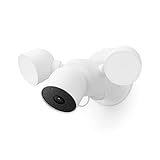
- 7. Google Nest Cam with Floodlight: Best for Google Home
- 8. Ring Floodlight Cam 4K Pro: Best 4K Detail
- 9. Tapo C615F 2K Solar Pan/Tilt: Best Solar Power
- 10. Tapo C720 2K+ Wired Floodlight: Best Bright 2K Coverage
- 11. Arlo Wired Floodlight 2K HDR: Best Articulating Lights
- 12. Wyze Cam Floodlight 2600 Lumen: Best Budget Starter
- How to Choose a Floodlight Camera for Your Driveway
- Installation: Swapping an Existing Driveway Light
- Frequently Asked Questions
- Conclusion
Top 3 Picks for Driveway Security in 2026

Ring Floodlight Cam Wired Plus
- 2000 lumen floodlights
- 1080p HD video
- 105dB siren
- Customizable motion zones

Blink Wired Floodlight Camera
- 2600 lumens
- 1080p HD
- Color night vision
- Dual-zone motion detection

Best Floodlight Cameras for Driveways at a Glance in 2026
Everything below is a hardwired, solar, or battery unit designed to sit outside and cover a vehicle approach. Lumens decide how much of your driveway gets lit; field of view and pan/tilt decide how much of it you can actually see once the lights fire.
| Product | Specs | Action |
|---|---|---|
| Ring Floodlight Cam Wired Plus |
|
Check Latest Price |
| Blink Wired Floodlight Camera |
|
Check Latest Price |
| Ring Floodlight Cam Wired Pro |
|
Check Latest Price |
 WYZE Floodlight Camera v2 WYZE Floodlight Camera v2 |
|
Check Latest Price |
 Blink Outdoor 4 Floodlight Camera Blink Outdoor 4 Floodlight Camera |
|
Check Latest Price |
 eufy Floodlight Camera E340 eufy Floodlight Camera E340 |
|
Check Latest Price |
 Google Nest Cam with Floodlight Google Nest Cam with Floodlight |
|
Check Latest Price |
 Ring Floodlight Cam 4K Pro Ring Floodlight Cam 4K Pro |
|
Check Latest Price |
 Tapo C615F 2K Solar Pan/Tilt Tapo C615F 2K Solar Pan/Tilt |
|
Check Latest Price |
 Tapo C720 2K+ Wired Floodlight Tapo C720 2K+ Wired Floodlight |
|
Check Latest Price |
 Arlo Wired Floodlight 2K HDR Arlo Wired Floodlight 2K HDR |
|
Check Latest Price |
 Wyze Cam Floodlight 2600 Lumen Wyze Cam Floodlight 2600 Lumen |
|
Check Latest Price |
1. Ring Floodlight Cam Wired Plus: Best Overall for Driveways
Ring Floodlight Cam Wired Plus, Outdoor Home or Business Security with Motion-Activated 1080p HD Video and Floodlights, White
1080p HD
2000 lumens
105dB siren
Hardwired
Wi-Fi
Pros
- Bright 2000-lumen motion-activated floodlights
- Clear 1080p day and night video
- Straightforward hardwired install with all screw sizes included
- Reliable motion detection with customizable zones and schedules
- Works seamlessly with the Ring app and Alexa
Cons
- Fixed camera position with no pan or tilt
- Floodlight is fully on or off with no dimmed ambient mode
- Advanced AI alerts and video history need Ring Protect
Out of the box, this is the least fussy unit we fitted. It mounts over a standard exterior light box, the multi-tool and every screw size you need are in the box, and the 2000 lumens covered a two-car drive with room to spare at 10 feet of mounting height. Motion zones let you carve out the street so passing headlights stop waking the camera at 2am.
The 1080p sensor is not the sharpest here, but at normal driveway distances the difference only shows if you are trying to read a plate from 80 feet away. Colour night vision kicks in with the floodlights on, so a car pulling in is rendered in full colour rather than as a grey infrared blob.
Two limits are worth planning around before you order. The camera does not pan or tilt, so the mount position is the only aiming tool you get, and on a long drive you should mount it as close to the far end of the property as the wiring allows. Second, the light is binary at night: it is either full brightness or off, with no dimmed always-on mode for the times you just want the drive visible without lighting up the whole street.
On storage, basic live view and motion alerts are free, but video history and the smarter AI alerts sit behind Ring Protect. Owners across r/Ring consistently describe the hardware as the reliable part of the package and the subscription as the part you budget for separately.
How it handles a long, dark driveway
The 2000-lumen output is genuinely useful at the house end of a two-car drive, where package thieves and people trying door handles work. Because the sensor is fixed and fairly wide, the coverage falls off noticeably past about 40 feet, which is exactly where a long drive is most vulnerable.
Motion detection is where Ring has clearly matured. Custom zones plus scheduling handled our test setup without a single headlight-triggered false alert, and the app timeline loads fast enough that you can scrub back through the evening in seconds.
Where it falls short
If you rent, or your driveway has no accessible wiring, this is the wrong unit to start with. The install assumes a junction box or existing light fixture, and adding one where there is no power is an electrician job rather than a weekend one.
The second compromise is storage depth. If you want 24/7 local recording with no monthly fee, look at the eufy E340 or the Tapo models further down instead.
2. Blink Wired Floodlight Camera: Best Value at 2600 Lumens
Blink Wired Floodlight Camera, Smart security camera, 2600 lumens, HD live view, enhanced motion detection, built-in siren, Works with Alexa, 1 camera (White)
2600 lumens
1080p HD
Color night vision
Dual-zone detection
Wired
Pros
- Very bright 2600-lumen floodlights for wide coverage
- Simple DIY setup using existing outdoor wiring
- Dual-zone customizable motion detection cuts irrelevant alerts
- Two-way audio and color night view work well in the app
Cons
- Clip storage and person detection need a Blink subscription
- Only 1080p resolution
- Sync Module for storage sold separately
This is the pick if raw driveway illumination matters more than image resolution. At 2600 lumens it lights a wide two-car drive and the strip of pavement in front of the garage door, and the colour night view uses that light well enough to see clothing colours and vehicle paint at night.
Setup is the same hardwire-to-an-existing-box job as the Ring, and the camera body itself is not bulky. Dual-zone motion detection let us scope the drive tightly and cut the street out entirely, which matters on a driveway that runs parallel to a road.
Where it loses points is the video and the storage model. It records 1080p only, which is a visible step down from the 2K and 3K units here, and both clip storage and AI person detection require a Blink subscription plan. If you run the system locally you need a Sync Module, and on the local-storage version of the plan that is a separate purchase.
That makes it a good buy for a single driveway camera that mostly needs to push alerts to a phone, and a weaker one if you are building a whole-property system and want every clip without a plan.
Best fit for a wide two-car driveway
Where a 2000-lumen unit lights the drive itself, the extra 600 lumens here push out to the edges and the apron in front of the house. That extra reach is why it remains the strongest cheap option for wide, flat driveways that end at a garage.
Two-way audio was clear in our testing, and the built-in siren is loud enough inside the house to be worth having. If you mostly want deterrence at the street end of the property, brightness beats resolution here.
Where it falls short
The subscription is the sticking point. Cloud clips, person detection, and the AI classification features are all plan-gated, so the ongoing cost is higher than it looks at purchase.
The second issue is 1080p video. If a vehicle is turning in the drive and you need to identify it later, the extra detail on a 2K sensor is worth paying for.
3. Ring Floodlight Cam Wired Pro: Best 2K Upgrade
Ring Floodlight Cam Wired Pro, Home or business security, Retinal 2K Video, Color Night Vision and Two-Way Talk with Audio+, White
Retinal 2K HDR
2000 lumens
3D Motion Detection
110dB siren
Hardwired
Pros
- Retinal 2K HDR handles high-contrast driveway scenes
- 3D Motion Detection gives precise and fewer false alerts
- Bright 2000-lumen floodlights cover large areas
- Clear color night vision and polished app timelines
- Loud 110dB siren for active deterrence
Cons
- Floodlight color temperature is warmer than the Plus model
- Mounting strap is too short for some upside-down installs
- Gain over the Plus is mainly visible in HDR scenes
- Cloud storage and AI features need Ring Protect
The step up from the Plus is HDR handling, and for driveways that is not a vanity feature. A driveway that sits in shadow while the street outside it is sunlit is the hardest lighting situation an outdoor camera faces, and the 2K HDR sensor holds detail in both halves of the frame instead of crushing one of them.
3D Motion Detection combines radar with video, so it can tell a person walking up the drive from a branch moving in the wind. Across our test period it produced fewer junk alerts than the PIR-only units here, which is the single biggest quality-of-life difference in a driveway context where cars pass constantly.
Two practical notes from owners. The mounting strap is short enough that some people replacing an older fixture cannot reach the wiring without an extension, which is worth checking against your box depth before you start. And the light colour reads warmer and yellower than the Plus, so if you are matching an existing exterior light, expect a visible difference.
The 110dB siren is the loudest on this list, which matters if the goal is scaring someone off rather than recording them.
When the extra resolution actually pays off
On a shaded drive under a tree canopy, or one that faces a streetlight on the far side of the road, HDR is the difference between a usable clip and an unusable one. In even, open lighting the 2K advantage over 1080p shrinks to almost nothing.
The 3D detection also shines on long drives, where you can narrow the zone to the far half and ignore vehicles that never actually approach the house.
Where it falls short
If your driveway is evenly lit and short, the Plus does the same job for less. The Pro earns its step up mainly when there is a real contrast problem in frame.
Video history beyond the free trial window still requires Ring Protect, so the total cost over three years needs to be counted before you commit.
4. WYZE Floodlight Camera v2: Best 2800-Lumen Output with Local Storage
WYZE Floodlight Camera v2, 2K HD Outdoor Security Camera with 2800 Lumens
2K HD
2800 lumens dimmable
160 degree view
24/7 local microSD
IP65
Pros
- Sharp 2K video with color night vision
- Very bright 2800-lumen dimmable LEDs with ambient mode
- 160 degree view plus 270 degree PIR suits driveways
- 24/7 local microSD recording with no subscription
- True light sensor for dusk-to-dawn
Cons
- Some units report random offline behavior needing a reset
- Limited fixed tilt range and no pan to the side
- Cloud event recording needs a paid plan and playback can be choppy
- Fog can keep triggering the motion sensor
This one has the most complete feature set for a driveway on the whole list. 2800 lumens of fully dimmable LEDs, a 160 degree field of view, and 24/7 continuous recording to a microSD card up to 128GB with no subscription at all, which removes the recurring cost that decides so many of these purchases.
The dimming matters more than it sounds. On a suburban street you can drop the output for a person walking past and still record in colour, rather than flooding the neighbourhood every time a fox crosses the lawn.
The recurring complaint is connectivity. A share of owners report units dropping offline randomly and needing a power-cycle, and cloud playback on the paid plan is described as choppy. Local SD playback sidesteps most of that because the video never leaves the card.
Note that this is 2.4GHz Wi-Fi only. On a larger house with several walls between the router and the driveway, put an access point near the garage rather than blaming the camera.
Best fit for a subscription-free driveway
If you are running three or four cameras and the maths on a monthly plan per camera starts to hurt, this is the pick. Thirty days of continuous local recording covers more ground than a short cloud trial, and the AI detection runs on the device.
The 270 degree PIR zone with customisable motion zones gave us the tightest control on any fixed camera here, useful when the drive runs alongside a pavement.
Where it falls short
Random offline behaviour is the reason this is not our top pick despite the strongest spec sheet. If your router signal at the mounting point is marginal, test it before committing.
It also cannot pan, and the tilt adjustment range is narrow, so aiming has to be close to perfect at install time.
5. Blink Outdoor 4 Floodlight Camera: Best Battery Install
Blink Outdoor 4 Floodlight Camera — Wireless smart security camera, 700 lumens, two-year battery life, enhanced motion detection, Sync Module Core included — 1 camera system
700 lumens
1080p HD
Infrared night vision
Two-year battery
Sync Module Core included
Pros
- Sync Module Core included so no extra hub purchase
- No wiring required and installs in minutes
- Up to two-year battery life with two AA lithium batteries
- Dual-zone enhanced motion detection with smart person detection
Cons
- 700-lumen light is far dimmer than wired rivals
- Only 1080p resolution
- Cloud storage and person detection need a Blink plan
This is the only unit here you can put on a driveway wall with no wiring, no junction box, and no electrician. The Sync Module Core comes in the box, batteries are included, and the whole thing is a mounting-bracket job. For a rental, a side gate, or a drive with no accessible power, that solves the problem the other eleven cannot.
The trade is light output. Seven hundred lumens is a porch light, not a driveway floodlight, and the night vision is infrared rather than colour. You will record a silhouette with a recognisable outline, not a colour image of a face.
Battery life is quoted at up to two years on two AA lithium cells, but treat that as the best case. A driveway with heavy car traffic triggers the sensor constantly, and forum discussion on battery-only outdoor units is consistent that high-traffic positions drain faster than the headline figure suggests.
Local storage is possible through a Sync Module XR with a microSD card, but that module is a separate purchase, and the standard plan still gates cloud clips and person detection.
Where a battery install makes sense
Renters, and anyone whose driveway light sits far from a circuit, get more from this unit than from any amount of extra lumens elsewhere on the list. Pair it with a separate smart bulb if you need real light, which is the approach several Home Assistant users take.
It is also a sensible second camera at the far end of a long drive, where running cable is impractical but you still want movement alerts.
Where it falls short
If you have wiring, do not use this as your main driveway camera. A 2600-lumen wired unit for the same money transforms what you can actually see at night.
Cold weather also works against the battery, which is worth remembering in a northern climate.
6. eufy Floodlight Camera E340: Best for Long Driveways
eufy Security Floodlight Camera E340, Dual-Lens, 360° Coverage, 8X Zoom
Dual 2K/3K lenses
360 degree pan-tilt
2000 lumens
Local microSD
Wi-Fi 6
Pros
- Dual 3K wide and 2K telephoto lenses with 8x hybrid zoom
- 360 degree pan-tilt with smooth AI auto-tracking
- 24/7 local recording with no subscription fee
- Bright 2000-lumen light with adjustable brightness and 95dB alarm
- Dual-band Wi-Fi 6 for reliable connectivity
Cons
- Motion detection and recording can cut out mid-motion
- Field of view is narrower than some rivals despite pan-tilt
- Mounting bracket may need an adapter for a junction box
- Event playback is less polished than the Ring app
This is the long-driveway answer. Two lenses, a 3K wide view and a 2K telephoto with 8x hybrid zoom and 3x optical, plus a 360 degree pan-tilt head with AI tracking that follows a vehicle as it comes down the drive. A fixed camera at the far end of a long property simply cannot do this.
Storage is fully local, continuous 24/7 recording to a microSD card up to 128GB or a HomeBase S380, with no subscription. It also runs dual-band Wi-Fi 6, which matters on exactly the bigger homes where a 2.4GHz-only unit struggles.
Two things to weigh. The recording sometimes stops while motion is still happening, which matters on a driveway where a vehicle is the thing you need to see from start to finish. And while the head pans a full circle, the field of view at any one moment is narrower than a fixed 160 degree lens, so it is not a straight swap for a wide-angle install.
Installation over an existing box may need an adapter, and the bracket is chunky at 1380 grams. It is the heaviest unit on this list by a wide margin.
When a pan/tilt head is worth it
On a long linear drive or a circular turnaround, auto-tracking means a car pulling in at night stays framed instead of walking out of shot at the first bend. The telephoto lens then pulls detail back in on the vehicle once it stops.
For a short, straight two-car drive, that capability is money you do not need to spend.
Where it falls short
Recording cut-outs during motion are the main complaint from owners, and the app playback experience trails Ring noticeably when you are hunting through an evening of events.
HomeKit support is limited unless you add the HomeBase S380, so Apple-only households should check that first.
7. Google Nest Cam with Floodlight: Best for Google Home
Google Nest Cam with Floodlight – Outdoor Camera – Floodlight Security Camera, White, 1 Count (Pack of 1)
1080p HDR
130 degree view
3 hours free event history
Battery powered
IP65
Pros
- On-device detection of people animals and vehicles with no subscription
- 1080p HDR video with night vision and 3 hours of free history
- Keeps recording about an hour through a power or Wi-Fi outage
- Works seamlessly in the Google Home app with voice control
Cons
- Only 3 hours of event history without a paid plan
- 1080p resolution and 130 degree view trail newer cameras
- No zoom of any kind on the camera module
The reason to buy this one is the intelligence. Person, animal, and vehicle detection all run on the device with no subscription, and the three hours of free event history cover the majority of driveway incidents, which are almost always brief. You can add a paid plan for longer retention and familiar face recognition.
It also buffers about an hour of events locally during a power or Wi-Fi outage. On a driveway where a break-in happens at night and your internet drops with it, that buffer is genuinely valuable.
It is battery powered, so installation needs no wiring at all, though you will be replacing batteries on some schedule rather than running a cable. At 2.6 pounds it is a reasonable weight for a wall or soffit mount.
The specifications are modest against the competition. 1080p HDR at 130 degrees, no zoom of any kind, and a floodlight output that is not published as a lumen figure. On a long driveway you will notice the narrower field of view and the lack of optical reach.
Best fit for an all-Google household
If everything else you own lives in the Google Home app, this is the least friction option and the alert handling is the smoothest of anything on the list. Voice response through a display works without extra setup.
The free on-device classification means you get person and vehicle alerts without paying for AI features, which is the opposite of most rivals here.
Where it falls short
Three hours of history is genuinely short. A driveway camera is one you go back to after a holiday, and you will want more than that from a plan-free option.
No zoom means a vehicle at the far end of a long drive is a smudge. If identifying cars is the goal, this is not the camera.
8. Ring Floodlight Cam 4K Pro: Best 4K Detail
Ring Floodlight Cam 4K Pro (newest model), Wired, Retinal 4K with wide-angle video, 10x Enhanced Zoom, and 2000 Lumen Floodlights, White
Retinal 4K
10x enhanced zoom
2000 lumens adjustable
3D radar detection
85dB siren
Pros
- Noticeably sharper and wider Retinal 4K video
- Picture snaps in quickly with solid connection quality
- 10x enhanced zoom helps identify detail at distance
- Low-Light Sight gives full color in near-dark conditions
- Well-designed bracket with wiring strap and ground wire
Cons
- Only a modest real-world gain over the 2K Pro and plates stay hard to read
- Larger body with less pan/tilt range than earlier models
- Floodlight output is noticeably more yellow than previous generations
- Night vision gain over the prior model is minimal
The headline here is Retinal 4K with a 10x enhanced zoom, and on a driveway it is genuinely sharper than the 2K models. Low-Light Sight pushes for full colour in near-dark conditions when the floodlights have not yet reached full brightness, which catches the first few seconds of someone walking up.
Installation design is the quiet improvement. The bracket, the wiring strap, and an included ground wire are all better thought out than on the Pro, which matters if you are working in a junction box in the rain.
Owners upgrading from the 2K Pro report a smaller jump than the resolution numbers suggest, and that is the honest read. Doubling pixels does not make a motion-blurred licence plate legible. The body is also bulkier with less tilt range, and the light colour is noticeably more yellow than earlier generations.
This is the top of the Ring line and the third Ring on this list, so the case for it is specifically resolution and low-light colour, not features you have not already seen on the Plus.
When 4K changes the outcome
On a wide drive with a camera mounted high, extra pixels help you crop into a corner of the frame after an event and still get usable detail. That post-event crop is the main practical advantage over the 2K Pro.
Low-Light Sight is the second one. Footage captured in the first seconds after motion is detected, while the LEDs are still ramping up, is where most cameras produce the worst frames.
Where it falls short
If you are starting from scratch on a short driveway, the Plus or the Wyze v2 gets you the image you need for far less, and the 4K advantage will not be visible on your phone at arm’s length.
It remains the most expensive option here, and the value case only strengthens on a long drive where cropping matters.
9. Tapo C615F 2K Solar Pan/Tilt: Best Solar Power
Tapo 2K Outdoor Pan/Tilt Wireless Floodlight Security Camera, C615F KIT
2K 3MP
800 lumens
360 degree pan-tilt
Solar plus battery
Subscription-free AI
Pros
- Only unit here combining 360 degree pan-tilt with a solar panel
- Subscription-free person pet and vehicle detection
- No wiring needed with solar keeping it running
- Local microSD storage up to 512GB at no cost
- Compact body that is easy to install and aim
Cons
- 800-lumen light is dimmer than wired floodlights
- Requires 2.4GHz Wi-Fi only
- Solar charging does not work below 32F
- Continuous capture needs an SD card or hub
This is the most unusual combination in the roundup: a solar panel, a rechargeable battery, and a 360 degree pan-tilt head with AI tracking in one box, with no wiring and no subscription. The solar panel and bracket are included, and about 45 minutes of direct sun restores a full day of operation.
Detection is subscription-free for people, pets, and vehicles, and local microSD storage goes up to 512GB, which is the largest capacity any unit here supports. Continuous capture can be set between 1 and 60 second intervals.
800 lumens is the compromise, and on a wide driveway it will not replace a wired floodlight. The panel also needs an unobstructed southern or western sky, and charging stops below 32F, which is a real constraint for anyone north of the Ohio Valley through winter. Keeping a drive usable through those months means your snow blower choice for gravel driveways matters just as much as the camera hardware by then.
Night vision is quoted at 32.8 feet, so it is aimed at the near part of a drive rather than a long approach. The camera body is small at 1.4 pounds and easy to position precisely once it is up.
Best fit where power is not an option
If your driveway is long and there is no circuit anywhere near it, this covers more ground than a fixed solar panel camera because the head tracks a vehicle across the full 360 degrees horizontally and 130 degrees vertically.
It is also the cheapest route to subscription-free AI detection with tracking, which rivals usually reserve for the cloud tier.
Where it falls short
Winter is the honest limitation. Below 32F the panel does not charge, so in a cold climate the unit lives off stored battery through the darkest months, and a shaded drive will not suit it at all.
At 800 lumens, plan to use it as a detector and tracker rather than as your driveway’s main light source.
10. Tapo C720 2K+ Wired Floodlight: Best Bright 2K Coverage
Tapo 2K+ Outdoor Wired Floodlight Security Camera, C720, 2800LM
2K QHD 4MP
2800 lumens
150 degree view
24/7 local microSD
IP65
Pros
- Very bright 2800-lumen adjustable floodlight covering up to 30 ft
- Sharp 2K QHD video with color night vision
- Wide 150 degree field of view reduces driveway blind spots
- AI detection separates people pets and cars
- Free local recording with full scheduling and brightness control
Cons
- Only 2.4GHz Wi-Fi support
- Requires existing wiring and a junction box
- Live view can take several seconds to appear
- Connection quality depends on router placement
The spec combination here is hard to argue with on paper. 2800 lumens of fully adjustable light, 2K QHD 4MP video, a 150 degree field of view, and colour night vision out to 30 feet, with 24/7 recording and AI detection that needs no subscription.
The Tapo app gives more manual control than most rivals: full scheduling, brightness adjustment, and separate sensitivity per detection type. Owners who have moved away from other brands often single out how quickly the app loads footage compared with apps that stutter.
The install assumes existing wiring and a junction box, the same constraint as every hardwired unit here. The one recurring friction point is speed: live view can take several seconds to appear on the network, which is fine for reviewing clips and frustrating when you want to talk to a visitor at the gate.
Like the other Tapo units, this is 2.4GHz only. On a house with a detached garage or a long run of brick, put an access point near the driveway.
Why the 150 degree view matters here
A wider lens means more of a two-car drive and the verge in front of the house falls inside a single fixed frame, so you do not need a second camera to cover the near corner. On a short drive that is a real saving in both cost and installation effort.
Combined with 2800 lumens, it is one of the few units here that lights and covers the same area without help.
Where it falls short
Live-view startup delay is the main gripe, and it shows up most when you are trying to speak to someone arriving.
The unit is also large at nearly 12 inches, so it needs a mounting plate with room behind it rather than a slim soffit.
11. Arlo Wired Floodlight 2K HDR: Best Articulating Lights
Arlo Wired Floodlight Security Camera 2K HDR – 1-Cam
2K HDR
2000 lumens articulating
160 degree view
12x zoom
Hardwired
Pros
- Clear 2K HDR day and night with a wide 160 degree field of view
- Bright adjustable 2000-lumen light for a large driveway
- Hardwired power means no battery charging or failures
- Easy install over an existing junction box
- Compact body that is not bulky
Cons
- Advanced features need a paid Arlo Secure plan
- Some owners report animal false alarms and siren firing without matching clips
- Floodlight settings are scattered in the app with no always-on option
- Geofencing is unreliable
The differentiator is physical. These are articulating lights, meaning you can aim each LED head separately, which is the practical answer to driveway shapes where a single straight beam either floods the neighbour’s hedge or leaves the far corner black.
On video, 2K HDR with a 160 degree field of view and 12x digital zoom is competitive, and colour night vision reaches 25 feet. The compact 1.6 pound body fits a standard four-inch round weatherproof box, which is the junction box most existing driveway lights already use.
The app is where it falls down. Floodlight settings are buried in several menus, the light cannot be set to stay on continuously, and a number of owners report animal-triggered false alarms alongside sirens firing without a matching notification or recorded clip. Geofencing is described as unreliable.
Sixty-day history, AI detection, and emergency response all require a paid plan after the trial, though live streaming and basic alerts work without one.
Best fit for an awkwardly shaped drive
On a drive that curves, splits, or has planting and a wall in the way, aiming two independent heads beats fighting with a single fixed beam. It is also the easiest unit here to install over an existing fixture on a box you have never opened.
If your light spill is a problem, articulated heads let you point both beams down and inward at ground level.
Where it falls short
The detection and app quirks are the deal breaker for anyone who plans to rely on this as their only driveway camera. Sirens that fire without a recorded event are worse than no siren.
At 2000 lumens, output is mid-pack against the 2800-lumen units on wide, open driveways.
12. Wyze Cam Floodlight 2600 Lumen: Best Budget Starter
Wyze Cam Floodlight with 2600 Lumen LEDs, Wired 1080p HD IP65 Outdoor Smart Security Camera, Color Night Vision, 270-Degree Customizable Motion Detection, 105dB Siren, and Two-Way Audio
2600 lumens dimmable
1080p HD
Three PIR sensors
105dB siren
Wired
Pros
- Very bright 2600-lumen LEDs with a dimming option
- Three separate PIR sensors give 270 degrees of tunable coverage to 30 ft
- Starlight sensor delivers solid color night vision
- 105dB siren and two-way audio are genuinely loud
- Dusk-to-dawn automation makes it an easy first camera
Cons
- Only 1080p with a narrower 120 degree field of view
- Cloud recording and AI detection need a paid plan
- Requires wiring to an existing outdoor light box
- AI object detection is subscription-gated
This is the least expensive way to put real light on a driveway. Two dimmable LEDs deliver 2600 combined lumens, which covers a wide two-car drive, and three independently controlled PIR sensors give 270 degrees of motion coverage out to 30 feet with per-sensor sensitivity.
Three separate sensors is a quietly useful feature. On a drive where the pavement runs alongside a shared path, you can tune down the sensor covering the path and keep the one covering your car fully sensitive, which cuts false alerts far better than a single global slider.
It is the older of the two Wyze units here. The 1080p sensor and 120 degree field of view are both a step behind the 2K, 160 degree v2, and cloud recording plus AI object detection are gated behind a plan.
Like the rest of the wired floodlight category it needs an existing light box, so the no-power problem is unsolved. A true light sensor handles dusk-to-dawn rather than a schedule, which means it switches when the light actually fades rather than at a fixed time.
Best first driveway camera
If you have never run a driveway camera before, this is the lowest-risk place to start. Brightness is high, the app is straightforward, and 30 feet of motion coverage suits a standard suburban drive without any aiming calculation.
The 105dB siren is loud enough to matter and the two-way audio is clear, so you can talk to a visitor at the gate or a delivery driver at the kerb.
Where it falls short
Against the newer Wyze v2 it gives up resolution, field of view, and local 24/7 recording. If both are within reach, the v2 is the better camera and this is the better budget call only when cost is the deciding factor.
Feature gating is the other limit: expect to use the free tier only, or to budget for a plan.
How to Choose a Floodlight Camera for Your Driveway
Start with the power you actually have
Wiring is the single biggest blocker and it is worth resolving before you compare anything else. If you have an existing exterior light or a junction box at the mounting point, hardwired units are the better choice: no battery to die in February, brighter light, and a cleaner install.
If there is no power, the choice narrows fast. The Tapo C615F runs on solar and tracks 360 degrees, the Blink Outdoor 4 is pure battery, and the Google Nest Cam is battery powered. All three trade light output for the ability to install at all.
Long drives need tracking, short drives do not
A long linear driveway or circular turnaround benefits from a pan and tilt head, because a fixed lens cannot follow a vehicle along its length. The eufy E340 and the Tapo C615F both track, and the E340 adds a telephoto lens for detail at distance.
A short, straight two-car drive is better served by a fixed wide lens with more lumens, because nothing needs following. Adding motion tracking to a straight drive is paying for a feature that never gets used.
Decide on local storage or a plan
Local recording removes the recurring cost entirely. The eufy E340, the Tapo C615F, the Tapo C720, and the Wyze v2 all record 24/7 to a microSD card with no subscription, which over three years across several cameras is the difference that adds up fastest.
Cloud plans buy you longer retention, shared access, and AI features in some cases, but they are a permanent line item. Count the annual cost against the hardware for every camera in the house, not just the one on the driveway.
Check your ecosystem and your Wi-Fi band
Ring works best inside the Ring app and with Alexa. The Google Nest Cam with Floodlight is the natural fit for Google Home, and Tapo units cover both Alexa and Google Assistant. The Wyze v2 works with Alexa, Google Assistant, and IFTTT.
Most of these cameras, including both Tapo models and the Wyze v2, are 2.4GHz only. On a larger home with brick or several walls between the router and the driveway, add an access point near the garage. The eufy E340 is the one here with dual-band Wi-Fi 6.
Map the blind spots before you buy
Walk the driveway at night and note where a person would be invisible. That corner beyond the parked car, the side strip near the gate, and the stretch nearest the street are the three that fixed lenses miss. Draw motion zones to cover those areas and exclude the road.
Think about light spill at the same time. Aim beams down and inward, use the dimming or ambient modes to avoid full-output flares every time a fox crosses, and check your local light ordinances if you are on a close suburban street. Floodlight glare blinds neighbours faster than it deters anyone.
Installation: Swapping an Existing Driveway Light
Most hardwired floodlight cameras here assume a junction box or an existing exterior light fixture at the mounting point, and the box is the deciding factor. If you are replacing a standard driveway light, the swap is genuinely a weekend job: turn off the breaker, remove the old fixture, connect the two wires with the supplied connectors, and mount the new unit to the box.
Confirm before you buy that your box is a round or standard weatherproof box of the size the camera expects. Several models in this roundup note fitting quirks, including one where the bracket may need an adapter for a standard junction box and another with a wiring strap that is too short for some upside-down mounts.
If you need a new box, or there is no circuit at the driveway at all, that is where an electrician comes in. The cost of that visit will exceed the price of most cameras on this list several times over, which is exactly why the solar and battery options exist and why they are worth their lower lumens on a difficult driveway.
A couple of practical checks while you are up there. Mount at 10 to 12 feet for a balanced view that captures a vehicle without looking straight down at it, and keep the camera below any tree canopy if you are relying on a solar unit. If you go solar, the panel needs several hours of direct sun and does not charge below 32F.
Frequently Asked Questions
What is the best security camera for a driveway?
For most driveways, the best security camera is a hardwired floodlight camera that replaces an existing exterior light, because it delivers real illumination and 1080p or better video from a single power source. Our top pick for driveways in 2026 is the Ring Floodlight Cam Wired Plus, with 2000 lumens and customisable motion zones.
Can I have a camera facing my driveway?
Yes. A camera covering your own driveway, front path, or the public street is generally fine, since you are not recording inside your home or on a neighbour’s private property. Keep the field of view off a neighbour’s windows and their yard, avoid audio zones that capture private conversations, and tell people the camera is there.
How far can a Ring Floodlight camera see?
A Ring Floodlight camera with 2000 lumens lights roughly 40 to 60 feet usefully, and readable video extends a similar distance in good conditions. Beyond that, brightness falls off and a second camera at the far end of the property covers the gap better than a brighter single unit.
Do floodlight cameras work without Wi-Fi?
Most floodlight cameras need 2.4GHz Wi-Fi for live view and alerts, because they have no onboard storage outside a microSD card. A few models record continuously to a local card and keep recording through an outage, but you still need Wi-Fi to view footage live on your phone.
Are floodlight cameras better than spotlight cameras?
For driveways, floodlight cameras usually win, because the built-in light activates with motion and the camera records in full colour rather than infrared. Spotlight cameras are narrower and cheaper, which makes them better for a side gate or a back path where you mainly need to light one small area.
Conclusion
Three paths decide almost every driveway camera purchase. If you have a junction box or an existing light fixture at the mount, the Ring Floodlight Cam Wired Plus is the pick we would install, with 2000 lumens, dependable motion detection, and no battery to maintain. If you need brightness above everything, the Tapo C720 and the Wyze Floodlight Camera v2 both reach 2800 lumens, and the v2 adds 24/7 local recording with no subscription.
If you have no power at the mounting point, the Tapo C615F gives you solar power with 360 degree tracking, and the Blink Outdoor 4 is the simplest possible install. If your driveway is long enough that a fixed lens leaves the far end dark, the eufy E340 is the only unit here that both pans to follow a vehicle and zooms back in on it.
Before anything else, walk the driveway at night and find the blind spot, then check whether the mounting point has power. Those two checks answer most of the questions a spec sheet cannot. Whatever you choose, remember the driveway is the first thing a visitor sees, so keep the beams aimed down and off your neighbour’s windows.
Once the camera is up, your driveway cleaning and pressure washer choice matter too, and winter brings its own snow blower considerations once the ground is covered. Updated for 2026.
1 thought on “12 Best Floodlight Cameras for Driveways (October 2026) Reviewed”