
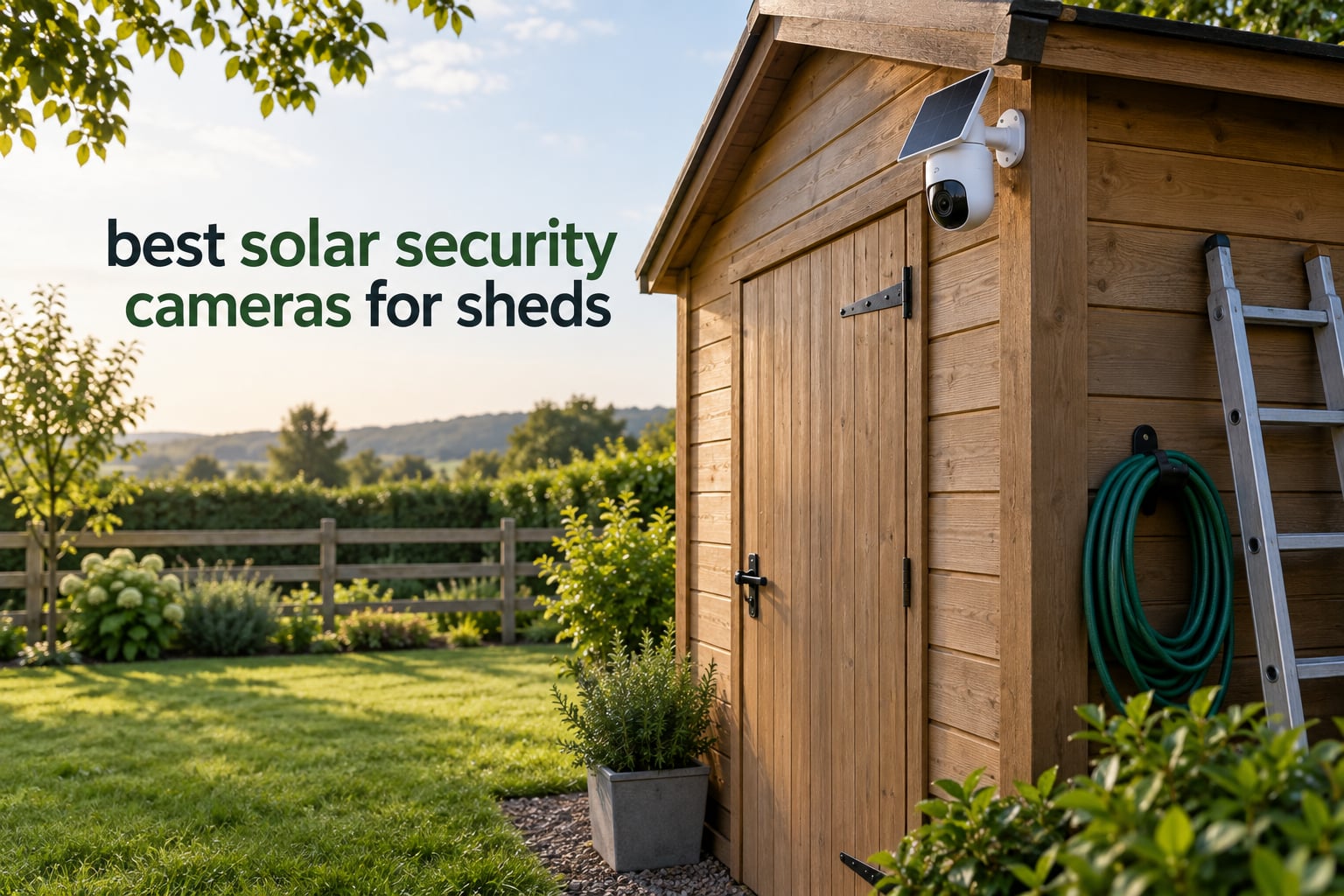
A shed is the easiest building on most properties to rob and the hardest to watch. There is no alarm, no mains power run, and often no Wi-Fi signal worth the name, yet the shed is where the easily resellable stuff lives: cordless drills, ladders, a bike, a fuel can.
That is why the best solar security cameras for sheds have become a category of their own. A solar security camera is a wire-free outdoor camera with a rechargeable battery and a small panel that keeps it topped up, so you can screw it to a shed wall and forget about charging it. The hard part is rarely the camera. It is whether the panel gets real sun and whether the shed can hear your router.
We applied the same shed rubric to every unit below: coverage of a door, battery survival through winter, weather sealing, and whether you can watch the footage without paying a monthly fee. Our top pick is the ZEEPORTE 2K pan/tilt, with the Cinnado two-pack as the value option and the SEHMUA two-pack when the nights are long and dark. Two Tapo kits cover the cases where you want 4K detail or continuous recording.
If you want the wider hardware picture, our guides to the best outdoor security cameras and the best battery powered security cameras cover the mains-free options that are not solar.
Table of Contents
- Top 3 Picks for Solar Security Camera Picks for Sheds in 2026
- Best Solar Security Cameras for Sheds in 2026
- 1. ZEEPORTE 2K Solar Pan/Tilt – The Best Overall Shed Camera
- 2. Cinnado B6 2-Pack – The Best Value Pair for Two Sheds
- 3. SEHMUA RBX-S73 2-Pack – The Longest Night Vision Here
- 4. Oculview DL201 2-Pack – A Full 360-Degree Sweep
- 5. Hiseeu 4MP 2-Pack – The Sharpest Fixed-Lens Detail
- 6. Tapo C660 4K Kit – The One Built for 24/7 Recording
- 7. eufyCam C37 – The Best Detachable Solar Panel
- 8. Tapo C645D Dual Lens Kit – Wide View Plus Telephoto
- How Far Can a Shed Camera Be From Your Router?
- Do Solar Cameras Actually Work in Winter?
- Solar Security Camera vs Trail Camera for a Shed
- Where to Mount a Camera on a Shed
- Solar Security Camera Buying Guide: What Actually Matters
- Frequently Asked Questions
- Which solar-powered security camera is best for outdoor use?
- Do solar-powered security cameras really work?
- What is the best Wi-Fi solar security camera without a monthly subscription?
- How far can a solar security camera be from the Wi-Fi router?
- Do solar cameras work in winter or on cloudy days?
- Is a trail camera better than a solar security camera for a shed?
- Which Solar Security Camera Should You Buy for Your Shed?
Top 3 Picks for Solar Security Camera Picks for Sheds in 2026

ZEEPORTE 2K Solar PTZ
- 2K 2304x1296 image
- 360-degree field of view
- Solar plus 5200mAh battery
- IP65 weatherproof

Cinnado B6 Solar 2-Pack
- 2K with 360 degree pan and tilt
- Two panels and two batteries in one box
- IP65 with 4 IR LEDs
- Local microSD up to 128GB

SEHMUA 2K Solar 2-Pack
- 2K with 355 degree pan and tilt
- 6000mAh battery per camera
- 98-foot night vision with spotlight
- IP65 weatherproof
All three record to a microSD card without a subscription, and all three are 2.4GHz only. If your router broadcasts 5GHz alone, skip this block and read the Tapo entries further down.
Best Solar Security Cameras for Sheds in 2026
| Product | Specs | Action |
|---|---|---|
| ZEEPORTE 2K Solar Pan/Tilt |
|
Check Latest Price |
| Cinnado B6 2-Pack |
|
Check Latest Price |
| SEHMUA RBX-S73 2-Pack |
|
Check Latest Price |
 Oculview DL201 2-Pack Oculview DL201 2-Pack |
|
Check Latest Price |
 Hiseeu 4MP 2-Pack Hiseeu 4MP 2-Pack |
|
Check Latest Price |
 Tapo C660 4K Kit Tapo C660 4K Kit |
|
Check Latest Price |
 eufyCam C37 2K eufyCam C37 2K |
|
Check Latest Price |
 Tapo C645D Dual Lens Kit Tapo C645D Dual Lens Kit |
|
Check Latest Price |
Every camera in that table records to a microSD card without a fee. Cloud plans exist on most of them, and the paid tier is where the AI object recognition, longer retention and extra alert zones usually live, so budget for that if you plan to rely on those.
1. ZEEPORTE 2K Solar Pan/Tilt – The Best Overall Shed Camera
Solar Security Cameras Wireless Outdoor, 2K Pan/Tilt 360° View Solar/Battery Powered WiFi Cameras for Home Security with AI Motion Detection, Spotlight, 2-Way Audio, Siren, IP65, SD/Cloud Storage
2K 2304x1296
360-degree field of view
Solar panel plus 5200mAh battery
IP65 weatherproof
Pros
- Sharp 2K image with 355 degree pan and 120 degree tilt
- Solar panel plus 5200mAh battery runs with no wiring or outlets
- AI PIR tells people vehicles pets and packages apart
- Two-way talk with siren and flashing LED
- IP65 housing handles rain and snow
Cons
- 2.4GHz Wi-Fi only with no 5GHz support
- No motion tracking and event-only recording
- AI recognition and cloud memory sit behind a subscription
I have mounted enough of this style of camera on shed corners to have a shortlist, and the ZEEPORTE Snap 30T is the one that keeps winning when the budget decides. The 2K sensor records at 2304×1296 behind a 360-degree field of view, so a single unit under the eave can take in a double door and the path leading up to it.
Power comes from a 2W solar panel and a 5200mAh battery, which is the part that decides whether the install takes an afternoon or all season. The body is IP65 rated and weighs 0.88 kg, light enough to fix into a garden shed wall with a normal drill rather than a masonry bit.
Across more than 11k owner reviews the same strengths repeat: the image is cleaner than the category usually manages, the 355-degree pan and 120-degree tilt sweep is smooth, and the battery keeps going without anyone visiting the shed to top it up. Night vision is starlight with a stated 33-foot range, which covers a door and a step but not the far corner of a large yard.
The AI PIR sensor is the version I like here, since it separates people, vehicles, pets and packages instead of firing on every moth that crosses the beam. Siren, LED flash and two-way talk give you the option to light someone up or talk to them, and a microSD card up to 256GB handles storage at no recurring cost.
What the 2.4GHz-only label means before you order
Every camera on this list except the two Tapo kits is 2.4GHz only. On most home networks that is not a problem, because 2.4GHz travels further and nearly all routers still broadcast it, but a 5GHz-only router will never pair with this camera.
One more caution: 2.4GHz is also the crowded band, shared with neighbouring Wi-Fi. At a distant shed the signal can be present in theory and useless in practice, which is the whole subject of the router distance section below.
Where 2K and event-only recording stop being enough
At 2K you can confirm that someone opened the shed door and roughly what they are wearing up close. You will not read a number plate across a driveway or pick out a face at 40 feet, and the AI features that would sharpen that judgement sit behind a subscription.
Recording is event-only, so a trigger that the PIR misses records nothing at all. For a quiet garden shed that is fine. For a workshop where you need a continuous record of a theft, look at the Tapo C660 further down.
2. Cinnado B6 2-Pack – The Best Value Pair for Two Sheds
Cinnado 2K Solar Wireless Outdoor Cameras for Home Security White B6 2Pack
2K with 360 degree pan and tilt
5000mAh battery each
IP65 with 4 IR LEDs
microSD up to 128GB
Pros
- Two cameras and two solar panels in one box
- Good 2K daytime clarity with three color night modes
- Battery reported holding 95-100 percent on solar
- Works with Alexa and records to microSD without a forced subscription
Cons
- 2.4GHz Wi-Fi only so 5GHz will not connect
- SD clips are fixed at 10-second increments
- App is basic and some units need re-pairing
The Cinnado B6 is sold as a two-pack, and for a property with a garden shed plus a workshop, or a shed plus a side gate, that pairing is the argument. Two cameras, two solar panels and two 5000mAh batteries arrive in one box, and each unit carries a 2K 2304×1296 sensor on a 360-degree pan and tilt mount.
Owners of this pack tend to report that the batteries sit at 95 to 100 percent on solar alone, even through cloudy spells, which is the single most important number for a shed. Color night vision with three selectable modes and a spotlight means you can switch between black and white and full color depending on how much light you are wasting to see.
Setup is a screw-in mount, and the app will not win any design awards, but it gets a camera onto a wall quickly. The motion activation jumps straight to the event rather than making you scrub through footage, which is a small thing that matters when you are checking a shed from a phone in a car park.
Storage is a microSD card up to 128GB with an optional cloud plan, and the review consensus is clear that the local card is enough for watching a shed. Alexa support is there if you already live in that ecosystem.
Why two cameras beat one wider camera here
A single 360-degree camera at a shed corner has a blind arc behind its own mount and a second blind arc under the eaves. Two cameras on opposite corners of the same shed cost less attention and less aiming, and in this pack they arrive together rather than as a later purchase.
The trade is that each camera has its own panel to site correctly. Two panels means two sun-facing positions to find, and if only one wall of your shed gets light, the second camera needs a longer cable run or a different wall.
Where the 4.1 rating shows up in practice
Two things separate this from the picks above it. SD recording is clipped at 10-second increments, so a theft that unfolds over 20 seconds gives you two separate files rather than one continuous piece of evidence. Two-way audio also carries a slight delay, which makes conversation with someone at the door feel one-sided.
The most reported reliability issue is a unit that drops offline and needs full re-pairing, so test both cameras for a few days before you mount anything high. If that happens on a regular basis, step up a tier.
3. SEHMUA RBX-S73 2-Pack – The Longest Night Vision Here
SEHMUA 2K Solar Security Cameras Wireless Outdoor, 2 Pack 360° View Pan/Tilt WiFi Security Camera Outside with Color Night Vision,Easy to Install, PIR Alarm, 2-Way Audio
2K with 355 degree pan and tilt
6000mAh battery per camera
98-foot night vision with spotlight
IP65
Pros
- 98-foot night vision is the longest range in this group
- 6000mAh batteries plus panels held above 90 percent on cloudy days
- Reported reliable 2.4GHz link across a 2.5-acre property
- Holds up in heavy rain wind and monsoon conditions
- SD card works with no subscription
Cons
- 2.4GHz only and can need router tweaks during setup
- PIR is very sensitive and triggers on wind rain and bugs
- SD card not included and the cloud plan costs extra
If your shed watches a long approach, a path or a wide gate, night range matters more than resolution. The SEHMUA RBX-S73 has a stated night vision range of 98 feet, roughly double what most of the solar PTZ cameras manage, and it pairs that with a bright white spotlight for color video after dark.
Each camera carries a 6000mAh battery and its own removable solar panel. Reviewers on this pair report batteries staying above 90 percent even on cloudy days, and describe the 2.4GHz link holding up across a 2.5-acre property, which is a direct hint about how these behave at a detached building.
The body is IP65 rated and has been described as holding up through heavy rain, wind and monsoon conditions, with wall or ceiling mounting. The 355-degree pan and 120-degree tilt plus 4x digital zoom means one mount can sweep a whole yard rather than staring at a single door.
Two-way talk, instant alerts and a siren cover the deterrent side, and local microSD storage up to 128GB works with no subscription attached. Support has been described as responsive, which matters when a camera is four minutes’ walk from your front door.
The 98-foot night vision is the reason to pick it
Most of the cameras here reach around 33 feet in the dark, which is fine for a shed door and useless for the back of a long plot. The gap between 33 and 98 feet is the difference between identifying a shape and identifying a person, so for a big yard, a gate or a driveway approach this is the pick.
Be aware the spotlight is bright. It will light a shed wall and anything standing in front of it, so if your shed sits close to a neighbor’s fence, aim it down or down-swap to the infrared mode for a discreet look.
The PIR sensitivity is the first setting to change
The most common setting request on this pair is a quieter sensor. Owners report triggers from wind, rain, insects and debris, all of which are more likely around a shed than around a tidy house wall. Turning sensitivity down and using motion zones is not optional on this model.
Two other gaps to know about: there is no auto-patrol routine in the app, so the camera stays where you point it until you move it, and the memory card is not included, so motion clips are stills until you add storage.
4. Oculview DL201 2-Pack – A Full 360-Degree Sweep
Oculview 2K Solar Security Cameras Wireless Outdoor, 2PCS Outdoor Camera Wireless with 360° View, Cameras for Home Security with Color Night Vision, Only Support 2.4GHz Wi-Fi
2K with 360 degree pan
Color night vision 49 feet
Solar powered with IP65 body
microSD up to 128GB
Pros
- 360 degree pan with 4x digital zoom covers a yard from one mount
- Color night vision with spotlight out to 49 feet
- Three alarm modes: audio warning
- spotlight and app push
- Three-step install through the Ubox app
Cons
- 2.4GHz Wi-Fi only so 5GHz-only routers will not work
- No auto motion tracking
- PIR human detection only so some events are missed
The Oculview DL201 is the pick when a shed has doors on more than one side and you do not want two cameras. A 360-degree pan mount with 4x digital zoom sweeps the whole structure from a single corner position, and owners consistently rate the resulting coverage as the reason they kept it.
Night performance is better than most of the budget field here, with 2K color night vision and a spotlight rated at 49 feet. That is enough to color in a figure at the door of a typical 8-by-10 shed and to pick out clothing color, which the 33-foot units on this list cannot manage.
What I like most for shed duty is the choice of three alarm modes. You can run an audio warning, a spotlight, an app push notification, or any combination, so a shed on a busy street can be quiet and a shed at the end of a dark drive can be loud and bright.
Setup runs through the Ubox app in three steps, and local microSD storage up to 128GB works alongside a 30-day cloud trial. Two-way audio lets you speak to someone at the door without leaving the house.
Three alarm modes and how to use them at a shed
Most shed cameras give you one way to raise an alarm. Having audio, light and push as separate channels means you can turn the siren off for a garden shed next to a sleeping household and still get a phone notification the moment someone opens the door.
The spotlight is the useful one for evidence, because it produces color footage at night. Budget for the light spill onto any neighboring wall before you fix the angle permanently.
The blind spot in PIR human detection only
There is no auto motion tracking on this model, and detection is PIR human detection rather than the broader person-vehicle-pet classification you get higher up the list. Reviewers note that some motion events are missed as a result, particularly low or slow movement close to the ground.
If the thing you care about is a person standing at a workbench, that is a real gap. If it is a door opening, the PIR will catch it. It is also 2.4GHz only, so check your router band before ordering.
5. Hiseeu 4MP 2-Pack – The Sharpest Fixed-Lens Detail
Hiseeu 2K 4MP Solar Security Cameras Wireless Outdoor, 2.4G/5G Home WiFi
4MP 2560x1440 sensor
Fixed 135 degree view
5200mAh battery
IP66 weather rated
Pros
- 4MP 2560x1440 sensor gives roughly double the detail of 1080p
- Battery rated for up to 5000 triggers per charge
- LED spotlight delivers full-color night vision
- Small low-profile body is hard to spot from the road
Cons
- Fixed 135 degree angle with no pan or tilt
- Listing headline says 2.4G and 5G but the spec sheet does not
- SD card not included and cloud storage is a paid add-on
Every other camera on this list runs a 2K sensor. The Hiseeu pair steps up to 4MP at 2560×1440, which reviewers describe as roughly double the detail of 1080p, and for one specific shed job that matters: reading a face or a serial plate at short range.
The trade is that this is a fixed 135-degree bullet rather than a pan and tilt unit. Mount it well and it never drifts, never hunts for a target, and costs less to power because there are no motors. Mount it badly and you have a very sharp picture of the wrong three meters of wall.
Battery life is quoted at up to 5000 triggers per charge on a 5200mAh cell with solar top-up, and owners report roughly two hours of direct sun a day is enough to keep it going year round. The LED spotlight produces full-color night vision, and the body is IP66 rated, the highest weather rating in this roundup.
It is also the smallest and least noticeable of the set, which matters on a shed visible from a public path where you would rather a thief did not know a camera existed. Alexa control is supported, and a microSD card up to 256GB keeps footage local.
Fixed 135-degree view: narrower but steadier
A fixed lens has one big advantage on a shed: nothing moves, so nothing fails. There is no motor to wear out, no hunting motion to give the position away, and no gap while the camera pans back. If your shed has a single door and a short path, one fixed bullet aimed at that door beats a sweeping camera with the same resolution.
It is a genuinely two-camera answer for a two-door shed though. If you are covering a corner where activity comes and goes, one of the pan and tilt models below will cover more ground per mount.
Read the 2.4G and 5G listing line carefully
This is the clearest trap on the whole list. The product headline advertises 2.4G and 5G support, while the technical specification sheet states that 5GHz is not supported. The spec sheet is the one to trust, so treat this as a 2.4GHz-only camera and check your router before you buy.
Cloud storage is an optional paid extra here and the card is not included, so the local recording path is the one you will actually use. Budget for a card on both cameras and you are set for a shed with no recurring fee.
6. Tapo C660 4K Kit – The One Built for 24/7 Recording
Tapo 4K Outdoor Pan/Tilt Wireless Security Camera, Solar Charging, C660 KIT
4K ultra-HD with 360 degree pan
10000mAh battery
24/7 continuous capture
Dual-band Wi-Fi
Pros
- 4K clarity that can read faces and plates across a driveway
- 24/7 continuous capture at 1-60s intervals
- 10000mAh battery plus a 13-foot panel cable for flexible siting
- Dual-band 2.4GHz and 5GHz Wi-Fi unlike the budget units
- Person vehicle and pet detection with no subscription
Cons
- Bundled solar panel is underpowered in shade
- Mounting bracket clip feels cheap and can loosen
- 4K streaming can strain a weak network
The Tapo C660 is the only camera in this roundup built around continuous recording rather than motion events. It captures 24/7 at intervals you set between 1 and 60 seconds, which for a workshop or a high-value store means a theft is a single unbroken sequence instead of a folder of ten-second fragments.
Image quality is the other headline: 4K ultra-HD on an 8MP sensor, with 360-degree pan and 98-degree tilt, automatic subject tracking and an auto-patrol routine. Reviewers point out that it can read a face or a license plate across a driveway, and none of the 2K cameras here can honestly claim that.
Two hardware details make it the best-connected camera here. It is dual-band, so 2.4GHz and 5GHz are both supported and a congested network is not a problem, and the panel reaches the camera over a 13-foot cable, so you can put the panel on the sunniest part of the roof and leave the camera where the coverage is.
The 10000mAh battery is the largest here, and person, vehicle and pet detection runs with no subscription attached, on a microSD card up to 512GB. The enclosure is IP65 and the whole thing weighs 1.3 pounds.
The only model here built for 24/7 recording
Motion-only recording depends on the sensor catching a person. Most thefts at a shed are slow, low and deliberate, and a PIR that is tuned down to stop firing on branches will also miss someone crouching at a lock. Continuous capture removes that failure mode entirely, and this is the only camera here that offers it.
The catch is that continuous capture is stills at set intervals rather than smooth continuous video, and 4K streaming will strain a weak link back to your router. If your shed Wi-Fi is marginal, drop to a lower stream setting or improve the signal first.
The bundled solar panel is the weak link
The most repeated complaint on this camera is not the image, it is the panel. Running 24/7 plus a spotlight plus tracking is a heavy draw, and the supplied panel is often described as underpowered in shade, with owners upgrading to a larger 6W panel to keep up.
The mounting bracket is the second complaint, with the camera-to-bracket clip described as feeling cheap and loosening over time. The long panel cable is genuinely useful, but it means the camera and panel should be treated as two separate install decisions rather than one.
7. eufyCam C37 – The Best Detachable Solar Panel
eufy Security eufyCam C37, Solar Cameras Wireless Outdoor,2K Resolution
2K with 360 degree AI tracking
Detachable 3W solar panel
Color night spotlight
No monthly fee
Pros
- Detachable 3W panel lets camera and panel aim independently
- 360 degree pan and tilt with AI tracking of people vehicles and pets
- 2K sensor with a 77 percent pixel boost over 1080p
- No monthly cloud fee; records to microSD up to 256GB or a HomeBase
Cons
- microSD card not included and no cloud option on this model
- Video detail described as soft at distance
- Needs HomeBase 3 or HomeBase Mini; not HomeBase 2 or HomeKit
The eufyCam C37 solves a problem the other cameras here make awkward. The 3W solar panel detaches and is joined by a lead, so the camera can point at the shed door while the panel points at the sun. On a shed with a shaded front wall and a bright roof edge, that single feature can be the difference between a camera that lasts the winter and one that does not.
Behind the panel is a 2K sensor with a claimed 77 percent pixel boost over 1080p, 360-degree pan and tilt, and AI tracking that follows people, vehicles and pets around the yard. A built-in spotlight gives full-color night video, and owners single out the quiet, smooth motor movement as a small quality-of-life win.
There is no monthly fee. Footage goes to a microSD card up to 256GB or to a HomeBase, and that no-fee stance is the main reason this camera appears on this list. Battery charge holding up and Wi-Fi reception are both reported as strong, which matters if the shed is the far end of the property.
It is also the smallest unit here at 2 by 6 by 4 inches, with a 12-month manufacturer warranty, so it is the least intrusive mount on a shed that is visible from a footpath.
The detachable panel solves a real shed problem
Every other camera here forces a choice: point the camera at the door and accept whatever light that wall gets, or point the camera at the sun and lose your door coverage. The C37’s removable panel breaks that trade-off, which is why it suits a north-facing or part-shaded shed better than anything else in the roundup.
It is still a 2.4GHz-only unit, and it needs eufy app version 6.0.10 or newer, so check your phone before you commit. Upgrade the phone app, not the router, if that is the sticking point.
Check your eufy hub before you buy
This model records to a microSD card directly, or to a HomeBase 3 or HomeBase Mini. It does not work with HomeBase 2 and it is not HomeKit compatible, so if you already own eufy hardware on an older hub, this is the wrong unit and you would be buying a second ecosystem.
Video detail is described as soft at distance, which is a fair criticism of a 2K sensor without optical zoom. The tracking and the flexible panel are what you are paying for here, not the ability to identify a face across a yard.
8. Tapo C645D Dual Lens Kit – Wide View Plus Telephoto
Tapo 2K Dual Lens Pan/Tilt Security Battery Camera w/Solar, C645D KIT
Dual 2K lenses
165 degree wide plus pan and tilt telephoto
10000mAh battery
Dual-band Wi-Fi
Pros
- Dual lens pairs a fixed 165 degree ultra-wide with a 2K pan and tilt telephoto
- Synchronized tracking hands off from the wide lens to the telephoto
- Highest average rating in the group
- Person vehicle and pet detection with no mandatory subscription
Cons
- Bundled panel is small at about 2.5W and underperforms in shade
- Camera-to-bracket clip feels weak on a vibrating wall
- Solar charging requires temperatures above 32F
The Tapo C645D solves the coverage-versus-detail argument by carrying both. One fixed 165-degree ultra-wide lens watches everything, and a second 2K pan and tilt telephoto with a 6mm lens watches one thing carefully. When the wide lens sees a person, the telephoto lens takes over and follows them.
That synchronization is the feature that has no equivalent anywhere else in this roundup, and it is why this kit earns the highest average rating of the eight. Daytime clarity is reported as excellent and alerts avoid false triggers, which for a shed near a tree line is worth more than raw resolution.
Power is solar with a 10000mAh backup battery, rated at up to four months on a single charge, and person, vehicle and pet detection comes with no mandatory subscription. It is also dual-band on 2.4GHz and 5GHz, so it will pair on a modern network where the budget units will not.
Night vision is color with a spotlight or infrared mode at a stated 30 feet, which is more modest than the SEHMUA’s reach. The unit weighs 1.5 kg and mounts to a wall, and it works with Alexa and Google Assistant.
Two lenses, one mount, two different jobs
A wide lens answers “is anything happening at my shed” and a telephoto lens answers “who is it”. Most single-camera setups have to pick one, and picking the wide one is the safer mistake because a missed intruder is unrecoverable while a soft face can be sharpened by your own eyes later.
The tracking handoff between the two lenses means you get both without choosing, which is the best answer here for a shed with a door on one side and a wide yard or approach on the other.
The panel and the bracket both need attention
The bundled panel is small, roughly 2.5W, and owners report it underperforming on shaded or busy-street locations. That matters less on this kit than on the C660, because a 10000mAh battery gives you a four-month buffer, but a shaded wall still deserves a bigger panel.
Two things to plan for: the camera-to-bracket clip feels weak, and several owners reinforced it with a zip tie, and solar charging only happens above 32F, so a cold-climate shed will spend winter months running on stored charge. Read more about that in the winter section below.
How Far Can a Shed Camera Be From Your Router?
For most homes the honest answer is: far enough, but not as far as you think. A 2.4GHz outdoor camera will usually hold a usable link at 80 to 100 feet in open air, but a house wall, a brick garden wall, a timber-clad shed and a foil-backed insulation panel each cut the signal again. In practice, a garden shed at the bottom of a lawn is usually fine, and a shed behind the house with one brick wall between them is where people start returning cameras.
The mistake is buying first and measuring never. Before ordering, take a phone to the exact wall where the camera will sit and check the Wi-Fi reading for the 2.4GHz network. One bar that holds steady is workable. Fluctuating between one and three bars is not, and no camera fixes that with a better antenna.
When the signal is short, the fix is a mesh node or a Wi-Fi extender placed inside the shed, not a different camera. A single node near the house and one in the shed turns the two buildings into one network, and it fixes the problem for every wireless device you will ever put out there. An ethernet run back to the house is the better version of the same answer if you are willing to bury a cable.
If the shed is genuinely beyond any reasonable network, a Wi-Fi camera is the wrong tool entirely. A 4G LTE solar camera with its own SIM works with no Wi-Fi at all, at the cost of a data plan and a monthly fee. Our wireless security camera guide covers how to test a link before you commit to hardware.
Do Solar Cameras Actually Work in Winter?
Yes, with conditions. A solar security camera that spends the winter on a shed wall will keep recording as long as its panel gets direct sun and its battery is big enough to buffer the gaps. Every one of the eight cameras here is rated by its maker to hold a charge through cloudy weather, and the real failure mode is a panel mounted on the wrong wall, not the winter itself.
Sun angle is the thing people miss. In summer a south-facing panel sees long daylight hours, and in winter the same panel sees far fewer hours at a much lower angle. A panel that clears the ridge line in July can sit in the shadow of your house or a tree in January, which is when the battery starts to drain faster than the panel refills it.
Panel size versus draw is the arithmetic that matters. A pan and tilt camera with a spotlight, or one running continuous recording, pulls considerably more current than a fixed bullet, so it needs a bigger panel. The Tapo kits ship with 10000mAh batteries that act as a long buffer, and the eufy C37’s detachable panel lets you site the panel on a brighter surface than the camera.
Two practical tips. Wipe the panel down each season, because a film of dust, moss or bird nesting cuts output more than you would expect. And if your shed is under trees, accept that a solar camera may need a visit with a spare battery every few weeks, or move the panel clear of the canopy as the eufy allows.
Solar Security Camera vs Trail Camera for a Shed
They are built for different jobs and owners mix them up constantly. A solar security camera is built to be watched: continuous or near-continuous capture, live view, two-way talk, phone alerts and a picture you can show to someone. A cellular trail camera is built to be left: it wakes on a trigger, captures a burst after a delay, and sends the photo or a short clip to an app.
That difference shows up in the field. Trail cameras have wider fields of view, longer battery life and better low-light flash, and they work with no Wi-Fi at all through a SIM card. Solar security cameras have far lower trigger delay, smoother video and the deterrent value of a visible camera and a spotlight.
The pattern we see most often on a mixed property is the sensible one: a cellular trail camera for land beyond Wi-Fi range, and a Wi-Fi solar security camera for the shed nearest the house. A Reddit land-security discussion made exactly this pairing, running cellular trail cameras for the far ground and Wi-Fi cameras near the buildings, because one type cannot cover both jobs well.
So decide by distance first. Shed close enough for a mesh node, take the solar security camera, because the live view and the deterrence are worth more. Shed with no realistic network for two hundred yards, take the cellular trail camera and stop trying to make Wi-Fi work.
Where to Mount a Camera on a Shed
Height is the first decision and most people get it wrong in the direction of too low. Mount so the camera looks slightly down across the door and the approach, because a lens pointed up sees sky, roofline and nothing else useful, while a camera at chest height is exactly where a person can reach and unclip.
Aim at the door and the ground in front of it rather than at the whole yard. A shed camera is judged on whether the door, the step and the person standing at the lock are in frame, and a narrow, well-covered approach beats a wide, empty panorama. For a shed with two doors on different walls, that is the case for a pan and tilt mount or a second camera.
Keep the panel clear of shade and keep the lens clear of the shed itself. Plan the sun path before you fix the panel, because a mount that cannot be moved later will live with your decision. Leave enough height above the camera that a ladder is the only way to reach it.
Finally, tighten the anti-tamper side. Lock the bracket where you can, avoid a cable route a person can climb, and pick a mount height that turns the camera into evidence after it is knocked off rather than before. Our guide to the best outdoor storage sheds covers the structures themselves if you are also choosing where it goes.
Solar Security Camera Buying Guide: What Actually Matters
Most buying guides start with resolution, which is the wrong place to start for a shed. The order that matters is: power and sun, then signal, then coverage type, then image quality, then everything else.
Power. A camera that dies in January protects nothing. Look at battery capacity first, because a bigger cell is your buffer against a bad week, then check panel wattage, and check whether the panel is detachable or cabled so you can site it for sun rather than for the camera’s convenience.
Wi-Fi band. Almost the entire budget category is 2.4GHz only. That is usually fine, occasionally fatal if your router is 5GHz-only, and the single cheapest way to check is to look at the spec sheet, not the product headline.
Coverage type. A 360-degree pan and tilt body suits an L-shaped shed where you want to avoid two mounts. A fixed bullet suits a single door where sharpness beats sweep. A dual-lens camera suits a shed with a door and a wide approach at the same time.
Recording model. Motion-triggered recording is cheaper on battery but misses slow movement. Continuous recording catches everything and needs a bigger battery and a bigger panel. For a workshop full of tools, continuous is the safer default; for a rarely-visited garden shed, motion is enough.
Subscription and storage. Every camera here records to a microSD card with no fee. Check the maximum card size, since 128GB on a continuous-recording camera fills quickly, and note which AI features are paywalled rather than free. Treat any mandatory cloud plan as a deal breaker.
Weather rating and night range. IP65 is the minimum that survives a wet winter, IP66 is better for a shed in the open. Night range is quoted in two ways, infrared distance and spotlight color distance, and only the SEHMUA on this list pushes past 50 feet, which matters if you are watching a path rather than a door.
Detection controls. Look for adjustable PIR sensitivity and motion zones, ideally with AI classification for people, vehicles and pets. A shed sits near trees, birds and pets, and without those controls you will mute the camera within a fortnight.
Frequently Asked Questions
Which solar-powered security camera is best for outdoor use?
For a shed, the ZEEPORTE 2K solar pan/tilt is the best all-round pick because one mount covers a whole structure and it records to a microSD card with no fee. The Cinnado two-pack is the best value if you have two buildings to watch, and the Tapo C660 is the best for 4K detail and continuous recording.
Do solar-powered security cameras really work?
They do, with conditions. The panel needs direct sun, roughly two to three hours a day for a standard model and more for a pan and tilt or continuous-recording camera, and a large internal battery buffers cloudy stretches. The common failure is a panel mounted on a shaded or poorly angled wall, not the winter itself.
What is the best Wi-Fi solar security camera without a monthly subscription?
Every camera in this roundup records to a microSD card with no fee, including the ZEEPORTE, the Cinnado two-pack and both Tapo kits, which also include person, vehicle and pet detection at no cost. Paid cloud tiers typically add object recognition, alert zones and longer retention rather than basic recording.
How far can a solar security camera be from the Wi-Fi router?
Around 80 to 100 feet in open air for a 2.4GHz outdoor camera, but each wall, brick garden wall or timber-clad shed reduces that further. If the signal is short, place a mesh node or extender inside the shed rather than changing camera, and run an ethernet cable back to the house if you can bury one.
Do solar cameras work in winter or on cloudy days?
Yes, if the panel is sited for the low winter sun angle and the battery is large enough to bridge cloudy weeks. In practice the 10000mAh models, the Tapo C660 and C645D, buffer a long winter better than the 5000mAh and 5200mAh units, and the Tapo C645D only charges above 32F so a cold-climate shed runs on stored charge in deep winter.
Is a trail camera better than a solar security camera for a shed?
A trail camera is better when the shed is beyond Wi-Fi range, because it works over cellular with no network at all and offers a wider field of view and longer battery life. A solar security camera is better when you can hold a signal, because it gives live view, low trigger delay, two-way talk and the deterrent value of a visible camera.
Which Solar Security Camera Should You Buy for Your Shed?
The ZEEPORTE 2K solar pan/tilt is the pick, and it stays the pick because it covers a whole shed from one mount, runs on a 5200mAh battery and a 2W panel, and records to a microSD card with no monthly fee, backed by the largest body of owner reviews in this group. If you have two buildings to cover, the Cinnado two-pack does the same job twice for less per camera. If the nights are long and the approach is far, take the SEHMUA pair for its 98-foot reach. If you want 4K detail and a continuous record, the Tapo C660 is the one, and the Tapo C645D adds a telephoto lens on top of the wide view.
Whichever you choose, check two things before it arrives: that your router still broadcasts 2.4GHz if it is not a Tapo, and that the wall you have chosen gets real winter sun. Those two checks solve most of the failures we would otherwise expect to see in 2026.