
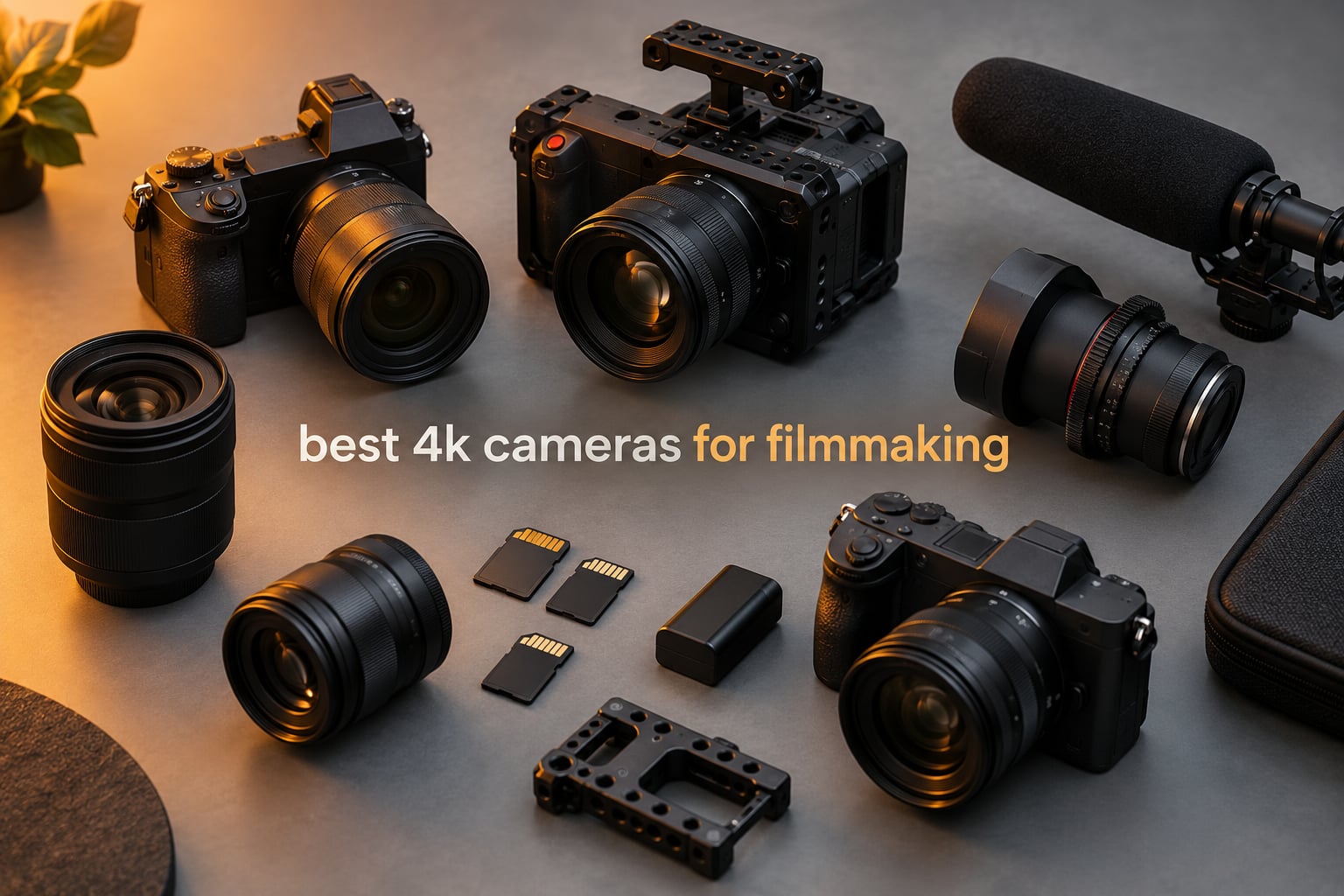
If you want one answer for the best 4K cameras for filmmaking in 2026, take the Blackmagic Design Pocket Cinema Camera 4K. It records 4096 x 2160 at 10-bit internally, writes ProRes and Blackmagic RAW, and includes a DaVinci Resolve Studio key, which makes it a complete filmmaking package rather than a bare body.
That matters because “for filmmaking” means something specific. You need manual control over exposure, focus, and white balance, a flat log profile so your grade has room to work, a codec that an editor can actually open, and a body that does not quit halfway through a take. A camera that shoots beautiful 4K but hunts for focus in dim rooms or cuts off after a fixed clip length is a stills camera with a video mode attached.
We spent weeks reading forum threads from r/videography, r/FX3 and r/photography alongside spec sheets, and the same complaints kept surfacing: bodies overheating during long takes, rolling shutter distortion nobody mentioned before buying, and lens costs that dwarf the body price. Those threads shaped every pick below. Before you commit, also check your card math against our guide to SD cards for 4K video, because the wrong card drops frames in exactly the codecs filmmakers care about.
Table of Contents
- Top 3 Best 4K Cameras for Filmmaking (October 2026)
- All 12 Cameras at a Glance
- 1. Blackmagic Design Pocket Cinema Camera 4K – Best Overall 4K Filmmaking Camera
- 2. Canon EOS R6 Mark II – Best Value Hybrid for 4K Filmmaking
- 3. SONY Cinema Line FX30 – Best Run-and-Gun Cinema Camera
- 4. Blackmagic Pocket Cinema Camera 6K EF – Best for Indie Narrative Work
- 5. Sony Alpha a7S III – Best 4K Camera for Low-Light Filmmaking
- 6. Nikon Z6 III – Best Hybrid Value with 6K RAW Video
- 7. Nikon Z8 – Best 4K Camera for 8K and Future-Proof Footage
- 8. Canon EOS R6 Mark III – Best for Stabilized Handheld Filmmaking
- 9. Sony Alpha a6400 Kit – Best Budget 4K Filmmaking Camera
- 10. Canon EOS R10 – Best 4K Camera for Content Creators
- 11. Nikon Z5 II – Best Full-Frame Filmmaking Camera for Starters
- 12. Panasonic LUMIX S5 – Best Run-and-Gun B-Camera with Stabilization
- How to Choose a 4K Filmmaking Camera in 2026
- Frequently Asked Questions
- The Bottom Line: Best 4K Cameras for Filmmaking in 2026
Top 3 Best 4K Cameras for Filmmaking (October 2026)

Blackmagic Pocket Cinema…
- 4K at 10-bit with 13 stops of dynamic range
- ProRes and Blackmagic RAW internal
- 13 stops dynamic range from a 4/3-inch sensor
- DaVinci Resolve Studio key included

Sony FX30 Cinema Line
- 6K oversampled 4K with S-Cinetone
- Dual base ISO with 14+ stops of range
- Active cooling for long continuous takes
- CFexpress Type A and SD dual slots

Canon EOS R6 Mark II
- 6K oversampled uncropped 4K at 60 fps
- 24.2MP full-frame sensor
- Subject detection for people and animals
- 5-axis in-body stabilization
All 12 Cameras at a Glance
Every camera below records 4K or higher. The differences that matter for filmmaking are the codec, the recording limits, and whether autofocus holds up when the subject moves.
| Product | Specs | Action |
|---|---|---|
| Blackmagic Design Pocket Cinema Camera 4K |
|
Check Latest Price |
| Canon EOS R6 Mark II |
|
Check Latest Price |
| SONY Cinema Line FX30 |
|
Check Latest Price |
 Blackmagic Pocket Cinema Camera 6K Blackmagic Pocket Cinema Camera 6K |
|
Check Latest Price |
 Sony Alpha a7S III Sony Alpha a7S III |
|
Check Latest Price |
 Nikon Z6 III Nikon Z6 III |
|
Check Latest Price |
 Nikon Z8 Nikon Z8 |
|
Check Latest Price |
 Canon EOS R6 Mark III Canon EOS R6 Mark III |
|
Check Latest Price |
 Sony Alpha a6400 with 16-50mm Lens Sony Alpha a6400 with 16-50mm Lens |
|
Check Latest Price |
 Canon EOS R10 Canon EOS R10 |
|
Check Latest Price |
 Nikon Z5 II Nikon Z5 II |
|
Check Latest Price |
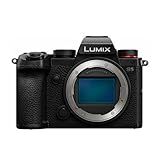 Panasonic LUMIX S5 Panasonic LUMIX S5 |
|
Check Latest Price |
1. Blackmagic Design Pocket Cinema Camera 4K – Best Overall 4K Filmmaking Camera
Blackmagic Design Pocket Cinema Camera 4K (CINECAMPOCHDMFT4K)
4/3-inch sensor
4096 x 2160 at 10-bit
13 stops dynamic range
ProRes and BRAW
Pros
- Exceptional 4K image quality with 13 stops of dynamic range
- ProRes and 12-bit Blackmagic RAW internal recording
- DaVinci Resolve Studio activation key included
- Bright 5-inch display in a compact carbon fiber body
- Records to SD or an external SSD over USB-C
Cons
- No continuous autofocus and no in-body stabilization
- Internal battery runs roughly 30 minutes per charge
- Fixed screen is hard to read in bright sun
This is the camera we keep coming back to. The 4/3-inch sensor produces a native 4096 x 2160 image, which is wider than DCI 4K rather than a cropped 16:9 slice, so a 24mm lens actually frames what you expect it to frame. With 13 stops of dynamic range and dual gain ISO up to 25600, the latitude between a blown window and a black jacket is wide enough to survive a real grade.
Where it wins decisively is the file format menu. It writes Apple ProRes in every format up to 4K, plus 12-bit Blackmagic RAW and CinemaDNG, to SD, CFast 2.0, or a drive over USB-C. Nothing else in this list gives a beginner that much flexibility, and the bundled Resolve Studio activation key means the whole post pipeline is covered on day one.
The honest headline is that this is a manual-focus camera with no in-body stabilization. Owners describe it as exceptional on a tripod, in a rig, or on a slider, and close to unusable for handheld run-and-gun work. Touch-to-focus exists, but reviewers report it is a single fixed focus point rather than a continuous tracking system, so a subject walking toward you will drift out of focus.
Battery life is the other repeated complaint, with roughly 30 minutes per charge from the internal cell. A practical setup is an external battery or a dummy load, and a small set of NP-F batteries. Our shotgun microphone picks pair well with the mini XLR input on this body for scratch audio on narrative work.
Check the record limit before you commit
This body is a fanless design, and reviewers generally report no heat problems in ordinary use. The constraints people hit are file size and card speed rather than thermal shutdown, especially with Blackmagic RAW running to an external SSD. Make sure your drive is rated for sustained throughput and that you carry a spare, because a full card mid-take is the failure mode you will actually encounter.
Also factor in the Micro Four Thirds lens situation. Used EF or adapted glass is available and reviewers price it as a genuine advantage, but MFT is not where the newest and sharpest options appear first. Budget for a fast prime rather than assuming the kit lens will carry a low-light scene.
Best fit for tripod and rig shooters
Choose this one if you shoot locked-off interviews, staged narrative, studio work, or anything where the camera sits still. The image quality and the Resolve integration make it very hard to argue with for those situations, and 757 reviews at a 4.7 average reflect how settled the user experience is.
Skip it if you need autofocus that tracks a moving subject for hours, or if you want a flip-out screen for low-angle and selfie work. The fixed display is a deliberate cost cut, and it matters more in the field than it does in a spec sheet.
2. Canon EOS R6 Mark II – Best Value Hybrid for 4K Filmmaking
Canon EOS R6 Mark II Mirrorless Camera (Body Only)
24.2MP full-frame
6K oversampled uncropped 4K at 60 fps
Dual Pixel CMOS AF II
5-axis IBIS
Pros
- Dependable subject detection for people animals and vehicles
- Uncropped 4K up to 60 fps from a 6K oversample
- Up to 6 hours of continuous Full-HD recording
- 0.5-inch 120 fps electronic viewfinder
- 5-axis sensor-shift stabilization
Cons
- Body-only package so a lens is a separate purchase
- DIGIC X menus are deep and take time to learn
- High-resolution modes are demanding on storage
If you shoot documentary, events, or anything where a person has to stay in focus while walking toward you, this is the body to beat at the money. The 6K oversampled uncropped 4K means you get full sensor width at up to 60 fps, so you can frame 16:9, 4:3, or 1:1 on the same take and crop into it in post without losing resolution.
Autofocus is the headline. Dual Pixel CMOS AF II with head, face, eye, and body detection is described by reviewers as class-leading, and Canon’s subject acquisition holds up on animals and moving subjects in a way most bodies at this level do not match. The 0.5-inch 3.69M dot viewfinder refreshing at 120 fps makes tracking feel smooth rather than jumpy.
The 24.2MP full-frame sensor does the heavy lifting for low light, and 5-axis stabilization at up to 8 stops of claimed performance makes handheld work far more viable than on most hybrid bodies. Recording capacity is generous too, with up to 6 hours listed for continuous Full-HD capture, and the listed 4K modes are uncropped.
Two practical warnings. This is a body-only package, so budget for an RF lens separately, and the DIGIC X menu system carries Canon’s long-standing complexity that reviewers consistently mention. If you are coming from a phone, budget an afternoon in the menus before your first shoot.
Storage and card planning for uncropped 4K
Uncropped 4K at higher bitrates fills cards quickly, and reviewers flag the storage demands directly. Use the highest-rated UHS-II or CFexpress card you can justify, and check our 4K card speed guide for the minimum class your chosen codec needs. A marginal card is the most common cause of dropped frames people report on this class of camera.
Record limits are not the concern they are on fanless high-resolution bodies. The listed capability of up to 6 hours of continuous Full-HD recording means a full ceremony or a long interview session is realistic, provided your media holds up.
Best fit for run-and-gun and hybrid shooters
This suits a shooter who is often the only camera operator, working interviews, small events, and documentary coverage where focus reliability decides whether a take is usable. The stills capability also means it can cover a photo job on the same shoot without a second body.
It is a weaker choice for a pure cinema workflow. There is no built-in ND filter, no XLR input, and no timecode on the body, so production audio and multi-camera sync mean adding accessories. The absence of those is a fair trade for autofocus you can trust in bad light.
3. SONY Cinema Line FX30 – Best Run-and-Gun Cinema Camera
SONY Cinema Line FX30 Super 35 Camera, Gray
20.1MP Super 35 sensor
14+ stops of dynamic range
Dual base ISO
S-Cinetone look
Pros
- 6K oversampled 4K with S-Cinetone color out of camera
- Dual base ISO for clean low-light footage
- Active cooling supports long continuous recording
- 495 phase-detection points with reliable Eye AF
- Compact body with full-size HDMI and dual card slots
Cons
- APS-C crop limits reach and depth of field versus full frame
- Modest battery life on long shoot days
- Body-only and needs an XLR handle for audio
The FX30 is the camera line between a mirrorless hybrid and a real cinema body, and it lands closer to the cinema side. It has S-Cinetone as a proper picture profile, Cine EI Log modes alongside standard S-Log3, user LUTs that can be applied to the LCD, the HDMI output, and embedded in the clip itself, and a full-size HDMI port that most hybrid bodies omit.
Dual base ISO with 14+ stops of dynamic range is the technical reason low-light footage stays clean. Instead of one native ISO pushing into noise, the camera switches base points so you ride a lower effective sensitivity. Combined with active cooling, reviewers report long continuous recording without the shutdowns that plague fanless bodies.
Autofocus is the part that closes the gap with hybrid cameras. The hybrid system uses 495 phase-detection points, and reviewers call Eye AF dependable for solo run-and-gun work where you cannot afford to miss focus. Media goes to CFexpress Type A or SDXC across dual slots, so you can relay mid-shoot or split records for backup.
The acknowledged trade-off is the Super 35 crop sensor. You give up roughly a stop and a half of light and you reach wider than a full frame, which matters on interiors and night exteriors. In return, the 6K oversampled 4K carries more detail than your final 4K deliverable needs.
What the crop actually costs you
A 1.5x crop affects three things. Your field of view narrows, so an 18mm becomes roughly equivalent to a 27mm and wide interiors get tighter. Your depth of field deepens, which is helpful for documentary and harmful if you want a heavily separated background. And your high-ISO performance sits a step behind a full-frame sensor of the same generation.
For narrative work with controlled lighting, most shooters find this an acceptable trade for the color science, the cooling, and the XLR handle ecosystem. For night-heavy documentary, read the low-light entries further down before you settle.
Best fit for narrative and commercial work
Pick the FX30 when you want a camera that looks like a cinema camera in the hand and edits like one in Resolve, but you still need autofocus to hold. S-Cinetone in particular means footage arrives with a filmic response that requires a lighter grade than a flat V-Log file.
Budget for the XLR handle if you need professional audio, and carry more batteries than you think you need, since endurance is the most common practical complaint among owners. Everything else about this body is described in terms people rarely use for a mirrorless camera.
4. Blackmagic Pocket Cinema Camera 6K EF – Best for Indie Narrative Work
Blackmagic Design Pocket Cinema Camera 6K with EF Lens Mount
Super 35 sensor
6K at up to 50 fps
Canon EF mount
Blackmagic RAW
Pros
- Superb 6K RAW image quality with excellent dynamic range
- Many resolution and frame-rate options for reframing
- EF mount accepts a broad affordable lens ecosystem
- External SSD recording keeps media costs low
- DaVinci Resolve Studio included
Cons
- Autofocus is effectively unusable and focus is manual
- Very large RAW files strain storage and editing hardware
- Weak battery life of roughly 20 minutes per battery
This is the model most short films and student narratives are actually shot on, and long-term users report results comparable to far more expensive cinema bodies once the RAW workflow is mastered. The Super 35 sensor gives you 6144 x 3456 at up to 50 fps, plus 2.4:1 and 17:9 options, and that headroom is what lets you reframe a single setup three different ways.
The Canon EF mount is the quiet advantage. Reviewers repeatedly note that the EF ecosystem is broad and often affordable, so you can build a lens kit on a modest budget with fast primes and zooms that are well tested. Compare that to paying a premium for native-mount glass in any of the other systems here.
Recording goes to SD rated V60 or higher, or to an external SSD, with HDMI Type A output. DaVinci Resolve Studio is part of the package, which matters more than it sounds because the RAW decode is the part of the pipeline that needs a capable workstation and monitor.
Every reviewer flags the same trade-offs. Focus is manual only, the battery is around 20 minutes, and the fixed LCD is dimmer outdoors than on the 6K Pro. Some owners also reported early dead pixels that Resolve Studio’s pixel remapping tool resolved.
Plan your storage and workstation first
RAW file sizes here are large enough that your edit machine becomes part of the purchase decision. A capable CPU, a fast scratch drive, and a color-managed display matter more than the camera. Shoot to an external SSD, back it up, and do not try to run this workflow on a laptop you bought for writing documents.
Card speed matters too. SD rated V60 or higher is the stated minimum, and going faster gives you headroom for long takes. This is the camera where storage math bites hardest, so do the arithmetic on your project length before you buy media.
Best fit for operators with focus discipline
Choose this if you are comfortable pulling focus, working with a follow-focus unit, or locking the camera off. A 5-inch tilting touchscreen with zoom assist helps with manual focus, and the wide resolution options mean one setup can cover multiple framings.
It is the wrong tool for a solo shooter who needs the camera to track a subject while moving, and the wrong tool for a long handheld day on one battery. A rig, a handle, or a gimbal solves most of those issues, and that accessory cost belongs in your real budget.
5. Sony Alpha a7S III – Best 4K Camera for Low-Light Filmmaking
Sony Alpha a7S III Full-Frame Mirrorless Camera Body Black
12.1MP full-frame sensor
4K 120p in 10-bit 4:2:2
ISO up to 409600
S-Cinetone
Pros
- Excellent low-light performance with ISO up to 409600
- Full-pixel-readout 4K up to 120 fps in 10-bit 4:2:2
- S-Cinetone picture profile straight out of camera
- 759-point fast hybrid autofocus
- Compact 612 g body with 5-axis stabilization
Cons
- Overheats during extended high-bitrate 4K 120p recording
- 12.1MP sensor limits heavy cropping for stills
- Small 3-inch screen and dense control layout
The a7S III remains the reference tool for shooting 4K in the dark. The 12.1MP Exmor R sensor uses large pixels rather than many of them, and the BIONZ XR processor handles the readout, which is how the body offers ISO 40 to 409600 expanded and 15+ stops of dynamic range at the same time.
Full pixel readout in every recording mode is the detail most people underestimate. It means 4K up to 120 fps in 10-bit 4:2:2 without a crop, so your framing stays put when you move from 24 fps to 60 fps. For a filmmaker that consistency is worth more than a higher resolution number that crops.
S-Cinetone gives a filmic response with a gentle curve and restrained contrast straight out of the camera, so a night exterior does not need a heavy grade just to look reasonable. XAVC S, XAVC HS, and XAVC S-I All-I options cover everything from a compact delivery file to a high-bitrate master, and dual CFexpress Type A and SD slots give you relay or backup.
The 759-point fast hybrid AF with dependable tracking, plus 5-axis SteadyShot INSIDE, makes this a genuinely usable handheld low-light camera. At 612 g it disappears in a run-and-gun kit better than most full-frame bodies.
Where the heat limits apply
Owners report overheating during extended high-bitrate 4K and 120p recording, so treat 120 fps as a special-effects mode rather than a default. Forum discussion across several communities is blunt that overheat behaviour varies between units and lots, which is exactly why you should test the body you actually own before a paid shoot.
At lower frame rates the picture quality holds up well, and the stabilization helps you keep the camera running longer without the heat of constant motion. Practically, carry spare batteries, because the compact body prioritizes sensor over thermal mass.
Best fit for night and documentary work
Pick this for available-light documentary, event coverage after dark, concert work, or any shoot where adding lights is not realistic. The high ISO ceiling combined with dual native handling is the reason professionals reach for this sensor size first.
The 12.1MP stills resolution is a real limitation if you also need heavy cropping frames for print, and the small 3-inch screen is fiddly for a large rig. The dense control layout takes a day to learn and then becomes fast.
6. Nikon Z6 III – Best Hybrid Value with 6K RAW Video
Nikon Z6 III, Black | Full-Frame Mirrorless Stills/Video Camera with 6K/60p Internal RAW Recording | USA Model
24.5MP stacked full-frame
6K 60p internal N-RAW
4000-nit viewfinder
299 AF points
Pros
- 6K 60p internal N-RAW plus oversampled 4K with little rolling shutter
- Exceptionally bright 4000-nit viewfinder in harsh light
- Deep-learning subject recognition with -10 EV detection
- Custom Picture Controls built in NX Studio
- Compact body below the flagship Z models
Cons
- Deep layered menu system with many AF modes
- Awkward dial and button placement for some users
- Battery drains quickly and some packages omit a charger
The Z6 III is the value argument in Nikon’s lineup: a 24.5MP partially stacked full-frame sensor, 6K 60p internal N-RAW, oversampled 4K UHD, 4K at 120 fps, and Full HD at 240 fps, in a body that sits below the flagship Z models. The partially stacked design is what pulls rolling shutter distortion down to almost nothing for pans and whip shots.
The 4000-nit maximum brightness viewfinder at 5760k dots with a 120 fps refresh is a genuine field advantage, not a spec sheet line. It is the difference between being able to see your framing in harsh daylight and squinting at a washed-out screen, and filmmakers who work outside report it as a change in working rhythm.
Autofocus uses 299 points with detection down to -10 EV and deep-learning subject recognition, described as roughly 20 percent faster than the Z6 II. ISO runs 100 to 64000 native and extends to 204800, and the on-body Custom Picture Controls plus waveform and line-in audio toolkit make it a working camera rather than a hybrid afterthought.
Where it costs you is learning time. Reviewers point to a deep, layered menu system with numerous autofocus modes that can take weeks to master, and some find the dial and button placement awkward. None of that affects image quality, but it affects the first month.
Internal RAW versus codec recording
Internal N-RAW is the headline feature and also the one that shapes your whole workflow. It is a compressed RAW format recorded in-camera, so you grade from a wide latitude without an external recorder, and 6K 60p gives you crop room that a 4K-only body cannot match. The trade is file handling, since RAW is heavier to store and to process than H.265.
If you prefer a finished codec, oversampled 4K UHD and 4K 120p are there. Choose RAW when you have a colourist and a workstation, and choose the codec when you need a fast turn workflow or a large multi-camera setup.
Best fit for hybrid shooters who also take stills
Pick the Z6 III when your production runs both photo and video on the same card set, or when you need a bright viewfinder and fast readout for narrative work on a moderate budget. The 24.5MP sensor crops more flexibly than the 12.1MP body above it.
Reviewers note it is not weather-sealed to the same standard as higher-tier Nikon bodies, so for rain, dust, or beach work either add a cover or step up. Battery drain is the other repeated complaint, so plan on multiple batteries per shooting day.
7. Nikon Z8 – Best 4K Camera for 8K and Future-Proof Footage
Nikon Z 8 | Professional Full-Frame mirrorless Stills/Video Hybrid Camera
45.7MP stacked full-frame
Internal 8K 60p and 4K 120p
12-bit N-RAW and ProRes RAW
493 AF points
Pros
- Z9-class autofocus reliability in a smaller body
- Internal 8K 60p and 4K 120p with N-RAW and ProRes RAW
- 45.7MP stacked sensor gives heavy cropping room
- Shutterless design with virtual shutter sound
- 20 fps RAW burst with no buffer stalls
Cons
- Smaller body runs hot and limits long 8K takes
- Only one CFexpress Type B slot with a UHS-II second
- Deep menu system with a thin printed manual
The Z8 takes everything the Z9 could do and puts it in a body most people can carry all day. A 45.7MP stacked BSI full-frame sensor with EXPEED 7 means no mechanical shutter at all, 493 phase-detection points with deep-learning subject detection down to -9 EV, and 3D tracking that owners coming from older Nikon bodies describe as a step change.
For video, internal 8K at 60 fps and 4K at 120 fps recorded as 12-bit N-RAW or ProRes RAW is the reason this body is on a filmmaking list at all. That is real internal RAW with no HDMI recorder in the chain, and it means a single body can be your A-camera, a high-resolution detail pass, and a slow-motion unit.
The stacked sensor also gives 20, 30, 60, and 120 fps shooting options with a burst that reviewers report does not stall, and the weather-sealed construction holds up in the field. Skin Softening and Portrait Impression Balance are stills-side additions that matter if you shoot narrative with a photo unit.
Two limits are worth planning around. The smaller chassis dissipates heat less well than the Z9, which shortens long 8K takes, and there is only one CFexpress Type B slot, with the second being standard UHS-II SD. A continuous high-power draw also means multiple batteries for a full day.
When 8K is worth the storage and heat
Eight internal K earns its keep in two situations: cropping a punch-in from a wide in post without softening, and delivering to clients who will finish on 4K or higher displays. In a normal narrative cut where shots are framed tightly, 8K adds heat, file weight, and card cost without changing the finished film.
Because the sensor is stacked, rolling shutter is low, which also makes this a good fit for fast handheld movement where a rolling-shutter body would bend straight lines. Pair it with a fast, high-capacity card and monitor the record time indicator on long takes.
Best fit for producers who also shoot stills
Choose the Z8 if you are a one-person operation that does narrative, commercial, and photo work, and you want the highest internal video spec available without an external recorder. The autofocus reliability and weather sealing suit location work.
It is overkill for a creator whose main output is talking-head content at 1080p, and the menu depth will slow you down for the first month. Reviewers also note that focusing point lock requires menu navigation rather than a dedicated lever, a small ergonomic regression from the Z9.
8. Canon EOS R6 Mark III – Best for Stabilized Handheld Filmmaking
Canon EOS R6 Mark III Body, Full-Frame Mirrorless Camera
32.5MP full-frame
Up to 8.5 stops of stabilization
40 fps with pre-continuous
CFexpress Type B
Pros
- High-resolution 32.5MP full-frame sensor with DIGIC X
- Up to 8.5 stops of coordinated control stabilization
- 40 fps with a 20-frame pre-continuous buffer
- Dual Pixel CMOS AF II with people animal and vehicle detection
- CFexpress Type B plus UHS-II SD dual slots
Cons
- Body-only package so a lens is a separate purchase
- Listed 4K capture limits and codecs are less clearly documented
- Smaller third-party lens ecosystem than the R6 II
The headline number here is 8.5 stops of coordinated control image stabilization at the centre, 7.5 at the periphery. For handheld documentary, run-and-gun, and any walk-and-talk work, that figure is the difference between footage you can use and footage that needs a gimbal. At 1.5 lb the body is also easy to hold for a full day.
Canon keeps the Dual Pixel CMOS AF II system with people, animal, and vehicle detection, plus Register People Priority for consistent focus on one face in a crowd. The 0.95x electronic viewfinder and 1/16000 s shutter pair sensibly with a 32.5MP sensor that resolves plenty of detail for photo inserts on a film set.
Media goes to CFexpress Type B and UHS-II SD across dual slots, which is a good configuration for a hybrid shooter who wants high frame rates on the fast card and long clips on the larger one. Forty fps with a 20-frame pre-continuous buffer is a stills feature that also means you catch the frame before the subject moves.
Be aware that this body has fewer reviews than its siblings, and reviewers note the listed video specifications lean on stills-centric features, so 4K capture limits and codecs are less clearly documented than on the R6 II. If video is your primary output, verify the modes in the menu before committing.
What 8.5 stops of stabilization does and does not fix
Sensor-shift stabilization reduces camera shake, not subject motion. If you are walking backwards through a forest on a gimbal-stabilized path, the system helps a great deal. If you are panning quickly across a moving subject, the frame still bends with your arms and the subject still blurs at a slow shutter speed.
It also does not replace stabilization inside a lens for subjects near the edge of the frame, which is why the 7.5 stop periphery figure matters. Practically, this is the body to shortlist if you want to handhold documentary without buying a gimbal first.
Best fit for hybrid and event work
Choose the R6 Mark III for a wedding, event, or corporate shoot where the camera operator is also moving, and where you want the same body to cover stills delivery. Dual slots and the fast sensor give you reliability on long paid days.
The body-only package needs a lens added separately, and reviewers point to a smaller accessory and third-party lens ecosystem than the R6 II. If you already own RF glass, that is a smaller concern, but it is worth checking your existing lenses cover what you need.
9. Sony Alpha a6400 Kit – Best Budget 4K Filmmaking Camera
Sony Alpha a6400 Mirrorless Camera: Compact APS-C Interchangeable Lens Digital Camera with Real-Time Eye Auto Focus, 4K Video, Flip Screen & 16-50mm Lens – E Mount Compatible – ILCE-6400L/B, Black
20.1MP APS-C sensor
4K video
Real-time Eye Autofocus
16-50mm kit lens
Pros
- Eye Autofocus stays accurate on moving subjects and children
- Image and video quality still strong years after release
- Compact and light at 10.3 ounces
- 180-degree tilting screen for vlogging and low angles
- Affordable third-party E-mount lenses widely available
Cons
- No in-body image stabilization
- Limited native Sony APS-C lens selection especially telephoto
- Messy menus and a fiddly companion app
With 1054 reviews at a 4.6 average, the a6400 is the most thoroughly owner-tested camera on this list, and that consistency is itself a reason to consider it. Owners describe a body that has aged well, with Real-time Eye AF that stays locked on moving subjects including kids and pets, which is still the feature people cite first.
The 20.1MP stacked back-illuminated 1-inch Exmor RS sensor brings 425 phase-detection points covering 84 percent of the frame, and 4K video capture at 24 or 30 fps. The 16-50mm kit lens covers roughly 24-75mm equivalent, so you can start shooting without buying anything else.
For filmmakers, the flip-out 180-degree touchscreen is more than a vlogging feature. It lets you frame low angles, mount the camera high or low on a rig, and shoot yourself without a second operator. Time-lapse and slow motion movie modes work without post processing.
There are real limitations. There is no in-body image stabilization, so handheld 4K needs a gimbal or a support of some kind, and the native Sony APS-C lens lineup is thin, especially for telephoto. The kit lens is weak indoors, and most owners add a fast third-party prime such as a Sigma 18-50mm f/2.8 for low light.
Is an older body still worth it in 2026
The reason this camera keeps selling is the gap between its capability and its cost. A stacked sensor, dependable eye AF, 4K capture, and a tilting screen cover most short-form and documentary work. The compromises are the missing stabilization, the single UHS-I card slot, and an older menu system.
Two practical notes from owners: the movie record button sits close to the front edge and is awkward to find by feel, and Sony’s companion app and Wi-Fi transfer are not user-friendly. Budget a fast prime and a small audio setup, and pair it with our shotgun microphone guide since the on-board mic is not a production solution.
Best fit for students and first productions
Choose the a6400 if you are learning, shooting a student film, or building a portfolio and need a body plus a usable lens in hand. The tilting screen and eye AF remove two of the biggest beginner friction points.
Skip it for a paid narrative shoot that needs 10-bit 4:2:2 log recording, external SSD recording, or a long record time. Those are the limits that stop this body from competing with the cinema cameras higher on this list.
10. Canon EOS R10 – Best 4K Camera for Content Creators
Canon EOS R10 Mirrorless Camera (Body Only)
24.2MP APS-C sensor
4K with no 30-minute cap
15 fps continuous
Movie Servo AF
Pros
- 24.2MP APS-C sensor resolves fast action and low light well
- DIGIC X processor handles sustained 4K with reduced noise
- Compact 382 g body that sits comfortably in the hand
- 4K UHD with no 30-minute recording limit
- Movie Servo AF with subject detection and tracking
Cons
- Body-only package requires a separate lens
- No sensor-shift stabilization in the body
- Single UHS-II card slot with no simultaneous backup
The R10 is the most complete creator package in Canon’s APS-C line. The 24.2MP sensor is the same resolution as the full-frame R6 II, so you get 4K UHD capture with no 30-minute recording limit, which removes the hard clip that has caught creators out on so many other bodies mid-interview.
Movie Servo AF adds subject detection and tracking on top of Dual Pixel CMOS AF, and reviewers highlight the removal of the 30-minute cap as the main filmmaking advantage over cheaper alternatives. At 382 g it is a body you can hold for a long vlogging or b-roll day without wrist fatigue.
It ships with the EOS R10 body, strap, LC-E17 charger, LP-E17 battery, battery pack cover, and shoe cover. You can use RF-S and RF lenses, or EF and EF-S glass through the Mount Adapter EF-EOS R, which is how many filmmakers pair it with an existing kit.
Two things to know before you commit. There is no sensor-shift stabilization, so the listed stabilization is digital, and a single UHS-II slot means no simultaneous backup recording. For a creator who is the only person operating, the missing gimbal-style stabilization is the more annoying of the two.
Why the missing recording cap matters more than it sounds
Many bodies stop at 30 minutes as a heat or power management measure. That is fine for a talking-head clip, and fatal for a ceremony, a long interview, or a lecture. The R10’s uncapped 4K means you can set one card rolling and forget about it, which changes how you plan a shoot day.
You still need media headroom. A single UHS-II slot at high bitrates means long takes will fill a card, so bring more cards than you estimate rather than fewer. Our camera monitor picks help if you need a bigger screen for focus on a compact body.
Best fit for solo creators and hybrid work
Choose the R10 for a creator who shoots video and stills on the same card set, wants a body small enough to carry daily, and needs reliable subject tracking for vlogging and b-roll. The RF-S 18-45mm is the lens most owners pair with it.
It is not the body for a narrative short that needs 10-bit log and manual control, and the digital-only stabilization means serious handheld work needs a gimbal. As a first serious filmmaking camera with strong stills capability, though, it is hard to argue against the package.
11. Nikon Z5 II – Best Full-Frame Filmmaking Camera for Starters
Nikon Z5 II | Full-Frame mirrorless Stills/Video Camera | USA Model, Black
24.5MP BSI full-frame
4K 60p and 12-bit N-RAW
7.5 stops of stabilization
3000-nit viewfinder
Pros
- Full-frame quality with -10 EV AF detection
- Up to 7.5 stops of built-in image stabilization
- 4K 60p and 12-bit N-RAW recorded in-camera
- Subject detection across nine subject classes
- Nikon Imaging Cloud handles transfers and updates
Cons
- Single SD card slot for both stills and video
- Body-only so a lens must be added separately
- 30 fps burst is RAW-limited against dedicated sports bodies
With a 4.9 average, the Z5 II sits at the top of the rating spread in this roundup, though it also carries the smallest review pool at 95, so treat the number as promising rather than settled. What owners praise is the combination: a 24.5MP BSI-CMOS full-frame sensor with EXPEED 7, 4K at 60 fps, and 12-bit N-RAW recorded in the camera.
Internal N-RAW matters more here than on a pricier body, because it gets you a wide-latitude RAW file without an external recorder. Add 9-class subject detection covering people, birds, dogs, cats, cars, bicycles, motorcycles, trains, and airplanes, with AF detection down to -10 EV for near-total darkness.
Stabilization is rated up to 7.5 stops of built-in 5-axis, which is close to the R6 Mark III figure and covers handheld documentary work without a gimbal. The electronic viewfinder peaks at 3000 nits, and the LCD is a 3.2-inch 2100k-dot panel.
The constraint is media. A single SD UHS-II slot handles both stills and video, so there is no relay or backup, and you need a fast card for 4K 60p and N-RAW. Nikon Imaging Cloud handles automatic transfer and firmware updates over SnapBridge, which reduces friction when you are moving between shoots.
What full-frame changes for your footage
A full-frame sensor gives you about a stop more light than APS-C, a wider field of view at the same focal length, and a shallower depth of field that separates a subject from its background more easily. In practice that means usable footage at lower ISO in a dim room, and a background that falls out of focus without an expensive lens.
The cost is lens selection. Nikon Z full-frame glass is priced above most, and the body-only package here needs a lens. If you are moving from APS-C with a crop factor habit, re-learn your framings: a 35mm now behaves like a 35mm, not a 52mm.
Best fit for first-time full-frame filmmakers
Choose the Z5 II if you are stepping up to full frame and want in-camera RAW, long stabilization, and modern subject detection without moving to flagship pricing. The 24.5MP sensor crops more flexibly than a 12MP body for reframing stills.
It is a weak choice for a multi-camera shoot that needs dual slots, and the 30 fps burst is RAW-limited compared with dedicated sports bodies. The 3.2-inch 2100k-dot screen is also modest next to the bright viewfinders higher on this list.
12. Panasonic LUMIX S5 – Best Run-and-Gun B-Camera with Stabilization
Panasonic LUMIX S5 Full Frame Mirrorless Camera, 4K 60P Video Recording with Flip Screen & WiFi, L-Mount, 5-Axis Dual I.S., DC-S5BODY (Black)
24.2MP full-frame
4K 60p 10-bit
V-Log with 14+ stops
6.5 stops of stabilization
Pros
- 10-bit 4K 60p with no overheating issues in normal use
- 5-axis Dual I.S. 2 stabilization rated to 6.5 stops
- V-Log and V-Gamut with 14+ stops of dynamic range
- Extensive physical controls and customizable profiles
- Affordable L-mount third-party lens options
Cons
- Autofocus hunts in low light with no phase detection
- Contrast-detect AF lags modern phase-detect systems
- 10-bit recording limited to a 30-minute clip ceiling
The S5 is the value B-camera filmmakers buy alongside a Blackmagic body or a higher-end hybrid, and the reason is the file it writes. V-Log with V-Gamut and 14+ stops of dynamic range lands in DaVinci Resolve alongside Blackmagic footage, and several owners grade mixed-brand projects this way without a conversion step.
You get 4K 60p in 10-bit, Full HD at 180 fps for slow motion, dual native ISO that keeps noise low at high sensitivities, and 5-axis Dual I.S. 2 stabilization rated to 6.5 stops. That combination covers a run-and-gun day with a gimbal, a shoulder rig, or a static tripod without a second thought.
Physical controls are unusually good for a hybrid body, with customizable picture profiles and a flip-out screen. There is a 96MP High Resolution mode for stills, 4:3 anamorphic support for the widescreen crop, and a Live View Composite mode for fireworks and starry skies.
Autofocus is the reason it is not higher on this list. Reviewers are consistent: contrast-detect AF hunts in low light and with rapid subject changes, and lags behind Sony, Fujifilm, and newer Canon bodies for tracking. Most owners shoot video manually, which is fine on a tripod but not on a moving subject.
The clip ceiling and the heat question
The 10-bit recording is limited to a 30-minute clip ceiling, and reviewers also note a shallow buffer without a V90 card. For a B-camera on a documentary shoot, both are manageable with planning: shoot shorter takes, offload between setups, and use a V90 card.
Heat is the less common complaint here. Owners report 10-bit 4K at 60 fps without overheating problems in normal conditions, and forum consensus treats Panasonic as a brand that does not surprise you in the heat department the way fanless high-resolution bodies do.
Best fit for second-unit and B-camera work
Pick the S5 for run-and-gun, second-unit, and B-camera duty where the footage has to match a cinema body in the grade and the operator is pulling focus manually. The L-mount third-party lens options keep the glass budget low.
It is the wrong choice if you are shooting a documentary alone with a subject who moves unpredictably in bad light, and the 1.6 lb body is heavy for travel where a smaller body would win. The grip can also fatigue on very long shooting days, according to owners.
How to Choose a 4K Filmmaking Camera in 2026
Resolution is the least important decision you are about to make. Every camera on this list records 4K, and several record 5K or 6K and downsample. The decisions that change your footage are codec, colour profile, recording limits, and whether autofocus can do the job on set.
4K vs 5.3K vs 6K: what the extra resolution actually buys you
Extra resolution buys you reframing, not a better-looking finished film. A 6K sensor recorded as 4K gives you pixels to crop into, so a wide shot becomes a punch-in without resampling, and a 5.3K body shot on a Super 35 sensor gives real latitude to move a frame without a crop factor surprise.
It also buys you bit depth indirectly. Higher resolution RAW formats like Blackmagic RAW and N-RAW capture more colour information per frame, which is why a 6K manual-focus body can produce a better grade than an 8-bit 4K mirrorless. What it does not buy you is a cinematic look on its own. Most forum discussion returns to the same point: people chase 8K when their real bottleneck is codec and bit depth.
10-bit 4:2:2 versus 8-bit, and why log profiles matter
8-bit 4:2:0 video records colour and brightness in the same 8-bit container, and banding shows up in skies and gradients as soon as you push the grade. 10-bit 4:2:2 keeps colour in a separate channel, roughly doubling the data, and it holds a heavy grade without stepping.
Log profiles are how that headroom gets used. Sony offers S-Log3 and the gentler S-Cinetone, Panasonic offers V-Log and V-Gamut, Blackmagic writes its own Film curves, and Nikon records N-RAW. Forum posters consistently say S-Cinetone and D-Log M grade flatter out of the box, while flatter V-Log and S-Log3 need more work but recover more.
Recording limits, heat, and card speed
This is where we would focus your research, because no competitor page we reviewed covers it and it is the number one complaint across video forums. Fanless bodies on high-resolution modes can hit thermal limits mid-take, and behaviour varies between units and production lots. On this list, the Sony FX30 uses active cooling, and the Panasonic S5 owners report no overheating at 4K 60p.
Reviewers flag the Sony a7S III overheating during extended high-bitrate 4K and 120p recording, the Canon R6 II and R10 running to long or uncapped limits, and the Nikon Z8 running shorter 8K takes in its smaller chassis. The Blackmagic bodies trade heat for file size, which is a different failure mode. Test the body you own before a paid shoot, and carry spare batteries regardless.
Card speed is the boring detail that breaks shoots. A codec that writes faster than your card sustains will drop frames or corrupt files, which people report most often on high-bitrate RAW. Match the card class to the codec, and check our SD card speed guide before your next unit purchase.
Sensor size, autofocus, and stabilization
Sensor size is a light and framing decision. Full frame gives roughly a stop more light, a wider view at the same focal length, and shallower depth of field. APS-C and Super 35 are lighter, cheaper, and give you more reach. Micro Four Thirds is the most portable and the deepest in crop.
Autofocus is the biggest practical split on this list. Sony, Canon, and Nikon use phase detection with subject recognition that holds up on moving subjects. The Blackmagic Pocket bodies are manual focus only. The Panasonic S5 has contrast-detect AF that reviewers say hunts in low light, so most owners shoot it manually. If your shoot is documentary or events, weigh this before resolution.
Stabilization lets you handhold a shot without a gimbal, and it does not stop subject motion or a fast pan. Bodies here range from none on the Blackmagics to 8.5 stops on the Canon R6 Mark III and 7.5 on the Nikon Z5 II. In-body stabilization also multiplies with stabilized lenses on some systems, which matters if you shoot wide and handheld.
ND filters, XLR audio, and the rest of the cinema kit
None of the twelve cameras in this roundup has a built-in ND filter. That is deliberate: most of these are hybrid or stills-first bodies, and an internal ND costs thickness and removes a filter mount option. Filmmakers add a variable ND in front of the lens, which is a cheaper and more flexible solution for a single body.
Audio is where dedicated cinema bodies pull ahead. The Blackmagic Pocket 4K has a built-in mini XLR input, and the Sony FX30 can take the XLR handle. Hybrid bodies usually need an external recorder or mixer. For production sound, our shotgun microphone roundup covers the options, and timecode matters as soon as you run more than one camera.
Total kit cost, not body cost
Forum advice on this point is unanimous and worth repeating: one lens can cost as much as the body. Every camera here except the a6400 is body-only, so a fast prime, a card, and audio are all separate. Budget the body, one usable lens, at least two cards of the right class, and a microphone before you compare bodies at all.
On-body monitoring is the other line item people forget. A compact body with a 3-inch screen is workable for a controlled shoot and frustrating for a focus puller, so a decent monitor changes the day more than an extra stop of ISO does. Our camera monitor picks cover the field and on-board options.
Frequently Asked Questions
What is the best 4K camera for filmmaking?
For most filmmakers the Blackmagic Design Pocket Cinema Camera 4K is the best starting point, because it records 4096 x 2160 at 10-bit internally, writes ProRes and Blackmagic RAW, and includes a DaVinci Resolve Studio key. If you need autofocus that tracks a moving subject, the Canon EOS R6 Mark II is the stronger choice, and the Sony FX30 is the best compromise between true cinema features and reliable tracking.
How much storage does 1 hour of 4K video take?
It depends entirely on codec and bitrate. As a rule of thumb, 4K 10-bit H.265 at a typical high bitrate runs roughly 1.4 GB per minute, so about 85 GB for one hour. Lightweight H.265 settings land closer to 25-40 GB per hour, while ProRes 422 and RAW formats can run to several hundred GB for the same hour. Check your camera’s bitrate menu and match your card to the sustained write speed before a long shoot.
Which cameras have built-in ND filters?
None of the twelve cameras in this roundup has a built-in ND filter. They are hybrid and stills-first bodies, and an internal ND adds thickness and removes a front filter thread. Filmmakers usually add a variable ND in front of the lens instead, which costs less, works across several focal lengths, and can be adjusted rather than swapped.
Do mirrorless cameras overheat when recording 4K?
Some do, and it depends on the body, the mode, and the individual unit. Owners report the Sony a7S III overheating during extended high-bitrate 4K and 120p recording, and the Nikon Z8 running shorter 8K takes in its smaller chassis. The Sony FX30 uses active cooling for long takes, and Panasonic S5 owners report no heat problems at 4K 60p. Forum consensus is that overheat behaviour varies between lots, so test the body you own.
Is 4K or 5.3K better for filmmaking?
Higher resolution buys you reframing rather than a better finished film. A 5.3K or 6K sensor recorded as 4K gives you pixels to crop into, so a wide shot becomes a punch-in without resampling, and RAW formats at higher resolution capture more colour information. If you frame tightly and deliver 4K, the extra resolution changes very little in the finished film, so pick the body with the codec and colour profile you need instead.
What is the best budget camera for taking 4K video?
The Sony Alpha a6400 kit is the strongest budget option here, with a 20.1MP sensor, dependable Real-time Eye AF, 4K capture and a 16-50mm lens in the box so you can start shooting immediately. The Canon EOS R10 is the better small buy for creators who need uncapped 4K recording and stills. Both are body compromises: neither has 10-bit log, external SSD recording, or in-body stabilization on the a6400.
The Bottom Line: Best 4K Cameras for Filmmaking in 2026
Take the Blackmagic Pocket Cinema Camera 4K as the best 4K camera for filmmaking overall. It gives you 10-bit 4K, ProRes and Blackmagic RAW, 13 stops of dynamic range, and a full Resolve Studio workflow in one box, and 757 reviews at 4.7 suggest the experience is settled rather than experimental.
Shoot the Canon EOS R6 Mark II when you are the only operator and focus has to hold on a moving subject. Shoot the Sony FX30 when you want a genuine cinema body with S-Cinetone, active cooling, and an XLR handle, and you can live with a Super 35 crop. Shoot the Blackmagic Pocket Cinema Camera 6K for narrative work where you pull focus yourself and want maximum crop room on an EF mount.
Everything else on this list is a strong second choice for a specific job: the a7S III for night work, the Z6 III for hybrid value, the Z8 for internal 8K, the R6 Mark III for handholding, the a6400 and R10 for smaller budgets, the Z5 II as a full-frame starting point, and the Lumix S5 as a B-camera that grades alongside the Blackmagics. Add a lens, a card, and audio to the body cost before you buy, and test the body you own before a paid shoot.