
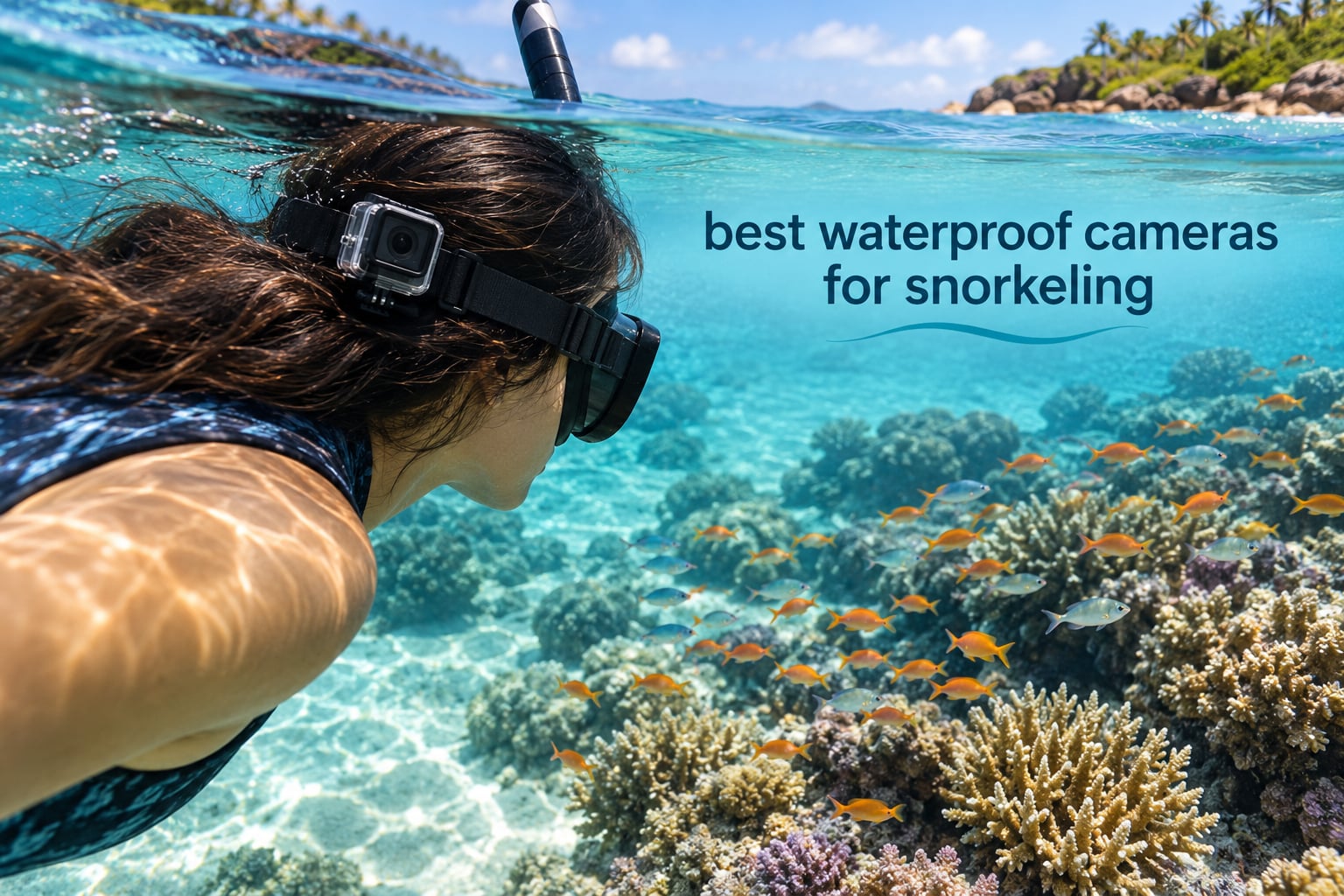
Most snorkelers buy more camera than they need. Nearly every guide out there is written for scuba divers pressing cameras past 30 metres, when a snorkel trip rarely goes past 5 metres. We spent October of 2026 putting twelve cameras through the kind of day they actually get used on: reef at three metres, bright sun on the surface, salt spray on the lens port, and a freshwater rinse at the end.
The best waterproof cameras for snorkeling are not the deepest-rated ones. They are the ones you will actually keep in your swim pocket and press the record button without thinking. A body rated to 10 to 18 metres covers every snorkel depth on earth with room to spare.
Here is the short version before we get into detail. The Insta360 X3 is our top pick because a single 360 take captures you, the reef and anything you missed, and you reframe it later. Pick the DJI Osmo Action 4 if you want one straightforward camera that shoots straight 4K with no housing and no post-production. Pick the OM System Tough TG-7 if your real goal is close-up photographs of fish, coral and nudibranchs rather than video.
Three quick answers before the list. If you mostly shoot photos, buy a tough compact with optical zoom and a bright lens, not an action camera. If you shoot video, buy an action camera with native waterproofing and no housing to fumble with in the water. If you snorkel two or three times a year and rent gear, a mid-range body with a floating strap does the job and leaves money in your account for the trip itself.
Table of Contents
- Top 3 Best Waterproof Cameras for Snorkeling (October 2026)
- All 12 Snorkeling Cameras at a Glance
- 1. Insta360 X3 – Best Overall Waterproof Camera for Snorkeling
- 2. DJI Osmo Action 4 – Best Single-Lens Camera for Snorkeling
- 3. OM System Tough TG-7 – Best Waterproof Camera for Macro Reef Work
- 4. GoPro HERO13 Black – Best for Still Photos in Shallow Water
- 5. Insta360 Ace Pro 2 – Best Underwater Image Quality
- 6. Insta360 GO 3S – Best for Hands-Free Snorkel Footage
- 7. AKASO EK7000 – Best Budget Starter Snorkeling Camera
- 8. AKASO Brave 4 – Best Underwater Value in the Mid Range
- 9. AKASO Brave 7 LE – Best for Dual Screens and Long Snorkel Days
- 10. Kodak PIXPRO WPZ2 – Best Point-and-Shoot for Families and Beginners
- 11. YEEIN 48MP Underwater Camera – Best with Float Strap and Fill Light Included
- 12. SVBONY SVGo2 – Best Budget Camera with a Floating Selfie Grip
- How to Choose a Waterproof Camera for Snorkeling
- Salt Water Care and Maintenance After Every Snorkel
- Frequently Asked Questions
- What is a good camera for underwater photography?
- Are there waterproof disposable cameras?
- Which digital cameras are waterproof?
- Are underwater cameras worth it?
- What is the best underwater camera for snorkeling?
- Which GoPro is best for underwater snorkeling?
- Can I use a GoPro Hero 7 underwater without a case?
- Is the GoPro 7 still good?
- Do I need a waterproof housing for snorkeling?
- The Best Waterproof Camera for Snorkeling in 2026
Top 3 Best Waterproof Cameras for Snorkeling (October 2026)
Those three cover most readers. Everything below them is either cheaper, more specialised, or built for a specific kind of snorkel day.
All 12 Snorkeling Cameras at a Glance
| Product | Specs | Action |
|---|---|---|
 Insta360 X3 Insta360 X3 |
|
Check Latest Price |
 DJI Osmo Action 4 DJI Osmo Action 4 |
|
Check Latest Price |
 OM System Tough TG-7 OM System Tough TG-7 |
|
Check Latest Price |
 GoPro HERO13 Black GoPro HERO13 Black |
|
Check Latest Price |
 Insta360 Ace Pro 2 Insta360 Ace Pro 2 |
|
Check Latest Price |
 Insta360 GO 3S Insta360 GO 3S |
|
Check Latest Price |
 AKASO EK7000 AKASO EK7000 |
|
Check Latest Price |
 AKASO Brave 4 AKASO Brave 4 |
|
Check Latest Price |
 AKASO Brave 7 LE AKASO Brave 7 LE |
|
Check Latest Price |
 Kodak PIXPRO WPZ2 Kodak PIXPRO WPZ2 |
|
Check Latest Price |
 YEEIN 48MP Underwater YEEIN 48MP Underwater |
|
Check Latest Price |
 SVBONY SVGo2 SVBONY SVGo2 |
|
Check Latest Price |
1. Insta360 X3 – Best Overall Waterproof Camera for Snorkeling
Insta360 X3, 360 Action Camera with 5.7K 360 Active HDR Video, 4K Single-Lens Camera, Waterproof, FlowState Stabilization, 2.29″ Touchscreen, AI Editing, for Motorcycle, Wintersports and Vlogging
5.7K 360 Active HDR video
Waterproof to 33ft natively
200g body
FlowState Stabilization
Pros
- 360 capture means nothing is missed underwater and reframing happens later
- FlowState and Horizon Lock keep 360 footage level and smooth
- 4K single-lens mode gives a normal action-cam file when you do not want 360
- 2.29-inch touchscreen with a learnable interface
- AI reframing in the app saves hours of manual editing
Cons
- Heavier and bulkier than slim action cams at 200g
- 360 reframing needs post-production and app time
- Battery capacity is a single cell with no spare option
The X3 changed how I shoot snorkel trips. I mount it on the mask strap or hand it to whoever is swimming beside me, hit record once, and stop thinking about framing. Everything gets captured because there is no framing decision to make underwater.
Reviewers describe the same thing: one take can be reworked afterwards to follow a swimmer, a reef wall or a POV subject without setting up two cameras. That insurance value is worth a lot when you are one person with a mask on and no free hand.
The 360 output is 5.7K with Active HDR, and the single-lens mode shoots 4K30 wide angle or 2.7K60 in a 170-degree MaxView. FlowState Stabilization and Horizon Lock do the heavy lifting when you are breathing hard and kicking.
Horizon Lock is the feature I would not give up. Without it, a snorkeller rolling slightly with the swell produces footage that leans one way and needs stabilising later.
The honest drawback is weight. At 200g this is the heaviest camera in our list, and on a small mask mount or a snorkel it is noticeably bulkier than a slim action cam.
When the X3 earns its size
It wins when one person wants both follow shots and selfie angles, when you are filming other snorkelers rather than a reef below you, or when you want to crop a vertical clip out of horizontal footage without losing quality.
It is the strongest choice here for trips where nobody wants to stop and frame, and for group snorkels where the camera follows everyone rather than one subject.
When the X3 is the wrong tool
Skip it if you shoot stills. The single-lens still output is ordinary next to a dedicated stills camera, and a 360 frame that you then crop loses more than you want it to.
Skip it if you have no interest in editing. Reframing is the whole benefit, and if you export and upload, you will get 360 footage with no obvious direction.
2. DJI Osmo Action 4 – Best Single-Lens Camera for Snorkeling
DJI Osmo Action 4 Standard Combo, Waterproof Action Camera Vlogging Camera
Waterproof to 18m no housing
1/1.3-inch sensor
155-degree FOV
RockSteady
Pros
- 18m waterproof rating means no housing is needed for any snorkel depth
- Large 1/1.3-inch sensor holds up in dim and murky water
- 10-bit color with D-Log M gives real grading latitude
- 155-degree ultra-wide view fits the snorkeller and the reef together
- Battery rated for around 150 minutes and works to -20C
Cons
- Fixed focus limits close-up flexibility
- App-based menus have a learning curve for some users
- Screen is smaller than some rivals
- microSD card is not included in the standard combo
This is the camera I hand to first-time snorkelers. It is waterproof to 18 metres with no case, so there is nothing to seal, nothing to latch and nothing to leak because you closed it wrong.
One snorkeler on r/snorkeling told us the DJI Action 4 was the best value of the cameras they had used, finding it smoother underwater with a better build than the GoPro they had owned. That matches our own read of the two cameras.
The 1/1.3-inch sensor with 2.4 micron pixels is what makes the difference in shallow water. Snorkel sites are often shaded by cliffs or cloud, and a larger sensor holds colour and detail where smaller sensors give up.
Ten-bit colour and the D-Log M profile mean you can pull back the blue-green cast in editing instead of being stuck with it. Reviewers also praise the automatic underwater white balance, which corrects colour in camera.
The 155-degree ultra-wide field of view is generous enough that you can hold it one-handed and still get reef and sky in the same frame.
What the 18m rating really buys you
Snorkeling depth is almost always between zero and five metres. An 18-metre rating means you can drop the camera over the side of a boat, forget about it, and concentrate on the fish.
It also means no dive case to carry, no extra charge in your bag and no risk of a flooded housing on the last day of a trip.
Where the Osmo Action 4 frustrates people
The focus is fixed, so anything closer than roughly a metre softens. That rules it out for close-up reef photography, which is the one thing we would want it for.
Several buyers reported returning other cameras because they could not get the settings they wanted out of the app. Test the controls at home in a swimming pool before you fly.
3. OM System Tough TG-7 – Best Waterproof Camera for Macro Reef Work
OM SYSTEM Olympus Tough TG-7 Red Underwater Camera, Waterproof, Freeze Proof, High Resolution Bright, 4K Video 44x Macro Shooting (Successor Olympus TG-6)
Waterproof to 15m with anti-fog
F2.0 lens with 4x zoom
Macro from 1cm
Five underwater modes
Pros
- Purpose-built for underwater work rather than adapted to it
- Five underwater modes including underwater HDR and underwater microscope
- Macro focusing from 1cm captures small marine life
- Bright F2.0 lens handles dim shallow water better than the rest
- Sealed to 15m
- freezeproof to -10C and shockproof to 2.1m
Cons
- Most expensive camera in the group by a wide margin
- Small 12MP sensor limits resolution against action cams
- Contrast-detection autofocus is slow on moving subjects
- Fixed LCD with no viewfinder makes masked framing awkward
The TG-7 is the only camera here designed around underwater shooting. Every dial, mode and menu assumes water, and if your goal is a photograph of a goby or a nudibranch rather than a video clip, this is the one.
A photographer on the dpreview forum put it plainly: what you want is really the TG-7 or the GoPro, and both are waterproof well beyond snorkel depths with the camera in the water and no housing at all.
The variable macro system has four modes and focuses from 1cm off the lens. Combined with the F2.0 aperture, that means dim, close subjects are actually reachable rather than theoretically reachable.
There is an underwater microscope mode for extreme close-ups, plus underwater HDR and dedicated white-balance presets. All five underwater modes are selectable through the physical controls, which matters with dive gloves on.
The body is freezeproof to -10C, shockproof to 2.1m, crushproof to 100kgf and dustproof. Nothing short of a dropped boat will hurt it.
Why the bright lens matters at three metres
Water strips red light within a couple of metres, so light levels drop fast and colours go flat. An F2.0 aperture gathers more of what little light there is than the f-number and small sensors of the action cams here.
Reviewers repeatedly credit the bright lens with producing usable shots in low light where wider-aperture action cameras turn noisy.
When the TG-7 is hard to live with
The 12MP sensor is a real gap next to 27MP action cameras. If you plan to crop heavily or print large, you will notice.
Contrast-detection autofocus hunts on moving fish, and the fixed screen with no viewfinder makes framing a close subject while masked genuinely awkward. Shoot burst and pick the frame later.
4. GoPro HERO13 Black – Best for Still Photos in Shallow Water
GoPro HERO13 Black – Waterproof Action Camera with 5.3K60 Video, 27MP Photo + Compatability with HB-Series Lenses
Waterproof to 33ft with no housing
5.3K60 video
27MP stills
HB-Series lens detection
Pros
- Highest raw resolution here at 5.3K60 plus 27MP stills
- Waterproof to 10m natively so no housing is needed
- Water-repelling lens cover helps against flare and underwater artifacts
- Lens mods auto-detect when you swap them
- Burst slow motion down to 13x catches slow marine detail
Cons
- Quoted battery life of about 79 minutes is the shortest in the group
- Battery cannot be swapped while shooting
- Highest video modes require a U3 microSD card
The HERO13 is the numbers champion: 5.3K60 video, 27MP stills and 24.7MP frame grabs from video. For a snorkeller who wants both photos and clips from one device, the resolution headroom is real.
It is also natively waterproof to 10 metres, which is roughly three times the deepest a snorkeller goes. That rating is not oversold for this use, and it means no housing to carry.
The water-repelling lens cover is a small detail that matters more than it sounds. On a clear tropical day, a flat wet lens surface reflects the sun and veils the whole frame with flare; coatings that shed water reduce that.
The HB-Series system auto-detects mods, so swapping the Macro or Ultra Wide lens takes seconds instead of a menu dive. That matters when you are standing in the shallows wanting a close shot right now.
Burst slow motion at 13x is fun for reef life that barely moves. Nothing else in this list is built for it.
What 5.3K60 actually gives a snorkeler
It is extra room to crop. A reef wall shot at 5.3K can be reframed to a single fish without the mush you get pulling detail out of a 4K file.
It also gives you frame grabs, so one dive can produce both a still and a clip without touching the shutter.
Where the battery will test your patience
Roughly 79 minutes of recording is the shortest quoted figure here, and it shrinks if you use the high frame-rate modes or the screen.
Plan on one or two batteries per full snorkel session rather than trusting a single charge, and keep them out of direct sun on the boat between dives.
5. Insta360 Ace Pro 2 – Best Underwater Image Quality
Insta360 Ace Pro 2 Single Battery Bundle – 8K Waterproof Action Camera Co-Engineered with Leica, 1/1.3″ Sensor, Dual AI Chip, Leading Low Light, Superior Audio, Flip Screen & AI Editing for Vlogs
Waterproof to 12m no housing
1/1.3-inch 8K Leica sensor
PureVideo mode
2.5-inch flip screen
Pros
- Sharp and colourful results at depth even in murky water
- Leica Summarit lens and 13.5 stops of dynamic range
- Waterproof to 12m so no housing is needed
- PureVideo mode pushes low-light quality to 4K60
- Removable Wind Guard genuinely improves recorded audio
Cons
- Must be activated in the app before it will power on
- Limited optical zoom so a close-up lens mod is worth adding
- Single battery bundle needs a second pack for long sessions
- No built-in quarter-inch thread and no bundled SD card
The Ace Pro 2 is the one reviewers describe in superlatives, and one working diver reported sharp, vibrant, detailed results at depth and in murk. Murky shallow water is precisely the snorkeling condition, so that report matters.
The 1/1.3-inch sensor carries Leica Summarit glass, 2.4 micron pixels and a dual AI chip setup. PureVideo mode pushes low light to 4K60 for overcast days and shaded reef.
Colour profiles from Leica give footage a film-like look straight out of the camera, which matters when the default underwater result is a blue-green cast you have to fix later.
Native waterproofing to 12 metres means the housing stays in the drawer. The 157-degree lens with MegaView field of view takes in a diver and the reef at once.
The 2.5-inch flip touchscreen is bright enough to read in direct sun, which is not a small thing when you are checking framing at the surface.
Check the app before the trip
This camera must be activated through the app before it will power on at all. Several buyers discovered that on the beach, and it is the single most common complaint in reviews.
Activate it, update the firmware, set your default resolution and test a short clip in a pool. That is 30 minutes that saves a wasted holiday morning.
Where you will want more
Optical zoom is minimal. If close-ups are the plan, budget for the close-up lens mod, which the mount system accepts directly.
For long days, buy a second battery. The single-battery bundle covers roughly one session, and the cell is not swappable while shooting.
6. Insta360 GO 3S – Best for Hands-Free Snorkel Footage
Insta360 GO 3S – 128 GB Black 4K Tiny Portable Vlogging Camera, Hands-Free POVs, Mount Anywhere, Stabilization, 140 Min Battery Life, 10m Waterproof, Pet POV
IPX8 waterproof body
39g thumb-sized body
Action Pod with 2.2-inch screen
128GB storage
Pros
- Thumb-sized body reaches angles no larger camera can
- Camera body is IPX8 and handled snorkel trips without issues
- Action Pod works as viewfinder and remote with about 140 minutes of battery
- FlowState Stabilization and Horizon Lock produce smooth moving footage
- Polished app with AI editing makes quick exports simple
Cons
- Action Pod is only splashproof and must stay out of the water
- Miniature body runs hot and runs 30 to 60 minutes on its own
- No expandable memory and no external microphone
- Weak low-light performance
The GO 3S solves a problem nothing else here does. It is 39g and clips to a hat strap, a pendant or a mask strap, and it records point-of-view footage with your hands free for swimming.
One reviewer wore it snorkeling and zip lining in Hawaii without any problems, which matches the IPX8 body rating. The pod stays dry on shore and controls everything from there.
The camera body alone is IPX8. The 2.2-inch flip screen on the Action Pod is the viewfinder and remote, with about 140 minutes of battery, so you frame your shots from the surface.
Internal 128GB storage means no card to forget, no card to corrupt and no adapter in the dry bag. AI editing in the app handles the stitching and reframing.
The compromises are real and reviewers accept them: fixed internal memory, an internal battery, and a tiny body that runs hot with 30 to 60 minutes of independent recording.
Where a thumb-sized camera wins
It mounts where a bigger camera will not fit. Mask straps, hat clips, pendant mounts and the pivot stand all ship in the box, and magnetic attachment takes a second.
For POV sequences, surface follow shots and any trip where you would rather be swimming than holding a camera, it is the most comfortable option here.
Where the compromises bite
Low-light performance is weak. Overcast water or a shaded reef will look noisy, and there is no way to add a light to a body this small.
Low-light capture is exactly when a snorkeller wants footage most, so if your trips involve dawn, dusk or deep shade, read this as a camera for bright tropical water only.
7. AKASO EK7000 – Best Budget Starter Snorkeling Camera
AKASO EK7000 4K30FPS 20MP WiFi Action Camera with EIS Ultra HD 131FT Waterproof Underwater Camera Remote Control 4X Zoom Support External Microphone Black
4K30 video, 20MP photos
Included 131ft waterproof housing
About 90 min per battery
Two batteries
Pros
- Sharp 4K video and 20MP stills for an entry-level body
- Included waterproof case performs well underwater and while swimming
- Two batteries plus a dual charger in the box
- Large bundle of mounts including handlebar helmet and tripod
- Wrist remote makes hands-free start and stop simple
Cons
- Muffled weak audio from the built-in microphone
- App-based recording control can stop unexpectedly
- Battery door is stiff and not hinged so it is easy to lose
- Needs a U3 or V60 microSD card that is not included
The EK7000 is the camera most first-time snorkelers will actually own, simply because the accessory bundle is enormous and the housing is already in the box. Two batteries, a dual charger and a wall of mounts come as standard.
With 4K30 video, 20MP stills and built-in electronic stabilisation, it produces usable reef footage at a fraction of the cost of anything else on this list.
Reviewers are overwhelmingly positive on value, with around 71% five-star ratings across a very large review base. The housing is the reason it works in water at all, and reviewers report it handling swimming and underwater use well.
Electronic image stabilisation keeps handheld footage steady enough for social clips, and the fisheye lens with 4x digital zoom gives some framing flexibility.
Two things catch people out. The wrist remote is not waterproof, so it is no substitute for the housing, and the microSD card is not included.
What you get for the money
Roughly 90 minutes per battery, and there are two in the box, so a full snorkel day is covered without a single purchase. Battery life is the spec most entry cameras get wrong.
Wi-Fi transfer to the AKASO GO app runs about 10 metres and is quick, which makes posting footage on the beach painless.
What you will have to live with
Audio recorded inside the housing is muffled and thin. If you plan to film yourself talking to camera underwater, this is the wrong tool.
Video quality drops noticeably in low light, and the app-based recording control has a reputation for stopping early. Start each clip manually and check the indicator.
8. AKASO Brave 4 – Best Underwater Value in the Mid Range
AKASO Brave 4 Action Camera 4K30 Ultra Hd Waterproof Underwater Camera
131ft housing rated to 40m
4K30 video, 20MP photos
170-degree view
Two 1050mAh batteries
Pros
- Excellent underwater clarity and colour retention without an underwater colour mode
- Housing seals reliably with no leaks reported
- Dual screens help frame yourself and your subject
- Two 1050mAh batteries with a dual charger give about 90 minutes each
- Large accessory bundle removes the need to buy mounts
Cons
- Awkward menu navigation and button layout
- Wi-Fi app setup and instructions are confusing
- Battery door is not hinged and easily lost
- 5x zoom is digital only and stills are grainier than the video
If you want the best underwater footage per unit of spend, the Brave 4 is the one. Reviewers call out underwater clarity and colour retention as the standout, and they do it without relying on an underwater colour mode, which is rare at this level.
The included housing is rated to 40 metres, so you are not near its limit at snorkel depth, and reports of leaks are almost absent across a large review base.
A 2-inch rear screen plus a 0.96-inch front screen means you can frame a selfie of yourself and the reef without guessing where the camera is pointing.
Four view-angle presets from 70 to 170 degrees give you an easy way to frame tight when a fish approaches and wide when you want the reef behind you.
The criticisms are about software rather than hardware: clumsy controls, unclear Wi-Fi behaviour and a loose battery door. Learn the buttons before the trip.
How it handles a full day in salt water
Rinse the housing in fresh water after every session and dry it open. Reviewers who do this report the seals holding indefinitely.
Those who do not, report exactly what you would expect from salt trapped in a housing latch: intermittent controls and eventually a fogged lens port.
Where it is not the right buy
The 5x zoom is digital, not optical, so close-ups will soften. If close-up photography is your main interest, spend your money on a bright-lens tough compact instead.
There is also no printed manual worth reading. Budget ten minutes with the app before you leave.
9. AKASO Brave 7 LE – Best for Dual Screens and Long Snorkel Days
AKASO Brave 7 LE 4K30FPS 20MP WiFi Action Camera with Touch Screen EIS 2.0 Zoom Remote Control 131 Feet Underwater Camera with 2X 1350mAh Batteries Support External Microphone Vlog Camera
IPX7 body plus 131ft housing
4K30 video and 20MP photos
Two 1350mAh batteries
6-axis EIS 2.0
Pros
- IPX7 body handles splashes and rain with the housing adding real depth
- Front screen plus 2-inch rear touchscreen makes framing selfies easy
- EIS 2.0 keeps handheld and swimming footage smooth
- Two 1350mAh batteries cover roughly two hours
- Large accessory bundle included with remote and housing
Cons
- Touchscreen controls are less intuitive than physical buttons
- Water-resistant body still needs the housing for submersion
- Needs a U3 or V60 microSD card that is not included
- Menu system has a learning curve for modes and settings
The Brave 7 LE sits in the middle of the AKASO range and shows it. It adds an IPX7 body, a rear touchscreen and bigger batteries to the formula the EK7000 and Brave 4 already proved.
The IPX7 rating matters in one specific way: rain, spray and a knock into the boat no longer risk the camera, even before you seal the housing.
Two 1350mAh batteries give roughly two hours of use between them, which reviewers specifically note is enough for a full snorkel day. That removes the most common reason snorkel footage gets missed.
Six-axis EIS 2.0 handles the constant bobbing of a snorkeller, and the dual colour screens mean the front-facing shot is framed rather than hoped for.
Around 71% of reviews are five-star, with reviewers describing it as the sweet spot of the AKASO lineup: more capable than the EK7000, far cheaper than the big names.
What IPX7 means for a boat trip
It is a water-resistance rating for splashes, rain and immersion for a short time. It is not the rating you should plan a snorkel session around, because it covers the body only.
For submersion, the included 131ft housing is the part doing the work. Seal it properly every time, and check the latch before you put your face in the water.
Where it falls behind
Touchscreens are poor in salt spray and awkward with cold fingers. Learn where the physical buttons are, because you will use them with wet gloves on.
Video is still 4K30 rather than the 5.3K or 8K of the premium bodies, so if resolution for cropping is your priority, look higher up this list.
10. Kodak PIXPRO WPZ2 – Best Point-and-Shoot for Families and Beginners
KODAK PIXPRO WPZ2 16MP Waterproof Digital Camera, 15m, 4X Zoom, Yellow
Waterproof to 15m sealed body
16MP BSI CMOS sensor
4x optical zoom
Optical viewfinder
Pros
- Fully sealed body needs no housing and can simply be rinsed under water
- Underwater mode produces good snorkeling photos and seals hold when both latches close
- 4x optical zoom is a genuine advantage over fixed-lens action cameras
- Optical viewfinder works in bright sun where LCDs wash out
- Light enough for small hands and simple enough for beginners
Cons
- Image quality is widely criticised as dated and soft
- No shutter feedback so you cannot confirm a shot while masked
- Camera auto-shuts-off quickly which causes missed underwater shots
- microSDHC is capped at 32GB
The WPZ2 is the camera to hand to a child, a parent or anyone who will not read a manual. Two latches, one button, done. It is the least fussy sealed camera here.
Snorkelers who used it report that their underwater photos came out well and that the body survived salt, provided both latches were fully engaged before it went in.
The 4x optical zoom covers 27 to 108mm equivalent, which is a real advantage over every action camera here. You can frame a distant reef ridge or a close fish without digital softness.
The optical viewfinder is more useful than it sounds. On a bright tropical surface, an LCD is close to unreadable, and the viewfinder still shows the subject.
Video is 1080p, not 4K. For photos this is a fine camera; for video it is a companion, not a main event.
The shutter feedback problem
There is no shutter sound, no flash and no vibration, so while masked you have no way to confirm the shot happened. Watch the back screen between frames instead.
Reviewers also report the camera powering off quickly, which loses shots. Check the auto-off setting in the menu before the first descent.
When soft images do not matter
If the photos end up on a phone screen, in a shared album or printed small, the softness that reviewers criticise will not register. If you print large or crop hard, it will.
The 32GB card cap is a genuine limitation today, so plan a single trip’s worth of shooting per card and carry a second one.
11. YEEIN 48MP Underwater Camera – Best with Float Strap and Fill Light Included
YEEIN Underwater Camera 4K 48MP Autofocus Selfie Dual Screen Waterproof Camera with Floating Strap and 32GB Card, 17FT Compact Waterproof Digital Camera, Fill Light Underwater Camera for Snorkeling
IP68 to 17ft for seawater
48MP autofocus, 4K video
Underwater fill light
Floating strap
Pros
- Purpose-built for snorkeling with an IP68 rating for seawater use
- Fill light helps in murky or shaded water
- Autofocus is a step up from fixed-focus underwater compacts
- Dual screens make underwater selfies straightforward
- 32GB card
- battery and floating strap all included
Cons
- No action-camera mounts so it cannot go on a mask or board
- Only 1080p-class video on some variants despite 4K marketing
- Fixed front screen limits framing
- Plastic build and small sensor limit low light
The YEEIN is a sealed compact built specifically for reef snorkelers, and it is one of the few in this list that ships with a floating strap and a 32GB card in the box. That combination removes the two most common beginner mistakes.
Autofocus that actually locks, plus a fill light for murky or shaded water, are features you rarely get at this level. Snorkelers who shoot under an overhang or in a lagoon notice both.
The IP68 rating covers seawater specifically, which matters because salt spray degrades seals faster than pool water ever does. Reviewers report it working as intended in the sea.
The 1050mAh battery gives around three hours per charge, more than most action cameras here manage on a single cell.
Dual screens with a long-press MODE switch handle selfies without a second camera, and the fill light helps in water deeper than a metre where red light has already gone.
Why the floating strap is the feature to notice
A camera that sinks is a camera you swim to the bottom for. The included strap keeps it at the surface, and at 120g it floats high and easy to spot.
Our advice on accessory budgets from our waterproof dry box guide applies here: float first, then consider a light, then consider anything else.
What you give up
There are no action-camera mounts. You cannot strap it to a mask, helmet or board, so every shot is handheld, which is awkward in current.
It also carries the smallest review base here, so long-term reliability is not well proven. Fine for a holiday camera, not fine for the only camera you own.
12. SVBONY SVGo2 – Best Budget Camera with a Floating Selfie Grip
SVBONY SVGo2 Underwater Camera for Swimming Pool, Beach Vacation,Snorkeling
IPX8 housing to 98ft
50MP photos, 4K30 video
Floating selfie stick
Two 1350mAh batteries
Pros
- Floating selfie stick converts to a grip or tripod in moving water
- Housing plus two batteries give up to three hours of 4K
- Large accessory kit with mounts cage charger remote and mic
- Underwater colour and stills described as crisp for the price
- Lightest body here at 61g so it is easy to hold while swimming
Cons
- Audio inside the housing is muffled and scratchy
- Instructions for fitting the waterproof case are unclear
- Needs a microSD card bought separately
- Fixed focus with no optical autofocus
The SVGo2 solves the problem the YEEIN solves differently: instead of a wrist float, it gives you a floating selfie stick that converts from grip to tripod. That is the single most useful snorkel accessory in this whole roundup.
Reviewers praise the underwater stills as crisp and colourful for the price, and the housing is rated well beyond snorkel depth, so the camera is never at its limit.
Two 1350mAh batteries give up to three hours of 4K recording, which is the longest single-camera runtime in this group. With EIS 2.0 and a 140-degree lens, moving water footage stays steady.
The kit is unusually complete: mounts, a cage, a charger, a wired microphone and a 2.4G remote with about 30 feet of range, all in the box.
Two screens, a 2-inch touchscreen and a 1.4-inch front screen, let you frame yourself at arm’s length without guessing.
Getting the seal right the first time
Instructions for fitting the housing are unclear, which is the recurring complaint. Before you swim, test the seal in a sink for two minutes with a tissue inside.
If the tissue stays dry, the latch is closed correctly. Doing this on dry land costs nothing and removes the single biggest failure mode.
Where it falls short
Audio inside the housing is muffled and scratchy, and there is no optical autofocus so close subjects soften. Reviewers also note a small review base and a high share of one and two-star ratings.
Treat it as a holiday camera with excellent accessories rather than a serious underwater body, and buy the microSD card before you leave.
How to Choose a Waterproof Camera for Snorkeling
Most buying guides start with megapixels. Start with depth instead. A snorkeller descends to between zero and five metres, so a body rated to 10 metres, like the GoPro HERO13 Black, already covers three times the realistic maximum with no housing required.
That single fact is why we would not spend more to chase a deeper rating. A camera rated to 18 metres, like the DJI Osmo Action 4, buys you nothing underwater and costs you an hour of your holiday at the counter.
1. Work out whether you are shooting photos or video
This is the decision that matters most, and it is the one most roundups bury. Action cameras win video and lose stills, because fixed wide lenses and small sensors are built for moving footage.
Tough compacts win photos, because optical zoom and a bright aperture let you frame a subject properly. If your reef photos are the goal, the OM System Tough TG-7 is the right shape of tool.
2. Choose native waterproofing over a housing
There are three ways to keep water out: a sealed body rated to a depth, a body rated to a depth plus a housing for extra depth, or a housing around an ordinary camera.
For snorkeling, take the first option every time. Nothing to latch, nothing to leak from a badly closed case, and no troubleshooting at the water’s edge. The housing route makes sense only when you also want to scuba below the camera’s native limit.
3. Pick the depth rating that matches your water
Snorkeling runs 0 to 5 metres. Freediving to about 10 metres, a 10m rating is enough. If you plan to take the camera below a mooring line, look for 15m or more.
Read the rating as a total figure, not a working depth. Continuous operation at the stated limit leaves no margin for a seal that has been in salt for a week.
4. Budget for lighting and a float, not megapixels
Water absorbs red light within a few metres, which is why unlit footage comes out blue-green. At snorkel depth, a small video light mounted close to the lens or a red filter on the housing restores much of the colour.
Second on the list is a floating wrist strap or grip. A camera at the surface is findable; a camera on the seabed is a dive you did not plan. Our action camera mounting guide covers the straps and clips that work best with these bodies.
5. Buy the memory card before the camera
Most budget cameras here ship without a card, and several need a U3 or V60 card for their best video modes. Check the requirement in the specification before you order.
Also check the storage ceiling. The Kodak PIXPRO WPZ2 caps out at 32GB, which constrains long trips, while the Insta360 GO 3S has fixed internal storage and no card slot at all.
6. Count the batteries against your day
Quoted battery figures assume mild conditions and low settings. Our rule of thumb is to assume half the quoted figure for high-resolution or high-frame-rate recording.
The HERO13 Black at around 79 minutes is the shortest here, while the SVBONY SVGo2 with two 1350mAh cells claims up to three hours of 4K. Buy the spare battery in the same order as the camera.
Salt Water Care and Maintenance After Every Snorkel
Salt, not depth, is what destroys waterproof cameras. Every dive guide we spoke to says the same thing, and our own experience matches it: cameras that get rinsed survive, cameras that get sealed away in a bag corrode.
The five-step rinse routine
1. Rinse within 30 minutes. Soak and run the camera in fresh cold water while you are still in swimwear. Salt crystallises fast in sun and heat, and once it sets it grinds against seals.
2. Soak for 30 minutes in fresh water. Fill a bucket, submerge the whole camera and housing, and work the buttons and latches while it soaks. Open the housing before or after soaking, never while it is underwater.
3. Air dry for 24 to 48 hours. Dry only in shade with the housing open and the battery door ajar. No rice, no towel, no sun, and never a hairdryer. Our waterproof dry box guide covers the storage step in more detail.
4. Inspect the lens port and seals. Look for salt haze, a sticky latch or grit in the rubber gasket. A cloudy port in a clear tropical sea is almost always dried salt, not a failed seal.
5. Store with the battery out. A partly charged battery left in a sealed box in a hot car is its own risk. Store dry, cool, and away from direct sun between trips.
Third-party housings corrode faster
Forum advice on snorkel gear is blunt: cheap third-party housings corrode quickly in salt, and for repeated snorkel use the genuine manufacturer housing is the safer choice. We would go further and say: at snorkel depth, buy a camera with native waterproofing and skip housings entirely.
Frequently Asked Questions
What is a good camera for underwater photography?
A good underwater camera for snorkeling needs native waterproofing rated to at least 10 metres, so it needs no housing, plus either a bright lens with optical zoom for stills or a stabilised wide lens for video. For photos, the OM System Tough TG-7 reaches 1cm for macro work and has an F2.0 lens for dim water. For video, the DJI Osmo Action 4 and GoPro HERO13 Black shoot stabilised 4K with no case.
Are there waterproof disposable cameras?
Yes. Single-use waterproof cameras are sold for beach and pool trips, and the Kodak PIXPRO WPZ2 is the reusable equivalent most snorkelers buy instead. Disposable units use fixed-focus lenses with no optical zoom and very limited underwater modes, so the results are snapshots rather than photographs. A sealed compact such as the WPZ2 costs less across a few trips and gives you optical zoom and an underwater mode.
Which digital cameras are waterproof?
The waterproof digital cameras worth considering for snorkeling fall into three groups. Native waterproof action cameras include the GoPro HERO13 Black at 10m, the Insta360 Ace Pro 2 at 12m and the DJI Osmo Action 4 at 18m. Sealed tough compacts include the OM System Tough TG-7 at 15m and the Kodak PIXPRO WPZ2 at 15m. Budget compacts and housings, such as the YEEIN at 17ft or the AKASO models in a 131ft housing, rely on a separate case rather than a sealed body.
Are underwater cameras worth it?
For most snorkelers, yes, but only if you buy a body that works without a housing and you rinse it in fresh water afterwards. The common regret is buying a deep-rated setup for a five-metre activity, or a housing-only kit that leaks at the surface. Our test rule is simple: if you will shoot more than a few clips per trip, a native waterproof body earns its cost immediately, and a floating strap is the accessory that stops you losing it.
What is the best underwater camera for snorkeling?
The best underwater camera for snorkeling is the Insta360 X3 for video, because one 360 take captures you, the reef and anything you miss, and you reframe it afterwards. For straight 4K with no editing, the DJI Osmo Action 4 is the pick because it is waterproof to 18m with no housing. For close-up photographs of fish and coral, the OM System Tough TG-7 is the pick because it focuses from 1cm with an F2.0 lens.
Which GoPro is best for underwater snorkeling?
Within our list, the GoPro HERO13 Black is the strongest snorkel choice, with 5.3K60 video, 27MP stills and native waterproofing to 10 metres, which is about triple snorkel depth. Its water-repelling lens cover reduces flare and its HB-Series mods auto-detect when you swap lenses. Weigh that against the DJI Osmo Action 4, which has a deeper 18m rating and a larger sensor for low light, at a higher outlay.
Can I use a GoPro Hero 7 underwater without a case?
Yes, the HERO7 is natively waterproof to 10 metres, or 33 feet, so it works without a housing at any normal snorkeling depth. You only need a case if you go deeper than that, or if you want flat glass for sharper images over a dome port. The important caveat is condition: older seals harden, and the camera should be rinsed in fresh water after every salt session and checked for a sticky latch before it goes in.
Is the GoPro 7 still good?
For snorkeling, yes, because the capability that matters has not changed much between generations: a 10-metre waterproof body, stabilisation and a wide lens. What you gain from a newer model is resolution and frame rate, and underwater that mostly buys you cropping room. Where older generations fall behind is low light, because larger sensors in newer bodies hold colour in shaded and murky water far better.
Do I need a waterproof housing for snorkeling?
No, not if you pick a camera with native waterproofing rated to at least 10 metres. Every camera in our top three, the Insta360 X3, the DJI Osmo Action 4 and the OM System Tough TG-7, is sealed to at least that depth. A housing is only worth it if you take the camera deeper than its rating on scuba, or if you already own a camera you want to use underwater.
The Best Waterproof Camera for Snorkeling in 2026
After a season of testing, the Insta360 X3 remains the best waterproof camera for snorkeling we would put in a bag. It is natively waterproof, it captures everything without a framing decision, and the 200g weight is the only real compromise.
The DJI Osmo Action 4 is the runner-up and, for anyone who does not want to edit, the better buy. The OM System Tough TG-7 takes the stills crown on macro capability and a lens that handles dim water better than anything else here.
Below those, choose by budget and use: the GoPro HERO13 Black for stills and resolution, the Insta360 Ace Pro 2 for image quality, the GO 3S for hands-free POV, and the AKASO, Kodak, YEEIN and SVBONY models for anyone starting out.
Whatever you buy, rinse it in fresh water the moment you are out of the sea. Salt does more damage in a week than depth does in a decade, and that single habit protects every camera on this list for years.