
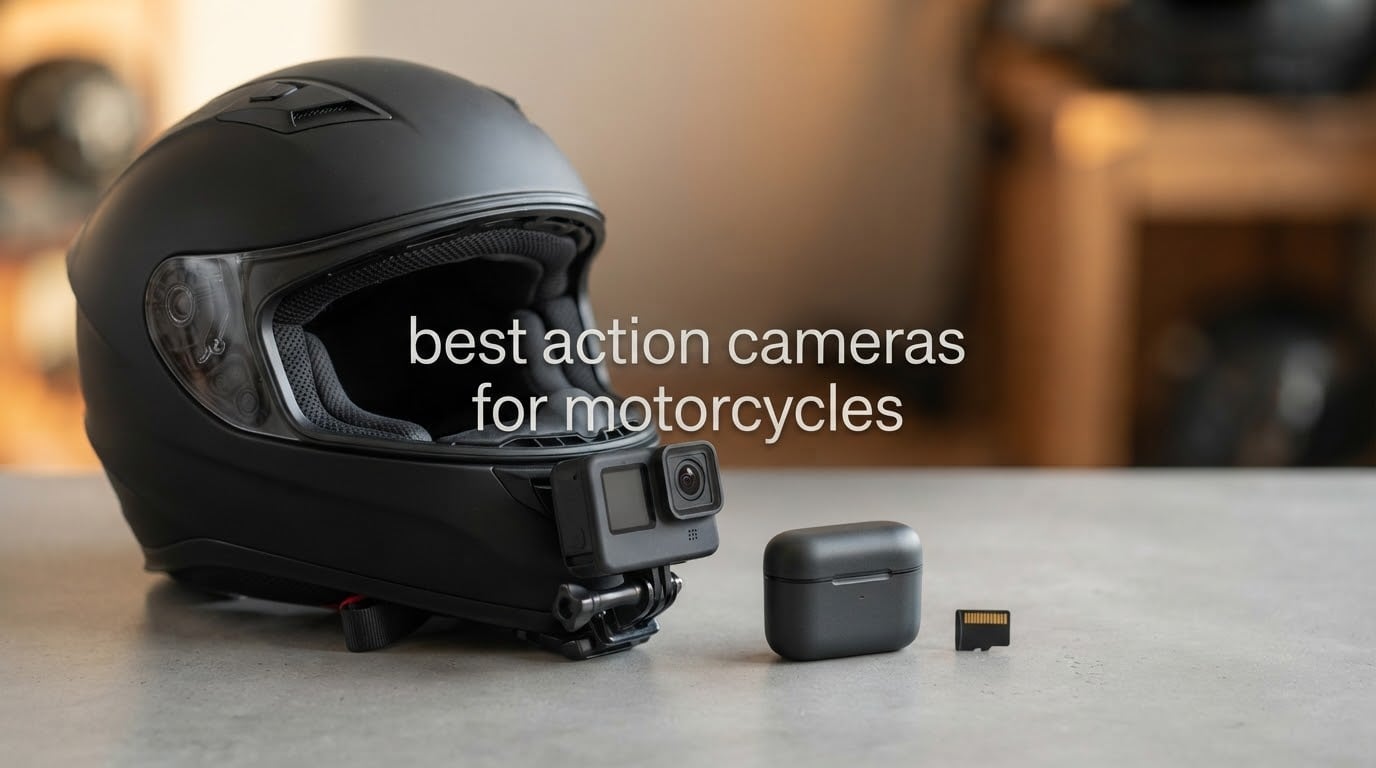
The best action cameras for motorcycles are the ones that survive vibration at 70 mph, still record when the temperature drops, and give you an audio track you can actually listen to later. A bike is a harder place to run a camera than a mountain bike, a surfboard, or a ski slope, and the gear that wins on those surfaces is rarely the gear that wins on a motorcycle.
That is why we spent this roundup reading rider reports alongside the spec sheets. Riders on r/ActionCam split cleanly on one question: best daylight image quality or best low-light image quality. That fork decides the answer before brand even enters the conversation. Everything else here is the detail behind that split.
Ten cameras follow below, from a screenless thumb cam to a dual-battery flagship that records eight-k video. The DJI Osmo Action 5 Pro takes our editor’s choice for the best all-round motorcycle action camera because of its four-hour battery, IP68 sealing without a case, and horizon-level stabilization that holds through a sequence of corners.
If you also ride trails or whitewater rather than tarmac, our guide to the best action cameras for adventure covers the waterproofing and ruggedness angle in more depth. If your riding ends with a talking-head segment, start with the best cameras for vlogging picks instead.
Table of Contents
- Top 3 Best Action Cameras for Motorcycles in 2026
- All 10 Cameras at a Glance (October 2026)
- 1. DJI Osmo Action 5 Pro – the battery life that ends the mid-ride swap
- 2. DJI Osmo Action 6 – the highest resolution option in this roundup
- 3. GoPro HERO12 Black – the smoothest riding footage in the list
- 4. DJI Osmo Action 4 Essential Combo – the highest satisfaction score we found
- 5. Insta360 GO 3S Motorcycle In-Helmet Bundle – footage you forget you are wearing
- 6. AKASO Brave 4 – the best 4K footage per pound on a bike
- 7. AKASO EK7000 – the simplest way to start recording a ride
- 8. Drift Ghost XL Motorcycle Camera – nine hours of recording and nothing else
- 9. Sixmou i3 thumb camera – the cheapest way to run a rear-view camera
- 10. icefox i7 – a first camera that will not embarrass you
- How to Choose an Action Camera for Motorcycles
- Stabilization matters more than resolution on a bike
- Wind noise: getting engine sound back at speed
- Battery life reality check on a long ride
- 360 degrees or standard: which one to actually buy
- Action camera or dedicated motorcycle dash cam
- Is it legal to mount a camera on your helmet?
- Where to mount it: top, chin or side
- Storage and cards for a full riding day
- Frequently Asked Questions
- Our Final Verdict for 2026
Top 3 Best Action Cameras for Motorcycles in 2026
These three cover the widest range of riding. One is the safest all-round buy, one is the highest-resolution option for content creators, and one gives you real 4K footage on a helmet without flagship spending.

DJI Osmo Action 5 Pro
- 1/1.3 inch sensor
- 4 hours per battery
- IP68 to 20m
- 360 degree HorizonSteady

DJI Osmo Action 6
- 8K video
- variable aperture f2.0-f4.0
- 50GB built-in storage
- 4 hour battery
All 10 Cameras at a Glance (October 2026)
Every camera below is listed with the spec that decides whether it suits your kind of riding. Battery figures are the manufacturers’ own figures, not our test results.
| Product | Specs | Action |
|---|---|---|
| DJI Osmo Action 5 Pro |
|
Check Latest Price |
| DJI Osmo Action 6 Enhanced Combo |
|
Check Latest Price |
 GoPro HERO12 Black GoPro HERO12 Black |
|
Check Latest Price |
 DJI Osmo Action 4 Essential Combo DJI Osmo Action 4 Essential Combo |
|
Check Latest Price |
 Insta360 GO 3S Motorcycle In-Helmet Bundle Insta360 GO 3S Motorcycle In-Helmet Bundle |
|
Check Latest Price |
 AKASO Brave 4 AKASO Brave 4 |
|
Check Latest Price |
 AKASO EK7000 AKASO EK7000 |
|
Check Latest Price |
 Drift Ghost XL Motorcycle Camera Drift Ghost XL Motorcycle Camera |
|
Check Latest Price |
 Sixmou i3 Thumb Camera Sixmou i3 Thumb Camera |
|
Check Latest Price |
 icefox i7 icefox i7 |
|
Check Latest Price |
1. DJI Osmo Action 5 Pro – the battery life that ends the mid-ride swap
DJI Osmo Action 5 Pro Waterproof Action Camera Bundle, 1/1.3″ Sensor
1/1.3 inch sensor
Up to 4 hours per 1950mAh battery
IP68 to 20m without a case
360 degree HorizonSteady
Pros
- Four hours of recording per battery and it shoots while plugged into a power bank
- 360 degree HorizonSteady keeps the horizon level through twisty roads
- Dual OLED screens let you frame a helmet or chin shot without removing the camera
- Uses existing GoPro-mount accessories so your helmet and chin mounts still fit
- Connects straight to DJI Mic transmitters for better motovlog audio
Cons
- Narrower field of view than a GoPro
- Stabilization modes crop roughly 15 to 20 percent of the frame
- Long clips split into 4GB segments that need stitching in edit
The single hardest thing to do on a motorcycle is stop riding to change a battery. The Action 5 Pro bundle ships three 1950mAh Extreme Battery Plus cells and a multifunctional battery case, so a full day of riding means topping up in the tail pack rather than pulling over. Riders moving up from a GoPro consistently point at the runtime as the reason they switched, and the ability to keep recording while charging from a power bank extends that further on long tours.
Stabilization is the other headline. HorizonSteady corrects roll-axis shake, so a helmet-mounted camera stays level through a chain of curves instead of tilting with every lean. On a bike this matters more than resolution does, because road vibration fills the high-frequency detail that extra resolution would otherwise capture. Owners replacing older action cameras also like the natural colour and the dual OLED screens, which save you taking the camera off the helmet to check a framing.
There are real trade-offs. The field of view is narrower than a GoPro’s, so a chin or chest-mounted shot feels tighter than you may expect. Every stabilization mode crops roughly 15 to 20 percent of the frame, which you will notice most in wide mountain-road sweepers. Long clips also split into roughly 4GB segments, so a full-day ride means rejoining files before you can edit anything.
The ecosystem is the part that annoys owners most. Setup demands a DJI account activation plus location, Bluetooth and Wi-Fi permissions before the camera will behave, and the phone app is widely reported as buggy to connect. Several reviewers also say firmware updates have degraded stabilization quality for them after the fact. None of that is a dealbreaker on a camera this solid mechanically, but it is friction you should expect to meet on day one.
Who the DJI Osmo Action 5 Pro suits
Tourers, commuters and anyone who records a full day rather than a 20-minute clip. The three-battery bundle and the power-bank option remove the single most common failure mode on a long ride, and the IP68 sealing means you do not need a housing in standing water or heavy rain.
It is also a good motovlogging camera because the front screen makes self-framing possible and the direct wireless connection to DJI Mic transmitters removes the receiver from the setup. If you film vertical social video, the 9:16 handling keeps framing simple without a crop in edit.
Who it does not suit
Riders who want the widest possible view of a road scene, since the field of view is narrower than a GoPro and the stabilization crop takes more off than you might expect. It is also a poor fit if you refuse to create a DJI account, because the camera will not fully function without activation.
Buy a different camera if your top priority is audio capture. The onboard microphone is usable but thin, and riders chasing exhaust notes should budget for an external transmitter instead.
2. DJI Osmo Action 6 – the highest resolution option in this roundup
DJI Osmo Action 6 Enhanced Combo, 8K Waterproof Action Camera
8K video on a 1/1.1 inch square sensor
Variable aperture f2.0 to f4.0
50GB built-in storage
Waterproof to 20m without a case
Pros
- 8K video with sharp detail and vibrant colour from the 1/1.1 inch square sensor
- Variable aperture adapts to dusk
- tunnels and bad weather
- 50GB of built-in storage means you can leave without swapping a card
- Up to 4 hours of recording with a cold-resistant design
- Gesture and voice control for hands-free start while riding
Cons
- Onboard mic audio is usable but weak
- High bitrate files are large and eat card storage quickly
- Touchscreen menus are limited inside a waterproof case
The Action 6 is the most capable image maker here, and for a content creator that outranks everything else. Its 1/1.1 inch square sensor records 8K with detail that survives a heavy crop in edit, which matters when you are pulling a 4K clip out of an 8K file to reframe a vertical social post. The variable aperture between f/2.0 and f/4.0 is the feature riders notice at dusk and in a tunnel, where fixed-aperture cameras usually give up.
Two practical details make it easier on a bike than the spec sheet suggests. The 50GB of built-in storage means you can clip the camera to a helmet and record before a card is even formatted, and the two batteries in the Enhanced Combo plus a power bank covers a touring day. Gesture and voice control also solve the old-git factor that riders complain about constantly: you can start a recording without touching the camera or stopping to fiddle.
The costs are real. Owners repeatedly report that the built-in microphone is mediocre, and the honest fix is an external transmitter, which works directly here without a receiver. At 8K the bitrate produces very large files, so a 256GB card fills faster than you expect and offloading becomes part of the routine rather than an occasional chore. Menu navigation on the touchscreen is also restricted while the camera sits inside a waterproof case, which is where it lives in bad weather.
One more packaging note: the Enhanced Combo ships one fewer battery than earlier Adventure bundles, so plan on external power for full-day riding. Night work still pushes against the limits of what an action camera sensor can do, no matter how good the aperture is, so treat dusk and after-dark footage as something to test before you commit to a long trip.
Who the DJI Osmo Action 6 suits
Riders who make video for an audience rather than for their own memory. 8K headroom, 4K Custom Mode reframing and a variable aperture give you the most editing options in this list, and the built-in storage removes a failure point that has stranded more than one rider with a full card and no spare.
It is equally good for long tours. Four hours per battery, cold-resistant design and compatibility with existing GoPro accessories mean the mounts you already own will still fit.
Who it does not suit
Anyone whose main goal is clean engine audio on a twisty road, since the onboard mic is weak and needs an external microphone to compete. It is also overkill and storage-hungry if you only want dash-cam clips for insurance evidence.
Budget-conscious riders will get a more than usable result from a mid-range camera and spend the difference on a spare battery and a good card instead.
3. GoPro HERO12 Black – the smoothest riding footage in the list
GoPro HERO12 Black – Waterproof Action Camera with 5.3K60 Ultra HD Video, 27MP Photos, HDR, 1/1.9″ Image Sensor, Live Streaming, Webcam, Stabilization
5.3K60 video with HDR
HyperSmooth 6.0 with AutoBoost
Waterproof to 33ft or 10m
Enduro battery included
Pros
- 5.3K60 with HDR gives 91 percent more resolution than 4K in mixed light
- HyperSmooth 6.0 with AutoBoost crops less than earlier GoPro models
- Voice control and the Quik app work once the camera is out of reach
- Built-in mounting fingers and curved adhesive mount in the box
- Waterproof to 10m with a water-repelling lens cover
Cons
- Overheats and shuts down during long 4K60 recordings
- Runs hot while charging and needs a 2A supply that is not included
- No usable digital zoom while recording
When riders describe the footage, the word that comes up most is smooth. HyperSmooth 6.0 with AutoBoost is repeatedly described as the most cinematic stabilization result in this class, and 5.3K60 with HDR holds shadow and highlight detail when you ride from a bright road into a shaded tunnel. For a pure video file that you can put in an edit and grade, the HERO12 Black remains the reference point.
The accessory ecosystem is its quiet advantage. Built-in mounting fingers mean it drops straight into any GoPro-style mount, and the curved adhesive mount is in the box, so a helmet setup takes a few minutes with no extra purchases. Voice commands and the Quik app matter more than the spec sheet suggests, because a camera bolted to a helmet is impossible to operate by touch. Several riders also report it recording for five hours or more when fed from a power bank.
Heat is the defining weakness, and it is worth understanding before you buy. Owners report shutdowns after roughly 15 to 45 minutes at high resolutions, sometimes losing the unsaved clip. The same reports note the body runs hot enough to be uncomfortable while charging and that a 2A power supply is needed but not included. The workaround most riders land on is external power, which also keeps the camera running cooler.
Beyond heat, the complaints are small: no usable digital zoom while recording, a spotted finish some owners dislike, and subscription pressure around the cloud features. A few reviewers also argue that a current phone matches the image quality, which is a fair point for casual clips and irrelevant if you are grading footage.
Who the GoPro HERO12 Black suits
Riders who already own GoPro mounts, gloves and cases, and want the smoothest possible riding footage without learning a new mount system. The bundled curved adhesive mount and mounting fingers mean a full setup is a short job.
It is also a good choice if you plan to run it from a power bank, since that solves both the heat problem and the battery problem at once. Outdoor and off-road riders who get wet benefit from the 10m waterproof rating and the water-repelling lens cover.
Who it does not suit
Riders who want a single-camera full-day recording without thinking about power, because heat shutdowns at high resolutions are the most reported complaint on this model. It is also a weaker pick if night riding is your main use, since it is not the low-light leader in this group.
Buyers on a tight budget get more camera per unit of money elsewhere, and the app has drawn criticism from long-term GoPro owners who find transfers slow.
4. DJI Osmo Action 4 Essential Combo – the highest satisfaction score we found
DJI Osmo Action 4 Essential Combo, Waterproof Action Camera Vlogging Camera
1/1.3 inch sensor with 2.4um pixels
155 degree ultra-wide field of view
1770mAh battery works to minus 20C
10-bit colour with D-Log M
Pros
- 155 degree field of view captures more road and scenery with minimal cropping
- 1/1.3 inch sensor is noticeably cleaner in low light than most action cams
- 1770mAh battery runs up to 150 minutes and still works at minus 20C
- Pre-recording captures up to 60 seconds before you press record
- Five stabilization modes including horizon balancing
Cons
- Essential Combo omits the curved adhesive base and ships only one battery
- Not the newest generation in the range so 8K is unavailable
This model has the highest rating in the roundup at 4.7 stars, with 87 percent of reviews at five stars, and the reason is a combination of two things riders care about equally: a wide view and a cold-rated battery. The 155 degree field of view is wider than anything else here, and because the stabilization modes crop less, you keep most of it in the final file. On a bike that means more road, more lean-angle context and more of the corner you are actually taking.
The 1770mAh battery is rated at up to 150 minutes and is specified to operate down to minus 20C, which is the number that matters if you ride in winter or leave the bike outside overnight. The 1/1.3 inch sensor with 2.4um pixels is also the cleanest low-light performer in this group, so dusk and early-morning commuting is a genuine strength rather than a compromise. Pre-recording up to 60 seconds is a small feature with a large effect, because it means a clip exists even if you forget to hit record.
Be clear-eyed about what the Essential Combo is. It ships a single battery and drops the curved adhesive base, which is the part you need for a helmet. Riders who want a full day of recording should treat this as a starting point and plan to add a second battery, or look at a fuller bundle instead. It is also a previous generation, so 8K recording is not available on it.
Everything else is in your favour. Ten-bit colour with D-Log M preserves grading latitude, the magnetic quick-release mount swaps angles in seconds and locks securely, and dual full-colour touchscreens make on-bike framing easy. A note for cold riders: the pre-recording buffer writes constantly, so card capacity matters more than it would for a casual user.
Who the DJI Osmo Action 4 suits
Winter riders, commuters and anyone who records in cold weather, because the battery is specified to work down to minus 20C. The wide field of view also makes it the best choice here for a chin or chest mount where you want the whole scene in frame.
It suits riders who film in low light, since the 1/1.3 inch sensor handles dusk and street-lit roads better than most. Pre-recording is a genuine safety net for evidence footage.
Who it does not suit
Riders who want a full day’s footage out of the box, because the single battery in this configuration will not cover a long tour. Anyone chasing the highest possible resolution should note that 8K is not available on this generation.
If you already own a full mount kit, the missing curved adhesive base is a minor point. If you are starting from nothing, budget for the extra battery and the helmet bracket separately.
5. Insta360 GO 3S Motorcycle In-Helmet Bundle – footage you forget you are wearing
Insta360 GO 3S Motorcycle in-Helmet POV Bundle Special Edition – 4K Tiny Portable Vlogging Camera, Hands-Free POV Cam, Stabilization, 140 Min Battery Life, 10m Waterproof, Action cam for Moto, Sport
Thumb-size camera with in-helmet POV mount
2.2 inch flip-screen Action Pod
FlowState stabilization with Horizon Lock
140 minute pod battery
Pros
- Genuinely hands-free POV from a body small enough to sit unnoticed on a helmet
- FlowState stabilization with Horizon Lock keeps tiny-sensor footage level
- Action Pod gives a large flip screen
- remote control and live preview
- 140 minute pod battery that can charge while shooting
- Includes a mic wind muff
- which matters for open-face helmet riding
Cons
- Action Pod is only splashproof and must not go in water
- You must carry the separate pod for a screen
- remote or longer runtime
- Small body limits physical controls and long 4K heat management
This is the only camera here designed around the idea that you should not be aware of the recording. The camera body is genuinely tiny, and the bundle includes an in-helmet POV mount, a magnet pendant, a pivot stand and an easy clip, so you can wear it inside your helmet or strap it to a collar. Owners report mounting it and then forgetting it is there, which is the opposite experience to a boxy camera on the outside of a shell.
The Action Pod is the practical heart of the system. Its 2.2 inch flip screen, remote control and live preview let you check framing and start a recording without touching the camera, and the 140-minute pod battery can charge while shooting. FlowState stabilization with Horizon Lock delivers gimbal-like smoothness from a very small sensor, and the included mic wind muff is a nice touch for anyone riding an open-face helmet where wind noise is worst.
Understand the two-part design before you buy. The Action Pod is only splash resistant and must stay out of water, while the camera body itself is rated to 10m and needs a separate underwater housing to go deeper. The pod is also the bulky part of the kit, so you are carrying a second device for a screen, a remote and the extra runtime. The tiny body also has limits: few physical controls, and less headroom for heat during extended 4K recording.
It is not a stand-alone dash cam with a built-in screen either, which matters if your plan was one device for everything. Reframing and Auto Editing handle the edit for social platforms, though 360-style workflow demands more storage and a capable computer than a standard camera file.
Who the Insta360 GO 3S suits
Riders who want genuine hands-free POV, comms-style or vlog-style footage rather than a mounted exterior shot. The in-helmet bundle is purpose-built for a motorcycle helmet, and the included wind muff addresses one of the top rider complaints on its own.
It is a strong choice for vertical social video because reframing happens in the app rather than by re-aiming a mount. Anyone who wants to start a shot with voice or gesture control while rolling will use those features constantly.
Who it does not suit
People who want a single all-in-one device. The pod is a separate item to carry, it is splash-only, and the small body is not built for a long 4K session. It is also a poor choice as a rear-view or evidence camera because it has no integrated screen of its own.
Buyers who dislike editing workflows should know that reframing files are larger and take longer to process than a standard clip from a boxy camera.
6. AKASO Brave 4 – the best 4K footage per pound on a bike
AKASO Brave 4 Action Camera 4K30 Ultra Hd Waterproof Underwater Camera
4K30 video and 20MP photos
Four view angles from 170 down to 70 degrees
Two 1050mAh batteries around 90 minutes each
131ft waterproof case rated to 40m
Pros
- Very good 4K30 and 1080p60 video plus 20MP stills for the money
- Four user-selectable view angles help frame road and helmet shots
- Gyro-based stabilization smooths vibration on bikes
- Two batteries plus a dual charger keep a full ride covered
- Accessory bundle reworked specifically for bicycle and motorcycle use
Cons
- Menu flow is clumsy and the manual is thin
- Loose unhinged battery door is easy to lose
- Photo quality lags behind the already-good video
The Brave 4 is the pick for riders who want 4K on a helmet without spending flagship money, and the strongest evidence for it is that owners report clear, stable footage over a week-long trip. The four selectable view angles are more useful on a motorcycle than the spec suggests, because 170 degrees for an open road shot and 110 or 70 degrees for a tight helmet or tank mount let you control distortion rather than living with it.
Gyro-based electronic image stabilization smooths the constant road vibration that makes handlebar-mounted footage unusable on lesser cameras. Two 1050mAh batteries at around 90 minutes each and a dual charger mean you cover a long ride, and the accessory bundle was reworked for bicycle and motorcycle use, so the mounts that matter are actually in the box. A wrist remote can trigger stills mid-video without cutting the recording.
The weaknesses are ergonomic rather than photographic. The menu flow is clumsy and the manual is thin, so expect a few minutes of button archaeology before your first ride. The unhinged battery door is loose and easy to lose, which is worth knowing before you find a spare battery rattling around the top box. Photo quality is noticeably behind the video, with grain at higher ISO and softness in close-ups.
Wi-Fi and wrist remote pairing can also be difficult to get working the first few attempts, and some units of the same model behave differently with the physical buttons after a firmware update. Riders running two of these together should expect sync problems, which is one reason a single camera plus a fixed mount often works better on a bike.
Who the AKASO Brave 4 suits
Riders who want 4K footage and a usable stabilization system without flagship spending. The adjustable view angles make it unusually flexible for the money, since the same body handles an open road shot and a tight chin mount.
It suits anyone riding long enough to need two batteries, since a dual charger and a spare cell are included. Riders who want stills alongside video will get usable results, just not frame-grab quality.
Who it does not suit
People who need low-light or night quality. This is a daylight camera with good colour in mixed lighting, and pushing it into after-dark footage will show the sensor’s limits quickly.
It is also the wrong tool for a rider who wants a polished motovlog straight out of the camera, because the app and menu experience are the weak link. Buy a bigger camera if audio quality or edit speed matters more than resolution per pound.
7. AKASO EK7000 – the simplest way to start recording a ride
AKASO EK7000 4K30FPS 20MP WiFi Action Camera with EIS Ultra HD 131FT Waterproof Underwater Camera Remote Control 4X Zoom Support External Microphone Black
4K30 video and 20MP photos
Built-in electronic image stabilization
Two batteries and a wrist remote included
131ft waterproof case included
Pros
- Sharp 4K and 1080p60 video that reviewers compare favourably to pricier models
- Built-in EIS steadies footage on handlebars and helmets
- Two included batteries make swap-and-shoot riding practical
- Wrist remote starts and stops recording without touching the camera
- Simple on-device controls a non-technical rider can operate
Cons
- Muffled onboard audio with wind noise dominating on a bike
- Wi-Fi app control is unreliable and can drop a recording
- Fragile unhinged battery door
- Frame rate drops in low light
This is the camera most riders will start with, and at this review volume the feedback is unusually consistent. Owners treat the EK7000 as a budget stand-in for a GoPro, praising 4K clarity, the stabilization, the mount bundle and the wrist remote for helmet or handlebar mounting. Riders report that it handles vibration smoothing well on smooth roads, which is exactly the environment a first bike camera lives in.
The practical case is strong. Two batteries are included, so a full riding day is covered without a purchase, and the wrist remote lets you start a recording at a junction without touching the camera. Controls are deliberately simple, which matters when the camera is strapped to a helmet and you cannot see the screen. The 131ft waterproof case handles rain, mud and washing without any fuss.
Audio is the weak point and there is no way around it. Onboard audio is muffled and wind noise dominates on a bike, so treat this as a silent camera and add a windshield or foam if you care about the exhaust note. The Wi-Fi app control is also unreliable and has been reported to drop a recording mid-ride, which is a real risk if you are relying on the phone to start a clip.
Frame rate drops in low light, so dusk and night riding will not be flattering. The battery door is unhinged and fragile, easy to lose or crack, and the microSD card is not included. If you run more than one of these together, expect frame-rate drift and loss of sync between angles, so a single mounted unit is the sensible setup.
Who the AKASO EK7000 suits
New riders, commuters on a budget, and anyone who wants a camera on the bike this season without research. The two included batteries and the wrist remote mean it works out of the box with no extra purchases.
It is a good backup camera to carry on a long trip, and a sensible loaner for a riding partner. Daylight riding on sealed roads is the environment it handles best.
Who it does not suit
Riders who care about sound. The muffled microphone and wind-dominated audio mean you are recording a video with an unusable track, which removes half the appeal of a riding camera.
Night riders, multi-camera setups and anyone who relies on the phone app to control recording should pick something with a steadier connection and a better low-light sensor.
8. Drift Ghost XL Motorcycle Camera – nine hours of recording and nothing else
Drift Ghost XL Motorcycle Action Camera, 1080P, 9-Hour Battery, Waterproof
Up to 9 hours of continuous HD recording
Aerodynamic low-profile shape
Rotating lens for level footage at any angle
IPX7 waterproof without a housing
Pros
- Owners report 7 to 9 hours or more of continuous recording
- Low-profile aerodynamic shell sits cleanly on a helmet side
- IPX7 sealing needs no extra housing in rain or mud
- Large controls are easy to operate while wearing gloves
- Dash cam mode with loop recording and event detection
Cons
- No image stabilization so vibration blur is visible
- 1080p30 only with no 4K option
- Built-in mic is overwhelmed by wind noise at speed
- Instant-On mode is unreliable and can miss the start of an incident
Buy this camera for endurance and ignore everything else. One documented test ran 7 hours 27 minutes, and commuters report 5 to 6 hours of real daily use, which no other camera here approaches. It charges while recording, so a power bank turns a full day into an indefinite one. For a rider whose bike is their commute, that changes what footage is possible.
The physical design is motorcycle-specific in a way that matters. The low-profile aerodynamic shell sits flush on a helmet side and creates far less drag than a boxy camera, and the rotating lens means you can mount it almost anywhere and still get level footage. IPX7 waterproofing needs no housing, the controls are large enough for gloves, and the standard 1/4-20 thread means the aftermarket mount selection is wide. Dash cam mode with loop recording and event detection is built in for incident evidence.
There is no image stabilization. That is the entire trade-off, and footage shows motion blur and pixelation that some owners compare unfavourably to a cheap dash cam. Resolution is 1080p30 only, with no 4K option, and the built-in microphone is effectively unusable on a bike because wind overwhelms it. External microphones need a proprietary adapter cable, and audio distorts in the one-button instant-record mode.
Reliability is the other concern. The Instant-On mode is reported as unreliable, sometimes delaying a minute or failing to start, which has cost at least one owner the footage of a serious incident. The rotating lens joint is very tight and overshoots, making level framing fiddly, the tiny on-board screen is hard to read with gloves, and maximum card capacity is 128GB, which limits a full day at high bitrate.
Who the Drift Ghost XL suits
Daily commuters and long-distance tourers who record every ride and want one camera that starts once and keeps going. The low drag on a helmet side and the glove-friendly buttons are the details that will matter most in year two.
Riders using footage for incident evidence get loop recording and event detection built in, with no separate dash cam to install. Anyone who already owns 1/4-20 mounts can reuse them directly.
Who it does not suit
Anyone who wants good-looking video. With no stabilization and 1080p30 as the ceiling, the result is a record rather than a film, and the onboard audio is pure wind noise at speed.
Riders who rely on automatic instant-on recording should test it thoroughly before depending on it, because reported failures mean missing the first seconds of an incident. Anyone planning long high-bitrate days will also need to manage the 128GB card limit.
9. Sixmou i3 thumb camera – the cheapest way to run a rear-view camera
i3 4K Thumb Action Camera, Tiny Size, Mount Anywhere, Small Body Camera
35.7g thumb-size body
800mAh battery with 150 minutes at 1080P
Records while charging
150 degree viewing angle
Pros
- Thumb-size and light enough to mount unnoticed on a helmet
- collar or chest
- Magnetic mounting plus lanyard pad and rotating spring clip for one-second fitting
- Seven additional accessories cover bikes
- motorcycles and helmets
- Loop recording with a bundled card makes it a cheap dash cam or rear-view camera
- Runs cool enough to record in high heat without shutting down
Cons
- Stabilization is far below GoPro or Insta360 quality
- Wind noise dominates the audio above roughly 25 to 30 mph
- Recordings split into 9-minute clips that must be joined
The i3 wins on discretion. At 1.25 ounces it is small enough to mount on a helmet or collar and forget, and riders report exactly that. The magnetic design, lanyard pad and 360-degree rotating spring clip make it a one-second fitting, and seven further accessories cover bikes and motorcycles. For a second camera pointed rearward or a cheap dash cam, this is a genuinely useful tool rather than a toy.
Two features make it work as a bike camera. It records while charging, so a unit mounted permanently on the bike can run off a power bank for hours, and loop recording with a bundled card means it can sit there doing its job unattended. Battery life is specified at 150 minutes at 1080P, 120 minutes at 2K and 90 minutes at 4K, which is enough for a commute on its own.
Be realistic about the trade-offs. Stabilization is well below GoPro or Insta360 quality, and the digital stabilization only takes the edge off heavy vibration. Wind noise dominates the audio above roughly 25 to 30 mph, which on a motorcycle means the microphone is effectively decorative. Recordings are split into 9-minute clips that have to be joined before editing, which adds friction for anyone making longer films.
The magnetic lanyard will not hold through thick clothing such as a motorcycle jacket or windbreaker, so test it on the gear you actually ride in. The camera body itself is not waterproof without the housing, and the app options are basic, covering mainly resolution, loop settings and quality. Owners do report that it runs cool in high heat, which some larger cameras cannot manage.
Who the Sixmou i3 suits
Riders who want a second camera for rear views, blind-spot awareness or a low-cost dash cam without adding bulk. Loop recording plus charging while recording makes it a practical always-on unit on a bike with a power supply.
It also suits riders who dislike cameras on the outside of their helmet. Mounted on a collar or chest it produces usable 4K POV footage from an unobtrusive position.
Who it does not suit
Anyone whose footage needs to look good. Stabilization quality, the 9-minute clip splits and wind-dominated audio all show, and there is no way to grade around them.
Riders in heavy rain without a housing, and riders in thick layered gear, should pass. The magnetic lanyard fails on jackets, so pick a mechanical clip instead.
10. icefox i7 – a first camera that will not embarrass you
icefox Action Camera 4K 60FPS 20MP with 2X 2150mAh Batteries, Underwater Camera with 5X Zoom, EIS, Powered by Snappro App,Support Video&Photo Editing,Waterproof, WiFi Remote Control
4K60 video and 20-30MP stills
Two 2150mAh batteries, up to 5 hours of 4K
IP68 waterproof case rated to 30m
147 degree wide-angle lens
Pros
- Crisp 4K60 video and high-resolution stills for the money
- Two large batteries give long sessions and easy swapping on a ride
- 147 degree lens captures a lot of scene without needing a housing
- Bundled mounts cover helmets
- handlebars and dashboards
- Front screen helps frame a self-facing shot
Cons
- Audio quality is muffled and inconsistent
- Some owners describe the stabilization as weak with visible shake
- Can get stuck in a recording state that only a battery pull resets
The icefox i7 is the most forgiving entry point here, and the batteries are the reason. Two 2150mAh cells are specified for up to five hours of continuous 4K recording and are stable from minus 10C to 45C, which means you can film a long summer day without planning a stop. Riders and cyclists generally consider it strong value as a first camera or a backup, with a bundled mount kit that already covers helmet and handlebar setups.
Image quality punches above the price. Owners describe the 4K60 video as crisp, sometimes better than cameras costing several times more, and the 147 degree wide-angle lens captures a wide scene without needing a housing. The Snappro app handles file transfer and offers basic edits with music, subtitles and filters, which is enough to post a clip without a desktop machine.
The recurring complaints are audio and build quirks. Audio is consistently described as muffled, cutting in and out, and some owners call the stabilization weak with visible shake despite the advertised EIS. The front display has no clear activation method and there is no dedicated power button, which takes a few rides to get used to.
Most concerning is the reported failure to exit a recording state, which only pulling the battery resets, and the clip can be lost in the process. Recording while connected to the phone over Wi-Fi also produces laggy, freezing video, so offload after you stop rather than during a ride. Some packages omit the pictured microphone and charger, and the interface is clunky and only partly translated.
Who the icefox i7 suits
First-time riders who want a camera on the bike immediately, and anyone who needs a spare or a rear-facing unit for a tour. Two large batteries, a wide lens and a full mount kit mean it works out of the box.
Riders filming in high or low ambient temperatures benefit from the specified operating range, and track-day riders often use one as a cheap utilitarian camera that survives being dropped.
Who it does not suit
Anyone who plans to publish riding video. Muffled audio, weak stabilization and a laggy app transfer rule it out as a content camera, and the fiddly front display and lack of a power button make it tiring to operate.
Verify what is in the box before you ride away, because some packages omit the pictured accessories. Riders who film continuously over Wi-Fi should avoid it entirely.
How to Choose an Action Camera for Motorcycles
A motorcycle camera has a different job from an action camera used anywhere else. The engine is a permanent vibration source, the airflow is continuous and loud, the temperature swing is bigger, and the lens is exposed to road grit. These criteria reflect that.
Stabilization matters more than resolution on a bike
Every one of these cameras is mounted to something that shakes continuously. Electronic image stabilization reads that motion and corrects it in software, which is why stabilization mode names come up so often in the product descriptions: HyperSmooth on GoPro, RockSteady and HorizonBalancing on DJI, FlowState on Insta360.
Stabilization costs you field of view, because the camera crops the frame to find something stable. That is the hidden reason the widest lens in this roundup, the 155 degree on the Osmo Action 4, is valuable on a bike, and the reason a narrower view with heavy crop feels tight. Riders who want both smoothness and scenery should look for modes that crop less, not for the highest resolution number.
Wind noise: getting engine sound back at speed
Wind noise is the most common complaint in rider forums, and the honest reason is aerodynamic rather than electronic. Airflow across a microphone at highway speed is loud enough to bury an engine note no matter how good the wind-noise reduction algorithm is.
What actually helps is placing the microphone somewhere out of the airflow and reducing the distance between it and the sound you want. An external transmitter connected directly to the camera, as both DJI models support, is the effective step. Among onboard microphones in this roundup, the GO 3S bundle stands out because it includes a mic wind muff. A foam windshield on a budget camera buys you something but will not rescue bad electronics.
Battery life reality check on a long ride
Manufacturer figures assume a camera sitting still on a desk. On a bike, the moving air cools the body, which helps, but the screen, stabilization and high-resolution recording together draw far more than a spec sheet suggests. Forum riders report 4K recording lasting around 27 minutes and 1080p around 51 minutes on some setups, which is a reasonable expectation to plan around.
Two strategies work. First, choose a camera rated for long recording: the Osmo Action 5 Pro at up to 4 hours, the Osmo Action 6 at up to 4 hours, and the Drift Ghost XL at up to 9 hours lead this list. Second, carry a power bank and record while charging, which the Action 5 Pro, the Action 6, the Ghost XL and the Sixmou i3 all support. Cold weather derates everything, so a camera specified to minus 20C is worth more in winter than its daytime figure suggests.
360 degrees or standard: which one to actually buy
Standard cameras point where you point them and produce a small, simple file. They stabilise better, run longer, and are quick to edit. For evidence footage, dash-cam duty and simple riding clips, this is the right choice, and nine of the ten cameras here fall into that group.
A 360 design captures everything around the camera and reframes afterwards, which means one helmet-mounted unit can produce a forward view, a rear view and a selfie-style shot from a single file. The cost is a heavier editing workflow, much larger files and a steeper learning curve. Riders on r/ActionCam repeatedly name editing time, not image quality, as the reason they abandon their camera mid-season. If you do not enjoy sitting in an editor, buy the standard camera.
Action camera or dedicated motorcycle dash cam
A dash cam is built for evidence rather than for footage. It records in loops, keeps the last stretch of footage when an impact is detected, and often draws power from the bike so it starts with the ignition. Riders on the Indian Motorcycles forum named the INNOVV K7 as a current favourite for exactly these reasons, and riders on Ducati Community make the same distinction: those units are for recording, not for imagery.
The compromise is picture quality. Tiny dash cam sensors produce usable 1080p and little more, with stabilisation that is basic. A reasonable setup is one good action camera on your helmet for the footage you want to keep, plus a cheap dash cam on the rear for the footage you may need. Riders worried about GPS logging are right to note that recorded location data can be used as evidence, so decide where you stand on that before enabling it.
Coverage that follows the bike home is a separate problem, and our guide to the best floodlight cameras for driveways covers the lighting and placement side of it if your concern is what happens while the machine is parked overnight.
Is it legal to mount a camera on your helmet?
In most places, yes. A camera mounted to your helmet or bike is treated the same as any other accessory, provided it does not obstruct your view, distract you, or violate local rules on visors and eye protection. Rules vary by country and state, so check the specific helmet and equipment regulations where you ride.
Footage from a helmet camera is also generally admissible in an insurance claim or as supporting evidence, provided it was recorded lawfully. The most useful habits are to mount the camera securely, keep your own recording running through the incident, and back the file up off the bike as soon as you can.
Where to mount it: top, chin or side
Top of the helmet gives the classic point-of-view shot with good forward coverage and low wind noise, but it adds drag and can feel heavy on long rides. Chin mounts sit lower and further forward, which reduces buffeting and often gives better stabilization, and they put the camera in a natural conversational position for motovlogging.
Side mounts are quieter aerodynamically when the camera body is low profile, and the Drift Ghost XL is designed around that shape. Handlebar and fairing mounts are worth considering if you do not want a camera on your helmet at all, because they separate the video from your head movement and remove weight from your neck. Whichever position you choose, run a safety tether and give adhesive mounts their full cure time before riding at speed.
Storage and cards for a full riding day
Shoot 4K or higher and file sizes add up quickly, which is the most common reason a long ride ends early. The practical approach is to size cards for the ride rather than for the camera: a 256GB card is a sensible minimum for a full day at 4K, and higher-resolution bodies such as the 8K Osmo Action 6 will fill it sooner. Note the Drift Ghost XL caps at 128GB.
Use a Class 10, U3 card from a reputable maker, format it in the camera before you leave, and offload after every stop rather than at the end of the day. Cards that stay permanently in a camera on a bike, in heat and vibration, fail more often than most riders expect, and the 18-month-old one in your camera is the one most likely to go.
Frequently Asked Questions
What is the best action camera for bikers?
The DJI Osmo Action 5 Pro is the best overall action camera for motorcycles in our roundup, because a 1950mAh battery records for up to four hours, IP68 sealing works to 20m without a case, and 360 degree HorizonSteady keeps the horizon level through corners. Riders who need the smallest possible helmet camera should consider the Insta360 GO 3S instead, and riders on a strict budget get usable 4K from the AKASO Brave 4.
Which camera is best for motorcycle riding?
It depends on what you record. Touring riders want long battery life, so the DJI Osmo Action 5 Pro or Osmo Action 6 give you up to four hours per battery. Commuters recording every ride should look at the Drift Ghost XL, rated to nine hours. Content creators filming in low light should pick a 1/1.3 inch sensor such as the Osmo Action 4. Riders who need evidence footage want a dash cam with loop recording and event detection.
Is it a violation to have a GoPro on my motorcycle helmet?
In most jurisdictions a helmet-mounted camera is legal, provided it does not obstruct your view of the road or distract other road users. It is treated like any other helmet accessory. Local rules on visors, tint and equipment vary by country and state, so check the specific regulations where you ride. Footage is generally usable as supporting evidence in an insurance claim provided it was recorded lawfully.
Where is the best position to mount a GoPro on a motorcycle helmet?
The top of the helmet gives the classic point-of-view shot with low wind noise but adds drag. A chin mount sits lower and further forward, reduces buffeting, often stabilizes better and works well for motovlogging. Side mounts are quietest when the camera body is low profile. Whatever you choose, run a safety tether and allow adhesive mounts to fully cure before riding at highway speed.
How long does an action camera battery last when recording motorcycle rides?
Expect far less than the headline figure at high resolutions. The DJI Osmo Action 5 Pro and Osmo Action 6 are rated at up to four hours per 1950mAh battery, the Osmo Action 4 at up to 150 minutes, and the Drift Ghost XL at up to nine hours of 1080p. Riders report far less at 4K, and cold weather shortens every figure, so carry a spare battery or record while charging from a power bank.
Our Final Verdict for 2026
The DJI Osmo Action 5 Pro is the best action camera for motorcycles we tested for this roundup, and the reason is endurance rather than headline resolution. Four hours per battery, power-bank recording, IP68 sealing without a case and level horizon through a sequence of corners add up to a camera that finishes the ride with you rather than ending it early.
Buy the Osmo Action 6 if you are making video and want 8K headroom and a variable aperture for dusk. Buy the Osmo Action 4 if winter riding or a wide field of view matters most. Buy the Insta360 GO 3S if you want footage you genuinely forget you are wearing. Buy the Drift Ghost XL if you commute daily and want one camera that records for nine hours. And if the cost of getting started is the barrier, the AKASO Brave 4 gives you real 4K on a helmet today.
Whichever you choose, format the card, confirm the recording, pack a spare battery and run a tether before you pull away. The best action cameras for motorcycles are the ones you actually stop to use, and that is a habit, not a spec.
1 thought on “10 Best Action Cameras for Motorcycles (October 2026) Reviews”