

A cellular trail camera works on remote land when three things line up: usable tower coverage at the exact mounting spot, a power source that survives a full season, and a data plan you size correctly. Miss any one of the three and the camera becomes an expensive box that never sends you a picture. That is why most failed setups trace back to a purchase decision rather than a hardware fault.
We spent weeks putting eight of the most requested cellular cameras through their specs, app flows, power options and coverage behavior, and we compared them against what owners report on hunting forums and in r/Hunting. The short version: the Moultrie Edge 2 is the best cellular trail camera for remote land overall, because its multi-carrier Auto Connect and internal memory fallback handle bad signal better than anything else here, and it carries the largest review base on the list at more than a thousand owner reports.
This guide covers the eight cameras most people land on when they search for the best cellular trail cameras for remote land, and it treats them as property tools rather than hunting gadgets. That changes what matters. A hunting camera can record to an SD card and get checked in the fall. Remote land cannot, because nobody is standing at the tree in February.
If you also want the non-cellular side of the picture for wildlife work, our [guide to trail cameras for deer hunting](https://mystorymysm.com/best-trail-cameras-for-deer-hunting/) covers the SD-only models. And for monitoring a driveway where power and WiFi do exist, our [floodlight camera roundup](https://mystorymysm.com/best-floodlight-cameras-for-driveways/) makes more sense. Neither substitutes for a cellular unit when the parcel is off-grid.
Table of Contents
- Top 3 Picks for Cellular Trail Cameras for Remote Land (October 2026)
- 8 Best Cellular Trail Cameras for Remote Land in 2026
- 1. Moultrie Edge 2 Cellular Trail Camera – Multi-Carrier Auto Connect
- 2. Tactacam Reveal Ultra – 4K Stills and Switchable No-Glow Flash
- 3. Spypoint Flex-M Starter Pack – Entry Pick With a Free Plan
- 4. VOOPEAK 4G LTE Camera – Solar Power and Pan and Tilt Live View
- 5. Tactacam Reveal X Gen 3.0 Two-Pack – Discreet Multi-Carrier Pair
- 6. Stealth Cam Revolver Pro 2.0 – 360 Degree Coverage in Thin Signal
- 7. Stealth Cam Fusion Max Two-Pack – Adjustable Resolution and Dual SIM
- 8. Tactacam Reveal Pro 3.0 Two-Pack – No-Glow Flash and Solar Power
- How to Choose a Cellular Trail Camera for Remote Land
- What to Do When the Signal Dies
- Data Plans and Ongoing Cost on Remote Land
- Legal and State Trail Camera Restrictions
- Installation Checklist for Off-Grid Sites
- Frequently Asked Questions
- Final Verdict by Reader Situation
Top 3 Picks for Cellular Trail Cameras for Remote Land (October 2026)


Spypoint Flex-M Pack
- Free 100-photo plan
- Dual-SIM carrier linking
- 28MP stills
- Four capture modes
Two details deserve attention before the list. First, none of these cameras will fix a genuine dead zone; signal at the tree is the only variable you cannot engineer around with software. Second, every one of them costs money every month after the hardware is home, so plan sizing matters more than most buyers expect. We cover both in detail further down.
8 Best Cellular Trail Cameras for Remote Land in 2026
| Product | Specs | Action |
|---|---|---|
| Moultrie Edge 2 |
|
Check Latest Price |
 Tactacam Reveal Ultra Tactacam Reveal Ultra |
|
Check Latest Price |
| Spypoint Flex-M Starter Pack |
|
Check Latest Price |
 VOOPEAK 4G LTE Camera VOOPEAK 4G LTE Camera |
|
Check Latest Price |
 Tactacam Reveal X Gen 3.0 2PK Tactacam Reveal X Gen 3.0 2PK |
|
Check Latest Price |
 Stealth Cam Revolver Pro 2.0 Stealth Cam Revolver Pro 2.0 |
|
Check Latest Price |
 Stealth Cam Fusion Max 2PK Stealth Cam Fusion Max 2PK |
|
Check Latest Price |
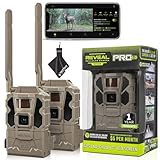 Tactacam Reveal Pro 3.0 2PK Tactacam Reveal Pro 3.0 2PK |
|
Check Latest Price |
1. Moultrie Edge 2 Cellular Trail Camera – Multi-Carrier Auto Connect
Moultrie Edge 2 Cellular Trail Camera 2-Pack – 36MP, Low-Glow Flash
36MP stills
1080p video
100ft detection
Auto Connect multi-carrier
8GB internal memory
Pros
- 36MP stills and 1080p video with audio
- 100-foot detection with low-glow IR flash
- Auto Connect links major networks with no SIM swapping
- 8GB internal memory plus cloud storage
- USA-based company with US support
Cons
- Requires a paid Moultrie plan for cellular transmission
- Cloud playback needs a subscription
We picked the Edge 2 as the top recommendation for the best cellular trail camera for remote land because it does the unglamorous work better than the rest. Auto Connect scans the major US networks and settles on whichever is actually usable at the tree, which removes the single most common failure we see: buying a camera locked to a carrier that has no bar on your parcel. Owners also describe it as the model that simply keeps running, and that consistency is what a camera 20 miles from the nearest road needs.
Image results are strong for a non-premium body. The sensor shoots 36MP stills and 1080p video with audio at 30 frames per second, and the 50-degree viewing angle plus 100-foot detection range covers a gate approach or a driveway without a fisheye distortion that makes identification harder. Night work uses a low-glow infrared flash out to 100 feet, so the red bloom that spooks deer at the treeline is reduced.
The details that matter on off-grid parcels are mostly physical. The body is IP65 rated, weighs 1.1 pounds and measures 4.2 by 3.6 by 5.5 inches, small enough to strap high on a trunk without a ladder. Eight gigabytes of internal memory means the camera stores images itself and then syncs them later, so a dead hour does not cost you the day. It also accepts solar packs and a battery box as add-ons, which is how we would run it.
The app is where Moultrie puts its effort. Game Plan analysis, activity charting and interactive maps turn a month of pictures into a readable timeline instead of a wall of thumbnails, and that is genuinely useful when you are trying to figure out whether the trespass you saw was a person or a coyote. A two-year warranty from activation is also the longest in this group, which matters when a replacement means a two-hour drive.
Why the Edge 2 fits remote parcels
The Auto Connect behavior is the whole argument. Rather than binding you to one network at setup, the camera hunts for a usable one, and if the signal drops it holds your images on internal memory until service returns. For a parcel in a valley or behind a ridge, that buffering behavior is worth more than any resolution upgrade.
It also removes SIM logistics. You are not opening the case, swapping a nano-SIM, and re-registering a device with a carrier’s activation portal in the field. For a multi-camera spread across several hundred acres, that alone saves a lot of windshield time.
Where the Edge 2 disappoints
The recurring complaint in reviews is cost, not capability. A paid Moultrie plan is required for cellular transmission, and cloud playback sits behind a subscription too, so the ongoing number grows once you add a second camera or a second person who wants access to the media.
Second, 1080p video is now mid-pack. The Tactacam Reveal Ultra captures 2.5K and 4K stills, so if your use case is identification of a person at a distance rather than general surveillance, the Edge 2 is not the sharpest option in this list.
2. Tactacam Reveal Ultra – 4K Stills and Switchable No-Glow Flash
TACTACAM Reveal Ultra Cellular Trail Camera: 4K Photo, 1080p Video, Live View, GPS Tracking-Enabled, Switchable No-Glow/Low-Glow Flash, LTE Connectivity, LCD Screen – Best Hunting, Game Camera
4K stills
2.5K video
Sub-0.5s trigger
Switchable no-glow IR
Active GPS
Pros
- 4K stills and 2.5K video with sub-0.5 second trigger
- Switchable low-glow or no-glow IR reduces spooking
- Active GPS alerts even if the camera is moved
- 16GB internal storage plus SD expansion
- On-device LCD for field setup
Cons
- Technical support is hard to reach
- Video requests sometimes fail to transmit
- Sensitivity can trigger on moving shadows
The Reveal Ultra is the best cellular trail camera for remote land if your concern is identification. Four-kilopixel stills and 2.5K video mean a face, a license plate, or a specific buck can be picked out of a frame later, and the sub-0.5 second trigger with up to a 9-shot burst captures movement that a slower camera would blur into a single unusable frame.
The flash control is the feature nobody else in this group offers in the same form. You can switch between a 96-foot low-glow flash and an 80-foot no-glow infrared array depending on what is in front of the lens. A no-glow array is the right call when the camera faces a house, a public road, or a neighbor’s timberline, because it does not announce the camera’s position.
Signal performance is the other headline. Owners report this model holding a connection in locations where their phones show nothing, and it auto-connects to leading 4G LTE networks with no carrier setup. Sixteen gigabytes of internal storage plus an SD expansion slot gives you two layers of fallback, which is the difference between a dead zone costing you nothing and costing you a season of evidence.
Active GPS is unusual and quietly valuable for remote land. The camera keeps transmitting its coordinates even when powered off or when the batteries are pulled, and it alerts you if the unit is moved more than a half mile. That is a theft deterrent and a tamper alarm in one, and on land nobody visits it is the only early warning you get.
What you gain with the Reveal Ultra
Image clarity at range, and the ability to choose your flash after you see the site. Live view streams reliably in our testing on a moderate signal, and on-demand high-resolution photo requests let you pull a single frame instead of downloading an evening’s worth of clips.
It also holds up in a fleet. Multi-camera owners on the forums report consistent behavior across units, and the 2-inch LCD on the camera body means you can verify framing, date and settings at the tree instead of guessing from your phone in the dark.
What to watch out for
Support is the biggest friction point. Owners describe chatbot loops and having to route issues back through the retailer, which is a poor experience when you cannot easily get to the camera yourself. Plan video options also cost more than basic photo tiers.
One more real complaint: sensitivity can be tuned so high that moving branches trigger constant captures, and on a busy parcel that fills your plan allowance with photos of a shadow. Plan the sensitivity before you leave, and expect a few iterations.
3. Spypoint Flex-M Starter Pack – Entry Pick With a Free Plan
SPYPOINT Flex-M and SD Card Pack – Cellular Trail Cameras |Best Value in Hunting Accessories |No WiFi Needed & GPS-Enabled |Hunting Night Vision | IP65 Waterproof |28MP Photos, 720p Videos
28MP photos
720p video
Dual-SIM cross-carrier
Time-Lapse+ mode
Free photo plan
Pros
- Free plan sends up to 100 photos per month
- Automatic cross-carrier connection with no SIM swapping
- Dual-SIM locks onto the strongest network
- Four capture modes including Time-Lapse+
- SD card included in the pack
Cons
- Image clarity is softer than costlier models
- 720p video ceiling
- Default settings use the free allowance quickly
The Flex-M starter pack is the smart first move on an untested parcel. It arrives with a 32GB microSD card and two preactivated SIMs, and the free SPYPOINT plan transmits up to 100 photos per month at no charge. If cellular service turns out to be marginal on your land, this is the least expensive way to find out before committing to a premium body.
Connectivity is handled by automatic cross-carrier monitoring. The camera watches the available networks on its own and the dual-SIM setup helps it hold onto the strongest one, which owners specifically credit for reliability in remote terrain. There is no carrier selection to configure in the app, which removes a whole class of setup frustration.
Capture modes are more capable than the spec sheet implies. Photo, Video, Time-Lapse and Time-Lapse+ cover everything from a buck at a feeder to a wide view of a gate, and Constant Capture records to the card while simultaneously sending images, so a transmission failure does not mean a blank card. The app adds maps, real-time weather, BUCK TRACKER AI species filtering and remote firmware updates.
Physically it is a small box at 3.15 by 3.93 by 5.1 inches with an IP65 housing, easy to strap to a sapling or a fence post. The included gasket-sealed antenna is a nice touch, since a rubber-grommeted antenna connection is the first thing to fail on cameras that live in wet ground.
Why the Flex-M earns its place
The free 100-photo monthly allowance means a low-activity camera can run for a season with no data spend at all, and for a deer or predator setup that generates a handful of images a day, that is realistic. Solar panels from the same brand bolt on directly for sites without grid power.
It is also the honest choice when you only need eyes on one lane of a property rather than a full survey. Time-Lapse plus AI species filtering is a low-cost way to keep an eye on a gate without paying for a plan that carries video.
Where it falls short
Image quality is the compromise. Reviewers consistently describe the stills as softer than costlier models, particularly at long range, and video tops out at 720p. If you need to identify a person or read a tag, this is the wrong body for the job.
There is also a real failure rate reported. A portion of buyers received units that needed replacement, and the supplied installation strap degraded outdoors faster than expected. Keep the mounting strap out of direct sun and check the seal before the season starts.
4. VOOPEAK 4G LTE Camera – Solar Power and Pan and Tilt Live View
VOOPEAK Trail Camera, 4G LTE Cellular Game Cameras with 360° Live Streaming
2.5K live streaming
355 degree pan
4W solar,7800mAh
IP68 rated
0.1s trigger
Pros
- Pan tilt live view with remote control over 4G LTE
- Built-in 4W solar panel and 7800mAh battery
- IP68 housing rated for -40F to 140F
- 0.1 second PIR trigger response
- Pre-installed SIM picks strongest network
Cons
- Only a short trial of cellular service is included
- SD card not included and cloud needed for playback
- Manual is difficult to read
- Limited night-vision range
This is the only camera here that is genuinely a remote-viewing device rather than a photo trap. The head pans 355 degrees horizontally and tilts 100 degrees vertically, so you can drive it from your phone across a gate, a yard or a boat dock and check the whole approach without walking the property. For remote land security, that live control is worth more than another few megapixels.
It also comes with the power problem largely solved. A 4-watt solar panel is built into the housing and pairs with a 7800mAh battery rated for up to 12 months per charge, so the box is self-sustaining as long as it gets sun. The IP68 housing is rated from -40F to 140F, which is the widest temperature range in this group and a genuine advantage on northern parcels in winter.
On the capture side, a 0.1 second PIR response is the fastest trigger here, and you can define a custom detection zone and sensitivity so the head reacts to a driveway rather than the whole field. Local SD storage accepts cards up to 256GB for offline recording, and a preinstalled 4G SIM auto-connects to Verizon, AT&T or T-Mobile, whichever is strongest where it sits.
Owners frequently call out how well it performs in cold weather, which matches what we would expect from the temperature rating. The body is small at 5 by 3 by 4 inches with multiple mounting options, so concealing it on a pole or under an eave is straightforward even though the head can move.
Where this camera wins
Live view. If your concern on remote land is a person walking a property line, a gate being opened, or a vehicle stopping where it should not, driving a pan-and-tilt head from your phone and speaking through it changes the response time from hours to seconds.
The bundled solar and battery also make it the least hands-on unit on this list. Combined with the -40F rating, it is the model we would pick for a cabin in a northern climate or a gate on a lease nobody checks until fall.
Where it does not
Night performance is the honest limit. Six infrared LEDs cover 65 feet, which is short next to the 100-foot ranges on the Moultrie and Stealth Cam models, and reviewers mention the illumination as modest. Anything happening beyond that distance at night is not going to be documented.
Only a short trial of cellular data comes included, so the plan question arrives quickly. The SD card is not included either, and playback of past events depends on cloud storage. The printed manual also draws repeated complaints for being hard to interpret, so budget an hour with the app before the trip.
5. Tactacam Reveal X Gen 3.0 Two-Pack – Discreet Multi-Carrier Pair
TACTACAM Reveal X Gen 3.0 Cellular Trail Camera – Multi Carrier, HD Photos & Videos, Pre-Installed Antenna, Built-in GPS, Best Battery Life, Low-Glow, Fast Trigger Speed + Cleaning Cloth | 2PK
Multi-carrier support
Built-in GPS
Low-glow IR
3-shot burst
Internal storage
Pros
- Works across multiple cellular providers
- Built-in GPS plus internal storage
- Low-glow flash described as undetectable to animals
- Pre-installed antenna improves signal and durability
- Beginner-friendly step-by-step activation
Cons
- Bundled as a 2-pack so single-location coverage costs more
- 3-shot burst is shorter than some rivals
Most remote parcels need two points, not one: the lane you drive in on and the far corner where equipment sits. The Reveal X Gen 3.0 ships as a two-pack, which is why we rate it as the best fit for two-point coverage rather than ranking it on image quality alone. You get identical cameras covering both approaches with a single plan and a single app login.
It works across multiple cellular providers, and owners highlight the flexibility that gives on a parcel where one network maps as covered and another actually is. Built-in storage plus an optional SD card slot means no card handling in the field, and the built-in GPS lets you confirm the camera’s position in the app if a storm or an animal moves it.
The low-glow infrared flash is described by owners as virtually undetectable to animals and people, which matters when the camera is pointed near a boundary or a public road. Three-shot burst mode centers a moving subject in the frame, and the REVEAL app walks you through activation with a preactivated SIM, so setup is quick even if you have never configured a cellular camera before.
A one-year comprehensive warranty with in-house support is a modest plus, and the pre-installed antenna location is a practical improvement: it is sealed at the factory rather than being an accessory you fit in the rain, and it does a better job holding signal than a stock internal antenna.
Best case for the two-pack
Two gates, a barn and a lane, or a cabin driveway and a separate equipment yard. Identical units make firmware settings and sensitivity easier to keep consistent, and a single account means one place to review everything rather than two accounts to juggle.
If you are covering a lease rather than your own parcel, the GPS tag on each unit also tells you quickly which camera a photo came from, which is more useful than it sounds once you have four units scattered over a few thousand acres.
Best case against it
If you only need one camera, the pack format makes single-point coverage more expensive than buying a single unit, and the extra camera becomes dead weight sitting in a closet. Some reviewers also note the three-shot burst is shorter than competing burst options, so a fast-moving subject can exit the frame early.
Video is 1080p here, the same ceiling as the Moultrie Edge 2 and below the Reveal Ultra’s 2.5K. If identification quality is the goal, this is not the body to buy.
6. Stealth Cam Revolver Pro 2.0 – 360 Degree Coverage in Thin Signal
Stealth Cam Revolver Pro 2.0 360 Degree Cellular Camera 40MP, 1-6 Zone On-Demand and Live View, 0.4 Sec Trigger, Built in Memory, HD Photo and Video
40MP selectable stills
1440p video
0.35s trigger
360 degree capture
100ft range
Pros
- Holds cellular service where other cameras fail
- 360 degree panoramic stills with 1-6 zone on-demand
- 100-foot detection and flash range
- 32GB internal memory
- Reported battery life across 10 months
Cons
- Live view times out and cannot be panned or zoomed
- Lens fogs on cool mornings
- PIR over-triggers on vegetation
The Revolver Pro 2.0 has the most unusual selling point in this group, and it is exactly the one that matters for weak signal. Owners report it connecting in places where cameras from larger manufacturers fail entirely, at remote camps where a phone shows no bar. AIO carrier determination handles the network selection, and the built-in GPS plus 32GB of internal memory keep the images local until service cooperates.
Coverage is the second argument. The head shoots panoramic 360-degree and 180-degree stills, and you can request on-demand images from 1 to 6 specific zones, so one unit mounted on a corner post can cover several approaches instead of forcing you to mount three cameras and pay three plans.
Image specs are the best in this roundup on paper. Selectable photo resolution runs from 4MP up to 40MP, video is 1440p QHD with audio, and the trigger fires in 0.35 seconds with a 1-3 photo burst and adjustable time-out delays from 2 to 59 seconds. Detection and flash range are 100 feet, powered by four LEDs.
Power options are unusually flexible: a 16-piece battery tray plus a 12V DC auxiliary jack means you can run a battery box or a deeper lithium pack, and there is an integrated multi-position mount with a 1/4-20 threaded insert and a python cable provision for theft deterrence. Reported battery life spans 10 months in conditions from above 80F down to -35F.
Where the Revolver Pro 2.0 makes sense
Wide areas with one mounting point. A gate with a wide approach, a yard where equipment sits in more than one spot, or a property where you would otherwise run three cameras. Zone-based on-demand requests mean you can check one corner instead of paging through 360-degree panoramas.
It is also the pick for a parcel where a single dead-end tower serves the area, because the internal memory buffer means a weak hour does not erase the hour before it. The 16-piece tray and auxiliary jack give you real freedom on battery choice.
Where it frustrates people
Live view is weak. It frequently times out and does not pan or zoom freely, so the remote-control advantage that the 360-degree head suggests is not available in practice. Treat this as a photo camera with an occasional preview, not as a live security feed.
Condensation on cool mornings is the other recurring complaint, and it degrades a real share of photos. The PIR is also extremely sensitive and triggers on leaves, weeds and grass, filling your card with vegetation. Video can look jerky where the signal is thin. Plan on site visits to wipe the lens and tighten sensitivity.
7. Stealth Cam Fusion Max Two-Pack – Adjustable Resolution and Dual SIM
Stealth Cam 36MP Fusion Max Cellular Trail Camera with 0.4 Second Trigger Speed, 80-Feet Detection Range and Infrared Flash (2-Pack)
36MP down to 4MP
0.35s trigger
1-6 image burst
Dual SIM
80ft range
Pros
- Photo resolution adjustable from 36MP to 4MP
- 0.35 second trigger with 1-6 images per trigger
- Two preinstalled SIM cards for AT&T and Verizon
- QR code Quick Scan setup
- COMMAND Pro app with remote viewing and sharing
Cons
- Runs on 16 AAA batteries that are not included
- 1080p video only
- Weatherproof rating not specified
- Two-pack may exceed single-site needs
The Fusion Max is the practical pick when one parcel needs two points and the second point is a low-traffic corner. The 2-pack covers a lane and a storage area, and the resolution control is genuinely useful in a way that only a few cameras in this group offer: you can drop from 36MP down to 4MP when you need many images per trigger, and push back up when you need identification detail.
Trigger performance is a step up for the money. It fires in 0.35 seconds and captures 1 to 6 images per trigger, which is the difference between recording a buck’s full body and recording its back half as it leaves frame. The detection and infrared flash range is 80 feet, solid for a gate or a trail crossing.
Connectivity uses two preinstalled SIM cards for AT&T and Verizon, so the choice is made at the card rather than in an app, and the QR code Quick Scan flow gets a new unit online fast. The COMMAND Pro app handles remote viewing, sharing and settings, which matters if you want a family member or a partner to see the feed without creating a second account.
Video is 1080p HD in MPEG-4, and the body is a compact 2.4-pound unit measuring 3.5 by 1 by 5 inches, easy to hide on a post or under a deck rail. It also accepts a 12V DC auxiliary jack and rechargeable cartridges for off-grid power.
Where the Fusion Max fits
Anywhere you need to control storage or transmission pressure. Being able to drop resolution mid-season when activity spikes and the plan allowance is running down is a real operational advantage, and the 1-6 image burst keeps fast-moving subjects in frame.
Dual SIM is the quiet benefit for remote land. If one of the two networks is marginal at your site, the other is usually not, and having both preinstalled removes a field visit to a tower.
Where it does not
Batteries are the biggest ownership cost. It runs on 16 AAA cells, which are not included, and stocking a remote site with alkaline AAAs is an ongoing chore, especially in cold months when capacity drops. Lithium AAAs work but raise the running cost per deployment.
Video is 1080p only, below the Revolver Pro 2.0’s 1440p and well below the Reveal Ultra’s 2.5K, and the weatherproof rating is not specified against the IP65 figures rivals publish. If the camera sits fully exposed in driving rain, that gap matters.
8. Tactacam Reveal Pro 3.0 Two-Pack – No-Glow Flash and Solar Power
TACTACAM Reveal Pro 3.0 Cellular Trail Camera – Multi-Cellular Network, GPS, 2″ LCD, No-Glow IR, Wi-Fi Enabled, HD Photos & 1080p Videos, Fast Trigger with Cleaning Cloth (2PK)
No-glow IR
5-shot burst
Built-in GPS and storage
Solar powered
1080p video
Pros
- Multi-cellular network support for carrier flexibility
- No-glow IR keeps night operation discreet
- Built-in GPS and built-in storage so no SD card is needed
- 5-shot burst captures more of a moving subject
- Quick step-by-step activation with preactivated SIM
Cons
- Highest tier in this roundup and sold as a 2-pack
- IP54 rating is weaker than the IP65 cameras here
- 1080p video only
- Solar power needs an unobstructed position
The Reveal Pro 3.0 is the top-of-list answer for a fully off-grid deployment. Solar is the listed power source, and paired with Tactacam panels it removes the annual battery run entirely. For a parcel where a 40-minute drive each way is the only option for changing cells, that single design decision is worth more than any spec here.
Multi-cellular network support gives it the same carrier flexibility as the rest of the Tactacam range, and the no-glow infrared technology keeps night operation from announcing the camera’s location. That combination is what you want when the camera overlooks a boundary that other people can see from the road.
Built-in GPS and built-in storage mean no SD card is required at all, so there is nothing to fail in the field and nothing to retrieve at the end of the season. The 2-inch LCD on the body lets you confirm settings at the tree. A 5-shot burst captures more of a moving subject per trigger than the shorter bursts on the lower models, and activation is a guided step-by-step process in the REVEAL app with a preactivated SIM.
Owners rate this one highly, and the share of five-star ratings is the strongest in the group. Setup is described as beginner-friendly, and a one-year comprehensive warranty with in-house customer service is included, which matters more than usual given how hard each service visit is.
Who should buy this one
Anyone committing a camera to a site for a full year with no intention of visiting it. Solar plus no-glow plus built-in storage is the lowest-maintenance configuration available, and the 5-shot burst helps when the subject is moving through a fast scene rather than standing still.
The discreet flash also makes it the right choice if the camera sits on a parcel adjacent to a public road or a neighbor’s view, where a visible red bloom would effectively advertise the camera’s position.
Who should not
The IP54 ingress rating is weaker than the IP65 housings on the Moultrie, Spypoint and Stealth Cam models in this group. Fully exposed sites in heavy rain and wind-driven storms are where that difference becomes a real failure mode, so add a shelter or a camera sleeve if the mount is unsheltered.
Video is 1080p, below the Reveal Ultra’s 2.5K, and solar only performs with a clear, unobstructed sun position. Under dense canopy or on a north-facing slope, plan a battery reserve rather than assuming the panel keeps up.
How to Choose a Cellular Trail Camera for Remote Land
Skip ahead to the most expensive option too often. The five criteria below decide whether a camera works on your parcel six months from now, and the first two decide whether it works at all.
Test the signal before you buy anything
Coverage maps are optimistic, and a parcel that maps as covered can sit in a genuine hole. Use the carrier coverage map for the specific site, then confirm it in the field with a phone test on the actual network you would use. A cheap camera with a free or trial plan is the most honest test because it will attempt a real transmission from the exact mounting spot.
Also check line of sight. A camera on the leeward side of a ridge, in a dense draw, or under a metal roof will not see a tower that maps as ten miles away. Mounting height and antenna direction matter more than the model you choose.
Trigger speed and recovery time are not the same thing
Trigger speed is how fast the camera fires after the PIR sensor detects movement. Recovery time is how long it stops recording before it can respond again. For remote land, recovery matters at least as much as trigger, because a camera that takes 30 seconds to reset misses anything that walks through quickly. The faster models here fire in 0.1 to 0.35 seconds.
Detection range and detection angle are separate numbers too. Range is distance, angle is width of the sensing zone, and the lens angle determines how much of that zone the image actually covers. A 100-foot range with a narrow lens angle can still miss a subject that walks across the edge of frame.
Flash type matters more on remote land than in the woods
Low-glow and no-glow infrared arrays are quieter and less visible than white flash, and on land bordered by a road or a neighbor they keep the camera from advertising itself. Low-glow reaches further, typically around 96 feet, while no-glow trades a little range for total invisibility. White flash is the most visible option and the least appropriate for security work.
WiFi or cellular for off-grid property
A WiFi camera needs a router and power at the site, which is exactly what remote land does not have, so cellular is the only viable option there. WiFi remains better where the camera sits near a building with internet, because there is no monthly data plan and no transmission failures. If your parcel has any usable cell coverage at the mounting spot, a cellular camera beats a WiFi unit every time.
Power and weather ratings
Lithium AA batteries outperform alkaline in cold conditions and hold charge far better through a northern winter, which is where most disappointed battery-life reports come from. Solar panels cut visits dramatically but need unobstructed sun, and a panel under canopy or on a shaded slope will not keep pace with a busy camera.
On weather resistance, IP65 means dust-tight and protected against water jets, while IP54 protects against splashing water but not jets, and IP68 allows submersion. For an unsheltered mount in open country, treat IP54 as the minimum you accept.
When to skip cellular entirely
If you have zero coverage at the site and no realistic way to improve it, a cellular camera is the wrong purchase. A plain non-cellular camera with a large SD card records everything locally and works forever with no plan, and you can retrieve it when you are on the property at season’s end. The only cost is that you find out about events weeks later.
Cellular earns its monthly cost when you need to know now: a break-in in progress, a gate being forced, a herd on the lease, or equipment being moved off the property.
What to Do When the Signal Dies
Every camera here stores images locally, which turns a dead zone from a loss into a delay. That is the single most important thing to understand about cellular trail cameras for remote land: a camera without service is not a dead camera, it is a camera that is writing to a card and will send everything when it reconnects.
Confirm that your choice has real local storage. The Moultrie Edge 2 carries 8GB internal, the Reveal Ultra has 16GB internal plus SD expansion, the Stealth Cam Revolver Pro 2.0 has 32GB internal, and the VOOPEAK and Spypoint units accept SD cards up to 256GB. The Fusion Max’s advantage here is resolution control, letting you reduce file size when a long stretch of poor signal is likely.
When the signal is weak rather than absent, four things help. First, aim the antenna. A folding or external high-gain antenna pointed at the nearest tower outperforms any software tweak, and models with a preinstalled sealed antenna connection do this better than units with a fixed internal one. Second, mount higher and clear of obstructions, because a tree trunk or a metal roof can eat the margin you need. Third, choose multi-carrier models so the camera can pick whichever network is usable instead of being locked to one.
Fourth, add an external cellular booster or an antenna booster at the mount if the tower is close but the line of sight is blocked. And always size the SD card for the full length of time you might be unreachable, because the camera will keep recording through every dead hour rather than stopping.
Data Plans and Ongoing Cost on Remote Land
The hardware is a fraction of what a cellular camera costs over a year, and forum users obsess over this for good reason. Plans are structured in three layers almost everywhere: a free or trial tier, a low photo-based monthly plan, and higher tiers that include video and live streaming.
Free tiers differ more than any other spec. The Spypoint Flex-M ships with a plan that transmits up to 100 photos per month at no cost, and the VOOPEAK unit includes 100MB of data with a preinstalled SIM. Everything else in this group expects a paid plan for cellular transmission, and the Moultrie additionally gates cloud playback behind a subscription.
Three habits keep the number down. Plan for photos, not video, unless you truly need clips, and the resolution controls on the Stealth Cam Fusion Max let you cut file size when activity spikes. Size the plan for the number of cameras, not the number of people, since a multi-camera property on a per-camera plan is where costs spike. And consider a third-party data-only SIM in an unlocked multi-carrier model, which is the workaround experienced owners use most often to escape manufacturer plan pricing.
Before deploying, run the arithmetic over a full year for your camera count. A plan that feels fine for one camera becomes the largest line in the budget at six, and that is the point where a plain non-cellular camera starts to make more sense for a low-priority corner of the property.
Legal and State Trail Camera Restrictions
Trail cameras sit in a legal gray area that varies considerably by state, and the rules are tightening. Several states have considered or enacted restrictions on where cameras may be placed, particularly on public land, and the questions people ask most often are about which states are moving and why.
The reasons behind those restrictions follow a pattern. Privacy of neighboring property is the main one, since a camera pointed over a boundary can record someone in their own yard. Bait or pen rules for hunting come next, because placing bait to attract animals to a specific property can be regulated differently across state lines. Some states also restrict camera use on state and federal land outright.
What you can do is straightforward. Confirm your own boundary lines and aim the camera inward, never outward toward a neighbor’s house. Check your state hunting regulations for bait, pen and trap rules before running any attractant. If the camera is on public land or a shared access point, check the managing agency’s rules first, since many prohibit them entirely. And avoid any camera pointed at a public road or a neighboring residence, which is both a privacy problem and a practical one, since that footage invites complaints rather than insurance claims.
Installation Checklist for Off-Grid Sites
Most field failures trace back to a rushed mount, and an hour of planning prevents a season of wasted trips.
Test signal at the exact mounting spot before the camera goes up, then mount at a height that clears the vegetation which will grow through the season. Aim the antenna at the nearest tower rather than wherever the cable happens to reach, and seal every opening on a body with an open SD slot.
Then secure it. A cable lock through the mount and a strap around the trunk deter the casual thief, and on remote land that is usually enough, since nobody drives out to cut a cable. Keep the camera above eye level so a passerby cannot read the screen or press buttons, and confirm your GPS position in the app immediately after mounting.
Finally, set sensitivity from the actual site. Trigger on grass and you will fill your plan allowance and your card with nothing. Take a test photo at mount time, confirm it transmits, and write down your plan settings somewhere other than your phone battery.
Frequently Asked Questions
What are the best remote trail cameras?
For remote land the strongest all-round choice is the Moultrie Edge 2, because its Auto Connect multi-carrier system, 8GB internal memory and 100-foot low-glow detection work in weak signal. The Tactacam Reveal Ultra leads on image quality with 4K stills, 2.5K video and switchable no-glow infrared, and the Spypoint Flex-M starter pack is the cheapest way to test whether cellular coverage exists on your parcel at all.
Will cellular trail cameras work with any carrier?
No. Each camera supports a specific set of networks, and most buyers end up locked to one carrier whose coverage map does not match what you get in the field. Multi-carrier models such as the Moultrie Edge 2, the Spypoint Flex-M with dual SIM, the Stealth Cam Fusion Max and the Tactacam range scan networks and connect to whichever is usable, which is the safer choice for remote parcels.
What is the best cellular trail camera for bad service?
The Tactacam Reveal Ultra holds a cellular connection in locations where phones show no bar, thanks to its upgraded antenna and 16GB of internal storage plus SD expansion. The Stealth Cam Revolver Pro 2.0 is the other strong answer for thin coverage, with AIO carrier determination and 32GB internal memory. Both keep recording locally through a dead period and transmit when service returns.
How much does a cellular trail camera cost per month?
Most brands offer a free or trial tier, a low photo-only monthly plan, and higher tiers that add video and live streaming. The Spypoint Flex-M includes a free plan sending up to 100 photos per month, and the VOOPEAK unit includes 100MB of data. Costs scale with camera count, so a six-camera property on per-camera plans is where ownership expense climbs fastest. Check current plan pricing in each brand’s app before deploying.
What are the downsides of cellular cameras?
The main drawbacks are the recurring data plan cost, dependence on carrier coverage at the exact mounting spot, and vendor app lock-in that makes switching brands or sharing access with family difficult. Some budget units arrive defective, and cold weather drains batteries faster than advertised figures suggest. If you have no signal at all and no need to know in real time, a plain non-cellular camera with a large SD card is cheaper and more reliable.
Final Verdict by Reader Situation
The Moultrie Edge 2 is the best cellular trail camera for remote land overall, because Auto Connect multi-carrier linking, internal memory buffering and the largest owner base in the group make it the one most likely to keep reporting back from a difficult site. Buy the Tactacam Reveal Ultra if identification quality decides the case, the Spypoint Flex-M if you need to test coverage before spending, the VOOPEAK if you want live pan-and-tilt control with bundled solar, and the Stealth Cam Revolver Pro 2.0 if one unit has to cover 360 degrees in thin signal.
Before any of them go up, confirm service at the mounting spot and run the plan math for a full year across all your cameras. That single hour of checking will matter more to your experience than another ten megapixels. We update this roundup for 2026 as new models and coverage changes land, and our [action camera roundup](https://mystorymysm.com/best-action-cameras-for-motorcycles/) covers the mobile-recording side of the same problem.