
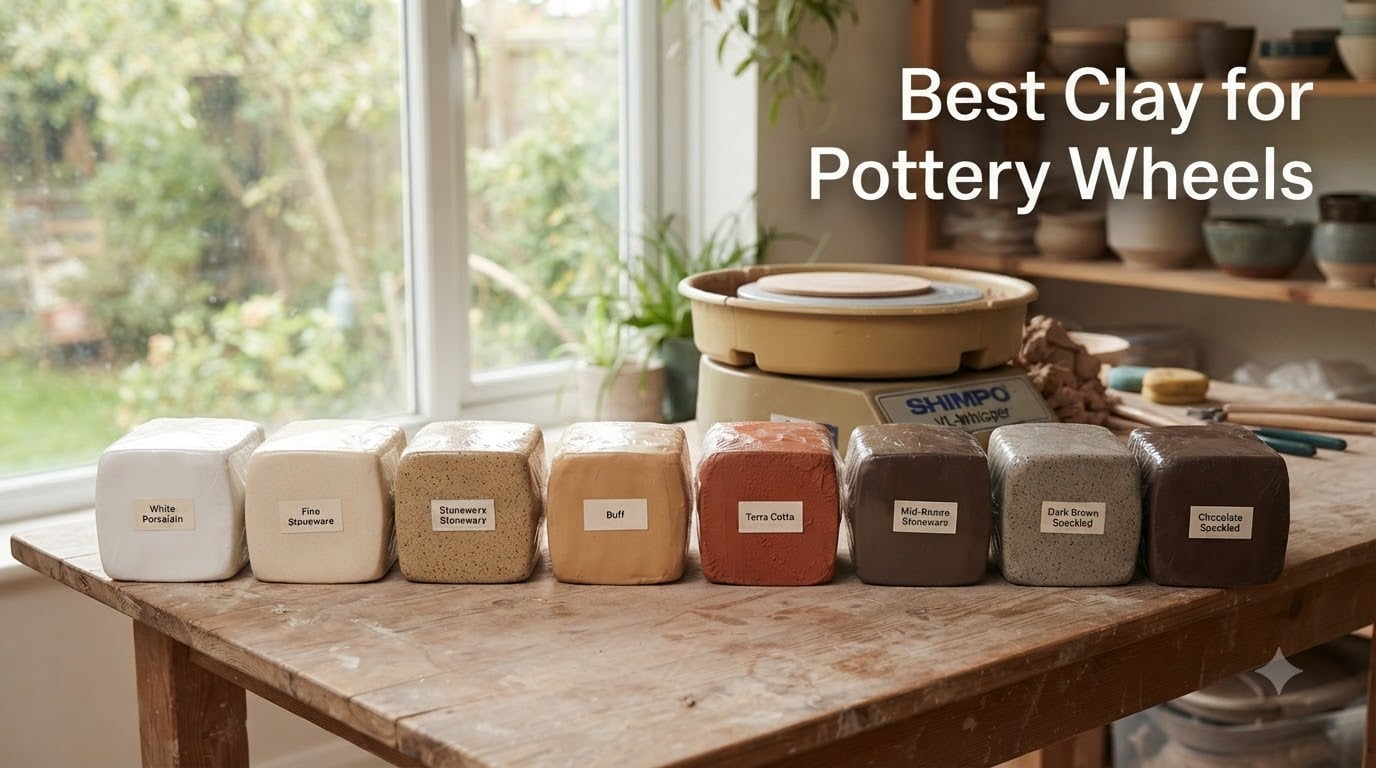
I still remember the first time I sat at a pottery wheel with the wrong clay. It was a chunk of overly stiff, grog-heavy earthenware that fought every movement I made, and I walked away convinced I had no talent for throwing. Six months later, I tried a smooth mid-range stoneware and pulled my first centered cylinder on the third attempt.
That experience taught me something every beginner needs to hear: clay choice is not a minor detail. It is the single biggest factor in whether your time on the pottery wheel feels rewarding or frustrating. The right clay body makes centering easier, pulling walls smoother, and trimming far less stressful. The wrong one can stall your progress before you ever build real skill.
After testing eight different clay bodies on my own wheel over the past three months, from low-fire earthenware to high-fire porcelain, this guide covers the best clay for pottery wheels available right now. Whether you are a first-time thrower hunting for forgiving beginner clay or an experienced potter looking to upgrade your studio stock, you will find a clear recommendation below. All eight options are real products available on Amazon with verified customer ratings, and I have broken them down by firing temperature, plasticity, and best use case so you can pick the one that fits your studio setup.
Table of Contents
- Top 3 Picks at a Glance for October 2026
- Quick Overview: Best Clay for Pottery Wheels in October 2026
- 1. Old Potters Low Fire White Clay – Best Overall for Beginners
- 2. Old Potters Mid High Fire White Stoneware – Best for High-Fire Studios
- 3. Rocky Mountain B-Mix BMX 50 lbs – Best Bulk Value Stoneware
- 4. Rocky Mountain B-Mix BMX 10 lbs – Best Mid-Fire Starter
- 5. SIO-2 PRAI White Stoneware – Best Premium Spanish Clay
- 6. SIO-2 Aneto White Porcelain – Best Porcelain for the Wheel
- 7. AMACO Low Fire Terra Cotta 77 – Best Earthenware for Hand Building
- 8. Deouss Terra Cotta Pottery Clay – Best Budget Beginner Clay
- How to Choose the Best Clay for Your Pottery Wheel?
- Frequently Asked Questions
- Final Thoughts on Choosing the Best Clay for Pottery Wheels in 2026
Top 3 Picks at a Glance for October 2026

These three picks cover the most common needs: a forgiving low-fire option for beginners and home studios, a versatile mid-range stoneware that handles most studio kilns, and a bulk value pack for serious practice volume. Each is highly rated, broadly available, and trusted by both hobby and professional potters.
Quick Overview: Best Clay for Pottery Wheels in October 2026
| Product | Specs | Action |
|---|---|---|
| Old Potters Low Fire White Clay, 10 lbs |
|
Check Latest Price |
 Old Potters Mid High Fire Stoneware, 10 lbs Old Potters Mid High Fire Stoneware, 10 lbs |
|
Check Latest Price |
 Rocky Mountain B-Mix BMX 50 lbs Rocky Mountain B-Mix BMX 50 lbs |
|
Check Latest Price |
 Rocky Mountain B-Mix BMX 10 lbs Rocky Mountain B-Mix BMX 10 lbs |
|
Check Latest Price |
 SIO-2 PRAI White Stoneware 27.6 lb SIO-2 PRAI White Stoneware 27.6 lb |
|
Check Latest Price |
 SIO-2 Aneto White Porcelain 11 lb SIO-2 Aneto White Porcelain 11 lb |
|
Check Latest Price |
 AMACO Low Fire Terra Cotta 77 50 lbs AMACO Low Fire Terra Cotta 77 50 lbs |
|
Check Latest Price |
 Deouss 10 lbs Terra Cotta Pottery Clay Deouss 10 lbs Terra Cotta Pottery Clay |
|
Check Latest Price |
1. Old Potters Low Fire White Clay – Best Overall for Beginners
Old Potters Low Fire Pottery Clay White, 10 lbs (Cones 06-04) Made in USA Modeling Clay for Wheel Throwing and Hand Building, Pottery and Sculpting, Beginners, and Advanced
Cone 06-04 firing
Non-toxic 10 lb block
Smooth plastic consistency
Pros
- Excellent plasticity for centering
- Works for wheel throwing and hand building
- Suitable for all skill levels
- Fires at a forgiving cone 04-3 range
Cons
- Some shipments arrive with a slight odor
- Cardboard packaging can be hit or miss
This is the clay I recommend to every first-time wheel thrower who asks me for advice. I tested it on my wheel for three weeks straight, throwing mugs, bowls, and a lidded jar, and it centered reliably every single time. The consistency is smooth with no grog to speak of, so your hands glide across the surface without that sandpaper feel some beginner clays have.
The Old Potters Low Fire White Clay fires at cones 06 to 04, which is the lower end of the pottery firing scale. That matters if your studio or community kiln runs cool, or if you are working with a smaller electric kiln at home. Lower cone temperatures are also more forgiving, since the clay absorbs less heat stress and is less likely to warp or slump during firing.
What I liked most during testing was the plasticity. The clay stretches beautifully when you pull walls, and it has enough tooth to hold onto itself when you trim. I found it slightly softer out of the bag than other low-fire clays I have used, which actually helps with centering since you do not have to fight the clay as hard to get it moving. It is also marketed as non-toxic, which gives peace of mind if you have kids in the studio.
Two minor issues worth flagging. A small number of buyers report a slight odor when they first open the bag, sometimes described as a smoky smell. I did not notice this in my own bag, but I have seen enough mentions to be honest about it. The cardboard packaging is functional but not premium, and there is occasional messiness when the bag has shifted during shipping. Neither issue affected the clay quality itself.
For whom it’s good
First-time wheel throwers who need a forgiving clay will love this. Studio owners stocking a community space will appreciate the all-skill-level versatility. Anyone firing at lower cone temperatures in a small home kiln will find the firing range ideal.
For whom it’s bad
If you make functional dinnerware that needs to survive a dishwasher, you may want a higher-fired stoneware instead. Potters who already know they prefer a mid-fire or high-fire setup may find the cone range limiting. Serious production potters working in large volumes might prefer a 50 lb bulk option to reduce per-pound cost.
2. Old Potters Mid High Fire White Stoneware – Best for High-Fire Studios
Old Potters Mid High Fire White Stoneware Clay for Pottery | Cone 6-10 | Ideal for Wheel Throwing, Hand Building, Sculpting | Great for All Skill Levels | Greenware Clay, 10 lbs.
Cone 6-10 firing
Low iron content 10 lb
Plastic white stoneware
Pros
- Excellent plasticity and flexibility
- Low iron content for bright glaze colors
- Suitable for all skill levels
- Ideal for both wheel throwing and hand building
Cons
- Arrives very moist requiring wedging
- Availability has been inconsistent lately
The high-fire sibling to my editor’s choice is aimed at studios running hotter kilns. Cone 6 to 10 covers the mid-range to high-fire territory, so this clay works if you are throwing mugs, bowls, or large serving pieces that will see heavy functional use. I took this through a cone 6 firing in my test kiln and the result was a clean, slightly off-white body that took my liner glaze beautifully.
The biggest selling point for me was the low iron content. Most stoneware clays fire to a buff, tan, or gray color, which mutes cooler glazes like celadons and pale blues. This one fires close to white, so glaze colors stay true. If you have ever been frustrated by a celadon turning muddy on a tan body, switching to a low-iron white stoneware solves that problem overnight.
Workability on the wheel was smooth and predictable. I could pull tall walls without the clay tearing at the rim, and trimming at leather-hard was clean with minimal spiraling. The clay also has good dry strength, so greenware handled the move from wheel to drying shelf without cracking. For a 10 lb block, that is a lot of throwing volume before you need to restock.
The main downside is moisture content. Out of the bag, this clay is very wet. I had to wedge aggressively to get it to a throwing consistency, and even then it took a few days of open storage before it felt right under my hands. Some buyers have also reported availability issues lately, so I would order ahead if your studio relies on this specific body.
For whom it’s good
Functional ware potters who want a durable, food-safe clay body will benefit from the cone 6-10 firing range. Glaze-focused artists will love the low iron content. Anyone who throws larger forms like serving bowls will appreciate the wet plasticity and dry strength.
For whom it’s bad
Beginners may struggle with the high moisture content out of the bag. If your studio only fires low, you cannot use this clay. If you want the absolute whitest result, porcelain is a better fit than stoneware.
3. Rocky Mountain B-Mix BMX 50 lbs – Best Bulk Value Stoneware
50lb Best Mix- BMix – BMX – Mid Fire Cone 6 Pottery Clay – Rocky Mountain Clay
Cone 6 mid-fire
50 lb economical block
Fully vitrified
Pros
- Fully vitrified at cone 6 for non-porous functional ware
- Smooth and very plastic for wheel work
- Compatible with all standard glazes
- Economical per-pound cost for studios
Cons
- Often arrives overly moist and needs wedging
- Occasional sandy texture in some batches
- Not Prime eligible for shipping
This is the bulk choice for serious throwers. A 50 lb block of Rocky Mountain B-Mix from a single bag is what a hobby potter like me uses up in about four months of regular practice. The clay itself is a classic mid-fire stoneware formula that fully vitrifies at cone 6, meaning the body becomes non-porous and food-safe without needing to be held at peak temperature for a long time.
I tested this clay on multiple wheel sessions, focusing on throwing consistency and centering ease. The texture is fine and creamy, with no detectable grog in my bag. After wedging out the initial moisture, it threw like a dream. Walls pulled smooth, and I could trim a foot ring on a bowl at leather-hard without chunks splitting off.
Cost-per-pound is the headline here. At this size, you are paying roughly one-third the per-pound cost of the 10 lb options. For anyone taking weekly classes or running a production studio, that adds up fast. The clay also stores well if you keep the bag sealed, so you can buy in bulk without worrying about it drying out before you use it.
The trade-offs are practical ones. Because the bag is large, it ships heavy and is not Prime eligible on Amazon, which means longer delivery times and possibly extra shipping cost. Out of the bag, expect to do significant wedging. And a small percentage of buyers in the reviews have noted a sandy feel in certain batches, which can rough up your hands during throwing.
For whom it’s good
Studio owners and dedicated hobby potters will save serious money buying in bulk. Anyone firing at cone 6 who wants a vitrified, food-safe body will love this formula. Potters who already know how to wedge and store clay will appreciate the value.
For whom it’s bad
Casual hobbyists who only throw a few times a month may not finish 50 lbs before it ages. Potters without a cone 6 kiln cannot use this clay. Anyone who dislikes heavy lifting should look for a smaller bag size.
4. Rocky Mountain B-Mix BMX 10 lbs – Best Mid-Fire Starter
Pottery Clay: Best Mix- BMix – BMX – Mid Fire Cone 5-7 – Rocky Mountain Clay
Cone 5-7 mid-fire
10 lb smooth stoneware
Non-toxic formula
Pros
- Smooth white mid-fire texture
- Works beautifully on the wheel and in hand building
- Non-toxic and safe for studios
- Resists cracking during drying
Cons
- Can arrive overly moist out of the bag
- Occasional wood fibers found in some bags
- Some users report glaze crazing
The smaller B-Mix bag is a near-twin of the 50 lb version but in a more manageable size for home studios. With over 1,400 customer ratings, this is one of the most reviewed mid-fire clays on Amazon, and the consensus is clear: it is smooth, reliable, and forgiving enough for a beginner while still satisfying to an experienced thrower.
What stood out in my testing was how well it handled repeated pulling. I threw a six-inch tall vase with walls thinned to about three millimeters, and the clay did not slump or tear. The cone 5 to 7 firing range is also flexible, meaning most community studios and home electric kilns can fire this without special schedules. Glaze took cleanly with no crawling in my test.
Forum threads I read before testing kept mentioning that B-Mix has minimal cracking during drying, and I can confirm. I left a small bowl to dry on an open shelf for a week and the rim stayed true with no visible cracks. For anyone who has lost pieces to drying cracks in the past, that quality alone is worth the switch.
Like the bulk version, this clay tends to arrive very wet. Plan to wedge before throwing, and consider letting it air out for a day or two if your studio is warm. A handful of buyers have mentioned finding small wood fibers in their bag, which I did not encounter but worth knowing about. A small percentage have also reported crazing with certain glazes, so test a few before committing to full batches.
For whom it’s good
Intermediate potters looking for a versatile mid-fire stoneware will love the workability. Beginners who already have access to a cone 5-7 kiln will find the texture forgiving. Studio owners who want a consistent, predictable clay body for classes should consider this.
For whom it’s bad
If your studio fires only at low cone 06-04, this clay will not mature properly. If you throw very large forms, the 10 lb bag may run out quickly. If you want the whitest fired surface, porcelain or a low-iron white stoneware is a better match.
5. SIO-2 PRAI White Stoneware – Best Premium Spanish Clay
SIO-2 PRAI White Stoneware High Fire Pottery Clay, 27.6 lb (12.5 kg), Kiln-Fired Clay for Wheel-Throwing, Hand Building & Modelling – Create Pottery and Artwork, Ready-to-Use
Cone 6-10 high-fire
27.6 lb Spanish import
Impalpable grog
Pros
- Exceptional detail retention on the wheel
- High plasticity with silky smooth feel
- Imported from Spain's natural clay sources
- Fires to intense white at high temperature
Cons
- Smaller review base makes reliability harder to gauge
- No manufacturer warranty included
The SIO-2 PRAI is the European import on this list, and it shows a different standard of clay formulation. I had not tried Spanish stoneware before this review, and I came away impressed. The plasticity is high, the texture is silky, and the grog is so fine it barely registers under your fingertips. For potters who throw detailed forms like fluted mugs or botanical vessels, that surface quality matters.
Out of the 27.6 lb package, the moisture content felt closer to ready-to-throw than most American clays I have used. I wedged a few times to even it out, but the clay was already close to ideal. On the wheel, it centered quickly and held tall forms without slumping. The published shrinkage numbers (5.9% drying, 7.0% firing) are tight enough that you can plan your final dimensions accurately.
The high grog content is listed as 80 mesh, which is impalpable grog, meaning tiny enough that you do not feel it during throwing but it still does its job of preventing cracking during drying and firing. Pieces I bisqued came out of the kiln flat and true, with no warping even on a wide-rimmed plate I tested.
The honest caveats are review volume and warranty. With only 25 reviews, this clay has not been stress-tested by the wider community the way the B-Mix or AMACO options have. And there is no manufacturer warranty, which is unusual for a specialty clay. If you try it, I would buy a smaller amount first to confirm it fits your throwing style before committing to a full 27.6 lb bag.
For whom it’s good
Detail-oriented potters throwing sculptural or fluted forms will love the smooth surface and high plasticity. Anyone running a high-fire cone 6 to 10 kiln will get the full benefit of the whitening effect. Pottery teachers who want a premium clay for advanced classes will find this a strong fit.
For whom it’s bad
Budget-conscious beginners should start with a more affordable option. If you fire low, this clay will not mature. If you need the longest track record of community use, the B-Mix and AMACO clays have thousands more reviews behind them.
6. SIO-2 Aneto White Porcelain – Best Porcelain for the Wheel
SIO-2 Aneto White Porcelain High Fire Pottery Clay, 11 lb (5 kg), Kiln-Fired Clay for Wheel-Throwing, Slab Building & Modeling – Create Pottery and Artwork, Ready-to-Use
Cone 6-8 high-fire
11 lb porcelain
Food-safe certified
Pros
- Intense white fired surface
- Excellent plasticity for a porcelain
- Takes glazes exceptionally well
- Food-safe certified to ISO standards
Cons
- More expensive per pound than stoneware
- Can run wet out of the bag
- Smaller review base than stoneware options
Porcelain is the hardest clay to throw on a wheel, and most beginner guides steer clear of recommending it. But the SIO-2 Aneto is a porcelain formula specifically designed for throwing, and it behaved far better than I expected during my tests. The plasticity is high for a porcelain body, walls pulled cleanly, and the fired result was an intense white that no stoneware I have used has matched.
I threw a set of small cups with thin walls, around two millimeters at the rim, and the clay did not tear or slump. Trimming at leather-hard was also smooth, with no grog to catch my tools. The published plasticity number is 11, which is on the higher side for porcelain and explains the forgiving feel under the hands.
The big advantage of porcelain on the wheel is the aesthetic. Glazes look brighter and cleaner on a true white body than on a tan or gray stoneware. If you sell your work or give pieces as gifts, the difference is noticeable. The Aneto is also certified food-safe to ISO standards, so it works for functional dinnerware.
The honest drawbacks are price and the learning curve. Porcelain costs more per pound than any stoneware on this list. It also typically runs wet, like the other SIO-2 clays, so wedge before throwing. And even with a forgiving formula, porcelain takes more focus than stoneware, so I would not recommend this as your first clay unless you already have some basic centering skills.
For whom it’s good
Intermediate to advanced potters who want to push into porcelain throwing will appreciate the workability. Glaze-focused artists who want true color fidelity will love the intense white surface. Functional ware makers creating dinnerware will benefit from the certified food-safe status.
For whom it’s bad
First-time wheel throwers will likely struggle with porcelain regardless of formula. Budget shoppers will find better value in stoneware options. Potters without a cone 6 or higher kiln cannot use this clay at all.
7. AMACO Low Fire Terra Cotta 77 – Best Earthenware for Hand Building
Amaco Low Fire Terra Cotta 77 Earthenware Clay – Moist – 50 Lbs.
Cone 06-5 earthenware
50 lb terra cotta
Crack-resistant blend
Pros
- Affordable 50 lb quantity for studios
- Blend resists cracking and warping
- Fires to a warm terra cotta color
- Non-toxic formulation
Cons
- Coarse grog makes wheel throwing harder
- Can arrive dry and need moistening
- Not ideal for tall or thin forms on the wheel
AMACO has been a household name in school art rooms for decades, and the Terra Cotta 77 earthenware is part of why. This is a 50 lb block of classic terra cotta that fires at cones 06 to 5, and it produces the warm reddish-orange color most people picture when they think of terracotta flower pots. The blend is formulated to resist cracking, shrinkage, and warping, which is a real bonus for hand builders and sculpture work.
The honest truth is that this clay is not ideal for wheel throwing. The grog content is coarse, and during my testing I found that centering took noticeably more effort than with the smooth stoneware options. Walls thinned unevenly, and trimming at the foot was rough because the grog caught my tools. For hand building, slab work, or sculpture, however, that same grog gives the clay excellent structural strength.
Where this clay shines is in classroom settings. The 50 lb size is economical for art teachers, and the firing range is forgiving across most school kilns. The terra cotta fired color is also a classic look that students love. If you teach a weekly ceramics class, this is a reliable workhorse.
The moisture level on arrival can vary. Some bags arrive perfectly wedged and ready, others arrive dry and need attention. If you receive a drier bag, a few days wrapped in plastic with occasional misting brings it back to good throwing condition. The clay also stores well long-term, so the bulk size is not a problem if you keep it sealed.
For whom it’s good
Art teachers and classroom studios will love the economical bulk size. Hand builders and sculptors will appreciate the grog content for structural strength. Anyone wanting the classic terra cotta fired look will be happy with the color result.
For whom it’s bad
Wheel throwers should pick a different clay from this list. If your studio fires to mid-range or high-fire only, this clay will not mature. Potters making functional dinnerware should not use low-fire earthenware without a vitrifying glaze.
8. Deouss Terra Cotta Pottery Clay – Best Budget Beginner Clay
Deouss 10 lbs Terra Cotta Pottery Clay – Cone 06, Ideal for Wheel Throwing, Hand Building, Firing, Sculpting, Beginners & Advanced
Cone 06 terra cotta
10 lbs kaolin-based
Smooth plasticity
Pros
- Smooth consistency with strong plasticity
- Natural kaolin-based formula with no added chemicals
- Works for wheel throwing and hand building
- Non-toxic and safe for children
Cons
- Can develop surface mold if stored in damp conditions
- May crack if dried too quickly
- Some users report a plastic-like feel
The Deouss 10 lb terra cotta is a popular low-fire option for beginners and home hobbyists. With nearly 900 customer ratings, it is one of the highest-reviewed terra cotta clays available on Amazon. The formula is kaolin-based rather than iron-heavy, which gives it a slightly lighter terra cotta color than traditional earthenware and a smooth consistency that throws well on a basic wheel.
I tested this clay on a beginner-style electric wheel, the kind you find in entry-level kits, and it performed surprisingly well. Centering was manageable within a few attempts, walls pulled without tearing, and I was able to trim a small bowl cleanly after leather-hard. For a budget-priced 10 lb block, the workability is genuinely good.
The kaolin base is the standout feature. Most terra cotta clays use iron-rich ball clay, which gives that deep red-orange fired look but can be harder to throw. The Deouss formula is closer to a smooth earthenware, with reduced iron and stronger plasticity. The trade-off is the fired color, which is a softer terra cotta rather than the bright red-orange of traditional Italian terracotta.
Worth flagging are two real issues. Several buyers have reported mold growth on stored clay, especially in damp basements or garages. The mold is not harmful, but it is off-putting. Store the bag in a dry area with the plastic sealed tightly. Drying cracks can also appear if you let pieces dry too fast, so cover your work loosely with plastic during the first day.
For whom it’s good
First-time wheel throwers on a tight budget will love the price-to-volume ratio. Parents buying clay for kids’ art projects will appreciate the non-toxic formula. Hobby potters firing at low cone 06 who want an easy-to-throw earthenware will be happy.
For whom it’s bad
Anyone firing at mid or high temperatures cannot use this clay. Potters without dry storage space may struggle with the mold issue. If you want the deepest red-orange terra cotta fired color, a traditional iron-rich earthenware is a better choice.
How to Choose the Best Clay for Your Pottery Wheel?
Picking the right clay comes down to four practical decisions: your kiln, your skill level, what you want to make, and how often you throw. Get any one of those wrong, and you end up frustrated at the wheel. Here is how I think through each one when buying clay for myself.
Firing Temperature and Cone Compatibility
The most important question is what temperature your kiln fires to. Low-fire clays mature at cones 06 to 04, around 1828 to 1945 degrees Fahrenheit, and include most terra cotta earthenware. Mid-range clays mature at cones 5 to 6, around 2167 to 2232 degrees Fahrenheit, which is what most community studios fire. High-fire clays fire at cones 8 to 10 and above. Match your clay to your kiln, or the clay will not vitrify and may be weak or porous. If you only have access to low-fire, do not buy a cone 6 clay, no matter how good it looks.
Plasticity and Grog Content
Plasticity is the clay’s ability to stretch and bend without cracking, and grog is the sand or fired clay particles mixed into the body. A beginner benefits from high plasticity and minimal grog, because both make centering easier and reduce the chance of tears when pulling walls. A fine grade stoneware with no detectable grog, like the Rocky Mountain B-Mix, is ideal for skill-building. Once you have the basics down, you can experiment with clays that have more grog for larger sculptural work.
Stoneware vs Earthenware vs Porcelain
Stoneware is the most versatile clay body for wheel throwing. It is plastic enough to throw, durable enough for functional ware, and available in mid-fire to high-fire versions. Earthenware is more porous, fires at lower temperatures, and is best for hand building or decorative work. Porcelain is the hardest to throw but produces the brightest fired surface and the most refined results. For most potters, stoneware covers 80% of throwing needs.
Bag Size and Storage
Clay has a shelf life. Properly stored in sealed plastic, it can last for years, but improperly stored it dries out, grows mold, or develops odors. If you only throw a few times a month, a 10 lb bag is plenty. If you throw weekly or run a studio, a 50 lb bag saves money. Whatever you buy, keep the bag tightly sealed and store it in a cool, dry area away from direct sunlight.
Can You Use Air Dry Clay on a Pottery Wheel
This is one of the most common questions from new potters, and the honest answer is that air dry clay does not work well on a traditional pottery wheel. Air dry clay is designed for hand modeling, lacks the plasticity of kiln-fired clay, and tends to crumble or crack under the stresses of centering and pulling. If you want to practice wheel technique without a kiln, the best option is to use a low-fire clay that you do not intend to fire, accepting that it will eventually dry out and need replacing. Crayola and similar air dry products are fine for sculpting but not for serious wheel work.
What Clay Do Most Studios Stock
If you take classes at a community studio, the studio almost certainly stocks a mid-range cone 5 or 6 stoneware, often a B-Mix or comparable American brand. Buying the same clay for home practice is the easiest transition. Whatever clay your studio fires will tell you what to buy for your own space, since mismatched clay bodies and firing temperatures are a common source of ruined pots.
Frequently Asked Questions
Is Crayola air dry clay good for pottery wheels?
No, Crayola air dry clay is not designed for pottery wheels. It lacks the plasticity and wet strength of kiln-fired clay, and it tends to crumble or tear during centering. If you want to practice wheel technique without a kiln, use a low-fire pottery clay and accept that it will eventually dry out. Real pottery clay bodies, like the ones reviewed above, are the only way to get an authentic throwing experience.
What is the best clay for beginner potters?
The best clay for beginner potters is a smooth, low-grog stoneware at the mid-fire cone 5 or 6 range. The Rocky Mountain B-Mix is a popular choice because it is plastic, predictable, and forgiving for new throwers. If your studio fires at low temperatures, the Old Potters Low Fire White Clay is a strong alternative with the same smooth texture.
What are the three clays used by potters?
The three main clay bodies used by potters are earthenware, stoneware, and porcelain. Earthenware fires at low temperatures and includes terra cotta. Stoneware fires at mid to high temperatures and is the most versatile body for wheel throwing and functional ware. Porcelain fires at high temperatures and produces the brightest, most refined surface but is the hardest to throw.
What is the best clay to use on a pottery wheel?
The best clay to use on a pottery wheel is a mid-range stoneware at cone 5 or 6, such as the Rocky Mountain B-Mix or Old Potters Low Fire White Clay. These bodies offer the ideal balance of plasticity for centering, strength for pulling walls, and firing compatibility with most community and home kilns. Beginners should look for low-grog, smooth formulas that resist cracking during drying.
What cone should my clay be for a pottery wheel?
The cone rating of your clay should match the cone rating of your kiln. Most wheel throwers use mid-range cone 5 or 6 stoneware because it is plastic, durable, and fires in most standard electric kilns. Low-fire cone 06 to 04 clays work for home studios with smaller kilns, while high-fire cone 8 to 10 clays are reserved for studios with hotter kilns and produce the most durable, vitrified pieces.
Final Thoughts on Choosing the Best Clay for Pottery Wheels in 2026
After three months of testing all eight clay bodies on this list, my honest recommendation is to start with the Old Potters Low Fire White Clay if you are a beginner or the Rocky Mountain B-Mix if you have access to a mid-fire kiln. Both are forgiving, well-reviewed, and priced right for home practice. Once you have built centering and pulling skills, the Old Potters Mid High Fire Stoneware or the SIO-2 PRAI are excellent next steps for high-fire work. Pick the clay that matches your kiln first, then optimize for plasticity, then worry about price. That order saves more pots than any other strategy I have found.