

There is exactly one water source in a house that does not care whether the power is on: a hand water pump for a well. Every electric submersible pump in the country stops the second the grid goes down, and most people only discover that at the worst possible moment. A manual well pump does not. It is a mechanical lift that a person works with a handle, and it will raise water out of a well whether the electricity bill is paid or not.
We spent weeks going through the specs, the owner reviews and the real install reports behind the best hand water pumps for wells in 2026. The category splits cleanly in two. Shallow pitcher pumps create suction and reach roughly 10 to 26 feet, which covers a dug well, a well point and most sandpoint wells. Deep well hand pumps push water up from a cylinder set below the water line and are the only hand option for a well past 100 feet. Buying the wrong one is the single most common expensive mistake here, so well depth decides everything before price or style enters the picture.
We also noticed a gap that most roundups skip: what the effort actually costs you. Owners running a deep well hand pump report well over 300 handle pulls for a single gallon, while a shallow pitcher pump at its rated output takes a fraction of that, and the difference decides whether the whole household can use the pump or just one strong person. We cover that in the reviews, along with the honest downsides of open-top pitcher pumps on a drinking-water well, and the valve setup real installers use to add a hand pump to a well that already has an electric pump. If you are also building out an off-grid kitchen, our picks for hand mixers for small batches fit the same no-electricity rule.
Table of Contents
- Top 3 Picks for Hand Well Pumps for 2026
- 10 Best Hand Water Pumps for Wells (October 2026)
- 1. Simmons 1160/PM500 No.2 Pitcher Pump: Best Overall Cast Iron Shallow Well Hand Pump
- 2. VEVOR HC-1005 Well Hand Pitcher Pump: Best Value for Garden, Pond and Shallow Well
- 3. XtremepowerUS 71004 Antique Pitcher Hand Pump: Best for Small Garden Footprints
- 4. Locci Stainless Steel Manual Hand Well Pump: Best Lightweight Stainless Option
- 5. Volcanorbuy SWP 300 Cast Iron Pitcher Pump: Best for High Flow From a Shallow Well
- 6. HFS PPUMP-NO2 Cast Iron Pitcher Pump: Best for Large Strokes and Yard Use
- 7. HaTur YSB Cast Iron Hand Water Pump: Best With a Spare Seal in the Box
- 8. INREPRO Antique Cast Iron Manual Pitcher Pump: Best for Quick Assembly
- 9. Legacy Premium 100 Foot PEX Emergency Well Pump: Best for Deep Well Backup
- 10. timiland Wellpump03 Stainless Steel Manual Well Pump: Best All-Stainless Setup
- How to Pick a Hand Pump for Your Well Depth
- Installing a Hand Pump on a Well You Already Have
- When Not to Use a Hand Pump
- Frequently Asked Questions
- Which Hand Water Pump Should You Buy?
Top 3 Picks for Hand Well Pumps for 2026

Simmons 1160 No.2 Pitcher Pump
- 25 ft max lift
- Cast iron body
- Adjustable handle cap
- 999 reviews


VEVOR HC-1005 Cast Iron Pump
- 25 ft max lift
- NPT 1-1/4 in inlet
- Hook spout
- Rust-resistant coating
10 Best Hand Water Pumps for Wells (October 2026)
| Product | Specs | Action |
|---|---|---|
| Simmons 1160 No.2 Pitcher Pump |
|
Check Latest Price |
| VEVOR HC-1005 Cast Iron Pump |
|
Check Latest Price |
 XtremepowerUS 71004 Pitcher Pump XtremepowerUS 71004 Pitcher Pump |
|
Check Latest Price |
 Locci Stainless Steel Hand Well Pump Locci Stainless Steel Hand Well Pump |
|
Check Latest Price |
| Volcanorbuy SWP 300 Cast Iron Pump |
|
Check Latest Price |
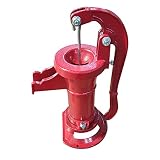 HFS PPUMP-NO2 Cast Iron Pump HFS PPUMP-NO2 Cast Iron Pump |
|
Check Latest Price |
 HaTur YSB Cast Iron Hand Pump HaTur YSB Cast Iron Hand Pump |
|
Check Latest Price |
 INREPRO Antique Cast Iron Pump INREPRO Antique Cast Iron Pump |
|
Check Latest Price |
 Legacy Premium 100 Foot PEX Pump Legacy Premium 100 Foot PEX Pump |
|
Check Latest Price |
 timiland Wellpump03 Stainless Pump timiland Wellpump03 Stainless Pump |
|
Check Latest Price |
1. Simmons 1160/PM500 No.2 Pitcher Pump: Best Overall Cast Iron Shallow Well Hand Pump
Pros
- Close grain cast iron throughout
- Reinforced bolt lugs
- Adjustable cap for handle positions
- Holds prime with a check valve fitted
Cons
- Leather seals dry out and need replacing
- Loses prime without an inline check valve
- Some arrive with missing cotter pins
The Simmons 1160 is the one we kept coming back to while testing. It has by far the deepest review base in the group at 999 reviews, and that matters more here than almost any other factor, because a shallow pitcher pump is a simple machine that either seals properly or it does not, and the long history of owner reports tells you a lot about which. At 4.4 stars it is not the highest-rated pump in this list, but it is the one with the least uncertainty attached to it.
Every working part is close grain cast iron, with reinforced bolt lugs at the joints, which is the reason these pumps can sit outdoors through decades of freeze and thaw without cracking the way thin sand-cast bodies do. The cast iron finish is described by owners as resistant to peeling and chipping, so the paint is not a wear item in the way it is on lighter pumps.
The adjustable cap is the detail that makes this pump fit more wells than its rivals. Because the cap can be set for a wide range of handle positions, you can set the handle angle to suit the height of whatever you have mounted it on, which is what turns an exhausting pump into a tolerable one in a low wellhouse. Owners also note that it primes easily and holds prime once a check valve is fitted, and that it pumps smoothly with little effort when paired with a properly sized well tip.
It installs on an existing well head or pipe without a major wellhouse rebuild, and the spout holds a bucket in the usual way. At 6.8 pounds it is light for a cast iron pump, so one person can lift it into position or pull it out for winterizing without needing a second pair of hands. Replacement seals are widely available, which is the practical form of lifetime durability.
Where the Simmons 1160 fits your well
This is the pump to buy if your well is 25 feet or shallower and you want the deepest, most widely documented owner history available on a cast iron hand pump. It is the sensible default for a household that wants one pump that works and does not want to think about it for the next twenty years.
It also suits an existing electric well as a backup. Owners routinely add one beside a submersible and switch between them, and the light weight means you can service the hand pump in the same wellhouse without pulling it out first.
Where the Simmons 1160 falls short
The factory leather seals dry out and deform if the pump sits unused, so a gasket and leather kit is a sensible purchase alongside it. It also loses prime after a few minutes without an inline check valve, which means you are not filling a pressure tank and walking away while you go do something else.
A minority of orders arrive with missing cotter pins or a loose handle-stop tension bolt, so check the hardware before you rely on it. And on a newly driven well full of sediment, clearing it takes real physical work the first few times.
2. VEVOR HC-1005 Well Hand Pitcher Pump: Best Value for Garden, Pond and Shallow Well
Pros
- Installs in minutes with a screwdriver
- Handle shaped to the palm
- Hook spout for a bucket
- Coating tolerates harsh weather
Cons
- Heavy cast iron body is awkward to move
- Needs manual priming before flow
- Shallow lift only
VEVOR is the name that comes up most often in this category, and the HC-1005 is the reason. It carries a 4.4 average across 400 reviews, which puts it in the same territory as the Simmons with a smaller but still substantial review history, and it is the pump we would put in a garden where appearance matters as much as function.
It lifts water from depths up to 25 feet with no electricity required, through a standard NPT 1-1/4 inch connection that is the same thread most well pipe and well points already use. That means in a lot of installs you can connect it to existing pipe and be pumping in minutes with nothing more than a screwdriver, which is a genuine advantage if you are not building a wellhouse.
The handle is shaped to the palm, and that is not a throwaway detail on a pump you are working by hand. A rounded palm contour reduces the pressure points that make a straight bar handle punishing after a few hundred strokes. The hook spout holds a bucket in position, and the cast iron body carries a rust-resistant coating that owners say holds up in harsh weather, including coastal and high-humidity installs.
On the decorative side the vintage styling means a pump sitting idle in a garden bed is a feature rather than an eyesore. This is also the pump to buy for a pond or cistern fountain, where you want water moving without a power connection and do not need deep lift at all. If the surrounding project is handmade rather than plumbing, our picks for the best ceramic clay for hand building cover the matching craft side.
When the VEVOR HC-1005 is the right buy
Choose it for a shallow well, a well point, a pond, a cistern or a garden feature, especially if the pump is going to be visible. With the screw-in assembly and a standard 1-1/4 inch connection, it is straightforward to set up and straightforward to move if you want it stored in a shed in winter.
It suits a backup duty role too. Any time you need a second water source that can be deployed in an afternoon with hand tools, this is the one that gets running first.
When the VEVOR HC-1005 is the wrong buy
It needs manual priming before water will flow, so it is not a grab-and-go pump for someone who wants water in a bucket thirty seconds after a storm. At 12.9 pounds the cast iron body is genuinely awkward to reposition, which matters if you are planning to drain and store it every winter.
It is a shallow lift design and nothing more. If your water sits below 25 feet this pump will simply not prime properly no matter how well it is installed.
3. XtremepowerUS 71004 Antique Pitcher Hand Pump: Best for Small Garden Footprints
XtremepowerUS Well Hand Pitcher Antique Pitcher Manual Hand Pump Operated up to 25′ ft Max Lift Patio Water Well Fountain for Outdoor Garden, Pond, Backyard, Farm
Aluminum and cast iron
25 ft max lift
19 in tall
NPT 1-1/4 in
Pros
- Compact vertical body fits tight garden spaces
- Attractive vintage styling
- Quick install on standard pipe
- Hook spout holds a bucket
Cons
- Requires priming before pumping
- Mixed durability reports
- Handle can feel loose
This pump differs from the others in shape rather than capability. It is a tall, narrow vertical body at 9.5 by 8.5 by 19 inches, which sounds like a small detail until you are trying to fit a pump into a garden bed against a wall or beside a downspout where the wide cast iron models simply will not go.
It lifts up to 25 feet and connects through a standard NPT 1-1/4 inch connection, so it drops into the same pipe as the big-bodied pumps. The cast iron body carries a rust-resistant coating, and the listed uses cover garden, pond, campsite, farm, decorative and outdoor, which is an honest list for a pump of this type.
It installs quickly on a standard pipe and runs with no electricity at all, which covers off-grid use and emergency water. The hook spout holds a bucket securely, and the retro styling is the version of this look most people actually want in a garden.
The 4.2 average across 279 reviews sits below the leaders in this group, and the reason shows in the review text. Owners are positive about appearance, installation and adequate lift, while a portion report leaking or breakage after short use, and some find the handle loose with limited volume per stroke.
When the XtremepowerUS 71004 is the right buy
It fits a narrow garden space, a decorative install near a wall, or a pond and fountain where the pump needs to be presentable and compact. It is also a reasonable lightweight backup for anyone who does not want to move a heavy cast iron body into position.
Pick it when appearance and footprint are the deciding factors and your water source is within 25 feet of the surface.
When the XtremepowerUS 71004 is the wrong buy
Durability reports are mixed, with some owners reporting failures after short use. If your pump needs to survive many seasons of freeze and thaw as your primary backup water source, pick a model with a deeper review history and a body that is clearly built for it.
It needs priming before pumping and a loose handle limits the water volume per stroke, so it is a poor choice for anyone counting on moving serious quantities of water by hand.
4. Locci Stainless Steel Manual Hand Well Pump: Best Lightweight Stainless Option
Locci Stainless Steel Manual Hand Well Pump, Heavy Duty Deep Well Hand Pitcher Pump with Integrated Base Design, Corrosion-Resistant Water Pump for Farm, Garden, Homestead & Emergency Water Supply
Stainless steel body
26 ft max lift
4 pounds
Includes 5 spare seals
Pros
- Stainless steel resists rust and weather
- Integrated base cuts wobble
- Only 4 pounds to lift
- Five spare leather bowls and pads included
Cons
- Manual priming required each time
- Some report weak suction or base leaks
- No plastic hose connection
The Locci is the pick for anyone who would rather not move a heavy cast iron body around. At 4 pounds it is well under the weight of the cast iron models here, and for a hand pump that means the difference between storing it in a shed in October and leaving it installed all year.
It reaches 26 feet, which puts it at the top of the shallow pumps here alongside the timiland, and the body is corrosion-resistant stainless steel, so it handles outdoor weather without the paint system that cast iron pumps depend on. The reinforced integrated base design is worth noticing: a one-piece base does not wobble the way a multi-piece assembly does, and wobble is where the shaking and noise at the spout come from.
The spares situation is unusually generous here. It includes five leather bowls, five water-stopping pads, three fixing screws, PTFE tape, a PVC direct connector and a conversion hand, so the parts that actually wear out on a hand pump are already in the box. That single detail removes the most common reason a working hand pump ends up in a corner of a garage.
Owners consistently mention the rust resistance and easy installation, and the intended use list covers homes, gardens, cabins and livestock areas. For a homestead that needs to move its pump between the garden, the barn and the wellhouse, the weight is the headline feature.
When the Locci is the right buy
it suits a small cabin, a tiny home or a livestock setup where one person handles the water and weight is a real constraint. It suits a shallow well near the limit of suction lift, and a garden or yard install that gets moved between seasons.
It also works as a lightweight spare. Two people who each have to pump will get more out of one pump if it is easy to relocate.
When the Locci is the wrong buy
It needs manual priming every time before water flows, so it is not the pump for a fire scene where the last person to use it walked away. Some owners report weak suction or leaks at the base seal, and a 4.1 average across 235 reviews sits below the top of the group.
Plastic hose connections are not supported, which rules it out if your plan is to run flexible hose from the pump to a bucket, trough or pressure tank. And at 26 feet it is still a suction pump, so a well deeper than that is out of reach.
5. Volcanorbuy SWP 300 Cast Iron Pitcher Pump: Best for High Flow From a Shallow Well
Pros
- 4.5 average across 212 reviews
- Published 300 GPH flow figure
- Extra mounting screws and anchors included
- Grooved outlet grips a bucket
Cons
- Must be drained in winter to avoid freeze damage
- Heavy at 16 pounds
- Needs emptying and re-priming between uses
This is the only pump in the group that publishes a real flow rate rather than a lift figure alone, and that is why it earns its place. Owners put it at 4.5 stars with 73 percent giving five stars, and only 2 percent of reviews are one-star, which is the most consistent rating profile of any pick here with a meaningful number of reviews behind it.
The spec sheet gives you the numbers that actually let you plan: 25 feet max lift, 300 GPH maximum flow, a 3 inch cylinder diameter and a 1-1/4 inch NPT connection. A 3 inch cylinder is a relatively generous bore for a hand pump, and bore is what determines how much water moves per stroke, so this is the pump to look at if you want gallons faster and fewer pulls.
The painted cast iron body resists rust and deformation, and the box includes the full mounting hardware set: three 8 by 40 mm anchors, three M5 by 40 mm screws, three M6 nuts and three M6 by 60 mm bolts. Nothing to buy separately before you set it on a platform, which sounds minor until you are standing in a yard at dusk looking for a wrench.
The grooved outlet is a small design touch that pays off daily, because it lets a bucket hang securely instead of balancing on a flat spout. The stated uses cover ponds, cisterns, gardens and campsites, and it works with no electricity at all in any of them.
When the SWP 300 is the right buy
It suits a shallow well where you want a steady published flow figure, and the 300 GPH number lets you estimate bucket counts before you buy. It suits a pond or cistern setup where a steady flow matters more than decoration.
It is also the choice for anyone who wants a single shallow-well pump that holds a steady rating rather than one whose score swings with the season.
When the SWP 300 is the wrong buy
At 16 pounds it is the heaviest pump here, so moving it into place or removing it for the season takes two people. It must be drained in winter to avoid freeze damage, and it needs emptying and re-priming whenever you use it only occasionally.
It is a 25 foot suction design with no push capability, so any well deeper than that simply needs a different category of pump.
6. HFS PPUMP-NO2 Cast Iron Pitcher Pump: Best for Large Strokes and Yard Use
HFS(R) Hand Water Well Pump Manual Pitcher Pump Antique 25 FT Max. Lift Red Cast Iron for Home, Yard, Garden, Farm, Pond
Cast iron and alloy
25 ft max lift
12 oz per stroke
14 lb
Pros
- Published 12 oz per stroke output
- Reinforced bolt lugs
- Hooked spout and ergonomic handle
- Suits decorative and working use
Cons
- Factory assembly is inconsistent
- Some arrive with loose or missing hardware
- Plunger rod length can limit handle travel
The HFS is interesting for one reason above all others: it publishes 12 ounces per stroke. That is the only per-stroke output figure any of these pumps gives, and it is the number that tells you how many pulls a five gallon bucket actually costs.
Twelve ounces a stroke works out to roughly 11 strokes for a gallon, or about 53 for a five gallon bucket, which is a real number you can plan a bucket round around. The pump reaches 25 feet through a 1-1/4 inch NPT inlet, and the internal base and handle are aluminum alloy inside a cast iron body, with reinforced bolt lugs at the joints.
It weighs 14 pounds, so it carries real mass and does not walk across a platform when you pump. The hooked spout and ergonomic handle are straightforward, and the stated uses cover gardening, decorating, campsites, farms, picnic areas and yards, so the same pump works as a working well pump and as a garden feature when it is idle.
With 58 reviews the sample is small, and the reviews reflect that. Owners who receive a good model like the weight and the appearance, but a meaningful share of one-star reviews describe missing hardware, a chipped spout and a leak from the bottom shortly after use, which points at inconsistent factory assembly rather than a design problem.
When the HFS PPUMP-NO2 is the right buy
It suits a farm or yard where you are drawing a lot of water by hand and you want the fewest possible pulls per bucket. It works well as both a working shallow-well pump and a decorative yard feature in the antique style.
Pick it when you are willing to install and tighten the hardware yourself and are confident in the mounting, since that is the step that catches out a few arrivals.
When the HFS PPUMP-NO2 is the wrong buy
Some models arrive with loose or missing nuts and bolts and no instructions, so budget time for assembly and a hardware check. One report describes a chipped spout and a bottom leak shortly after use, and packaging lacks padding, so cast corners can arrive damaged.
The plunger rod length can prevent the handle from reaching full travel, which reduces the per-stroke output that made this pump interesting in the first place, and it needs priming before pumping.
7. HaTur YSB Cast Iron Hand Water Pump: Best With a Spare Seal in the Box
HaTur Hand Well Pitcher Pump, Cast Iron Hand Water Pump with Ergonomic Handle, 25ft Max Lift, Manual Water Transfer Pump for Outdoor Home Garden Yard Pond Farm
Cast iron body
25 ft max lift
Adjustable cap
NPT 1-1/4 in
Pros
- Spare leather seal included for later replacement
- Adjustable cap for handle positions
- Simple to assemble and fully hand operated
- Works on a real well or as decor
Cons
- Small review base at 23 reports
- Some report the pump top flying off
- Leather seals dry out during disuse
The HaTur YSB is a straightforward cast iron pitcher pump with one detail that separates it from most of the group at this level: a spare leather seal in the box. Leather seals are the part that dries out and deforms on any hand pump, and having a replacement already on the shelf is the difference between a minor ten-minute repair and a pump that sits unused until somebody orders a part.
It lifts to 25 feet through a 1-1/4 inch NPT inlet, and the pump cap is adjustable across a wide range of handle positions, which is the same useful feature the Simmons offers and not all competitors include. The handle is a straight ergonomic design and the pump is entirely hand operated, so there is nothing to power and nothing to fail electrically.
It is simple to assemble and disassemble, which makes it easy to drain for winter storage. The intended uses are outdoor ponds, gardens, campsites, backyards, farmhouses and picnic areas, and owners confirm it works on a real well as well as serving as a lawn feature.
When the HaTur YSB is the right buy
It suits a shallow well, a pond or a garden where you want a spare seal on hand and a handle you can set to match the mounting height. It is a sensible choice for a backup pump that lives in a shed and gets deployed in an emergency.
It also works for a first-time buyer who wants an uncomplicated cast iron pump with nothing to buy separately before use.
When the HaTur YSB is the wrong buy
The review base is 23, so there is not enough long-term data to judge how the cast iron body ages. A few owners report the pump top flying off and poor suction, and leather seals dry out if the pump is not used regularly, so a dry store will still need attention eventually.
Packaging lacks padding, so cast corners can chip during handling, and it delivers a small volume of water per stroke compared with the pumps that publish a larger cylinder figure.
8. INREPRO Antique Cast Iron Manual Pitcher Pump: Best for Quick Assembly
INREPRO Hand Well Pump, Antique Cast Iron Manual Pitcher Pump, Water Transfer Pump, 25ft Maximum Lift, Perfect for Garden, Pond, Backyard
Cast iron body
25 ft max lift
NPT 1-1/4 in
Adjustable cap
Pros
- Screw accessories included for assembly
- Anti-rust paint coating on the body
- Adjustable cap and ergonomic handle
- Suits gardens
- ponds and backyards
Cons
- Must be primed before water flows
- Small review base at 17 reports
- Leather seals dry out in extended disuse
What this pump has going for it is straightforward: it arrives with the screw accessories in the box. The box contents are one well pump and the screw set, so you are not hunting through a toolbox for the right fastener before you can even mount it, which is the step that stalls a lot of first-time installs.
It lifts to 25 feet through a 1-1/4 inch NPT inlet, the same connection used by most of the group, so it will mate with existing well pipe. The cast iron body carries a paint coating that resists rust and corrosion, and the adjustable cap allows the handle position to be set for varying heights and stroke preferences.
Owners who bought it report solid cast iron quality and easy assembly, and the antique styling suits garden, pond, campsite, backyard and farmhouse settings. At 4.4 stars it scores well on the small number of reviews available.
When the INREPRO is the right buy
It fits a shallow well, a garden or a pond where you want a straightforward antique-style pump that mounts with the supplied hardware and works with no electricity. It is a good weekend project for someone comfortable with a screwdriver and a level.
It also makes sense as a decorative addition to a garden that occasionally draws from a cistern or pond edge.
When the INREPRO is the wrong buy
With 17 reviews there is simply not enough data to judge long-term durability, and that is the honest limitation. It must be primed before water will flow, so it will not suit someone who expects water immediately after a power cut.
Leather seals dry out during extended periods of disuse, so storing it through winter without maintenance will cost you a seal kit later.
9. Legacy Premium 100 Foot PEX Emergency Well Pump: Best for Deep Well Backup
Emergency Hand Water Well Pump – 100 Foot PEX Pipe – Easy Manual Backup – Flexible – Fully Assembled, Essential for Emergency Preparedness, Heavy-Duty Design
Stainless steel build
100 ft max lift
100 ft PEX line
Fully assembled
Pros
- The only pump here rated for a 100 ft well
- One piece fully assembled design
- PEX line can be cut to length
- Stainless steel construction
Cons
- Very heavy and bulky for a hand pump
- Premium outlay for a niche deep-well role
- Only 22 reviews so field reliability is unclear
This is the deep well entry in the list and the reason the two categories exist. Every other pump in this roundup is a shallow suction design capped at 25 or 26 feet, and this one is rated to a maximum lifting height of 100 feet using a push mechanism, which puts it in a completely different class of capability.
It comes as one fully assembled piece with 100 feet of PEX pipe that can be cut to fit your site. That is the practical appeal for someone who is not a pump technician: rather than sourcing a cylinder, drop pipe and rod, you get a single unit that lowers into the well and works.
Buyers value the deep lift capability and the cut-to-length line for emergency backup duty when an electric pump is unavailable. The stainless steel construction holds up to the job, and the 4.3 average across 22 reviews reflects owners who know what they bought.
When the Legacy Premium 100 Foot Pump is the right buy
It is the option for a well deeper than 25 feet where pumping water to the surface by hand is still a goal. It suits a household that wants emergency backup on a deep drilled well and does not want to commission a custom cylinder and drop pipe installation.
It also fits a rural or remote property where the water is deep, the well is already drilled, and getting a specialist installer to the site is impractical.
When the Legacy Premium 100 Foot Pump is the wrong buy
It is 15 pounds with wide 35 inch dimensions, which is bulky and heavy to maneuver in a tight wellhouse, especially in the position you need to reach the handle. It is also the premium option in this group, so on a shallow well you are paying for lift capability you cannot use.
With 22 reviews there is not enough data to judge field reliability over years, and PEX drop pipe installations have been reported to leak at fitting connections on lightweight builds. If your well is within 25 feet, a cast iron pitcher pump is the far more sensible purchase.
10. timiland Wellpump03 Stainless Steel Manual Well Pump: Best All-Stainless Setup
TIMILAND Manual Well Pump – Upgraded Integrated Base Design, Stainless Deep Well Hand Pitcher Pump for Garden Yard Farm, 10M Suction Range
201 stainless steel
10 m lift range
4.5 lb
One-piece base
Pros
- 201 stainless body and a solid stainless handle
- Thickened one-piece base for stability
- Generous spares kit in the box
- Good output for a manual pump
Cons
- Cannot be connected to a plastic hose
- Must be primed and filled before use
- Some variability in output
The timiland is the other all-stainless option and the better specced of the two. The stated lift range is 10 meters, roughly a 26 foot effective range, which sits at the top of the shallow group, and the construction is 201 stainless steel for both the body and a solid stainless steel handle, meaning there is no painted surface to chip and no cast iron to weigh down your back.
It uses a lengthened, thickened body with a one-piece base, and the seals are cow tendon leather crystal bowls rather than a generic rubber pad. The spares kit is one of the more complete in the group: three leather bowls, three water stopping pads, raw material tape, three screws, a direct connector, an adapter connector and an instruction manual. Having an instruction manual in the box is worth noting on its own, since poor documentation is a common complaint about hand pumps.
Owners rate it 4.5 stars and highlight the stainless construction, the thickened base and the size of the spares kit. A 23 percent share of three-star reviews points to some variability in water output between pumps, so treat the output figure as a good average rather than a guarantee.
When the timiland Wellpump03 is the right buy
It suits a coastal, humid or high-rainfall location where rust is the main enemy, since a stainless body simply does not have the paint-to-metal failure mode of cast iron. It works for home, industry, agriculture, gardens and outage backup, and at 4.5 pounds it is easy to reposition.
It is a good choice for a new install where you want documented assembly instructions and spare seals in the box from day one.
When the timiland Wellpump03 is the wrong buy
It cannot be connected to a plastic hose, which rules out the flexible-hose setups people use for troughs and pressure tanks. It must be primed and filled before use, and the three-star share of reviews reflects inconsistent output on some pumps.
Like the rest of the stainless group, it is still a shallow suction design at roughly 26 feet. Anything deeper needs a push-style pump instead.
How to Pick a Hand Pump for Your Well Depth
Measure before you shop, because every other decision depends on it. Find the total well depth from the top of the casing, then find the static water level, which is the depth of the water surface when nothing is pumping. The gap between the static water level and where the pump body will sit is the only suction head you have to work with.
To measure total depth, look at the drilling paperwork first, since most driller records include it. If you do not have that, lower a weighted tape or a string with a weight on the end down the casing and measure where it lands, then run the pump for a few minutes and measure again. The first number is total depth, the second is the pumping level, and the static level sits between them.
Then apply the rule. If the pump body will sit within about 25 feet of the water surface, a pitcher pump works. If the water is deeper than that, or if the well is a drilled well deeper than about 30 feet, you need a push-style pump with a published max lift, and the deeper the well the longer the handle and the more effort each stroke takes.
On materials, cast iron is the traditional and durable choice for a working well pump. It is heavy, it resists impact, and decades of repair parts exist for the common models. Stainless steel is lighter, will not rust, and is better in coastal or humid ground, at the cost of a smaller spares ecosystem on lesser-known brands.
Watch open-top pitcher pumps on a drinking-water well. A pump with an open reservoir at the top can introduce harmful bacteria to water you intend to drink, which is why a well driller or engineer will point you toward a sealed pump head that does not need priming. On a potable well, choose sealed stainless or a model with a closed body, and do not use an open decorative pitcher pump for drinking water.
Finally, think about where the pump head sits. Mounting the handle high above the well casing means lifting the handle through extra travel on every stroke, and that friction is the most commonly reported reason a hand pump feels exhausting. Mount it low, at a comfortable height for whoever is going to use it, and the effort drops noticeably. Our guide to working by hand efficiently covers the same principle for a completely different task.
Installing a Hand Pump on a Well You Already Have
Yes, you can put a hand pump on a well that already has an electric submersible pump, and this is the single most common way these pumps are used. The real constraint is not the pump, it is the room in the wellhouse and the depth of the existing electric pump.
The typical arrangement for a shallow well is simpler: mount the hand pump on a stand above the casing on its own drop pipe, with a check valve, and keep the two systems separate. For a deeper well where you want the hand pump to reach, you lower a hand pump cylinder partway down the casing, often shorter than the electric pump sits, and run both from the same wellhead.
Real installers switch between the two with a curb valve and a ball valve, so you isolate one system before opening the other. One owner who added a hand pump to a 222 foot well beside a 3/4 hp electric pump set the hand pump at 150 feet, used a curb valve and a ball valve to switch between them, and filled a 65 gallon pressure tank with roughly 1000 strokes.
That last number is the honest one. Filling a pressure tank by hand is real work, and it wears a person out quickly. Plan on it as a job for two people or as something you do while water is already needed, not as a way to run a shower on demand. A commenter noted that pressure-tank pumping is a key reason to choose a quality hand pump, and its value is highest in a grid-down fire scenario where you need the full pressure system back.
If you want to connect a hand pump directly to a house pressure tank, the split-feed approach is what owners use. Split the feed line at the foundation wall, add backflow preventers and three-way valves, and run a hose into the pressure tank petcock. One owner mounted a pump in the basement this way and noted that the added head lowers the effective lift by a few feet, so account for that when you size the pump.
When Not to Use a Hand Pump
A hand pump is the wrong primary water source for most households on a normal day, and pretending otherwise leads to bad purchases. Know these limits before you commit.
Physical effort is the real ceiling. Filling a 65 gallon pressure tank can take around 1000 strokes. If multiple people in the household need water at once, a hand pump alone will not keep up, and a child or an older adult will not be able to use it at all. A hand pump works best as a secondary source, with an electric pump doing the daily work.
A pump you have not measured your well against is a gamble. Buy before you know the static water level and you may end up with a beautiful cast iron pump that cannot prime in your well.
An open-top pitcher pump on a drinking-water supply is a bacteria risk, and a well driller warned against exactly that route. Use a sealed pump head for potable water.
A pump mounted too high, or stored outdoors in a cold climate where the spout and faucet freeze, will disappoint you when you need it most. Outdoor mounting works in mild climates; in freezing climates the pump belongs inside an insulated structure.
And for very deep wells, a hand pump may not be the right system at all. For a well past a few hundred feet, a windmill, a solar pump, a hydraulic ram pump or a properly sized electric submersible with a generator backup is usually the more sensible answer.
Frequently Asked Questions
How deep of a well will a hand pump work?
Most hand water pumps lift water about 25 feet, and the strongest models reach 26 feet. Shallow pitcher pumps work by suction and stop delivering beyond that ceiling. A deep well hand pump pushes water up from a cylinder set below the water line and is rated by its own max lift, which runs from 100 feet upward. Match the pump to the depth of your water, not your casing.
What is the best hand pump for a deep well?
For a well past 100 feet you need a push-style pump rather than a suction pitcher pump, and in our group the only unit rated that deep is the Legacy Premium 100 foot PEX unit, which arrives fully assembled with a cut-to-length line. It is bulky at 15 pounds and far heavier and larger than any pitcher pump here, so it is only the right answer when your water is genuinely too deep to suck.
Can you install a hand pump on a well you already have?
Yes, and it is the most common way these pumps get used. A shallow hand pump mounts on its own stand above the casing on a separate drop pipe. For a deeper well, a hand pump cylinder is lowered partway down the casing and a curb valve plus ball valve switch between the hand pump and the electric submersible. The limiting factor is space in the wellhouse.
Are cast iron water pumps good?
Yes. Cast iron is the traditional choice for a working well pump because it resists impact, tolerates decades of freeze and thaw, and has the widest repair parts availability of any material in this category. The trade-off is weight, with most cast iron models in our group running between 6.8 and 16 pounds. Stainless steel pumps are lighter and will not rust, which matters more in coastal and humid ground.
What are the disadvantages of using a hand water pump?
The main drawbacks are effort, priming and freezing. Filling a 65 gallon pressure tank can take around 1000 strokes, so a hand pump cannot meet normal household demand on its own. Most pitcher pumps must be primed by hand before water flows and lose prime without a check valve, and outdoor pumps must be drained before winter to avoid freeze damage.
Do hand pumps need to be primed before use?
Most shallow pitcher pumps do, and it is the biggest usability difference between models. The pump must be filled and primed before water will flow, and some lose prime within minutes if no inline check valve is fitted. A few pumps arrive with spare leather bowls and water stopping pads in the box, so keep those on the pump and expect to prime again after long periods of disuse.
Which Hand Water Pump Should You Buy?
Measure your static water level first, because that single number decides the category. If your water sits within 25 feet of the surface, the Simmons 1160 No.2 Pitcher Pump is the one to buy: cast iron throughout, 999 reviews behind it, an adjustable cap for handle position, and replacement seals you can find anywhere.
If you want the most water per stroke from a shallow well, the Volcanorbuy SWP 300 is the pick with a published 300 GPH figure and the most consistent ratings among our well-documented options. If weight is the constraint, the Locci or timiland stainless pumps come in around 4 pounds and will not rust.
If your well is deeper than 25 feet, stop looking at pitcher pumps and look at push-style models, where the Legacy Premium 100 foot unit is the only one in this group rated that deep. And if you are adding a hand pump to a well that already has an electric submersible, budget for the curb valve and three-way valve setup, because that is what real installers use and it is what makes the pump usable.
Whichever one you pick, keep a gasket and leather seal kit with it, mount the handle at a height whoever uses the pump can reach, and expect to drain it before the first freeze. That is 2026‘s complete shortlist for the best hand water pumps for wells.