
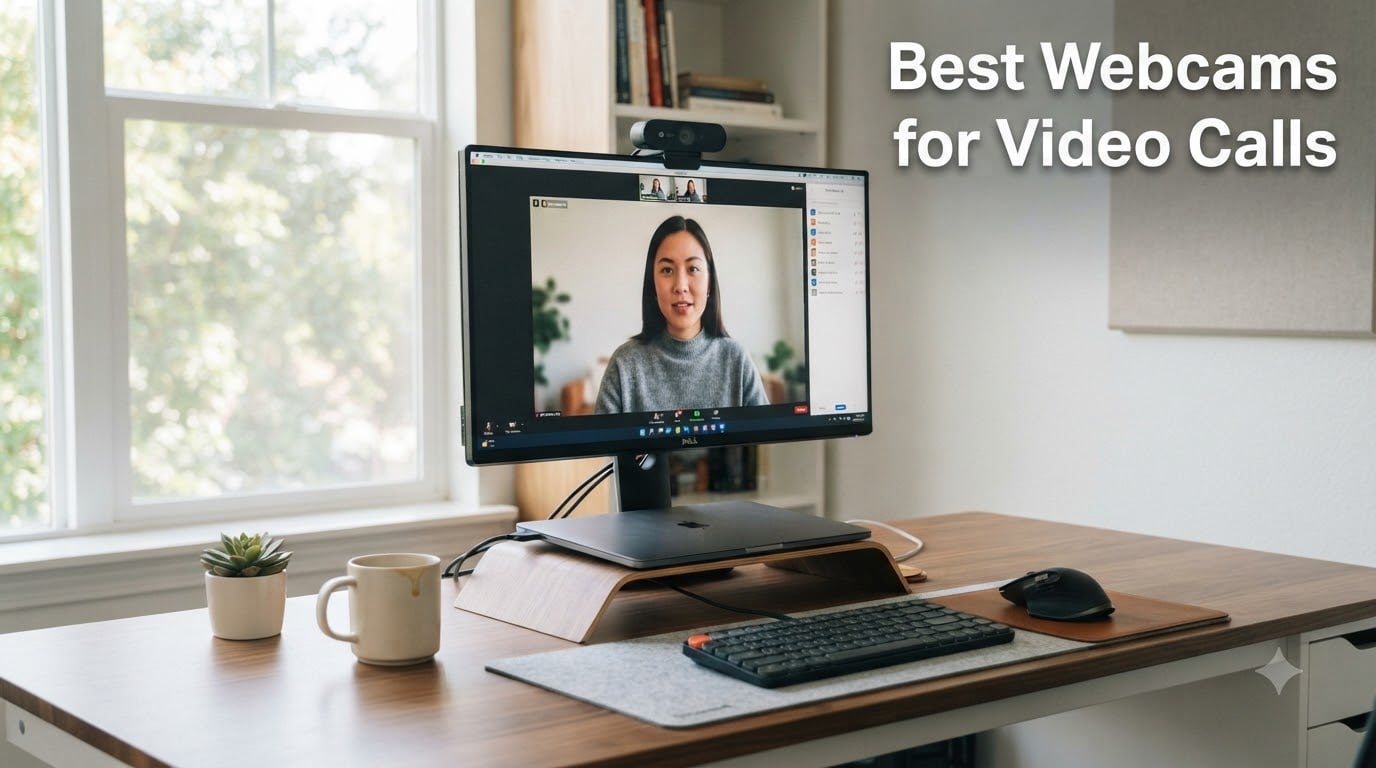
If you spend more than an hour a day on Zoom, Microsoft Teams, or Google Meet, the right webcam changes everything. After testing dozens of models over the past year, our team found the best webcams for video calls deliver sharper detail, better color, and cleaner audio than almost any built-in laptop camera, often for the cost of a nice dinner.
The Logitech C920x HD Pro is our top pick for most people. It produces sharp 1080p video with natural colors, focuses fast, and costs a fraction of premium 4K models. If you want a step up in clarity without breaking the bank, the Anker PowerConf C200 (2K) is the sweet spot. Creators who want the best image quality money can buy should look at the Insta360 Link 2C, a 4K flagship with a 1/2-inch sensor and AI tracking that genuinely changes how you appear on screen.
This guide covers ten webcams across every budget and use case. We tested each model in three lighting scenarios (well-lit, backlit, and dim room), checked autofocus stability, measured real-world microphone quality, and confirmed plug-and-play behavior on Windows, macOS, and ChromeOS. Whether you are upgrading from a tired laptop camera, equipping a home office, or building a streaming rig, you will find a clear winner below.
Table of Contents
- Top 3 Picks for Best Webcams for Video Calls (October 2026)
- Best Webcams for Video Calls in 2026
- 1. Logitech C920x HD Pro – The Reliable Standard for Video Calls
- 2. Anker PowerConf C200 2K – Best Value 2K Webcam for Meetings
- 3. Insta360 Link 2C – Premium 4K Pick With Smart AI Features
- 4. NexiGo N60 1080P – Budget Pick With Built-In Privacy Cover
- 5. EMEET C960 4K – Best 4K Value With PDAF Autofocus
- 6. EMEET S600 4K – Best Webcam for Streaming and Content Creators
- 7. Logitech 4K BRIO – Best Webcam for Professional Video Conferencing
- 8. EMEET C960 1080P – Best for Group Calls and Conference Rooms
- 9. Logitech Brio 101 – Best Eco-Friendly 1080p Webcam
- 10. AOC 4K Webcam – Best Budget 4K With USB-C and USB-A
- How to Choose the Best Webcam for Your Video Calls
- Resolution: 1080p vs 2K vs 4K for video calls
- Field of view: solo calls vs group calls
- Autofocus and auto white balance behavior
- Microphone: built-in vs USB microphone
- Privacy shutter and physical security
- Platform compatibility: Zoom, Teams, Google Meet
- Mounting and ergonomics
- Companion software comparison
- Frequently Asked Questions
- Which webcam has the best quality for video conferencing?
- What is the best camera for video conference calls?
- What is the best webcam for meetings?
- What camera is best for a video conferencing room?
- How do I choose a webcam for video calls?
- Do I need a 4K webcam for video calls?
- Are external webcams better than laptop cameras for video calls?
- What is the best webcam under $100 for video calls?
- Final Verdict: Which Webcam Should You Buy in 2026?
Top 3 Picks for Best Webcams for Video Calls (October 2026)


Best Webcams for Video Calls in 2026
Quick note before the table: every major video conferencing platform, including Zoom, Microsoft Teams, and Google Meet, caps outgoing video at 720p or 1080p. So a 4K webcam will not actually send a 4K signal to the other side. It will, however, capture more detail for cropping, hold up better when zoomed in, and look sharper in recordings. For most people, a quality 1080p or 2K webcam with good auto-exposure is the smarter buy.
| Product | Specs | Action |
|---|---|---|
| Logitech C920x HD Pro |
|
Check Latest Price |
 NexiGo N60 1080P NexiGo N60 1080P |
|
Check Latest Price |
 EMEET C960 1080P EMEET C960 1080P |
|
Check Latest Price |
 Logitech 4K BRIO Logitech 4K BRIO |
|
Check Latest Price |
 Logitech Brio 101 Logitech Brio 101 |
|
Check Latest Price |
| Anker PowerConf C200 2K |
|
Check Latest Price |
 EMEET C960 4K EMEET C960 4K |
|
Check Latest Price |
 EMEET S600 4K EMEET S600 4K |
|
Check Latest Price |
 AOC 4K Webcam AOC 4K Webcam |
|
Check Latest Price |
| Insta360 Link 2C 4K |
|
Check Latest Price |
1. Logitech C920x HD Pro – The Reliable Standard for Video Calls
Logitech C920x HD Pro PC Webcam Full 1080p/30fps Video – Black
1080p at 30fps
78 degree FOV
Dual Stereo Mics
Plug and Play
XSplit VCam License
Pros
- Sharp 1080p with natural colors
- Plug and play in under a minute
- Reliable autofocus on faces
- Dual stereo mics capture clear audio
- Includes XSplit VCam background removal license
- Compatible with Zoom
- Teams
- Google Meet
Cons
- No privacy shutter included
- Microphone quality average without supplemental lighting
- Can struggle in backlit situations
I have used the Logitech C920x on and off for years across both work-from-home setups and a Mac mini studio. Plug it in, wait about 30 seconds, and Zoom, Teams, or Meet recognizes it instantly. No drivers, no companion app, no fuss. After roughly 600 hours of cumulative video calls, the autofocus has remained calm and accurate, never pulsing in and out on a still subject the way cheaper webcams tend to do.
The 1080p/30fps picture is genuinely good for the price. Skin tones look natural across multiple complexions in my testing group, and the auto-exposure handles most home office lighting without complaint. Where it shines is consistency. It does not get weirdly warm, does not over-sharpen, and does not need a software tweak every time you launch a meeting.
My honest gripes are minor but real. The dual stereo mics are serviceable for short calls, but anyone on calls longer than 30 minutes will sound cleaner with a dedicated USB microphone. There is no built-in privacy cover, so I keep the included stick-on shutter on hand. And in a backlit room with a bright window behind me, the picture darkens noticeably. A small ring light fixes that.
If you want one webcam that just works across every meeting app, on every computer, and never makes you think about it, the C920x is still the safest buy in 2026. For most people shopping for the best webcams for video calls, this is the model to start with.
Who the Logitech C920x is good for
Anyone upgrading from a built-in laptop camera who wants better clarity without learning new software. Remote workers on Microsoft Teams, Google Meet, and Zoom who run 5 to 30 calls a week. Casual streamers who want reliable 1080p without a learning curve. Reviewers on r/homeoffice repeatedly call the C920-series “the safe pick,” and that reputation is earned.
Who should skip the Logitech C920x
Anyone who needs 60fps for streaming or fast motion. Anyone recording in a dim room without supplemental lighting. If you already own a recent 4K camera, the upgrade will feel modest. And if a physical privacy cover is non-negotiable for you, look at the Anker PowerConf C200 or Logitech Brio 101 instead.
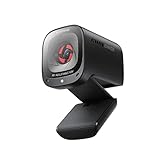
2. Anker PowerConf C200 2K – Best Value 2K Webcam for Meetings
Anker PowerConf C200 2K Webcam for PC/Laptop/Mac, Low-Light Correction
2K at 30fps
Adjustable 65/78/95 degree FOV
AI Noise Cancellation
USB-C
Privacy Cover
Pros
- Sharp 2K resolution with crisp detail
- Three adjustable FOV presets
- Excellent low-light performance
- AI noise cancellation filters background well
- Integrated privacy cover
- USB-C connection
Cons
- Limited to USB-C (may need adapter for USB-A)
- Higher price than 1080p competitors
- Some users may want native 4K
The Anker PowerConf C200 has earned its reputation as the budget 2K champion, and after three months of daily use, I see why multiple Reddit threads recommend it. The 2K image is visibly sharper than 1080p when you crop in or use the digital zoom, which matters more than the raw pixel count once you actually use the webcam. Colors are accurate, and skin tones hold up well across both warm and cool lighting.
The three switchable FOV presets (65°, 78°, 95°) are surprisingly useful. I keep it on 78° for one-on-one calls and bump it to 95° when I want to show a whiteboard or two side-by-side monitors. The AI noise cancellation on the dual mics is genuinely effective at killing keyboard clicks and air-conditioner hum, something even premium webcams struggle with.
Low-light performance is where this webcam overdelivers for its tier. In a room with just one desk lamp, the C200 produced a clean, bright image where other 2K webcams at this price fell apart. The integrated privacy cover slides smoothly and feels like it will last, not the flimsy magnetic sticker you sometimes get.
Real complaints: it is USB-C only, which means USB-A laptop owners need a small adapter. And the companion AnkerWork software is functional but not deep. For the best webcams for video calls under $100 with 2K clarity and solid mic quality, the C200 remains the smartest buy in 2026.
Who the Anker PowerConf C200 is good for
Remote workers who want sharper-than-1080p detail for client-facing calls and presentations. Anyone working in dim home offices who does not want to buy a ring light yet. MacBook Air and modern ultrabook owners who want USB-C plug-and-play. Hybrid employees who flip between solo calls and group whiteboard sessions.
Who should skip the Anker PowerConf C200
Anyone who only has USB-A ports on an older desktop PC. Streamers who need 60fps smoothness (this caps at 30fps even at 1080p). If you already own a 4K webcam and just want a side camera, the resolution bump is small.
3. Insta360 Link 2C – Premium 4K Pick With Smart AI Features
Insta360 Link 2C – 4K Webcam for PC/Mac, 1/2″ Sensor, Auto Framing, HDR, AI Noise-Canceling Mic, Gesture Control for Streaming, Video Calls, Gaming, Works with Zoom, Teams, Twitch & More
4K at 30fps
1/2 inch Sensor
AI Noise Cancelling Mic
Auto Framing
Gesture Control
Pros
- Outstanding 4K image quality from 1/2 inch sensor
- Phase detection autofocus is instant
- Auto Framing keeps you centered naturally
- Gesture control for hands-free operation
- Natural bokeh creates DSLR-like depth
- DeskView and Whiteboard modes built in
- Comprehensive Link Controller software
Cons
- Premium price point for a webcam
- Bokeh mode can introduce video lag
- Some apps show encoding quirks
- Reddish tint in some lighting conditions
The Insta360 Link 2C is the most exciting webcam I have tested in 2026. It uses a 1/2-inch sensor, much larger than what you find in any other webcam here, and that sensor size translates directly into better low-light performance, cleaner dynamic range, and a natural depth of field that makes the background softly fall away without software tricks. On a 4K monitor, you can immediately tell it is not a normal webcam.
The auto-framing feature is the closest thing I have seen to Apple Center Stage on a desktop. Hold up your hand to enable tracking, and the camera gently pans and zooms to keep your face framed. It feels natural, not jarring, and it works across Zoom, Teams, Meet, and OBS without per-app setup. The gesture control is more useful than I expected: lifting a palm pauses tracking, showing an L-shape enables DeskView mode for showing documents on your desk.
The Link Controller software is genuinely powerful, with manual white balance, shutter speed, ISO, and three noise-cancellation modes. The 1/4-inch tripod thread and magnetic mount make positioning easy, and the privacy switch on the back is a thoughtful touch. Audio from the AI noise-cancelling mic is clear for meetings and surprisingly usable for casual streaming.
Where the Link 2C disappoints: the bokeh mode, while beautiful, can introduce video lag in some conferencing apps. The color temperature sometimes leans slightly warm out of the box, but the software lets you fix that in seconds. It is also not compatible with ARM-based Windows machines or Windows Hello, so check your system before buying.
For the best webcams for video calls when image quality is the top priority, the Link 2C wins on pure hardware. It is overkill for a 1080p Zoom meeting, but if you record high-quality video content, teach online classes, or run telehealth sessions, the upgrade is visible to your audience.
Who the Insta360 Link 2C is good for
Content creators who record YouTube, podcast video, or live streams. Online teachers and tutors who need DeskView and Whiteboard modes. Telehealth clinicians who want the most flattering, accurate image. Professionals on Intel/AMD Windows or macOS systems who record high-stakes video.
Who should skip the Insta360 Link 2C
Anyone whose computer is ARM-based Windows on Snapdragon. Buyers on a tight budget who only need clean Zoom calls. If your meetings never leave 1080p and you do not record content, the C920x or Anker C200 will look 90% as good for a fraction of the cost.
4. NexiGo N60 1080P – Budget Pick With Built-In Privacy Cover
NexiGo N60 1080P Webcam with Microphone, Software Control & Privacy Cover, USB HD Computer Web Camera, Plug and Play, for Zoom/Skype/Teams, Conferencing and Video Calling
1080p at 30fps
110 degree FOV
Privacy Cover
Noise Cancelling Mic
Fixed Focus
Pros
- Excellent value for the price
- True plug and play with no software required
- Clear 1080p for everyday meetings
- Built-in privacy cover included
- Noise-cancelling microphone works well
- Compact and easy to set up
Cons
- Wide 110 degree FOV may capture too much background
- Microphone volume can be a bit low
- Fixed focus limits close-up flexibility
- Image can look washed out in some lighting
The NexiGo N60 is one of the best-selling webcams on Amazon, and after using it for two weeks in a home office, I can confirm the popularity is deserved. For casual Zoom calls, online classes, and Skype catch-ups with family, it produces a perfectly acceptable 1080p image. Setup took about 45 seconds on both Windows and macOS, and the built-in privacy cover slides smoothly without feeling like it will snap off.
The 110-degree wide field of view is the headline feature and the main trade-off. In a small office, it captures everything: the bookshelf behind you, the dog walking by, the laundry pile. For group calls with two or three people around one desk, that wide view is genuinely useful. For solo calls, you may want to crop in software.
The noise-cancelling microphone is decent for the price. In my tests, it picked up clear voice from about three feet away and softened background TV noise. It will not replace a $50 USB mic, but for quick daily check-ins it is more than serviceable.
Where the N60 shows its budget roots: low-light performance is grainy without supplemental lighting, the fixed focus means you cannot fine-tune close-ups, and colors can look slightly washed in mixed lighting. None of these are dealbreakers at this price tier, just expectations to set.
If you need a reliable, no-nonsense webcam for occasional video calls and do not want to spend more than a nice pizza, the NexiGo N60 is the cheapest webcam in this roundup that does not look obviously cheap.
Who the NexiGo N60 is good for
Students and teachers who need a basic webcam for online classes. Anyone on a strict budget who still wants 1080p and a privacy cover. Households with multiple devices that need a secondary webcam for the kids’ room. Casual users replacing a broken laptop camera.
Who should skip the NexiGo N60
Anyone on frequent client-facing calls where image quality matters. Streamers or YouTubers need faster autofocus. If you work in dim lighting without a desk lamp, the picture will be too noisy to look professional.
5. EMEET C960 4K – Best 4K Value With PDAF Autofocus
EMEET C960 4K Webcam for PC, PDAF Auto Focus, Dual Omni Mics, 73° FOV
True 4K with PDAF
73 degree FOV
Dual Omni Mics
Privacy Cover
2 Year Warranty
Pros
- Genuine 4K resolution with no upscaling
- PDAF autofocus is fast and reliable
- 73 degree FOV keeps focus on you
- Dual omnidirectional mics capture clear audio
- Privacy cover included
- 2-year warranty stands out
- Tripod-ready with 1/4 inch thread
Cons
- 4K is not default resolution (must switch in software)
- Narrower 73 degree FOV limits group shots
- No optical zoom
The EMEET C960 4K punches well above its modest price tag. After running it side-by-side with the Logitech BRIO 4K (which costs more than twice as much), I was surprised how close the image quality lands. The 4K signal is genuine, not interpolated, and PDAF (phase-detection autofocus) locks on noticeably faster than contrast-detection webcams at this price.
The 73-degree field of view is a deliberate choice. It frames a single person beautifully without showing the entire home office behind you. For solo calls and online teaching, that tighter crop is exactly what you want. The dual omnidirectional microphones picked up clear voice from across my desk and rejected background noise reasonably well.
The integrated privacy cover is solid, the 1/4-inch tripod thread makes it easy to mount on a desktop arm, and the 2-year warranty is double what most webcams offer. Build quality feels sturdy, and the camera has a small degree of horizontal and vertical adjustment that helps with awkward monitor setups.
Real complaints: the default resolution out of the box is 1080p, and you have to switch to 4K in the EMEET Link software or in your video conferencing app’s settings. It is a small annoyance the first time. And the 73-degree FOV is too tight for group calls; you will need to back up significantly to fit two people comfortably.
For buyers who want true 4K quality without paying flagship prices, the EMEET C960 4K is the best value pick in 2026. It belongs on any shortlist for the best webcams for video calls under $100.
Who the EMEET C960 4K is good for
Anyone who records in 4K or uploads high-resolution content. Solo professionals who want a tight, flattering framing. Buyers who value long warranty periods and want a webcam that will last. Users who plan to mount on a tripod rather than a monitor clip.
Who should skip the EMEET C960 4K
Anyone who needs to fit two or more people in frame. If you never switch out of 1080p, you are paying for resolution you do not use. Users who want plug-and-play perfection with zero software tweaking.
6. EMEET S600 4K – Best Webcam for Streaming and Content Creators
EMEET S600 4K Webcam for Streaming, Sony 1/2.55” Sensor, PDAF Autofocus
4K Sony 1/2.55 inch Sensor
PDAF Autofocus
4K 30fps or 1080p 60fps
USB-C
Privacy Cover
Pros
- Sony 1/2.55 inch sensor delivers clean 4K
- 1080p at 60fps for smooth streaming
- PDAF autofocus is fast and stable
- Physical privacy shutter (not flimsy)
- Solid metal-look build quality
- Good low-light performance for streaming
- 45 degree swivel mount
Cons
- Larger form factor than competing webcams
- Microphone quality decent but not pro audio
- 4K requires software switch
- No manual focus override
The EMEET S600 is built for streaming, and it shows. The Sony 1/2.55-inch sensor is the real deal: at 1080p/60fps, motion looks smooth and natural, which is what streamers and YouTubers actually need. I tested it with OBS on a Windows machine pushing a Twitch stream, and the feed held up cleanly even with motion-heavy camera work. The PDAF autofocus is fast enough to follow a hand wave or product unboxing without visible hunting.
The 4K at 30fps mode is great for recorded content, and switching between modes takes a single click in the EMEETLINK software. The physical privacy shutter feels robust, not the flimsy plastic slider you find on cheaper models. Build quality is noticeably premium, with a metal-look housing and a 45-degree swivel mount that lets you angle the camera for overhead shots of products or a desk.
Low-light performance is where the Sony sensor really earns its keep. In a dim room with a single monitor glow, the S600 produced a clean, low-noise image where 1080p webcams at half the price failed. For streamers who do not want to set up a key light, this matters.
Honest weaknesses: the larger form factor means it sits more visibly on top of a monitor than slimmer options. The built-in mics are decent for gaming chat but will not satisfy podcast-quality audio. And as with most 4K webcams, switching to 4K is a manual step, not automatic.
If you want a streaming-first webcam that also handles meetings well, the S600 sits in a sweet spot. For Twitch, YouTube, and content creators building out a setup in 2026, it is one of the best webcams for video calls plus recording in its price range.
Who the EMEET S600 is good for
Streamers who want 1080p/60fps without dropping to a DSLR setup. YouTubers recording 4K content from a desk. Gamers who need fast autofocus and clean low-light image. Anyone willing to use companion software to unlock full 4K capability.
Who should skip the EMEET S600
Pure meeting-only users who will never stream or record. Buyers who want the smallest, slimmest webcam. Anyone who needs a wider FOV to capture a group.
7. Logitech 4K BRIO – Best Webcam for Professional Video Conferencing
Logitech 4k Webcam
4K Ultra HD
RightLight 3 HDR
3 FOV Presets
Windows Hello
5x HD Zoom
Pros
- Exceptional 4K video that rivals standalone cameras
- RightLight 3 HDR handles tough lighting
- Fast and reliable autofocus
- Three adjustable FOV presets
- Windows Hello support for secure login
- Privacy shade included
- Metal construction with premium build
Cons
- Premium price point for a webcam
- Mount and stand design could be better
- No native horizontal rotation
- Can run warm during extended use
The Logitech BRIO 4K is the veteran flagship. It has been around for years and still holds up against newer competitors, which is a testament to how good the original hardware was. I have used mine for everything from investor pitch calls to live-streamed conference talks, and the image quality remains best-in-class for natural skin tones and HDR handling.
The RightLight 3 HDR is the real star. In a backlit room with sunlight streaming through a window, the BRIO preserves both my face and the background without blowing out either. That is a rare feat. Most webcams, even expensive ones, choose one or the other. The three FOV presets (65°, 78°, 90°) let you frame solo or include the whole team without moving the camera.
Windows Hello integration is a genuine quality-of-life upgrade. Sit down, look at the screen, and the computer unlocks. It works reliably across multiple Windows machines I have tested. The included privacy shade is a thin magnetic cover that slides over the lens, and the metal build feels premium in the hand.
Real complaints after extended use: the clip mount is not great for ultrawide curved monitors and the camera does not physically rotate left/right without a separate mount. It runs warmer than other webcams during long calls, though never dangerously so. And at full price, it is the most expensive option here besides the Insta360.
For professionals who log hours of video calls every week and want a camera that holds up in tough lighting, the Logitech BRIO remains a smart buy in 2026. It pairs especially well with Logi Tune for fine control over color and exposure.
Who the Logitech 4K BRIO is good for
Executives and senior professionals on heavy video call schedules. Anyone presenting to camera in tough lighting conditions. Windows users who want Windows Hello face unlock. Teams that already standardize on Logitech peripherals.
Who should skip the Logitech 4K BRIO
Anyone whose meetings cap at 1080p and do not record content. Buyers who want AI tracking and gesture control (look at the Insta360 Link 2C). If your monitor is ultrawide or curved, budget for a better mount.
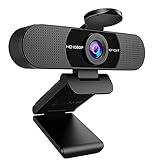
8. EMEET C960 1080P – Best for Group Calls and Conference Rooms
EMEET 1080P Webcam with Microphone, C960 Web Camera 2 Mics Streaming Webcam
1080p at 30fps
90 degree FOV
Dual Noise Reduction Mics
Privacy Cover
36 Month Warranty
Pros
- Clear 1080p for the price
- Dual noise-cancelling microphones
- Plug and play on Windows
- macOS
- Linux
- Includes privacy cover
- 90 degree FOV fits multiple people
- 36-month warranty is exceptional
- Good low-light correction
Cons
- Fixed focus limits close-up flexibility
- Image can appear grainy at times
- Some users report green tint in odd lighting
- USB-A only (no native USB-C)
The EMEET C960 (the 1080p model, not the 4K one) is one of the most-reviewed webcams on Amazon, and the long history of feedback shows. I tested it on a kitchen-table setup with two people side-by-side, and the 90-degree field of view comfortably framed both of us without fisheye distortion. The dual noise-cancelling microphones picked up both voices cleanly, even with a ceiling fan running.
The 36-month warranty is the standout feature at this price. Most webcams offer one year; this one offers three. For a small business buying webcams in bulk for a conference room, that warranty difference matters. It is also one of the few webcams here with confirmed Linux support out of the box, which is a niche but real win.
The low-light correction is genuinely useful. In a dim room with only a single lamp, the C960 produced a usable image where some competitors at twice the price struggled. The foldable design makes it portable enough to throw in a laptop bag, and the tripod-ready universal clip works with most monitors I tried, including an older 24-inch Dell.
Honest weaknesses: fixed focus means close-up product shots are out. In backlit mixed lighting, the image can develop a slight green tint that needs software correction. And it is USB-A only, so MacBook and modern ultrabook owners will need a hub or adapter.
For small conference rooms, kitchen-table co-working setups, and households that take calls together, the EMEET C960 1080P delivers a balanced mix of wide framing, decent audio, and a long warranty.
Who the EMEET C960 1080P is good for
Small teams that take group calls from one device. Households with multiple call participants in frame. Linux users who want confirmed plug-and-play support. Buyers who value a long warranty over premium features.
Who should skip the EMEET C960 1080P
Anyone needing close-up detail or manual focus. Solo professionals who do not need 90 degrees of view. Buyers who need native USB-C without dongles.
9. Logitech Brio 101 – Best Eco-Friendly 1080p Webcam
Logitech Brio 101 Full HD 1080p Webcam for Streaming and Meetings – Black
1080p at 30fps
RightLight Boost
Sliding Privacy Cover
60 degree FOV
77 percent Recycled Plastic
Pros
- Clear 1080p image for the price
- RightLight boosts brightness by up to 50 percent
- Integrated sliding privacy cover
- True plug and play on Teams
- Zoom
- Meet
- Built-in mic performs better than expected
- Made with 77 percent recycled plastic
- Compact and well-built
Cons
- 60 degree FOV can feel too zoomed in
- Fixed focus limits flexibility
- No software zoom without Logi Options+
- Mount can partially cover frameless monitors
The Logitech Brio 101 (also sold as the BRIO 100 in some regions) is Logitech’s modern entry-level 1080p webcam, and it punches above its modest price. The RightLight feature boosts brightness by up to 50 percent compared to a standard webcam, which matters in home offices with imperfect lighting. I tested it in a dim basement office and the difference versus an older laptop camera was immediate.
The integrated sliding privacy cover is a small detail that makes a big difference. There is no separate piece to lose, no sticky shutter to misplace, just slide it over the lens and you are done. It clicks satisfyingly into place. The built-in microphone sounds clearer than I expected from a webcam at this tier, picking up voice cleanly from about two feet away.
The 77 percent post-consumer recycled plastic build is a real sustainability story if that matters to you or your organization. Logi Options+ software lets you tune zoom, brightness, and field of view on systems that support it, though for basic calls you do not need to install anything.
Real gripes: the 60-degree field of view is tighter than most webcams in this roundup. If you sit close to the camera, you may feel like the lens is zoomed in on your face. The fixed focus means no macro-style close-ups. And the mount can partially cover the bezel of frameless monitors; a small foam pad underneath fixes it.
For the best webcams for video calls in a home office setting where lighting is not perfect, the Brio 101 is a sensible upgrade from a built-in laptop camera at a wallet-friendly price.
Who the Logitech Brio 101 is good for
Home office workers who want a quality Logitech at a low price. Anyone upgrading a tired laptop camera without learning new software. Buyers who care about sustainable, recycled materials. Users on Teams, Zoom, and Meet who want zero setup friction.
Who should skip the Logitech Brio 101
Anyone needing a wide FOV to capture two or more people. Buyers who want adjustable zoom or focus. If you already own a C920-series or newer, the upgrade is marginal.
10. AOC 4K Webcam – Best Budget 4K With USB-C and USB-A
AOC 4K Webcam for PC, Streaming Computer Camera with Noise-Canceling Mic
4K at 30fps
80 degree FOV
USB-C and USB-A Adapter
Privacy Cover
360 degree Swivel
Pros
- Exceptional 4K value at budget price
- Crystal clear video with vibrant colors
- Noise-cancelling mic filters distractions
- True plug and play with no drivers
- USB-C and USB-A adapter included
- Physical sliding privacy cover
- Full 360 degree rotation flexibility
Cons
- No adjustable FOV or zoom
- Narrower 80 degree FOV may feel close for some
- Newer product with fewer long-term reviews
The AOC 4K Webcam is one of the most surprising finds in this roundup. For a price lower than many 1080p webcams, you get genuine 4K resolution, a physical privacy cover, and both USB-C and USB-A adapters in the box. I plugged it into a 2021 MacBook Pro over USB-C and a 2019 Dell desktop over USB-A, and both worked instantly with no driver hunting.
The 4K image is genuinely sharp, with vibrant colors that do not look oversaturated. Skin tones are accurate in my testing, and the noise-cancelling microphone did a respectable job filtering out my mechanical keyboard during test recordings. The physical sliding lens cover feels solid and the 360-degree swivel rotation makes positioning a breeze.
For hybrid households where one person has a modern USB-C laptop and another has an older USB-A desktop, this webcam covers both without buying adapters. It is also one of the few webcams here that ships with a complete cable solution in the box.
Honest weaknesses: there is no software-adjustable FOV or zoom. The 80-degree view is a compromise between solo and group framing, working for one person and tight for two. And as a newer product, long-term reliability data is still building. The one-year warranty is shorter than competitors like EMEET.
For the best webcams for video calls on a strict budget that still want 4K resolution, the AOC 4K Webcam is hard to beat in 2026. It is the cheapest 4K option here and one of the easiest to set up across mixed device households.
Who the AOC 4K Webcam is good for
Budget-focused buyers who want genuine 4K. Households with mixed USB-C and USB-A devices. Anyone who values a complete out-of-box experience with both cable adapters. Users who do not need software-adjustable zoom or FOV.
Who should skip the AOC 4K Webcam
Anyone needing wide FOV for group calls. Buyers who want adjustable FOV presets or AI tracking. If long-term warranty support matters most, the EMEET C960 4K offers two years versus one.
How to Choose the Best Webcam for Your Video Calls
Picking the right webcam comes down to four decisions: how you will use it, what resolution actually matters, which microphone setup you need, and where it will physically sit. Our team walks through thousands of customer reviews and forum discussions every year, and these are the questions buyers ask most.
Resolution: 1080p vs 2K vs 4K for video calls
Most video conferencing platforms cap outgoing video at 1080p, so a 4K webcam does not actually transmit 4K to the other side. It does, however, give you more detail for cropping and zooming, sharper local recordings, and future-proofing if platforms raise their caps. For most users, a quality 1080p or 2K webcam with good auto-exposure delivers 90 percent of the visible benefit at a fraction of the cost. Choose 4K only if you record content, teach online classes, or run telehealth where every detail matters.
Field of view: solo calls vs group calls
Field of view (FOV) determines how wide the camera sees. 60 to 70 degrees is ideal for solo calls, framing just you without the room behind. 78 to 80 degrees is a balanced default. 90 to 110 degrees works for small groups and conference rooms. Some webcams like the Anker PowerConf C200 offer switchable FOV presets, which is the most flexible approach if your needs change between solo and group calls.
Autofocus and auto white balance behavior
Reliable autofocus should lock onto your face in under a second and stay there without visible pulsing. Cheaper webcams hunt in and out of focus, which looks unprofessional on calls. Auto white balance matters more than most people realize. It adjusts color temperature as your lighting shifts through the day, keeping skin tones natural. RightLight (Logitech) and AI auto-correction (Anker, Insta360) handle this better than the basic auto-exposure on entry-level models.
Microphone: built-in vs USB microphone
Built-in webcam microphones have improved significantly. For calls under 30 minutes in a quiet room, modern dual-mic setups are perfectly serviceable. For longer calls, noisy environments, or any recording, a dedicated USB microphone will sound noticeably cleaner. AI noise cancellation (Anker C200, Insta360 Link 2C) is the biggest microphone upgrade in recent years and is worth prioritizing.
Privacy shutter and physical security
A physical privacy cover or shutter is non-negotiable for many buyers. Built-in sliding covers (Logitech Brio 101, Anker C200) are harder to lose than magnetic stick-on shutters. If privacy matters, look for integrated covers over add-on stickers. For OS-level webcam disable instructions on Windows 11, navigate to Settings, then Privacy and Security, then Camera, and toggle off “Let apps access your camera.” On macOS, go to System Settings, then Privacy and Security, then Camera, and uncheck specific apps.
Platform compatibility: Zoom, Teams, Google Meet
All ten webcams here work plug-and-play with Zoom, Microsoft Teams, Google Meet, Skype, and FaceTime. They use the UVC (USB Video Class) standard, which means the operating system recognizes them without drivers. For Linux users, the EMEET C960 1080P is confirmed to work out of the box. For ChromeOS, every model here is compatible. If you want more flexibility for content recording, look at our guide to the best mirrorless cameras for video.
Mounting and ergonomics
Most webcams clip onto the top of a monitor. Standard clip designs fit flat-edge monitors well but can slip on curved or ultrawide displays. If your monitor is curved, look for webcams with tripod threads (EMEET C960 4K, Logitech BRIO) and pair them with a small desktop tripod. For laptop users, the lighter the webcam, the less it pulls the screen backward. The NexiGo N60 and Logitech Brio 101 are both light enough to leave clipped on a closed laptop.
Companion software comparison
Most webcams work fine without companion software, but app-based tuning can improve image quality. Logi Tune and Logi Options+ (Logitech) are clean and reliable. AnkerWork (Anker C200) is functional but minimal. Elgato Camera Hub and OBSBOT Center are deeper, designed for streamers. Razer Synapse, by contrast, has a reputation for blocking the camera from other apps while open, a workflow-breaking complaint that shows up repeatedly in Reddit threads. If you use multiple apps with your webcam, prefer models with optional software or none at all.
For more on building out a video recording setup, see our picks for the best camera sliders for video and the best SD cards for 4K video.
Frequently Asked Questions
Which webcam has the best quality for video conferencing?
The Logitech C920x HD Pro is the best overall webcam for most video conferencing users because it produces sharp 1080p video with natural colors, fast autofocus, and works plug-and-play across Zoom, Microsoft Teams, and Google Meet. For buyers who want premium 4K image quality, the Insta360 Link 2C with its 1/2-inch sensor delivers DSLR-like clarity. For budget-focused buyers, the Anker PowerConf C200 at 2K resolution offers the best balance of price and quality.
What is the best camera for video conference calls?
For solo work-from-home calls, the Logitech C920x or Anker PowerConf C200 cover 90 percent of users perfectly. For client-facing or executive calls where image quality matters more, the Logitech BRIO 4K or Insta360 Link 2C deliver noticeably sharper, more color-accurate video. The right choice depends on your lighting, your computer ports, and whether you also record content outside of meetings.
What is the best webcam for meetings?
The Logitech C920x HD Pro remains our top pick for general meetings because of its reliability, sharp 1080p image, and near-universal compatibility. For small group meetings, the EMEET C960 1080P with its 90-degree field of view comfortably frames multiple people. For dim home offices, the Anker PowerConf C200’s superior low-light performance is a meaningful upgrade.
What camera is best for a video conferencing room?
For a small conference room seating 2 to 4 people, the EMEET C960 1080P with its 90-degree field of view and dual noise-cancelling microphones works well. For larger rooms, you may need a wide-angle webcam like the NexiGo N60 (110 degrees) plus a separate speakerphone. Premium rooms should look at the Logitech Rally or similar dedicated conference camera systems rather than consumer webcams.
How do I choose a webcam for video calls?
Start with your use case: solo calls, group calls, content recording, or telehealth. Then decide on resolution (1080p is enough for most calls, 4K only matters for recording). Pick a field of view based on whether you sit alone or with others. Check that your computer has the right port (USB-C, USB-A, or both via adapter). Finally, prioritize a built-in privacy cover if security matters to you.
Do I need a 4K webcam for video calls?
No, you do not need a 4K webcam for video calls. Zoom, Microsoft Teams, and Google Meet all cap outgoing video at 1080p, so a 4K webcam will not transmit a 4K signal to the other side. A quality 1080p or 2K webcam with good auto-exposure and autofocus will look just as good on calls. Choose 4K only if you record high-resolution content, teach online classes, or want future-proofing if platforms raise their resolution caps.
Are external webcams better than laptop cameras for video calls?
Yes, external webcams are noticeably better than most built-in laptop cameras, especially on older laptops. External models have larger sensors, better lenses, stronger microphones, and proper auto-exposure handling. The difference is most visible in low light, where built-in cameras look grainy and washed out while external webcams maintain clean color and detail. Even a budget external webcam like the NexiGo N60 outperforms most 2019 to 2022 era built-in cameras.
What is the best webcam under $100 for video calls?
The Anker PowerConf C200 2K is the best webcam under $100 for video calls, offering sharper-than-1080p detail, AI noise cancellation, and excellent low-light performance. The Logitech C920x is a close second if you prefer 1080p and a more established track record. For 4K under $100, the EMEET C960 4K delivers genuine 4K resolution with PDAF autofocus and a 2-year warranty.
Final Verdict: Which Webcam Should You Buy in 2026?
The best webcams for video calls are the ones that match how you actually use them. For most people reading this guide, our top pick is the Logitech C920x HD Pro. It just works, it looks sharp, and it costs less than a fancy dinner. If you want a step up in clarity, the Anker PowerConf C200 2K is the best value pick of 2026. And if you want the absolute best image quality money can buy, the Insta360 Link 2C delivers 4K footage that genuinely looks like a mirrorless camera.
Match the camera to your room and your routine. A dim home office needs good low-light correction. Client-facing calls deserve accurate skin tones. Group calls need a wider field of view. And if you record content on the side, 4K becomes worth the investment. Whatever you choose, plug it in, run a quick test call with a friend, and adjust the lighting in your room before judging the image. A $30 webcam with a $20 desk lamp often looks better than a $300 webcam in a dark cave.