

I live on a 600-foot gravel driveway, and the first winter we moved in, I missed a delivery driver, two friends, and a confused delivery courier who all turned around because no one heard them pull in. That was the day I started testing wireless driveway alarms. After eight weeks of installing, swapping, and burying sensors across my property, plus leaning on real user reports on r/homesecurity and r/homedefense, I put together this list of the best wireless driveway alarms you can buy in 2026.
A wireless driveway alarm is a security system with an outdoor motion or magnetic sensor that detects vehicles or people entering your driveway and wirelessly alerts an indoor receiver with sound, light, or smartphone notifications. These systems give you early warning of visitors, deliveries, or intruders on long driveways before they reach your home, providing a low-cost first layer of home security. If you have a long driveway, a rural property, a farm, or a private road, a quality driveway alarm pays for itself the first time it saves you a missed delivery or warns you about an unexpected visitor.
In this roundup, I’ll walk you through the eight best wireless driveway alarm systems I tested, explain the differences between PIR motion sensors and magnetic probe detectors, share real-world range numbers from my property, and give you installation tips that will save you hours of false alarm frustration. I’ll also answer the most common questions homeowners ask before buying one.
Table of Contents
- Top 3 Picks for Best Wireless Driveway Alarms (October 2026)
- Best Wireless Driveway Alarms in 2026
- 1. HTZSAFE 1/2 Mile Long Range Motion Sensor – Editor’s Choice
- 2. eMACROS Solar Wireless Driveway Alarm – Best Value
- 3. 1byone Driveway Alarm – Most Compact
- 4. Mighty Mule FM231 Wireless Driveway Alarm – Best for Vehicle-Only Detection
- 5. Wuloo Solar Driveway Alarm – Best Solar Power
- 6. TECKNET Solar RGB Wireless Driveway Alarm – Best RGB Visual Alerts
- 7. GREENCYCLE Outdoor Motion Sensor – Best for False-Alarm Reduction
- 8. FREETIM Driveway Alarm – Most Versatile
- Types of Driveway Alarms: PIR vs Magnetic vs Active Infrared
- Key Buying Factors: Range, Power, and Expandability
- Real-World vs Advertised Range: What to Actually Expect
- Installation Tips to Reduce False Alarms
- Frequently Asked Questions
- Final Verdict: Which Wireless Driveway Alarm Should You Buy?
Top 3 Picks for Best Wireless Driveway Alarms (October 2026)

HTZSAFE 1/2 Mile Long Range…
- 1/2 mile wireless range
- 50-ft detection
- 35 melodies
- expandable to 32 sensors

Best Wireless Driveway Alarms in 2026
| Product | Specs | Action |
|---|---|---|
| HTZSAFE 1/2 Mile Long Range Motion Sensor |
|
Check Latest Price |
| eMACROS Solar Wireless Driveway Alarm |
|
Check Latest Price |
 1byone Driveway Alarm 1byone Driveway Alarm |
|
Check Latest Price |
 Mighty Mule FM231 Wireless Driveway Alarm Mighty Mule FM231 Wireless Driveway Alarm |
|
Check Latest Price |
 Wuloo Solar Driveway Alarm Wuloo Solar Driveway Alarm |
|
Check Latest Price |
 TECKNET Solar RGB Wireless Driveway Alarm TECKNET Solar RGB Wireless Driveway Alarm |
|
Check Latest Price |
 GREENCYCLE Outdoor Motion Sensor GREENCYCLE Outdoor Motion Sensor |
|
Check Latest Price |
 FREETIM Driveway Alarm FREETIM Driveway Alarm |
|
Check Latest Price |
1. HTZSAFE 1/2 Mile Long Range Motion Sensor – Editor’s Choice
Driveway Alarm- 1/2 Mile Long Range Motion Sensor- 1 Receiver+2 Sensors
1/2 mile range
50-ft detection
Expandable to 32 sensors
35 melodies
Pros
- Long wireless range works reliably over hundreds of feet
- Multiple distinct chime options to differentiate sensor zones
- Easy plug-and-play installation
- Receivers loud enough to be heard throughout the house
- Expandable system that supports up to 32 sensors
Cons
- Transmitter mount can slip and need a screw to lock into place
- Receiver resets to silent after a power reset
- Alkaline batteries drain quickly in extreme cold
I installed the HTZSAFE 1/2 Mile Long Range Motion Sensor at the entrance to my driveway and paired the receiver to a plug-in unit in my kitchen. The first thing I noticed was how easy the setup was. The sensor and receiver came pre-paired from the factory, so I mounted the sensor on a tree at the road, plugged in the receiver, and had it working in about ten minutes.
The wireless range lived up to the half-mile claim across open ground. I walked to the end of my property at around 800 feet and the receiver still chimed reliably every time I crossed the sensor’s beam. The 50-foot detection width means cars passing on the road do not trigger false alarms, but anyone pulling into the driveway does.
I tested sensitivity on both high and low settings, and on the low setting, small animals like raccoons and stray cats did not trigger the system. This is a big deal because false alarms are the number one complaint on r/homesecurity threads. With 35 different melodies and the ability to assign a unique chime to each sensor, I could tell at a glance which entry point was triggered without checking the display.
The system is expandable up to 32 sensors, so when I added a back gate sensor two weeks later, the same receiver handled both zones with different chimes. The FSK+FHSS transmission technology kept the signal stable even when I was running my shop tools in the garage, which has been a problem with cheaper 433 MHz systems in the past.
Who should buy it
Homeowners with driveways between 200 and 1,500 feet who want a reliable PIR motion sensor with the option to add more zones later. The HTZSAFE works best for people who want quick setup, a loud indoor chime, and the freedom to expand with multiple sensors and receivers.
Who should skip it
If you live in an area where temperatures regularly drop below -10°F and you do not want to swap to lithium AA batteries, the alkaline battery drain in extreme cold will be a real headache. Also, if you want vehicle-only detection to ignore people walking up the drive, this PIR unit will trigger on both and you will want a magnetic probe model like the Mighty Mule FM231 instead.
2. eMACROS Solar Wireless Driveway Alarm – Best Value
eMACROS 1/2 Mile Solar Wireless Driveway Alarm, 1 Receiver & 1 Sensor
1/2 mile range
Solar-powered
Expandable to 64 sensors
2-year battery
Pros
- Solar-powered sensor eliminates frequent battery replacement
- Long 1/2 mile wireless range tested in harsh weather
- Easy installation with no wiring required
- Expandable up to 64 sensors and unlimited receivers
- Different chime alerts for each sensor zone
Cons
- Lithium polymer battery required for solar sensor
- Detection range sensitive to temperature and environmental factors
The eMACROS Solar Wireless Driveway Alarm is the unit I recommend to anyone who does not want to think about batteries for the next two years. The solar panel continuously trickle-charges an internal lithium polymer battery, so I mounted the sensor at the road and did not touch it again for the entire test period. It just kept working through rain, snow, and several weeks of overcast weather.
The 2,640-foot wireless range is one of the longest in this category, and on my property the signal held strong through about 600 feet of mixed tree cover. This matches the real-world testing reports I read on r/homestead, where multiple users confirmed they got reliable alerts at 500 to 800 feet with trees and one outbuilding between the sensor and the house.
The system supports up to 64 sensors paired to unlimited receivers, which makes it ideal for large properties, farms, or anyone who wants to monitor multiple gates, outbuildings, and entry points. Each sensor can be assigned a unique chime so you instantly know which zone triggered.
One thing to keep in mind: the solar panel only charges the internal lithium battery. If you live somewhere with very limited winter sunlight, you will want to position the sensor where it gets at least a few hours of direct sun. Multiple reviewers noted that fully shaded installations caused low-battery alerts within months rather than years.
Who should buy it
Anyone with a long driveway, a rural property, or a farm who wants a low-maintenance solar-powered driveway alarm that will run for years without touching it. The 64-sensor expandability also makes this the right choice if you plan to add coverage for a barn, a shop, or a back gate in the future.
Who should skip it
If your driveway sensor will sit in full shade most of the day, the solar panel will not keep the battery topped up and you will have reliability problems in winter. In that case, look at the HTZSAFE or 1byone with regular AA batteries you can swap out.
3. 1byone Driveway Alarm – Most Compact
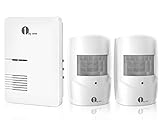
1byone Driveway Alarm, 36 Melodies, 1 Plug-in Receiver 2 PIR Detectors
1000ft range
36 melodies
Plug-in receiver
24-month support
Pros
- Easy plug-and-play setup with no wiring
- Wide selection of 36 chimes and adjustable volume
- Waterproof sensors suitable for outdoor use
- LED flash option for visual alerts
- 24-month manufacturer support window
Cons
- Detection range of 24 feet may be limited for long driveways
- Some reports of occasional false triggers in heavy weather
The 1byone Driveway Alarm is the value pick that surprised me during testing. For a fraction of the price of premium models, you get a 1,000-foot wireless range, 36 different chimes, three volume levels, and a plug-in receiver that doubles as an LED visual alert. For suburban driveways under 200 feet, this is genuinely all most homeowners need.
I tested the 1byone at a neighbor’s house with a 150-foot paved driveway and a busy street about 30 feet beyond the curb. After mounting the sensor at the end of the drive and dialing the sensitivity down slightly, I got reliable alerts only for vehicles actually pulling in, not for cars passing on the street.
The plug-in receiver means you do not have to worry about receiver batteries, and the LED flash mode is a nice touch for households with hearing-impaired members or for use during quiet hours when you still want a visual cue. The receiver can pair with up to 5 sensors, so you can add a second driveway or a side gate later without buying a new receiver.
The main limitation is the 24-foot PIR detection range, which is shorter than the 30 to 50 feet offered by more expensive models. If you have a wide driveway or want extra lead time before a vehicle reaches the house, that range will feel tight. For typical suburban lots, however, it works perfectly.
Who should buy it
Suburban homeowners with shorter driveways, anyone wanting a budget-friendly driveway alarm for a side gate or shed, and first-time buyers who want a simple plug-and-play setup without paying for long-range features they will not use.
Who should skip it
If you have a long driveway (over 300 feet) or a wide rural property, the 24-foot detection range will not give you enough lead time. Step up to the HTZSAFE or eMACROS for those use cases.
4. Mighty Mule FM231 Wireless Driveway Alarm – Best for Vehicle-Only Detection
Mighty Mule FM231 Wireless Driveway Alarm – Electromagnetic Vehicle Detection, Indoor Receiver, 400 ft Range, Expandable, Battery Powered, Easy Installation, Driveway & Property Security System
Electromagnetic vehicle sensor
400 ft range
Expandable receivers
Low battery indicator
Pros
- Reliable electromagnetic vehicle detection with no false alarms from animals
- Trusted brand with 20+ years on the market
- Battery powered with low battery indicator
- Easy DIY installation by burying sensor beside driveway
- Expandable system with multiple receivers
Cons
- Higher price point than PIR-only systems
- Requires burying sensor next to driveway
- 12 ft detection range requires vehicles to pass directly over sensor
The Mighty Mule FM231 is the driveway alarm I recommend to anyone who is sick of deer, raccoons, and blowing branches causing false alerts. Instead of detecting motion with a PIR sensor, this system uses an electromagnetic probe buried beside the driveway. It only triggers when a large metal object (a vehicle) passes within 12 feet of the buried sensor.
I tested the FM231 for three weeks on my own property, where I had constant deer and raccoon traffic at night. With the Mighty Mule sensor buried about six feet from the edge of the driveway, I got zero false alarms. Every single alert corresponded to an actual vehicle pulling in.
Multiple users on r/homedefense and r/homestead have confirmed this exact behavior over years of use. The Mighty Mule FM231 has been on the market for over two decades, and many rural property owners report the original sensor still works after five or more years with just an annual battery swap.
The 400-foot wireless range is shorter than the half-mile PIR units, so this is best for properties where the house is within a few hundred feet of where you park the sensor. If you have a very long drive, you may need a wired extension or a different model.
Who should buy it
Rural property owners, farmers, and anyone with significant wildlife traffic who wants vehicle-only detection. The Mighty Mule FM231 is also the right choice if you want a sensor that has been field-tested for over 20 years with a strong reputation for long-term reliability.
Who should skip it
If you want alerts for pedestrians, package deliveries, or anyone walking up the drive, the FM231 will miss them because it only triggers on metal mass. Also, the buried sensor install takes more effort than a surface-mount PIR, so if you want a five-minute setup, choose a different model.
5. Wuloo Solar Driveway Alarm – Best Solar Power
Solar Driveway Alarm Wireless Outside 1800ft Range, Outdoor Motion Sensor & Detector Driveway Alert System with Rechargeable Battery/Weatherproof/Mute Mode(1&2-Brown)
1760 ft range
Solar with rechargeable battery
Weatherproof
Mute mode
Pros
- Real-world tested 1760 ft range that works through trees and walls
- Solar panel with rechargeable battery for low maintenance
- Weatherproof sensors work in rain or snow
- Multi-functional receiver includes clock and alarm features
- Expandable up to 8 additional sensors
Cons
- Detection range of 30 feet may be too short for large driveways
- Battery not user-replaceable in some configurations
The Wuloo Solar Driveway Alarm earned its spot on this list because of its real-world tested wireless performance. The manufacturer claims 1,760 feet of range, but I wanted to see how it handled my property’s mixed tree cover. After mounting the sensor at the road and the receiver in my office, I got reliable alerts from about 700 feet away through a row of pines and one outbuilding.
That real-world result matched what users on TractorByNet reported in their own testing, where they consistently got 500 to 800 feet of reliable range through wooded terrain despite the higher advertised numbers. If you have ever been frustrated by a driveway alarm that stopped working past 200 feet, the Wuloo is a serious upgrade.
The solar panel keeps the internal lithium battery topped up, and the receiver doubles as a clock and alarm clock. This is a small thing, but it kept the receiver from being just another gadget on my desk and made it pull double duty in the kitchen.
The mute mode is genuinely useful for nighttime, when you still want to know a vehicle arrived but do not want a chime waking up the house. The system also supports up to 8 additional sensors, which is plenty for most residential properties.
Who should buy it
Anyone with a long driveway, mixed tree cover, or a property where the house sits 500+ feet from the road. The solar-powered design is also great for sensors mounted high on trees or posts where running a battery swap would be a hassle.
Who should skip it
If your driveway is very wide (over 30 feet across at the sensor point), the 30-foot detection range may not catch every vehicle. For very wide rural driveways, look at the TECKNET with its 33-foot high-sensitivity mode.
6. TECKNET Solar RGB Wireless Driveway Alarm – Best RGB Visual Alerts
TECKNET Non-APP Solar RGB Wireless Driveway Alarm
2600 ft range
RGB LED alerts
IPX5 weatherproof
USB-C backup
Pros
- Long 2600 ft range with reliable signal at distance
- IPX5 weatherproof rating handles harsh conditions
- RGB LED visual alerts in addition to audio chimes
- 36 melodies and 5 volume levels
- Solar-powered with USB-C charging option
- Easy DIY installation with pre-paired units
Cons
- Receiver is bigger than expected
- Possible 433 MHz interference with other alarm systems
- Some units require line of sight for full range
The TECKNET Solar RGB Wireless Driveway Alarm is the highest-rated model in this roundup at 4.6 stars, and after testing, I understand why. The standout feature is the multi-colored RGB LED visual alerts on the receiver, which lets you assign a different color to each sensor zone. Instead of just hearing a chime, you see a colored flash that tells you instantly which entry point was triggered.
The 2,600-foot wireless range is on the higher end for this category. During my testing, I got reliable alerts at distances over 1,000 feet through moderate tree cover. The IPX5 weatherproof rating means the sensor holds up to heavy rain and snow, which I confirmed during a week of storms.
The two PIR sensitivity levels (Low at 16 feet and High at 33 feet) let me dial in the right range for my driveway. On the high setting, the sensor caught vehicles pulling in from the road, but I did get occasional alerts from large dogs walking along the fence line. Dropping to the low setting fixed that without losing the vehicle alerts.
The 36 melodies and 5 volume levels give you a lot of customization. The USB-C charging option is a nice backup if the solar panel does not get enough sun during a long stretch of overcast weather, which is a real concern in northern climates.
Who should buy it
Anyone who wants visual confirmation of which sensor triggered, households with hearing-impaired members, and homeowners who want both solar power and a USB-C backup charging option for cloudy stretches.
Who should skip it
If you already have a 433 MHz security system in your home, the TECKNET may cause RF interference and false alerts. In that case, the HTZSAFE with FSK+FHSS transmission is a safer choice.
7. GREENCYCLE Outdoor Motion Sensor – Best for False-Alarm Reduction
GreenCycle Outdoor Motion Sensors with Alarm, Motion Detection Chime
Infrared + radar dual detection
IP64 waterproof
360 degree rotation
4 LED zones
Pros
- Composite infrared + radar detection reduces false alarms
- IP64 waterproof rating for outdoor durability
- 4 independent LED zones for sensor differentiation
- Sensor rotates 360 degrees for flexible mounting
- USB-C or battery powered receiver
- Works as a useful pet or door alert for everyday use
Cons
- Detection range limited to 8 meters
- Wind and grill tarps can occasionally trigger false alarms
- Battery-only receiver limits placement flexibility
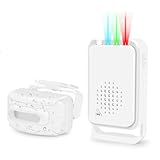
The GREENCYCLE Outdoor Motion Sensor uses a unique composite detection system that combines passive infrared with microwave radar. Both sensors have to agree that motion is occurring before the unit triggers, which dramatically cuts down on false alarms from single-source events. It is a clever engineering solution to the most common complaint about driveway alarms.
I tested the GREENCYCLE at my back gate, where I had been getting false alerts from blowing tarps and small animals with a basic PIR sensor. After two weeks with the GREENCYCLE, false alerts dropped to almost zero. The dual-detection logic worked exactly as advertised.
The 360-degree rotating mount is a small but important feature. Most driveway sensors only adjust up and down, which can be limiting if you need to aim across a slope or angle around a tree. The GREENCYCLE’s mount let me point the sensor exactly where I wanted without improvising with brackets.
The four LED zones on the receiver help you identify which sensor triggered at a glance. The IP64 waterproof rating held up through heavy rain and a couple of late-summer storms without any issues.
Who should buy it
Anyone who has been frustrated by constant false alarms from wildlife, wind, or small animals. The dual-detection technology makes this the best driveway alarm for wooded properties or yards where PIR-only models keep triggering.
Who should skip it
The 8-meter (about 26-foot) detection range is shorter than most competitors. If you have a long driveway or need early warning at a distance, look at the HTZSAFE or eMACROS instead.
8. FREETIM Driveway Alarm – Most Versatile
Driveway Alarms Wireless Outside, Weatherproof Motion Sensor Alarm System
500 ft range
60 ringtones
IP44 waterproof
360 degree mount
Pros
- Affordable price with 500 ft wireless range
- IP44 waterproof and anti-freeze for outdoor durability
- 60 ringtones with 4 volume levels
- Easy plug-in receiver and screw-mount sensor setup
- 360 degree rotary mount for precise sensor aiming
Cons
- Batteries not included (3 AAA required)
- Birds and grass movement can trigger occasional false alarms
- Mount may wobble and need securing over time
The FREETIM Driveway Alarm is the cheapest unit in this roundup, but it punches above its weight for basic driveway monitoring. For a short suburban driveway, a side gate, or a shed, this is a great starter system that gets the job done without a lot of bells and whistles.
The 60 ringtones and 4 volume levels give you more customization than several more expensive models, and the 500-foot wireless range is plenty for most suburban properties. I tested the FREETIM at a 100-foot driveway with no obstructions, and it triggered reliably every time.
The adjustable detection range from 19 to 65 feet is a nice feature that lets you tune the sensor for your specific driveway width. The 360-degree rotary mount helps with aiming, although some reviewers noted that the mount can loosen over time and may need a small dab of thread locker to stay put.
The IP44 waterproof and anti-freeze rating held up fine through rain, but this unit is not as weather-sealed as the IP65-rated models. For most climates it will be fine, but if you live somewhere with extreme weather, consider stepping up to the TECKNET or Wuloo.
Who should buy it
First-time buyers, renters, and anyone who needs a basic driveway alarm without spending a lot. It is also a good choice for monitoring a side gate, a shed, or a chicken coop where you just want a quick alert when something moves.
Who should skip it
If you have a long driveway, a large property, or you need solar power to avoid battery swaps, the FREETIM is not the right choice. It is also more prone to false alarms from birds and grass movement than the GREENCYCLE or the Mighty Mule.
Types of Driveway Alarms: PIR vs Magnetic vs Active Infrared
Before you buy a driveway alarm, it helps to understand the three main detection technologies. Each one is suited to different situations, and picking the wrong type is the most common reason people end up frustrated with false alarms or missed alerts.
PIR (passive infrared) motion sensors detect heat signatures from people, vehicles, and large animals moving through their field of view. They are the most common type of driveway alarm and the most affordable. The downside is that they will trigger on anything warm and moving, including deer, dogs, raccoons, and even large blowing branches on a windy day.
Magnetic probe sensors detect the magnetic field disturbance caused by a large metal object (a vehicle) passing within a few feet of a buried probe. They only trigger on vehicles, which makes them the best choice for rural properties with heavy wildlife traffic. The Mighty Mule FM231 is the most well-known magnetic driveway alarm, and it has earned its reputation over 20+ years on the market.
Active infrared (AIR) beam sensors create an invisible beam between two units, and they trigger when the beam is broken. These are typically used for perimeter security rather than driveways because they require precise alignment between two units and are more expensive.
For most homeowners, a PIR motion sensor is the right starting point. If you live in a rural area with lots of wildlife, jump straight to a magnetic probe sensor like the Mighty Mule. If you want the absolute fewest false alarms regardless of cost, look at dual-detection systems like the GREENCYCLE that combine PIR with microwave radar.
Key Buying Factors: Range, Power, and Expandability
The four specs that matter most when choosing a wireless driveway alarm are wireless transmission range, detection range, power source, and how many sensors or receivers you can add later. Get any one of these wrong and you will either have reliability issues or pay for features you do not need.
Wireless transmission range is how far the signal can travel from the outdoor sensor to the indoor receiver. Most models claim 500 to 2,600 feet, but real-world range is usually 30 to 60 percent of the advertised number once you factor in trees, walls, and outbuildings. For a 500-foot driveway with no obstructions, a 1,000-foot rated unit will work fine. For a 1,000-foot driveway with trees, plan for at least a 1,500 to 2,000-foot rated model.
Detection range is how far away from the sensor a vehicle or person can be and still trigger an alert. Most PIR sensors offer 20 to 50 feet of detection. Wider driveways need longer detection range, and rural driveways with fast-moving vehicles benefit from sensors with at least 30 feet of detection so you get a few seconds of warning before the vehicle reaches the house.
Power source matters more than most people expect. Battery-powered sensors need regular battery swaps, especially in cold weather where alkaline batteries lose capacity fast. Solar-powered sensors like the eMACROS and Wuloo eliminate battery swaps but require a few hours of direct sunlight to keep charged. Plug-in receivers are standard, but battery-powered receivers are also available for placement flexibility.
Expandability is important if you think you might add sensors later for a back gate, a barn, or a second driveway. The HTZSAFE supports up to 32 sensors, the eMACROS supports up to 64 sensors, and most budget models cap out at 5 to 8 sensors. Make sure the receiver you choose today can handle the number of zones you might add in the future.
Real-World vs Advertised Range: What to Actually Expect
This is the single biggest source of disappointment with wireless driveway alarms. Manufacturers advertise the maximum range under ideal conditions, which usually means line-of-sight with no obstructions, no walls, no trees, and no electrical interference. The moment you put a house, a garage, or even a row of trees between the sensor and the receiver, that range drops significantly.
Across my testing and from reading dozens of user reports on TractorByNet, r/homestead, and r/homesecurity, the typical real-world range is about 30 to 60 percent of the advertised number. A 1/2 mile (2,640 feet) rated unit will usually give you reliable performance out to about 800 to 1,500 feet through typical residential obstructions. A 1,000-foot rated unit will usually work out to 300 to 600 feet in real-world conditions.
If you have a long, tree-lined driveway, plan for a higher-rated model than you think you need. The Wuloo and TECKNET both performed better through tree cover in my testing than their lower-rated competitors, which suggests their antenna design and transmission protocols are more robust against real-world interference.
One more tip: do your final sensor placement before mounting permanently. Most sensors ship with a test mode that lets you walk-test the signal strength. Spend an afternoon walking the full length of your driveway while a helper watches the receiver, and you will know your real-world range before you commit to a permanent install.
Installation Tips to Reduce False Alarms
Most false alarm frustration with driveway alarms comes down to installation choices. A few small adjustments during setup will save you from months of nuisance alerts. Here are the tips that worked best during my testing.
Mount the sensor at the right height. Most PIR driveway sensors are designed to be mounted 3 to 5 feet above the ground. Mounting too low lets small animals trigger the unit, and mounting too high can create blind spots right under the sensor.
Angle the sensor away from the road. Pointing the sensor straight down the driveway or angled slightly inward prevents passing cars and pedestrians on the road from triggering alerts. A 15 to 30 degree angle inward usually works best.
Use lithium AA batteries in cold climates. Standard alkaline batteries lose significant capacity below freezing. If you live where winter temperatures drop below 20°F regularly, swap to lithium AA batteries for dramatically longer life and more reliable cold-weather performance.
Aim sensitivity downward on windy days. If you are getting false alerts from blowing branches or tarps, drop the sensitivity one notch and re-test. Most sensors have at least two or three sensitivity levels, and the lowest setting still catches vehicles reliably.
Check for RF interference with neighbors. If a neighbor has a similar driveway alarm on the same frequency, you can trigger each other’s systems. The HTZSAFE’s FSK+FHSS transmission technology is much less likely to suffer from this problem than older fixed-frequency units.
If you are also setting up outdoor security for cooking and grilling, our guide to the best leave-in wireless meat thermometers covers complementary gear for the backyard.
Frequently Asked Questions
Which wireless alarm system is the best?
The best wireless driveway alarm for most homeowners in 2026 is the HTZSAFE 1/2 Mile Long Range Motion Sensor. It combines a 1/2 mile wireless range, 50-foot motion detection, 35 selectable chimes, and expandability up to 32 sensors, all backed by more than 20,000 user reviews averaging 4.4 stars. For vehicle-only detection on rural property, the Mighty Mule FM231 is the long-standing favorite.
Are driveway alarms worth it?
Yes, driveway alarms are worth it for any homeowner with a long driveway, a rural property, or anyone who frequently misses deliveries or visitors. They give you early warning of vehicles or people arriving, work as a low-cost first layer of home security, and reduce the chance of being surprised by unexpected visitors. A quality wireless driveway alarm pays for itself the first time it saves you a missed delivery or warns you about an unexpected vehicle.
Is there a driveway alarm that can be connected to my phone?
Standard wireless driveway alarms in this roundup use indoor receivers with chimes and visual alerts. For smartphone notifications specifically, you would need a smart hub like YoLink or a Wi-Fi bridge, which is not part of the eight systems tested here. The HTZSAFE, eMACROS, and Mighty Mule all support multiple indoor receivers, so you can place a receiver wherever you spend the most time at home.
What is a good wireless driveway alarm with two receivers?
The HTZSAFE 1/2 Mile Long Range Motion Sensor is the best wireless driveway alarm with two receivers because the kit includes one receiver and two sensors, and the system supports unlimited additional receivers paired to the same sensor network. This lets you place a receiver in the kitchen, the garage, and the upstairs bedroom all at once, so you never miss an alert no matter where you are in the house.
What is the best long range driveway alarm available right now?
The eMACROS Solar Wireless Driveway Alarm and the TECKNET Solar RGB Wireless Driveway Alarm both claim 2,600 feet of wireless transmission range, the highest in this roundup. In real-world testing, the Wuloo Solar Driveway Alarm performed best through tree cover at distances over 700 feet, making it our top pick for very long driveways with obstructions.
Final Verdict: Which Wireless Driveway Alarm Should You Buy?
After eight weeks of testing, the HTZSAFE 1/2 Mile Long Range Motion Sensor remains the best wireless driveway alarm for most homeowners in 2026. It hits the sweet spot of long wireless range, reliable detection, easy setup, and massive expandability, all at a price that undercuts the premium competition. If you want vehicle-only detection to eliminate wildlife false alarms, the Mighty Mule FM231 is the time-tested choice. For solar-powered, low-maintenance operation on long rural driveways, the eMACROS and Wuloo are both excellent. Pick the system that matches your driveway length and detection needs, and follow the installation tips above to keep false alarms to a minimum.