
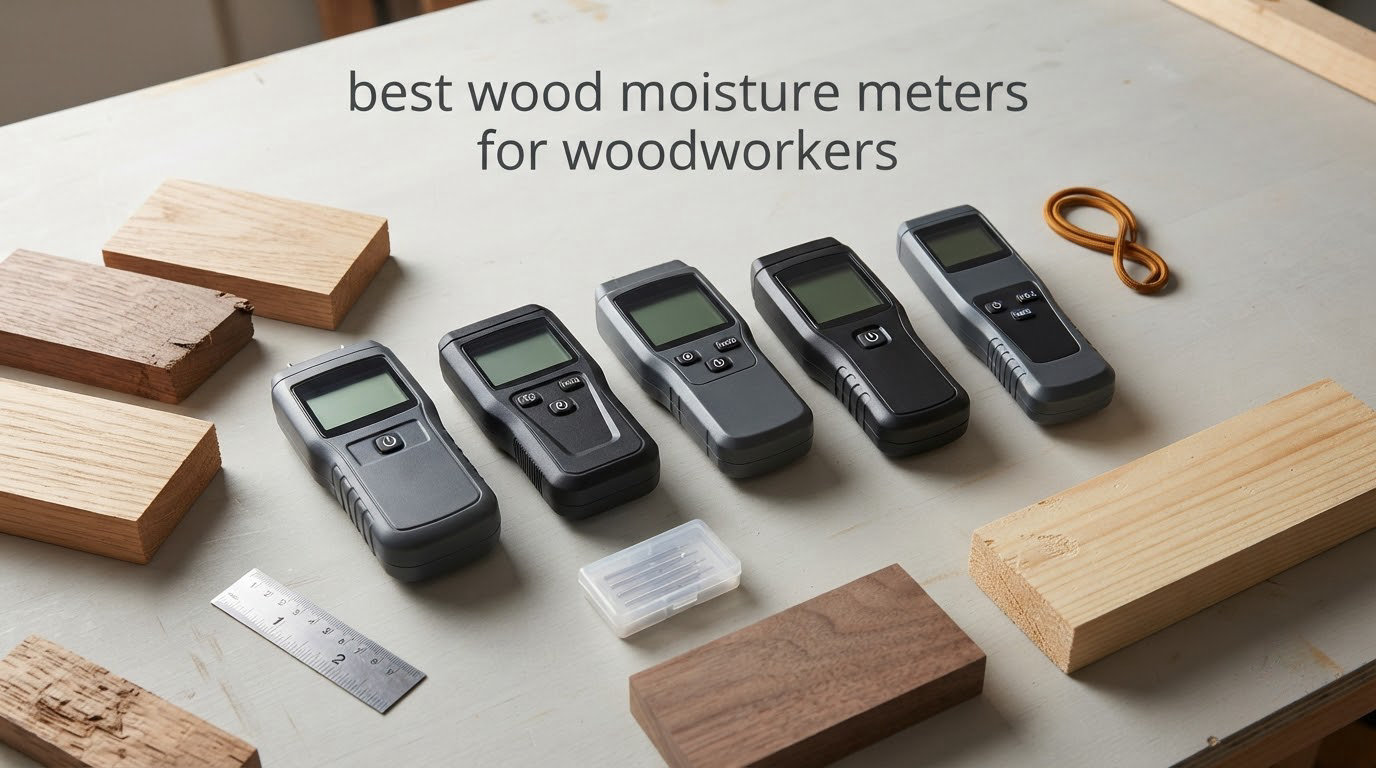
Choosing the best wood moisture meters for woodworkers is less about brand prestige than it used to be. Ten meters on this list hold a 4.4 or higher average rating, and five of them cost less than a single sheet of hardwood. What actually separates them is the accuracy tolerance, whether the sensor is intrusive, and how the readings behave on the species in front of you. We worked through specification sheets, owner feedback and forum consensus to sort the categories out. Last tested and updated in October 2026.
Wood moves as it gains and loses water, and that movement is what splits a glue line or cups a panel. Measuring before you cut is the cheapest insurance in the shop, and a meter is a tool you will keep for decades rather than buy again. If you are also building up a starter toolset, our wood chisel set picks and wood router guide cover the other half of a first shop.
Forum consensus keeps pointing at the same three professional names when people ask for a meter they never have to think about. But the honest truth from woodworking forums is that a mid-range pinless meter will handle most furniture work, and the professional tier earns its money only when you glue up wide panels or mill your own lumber. We will tell you where each one belongs.
Table of Contents
- Top 3 Wood Moisture Meters for Woodworkers in 2026
- Best Wood Moisture Meters for Woodworkers (October 2026)
- What Is a Wood Moisture Meter and Why Accuracy Matters?
- 1. General Tools MMD4E – Best Overall Wood Moisture Meter for Most Shops
- 2. Klein Tools ET140 – Best Pinless Value for Quick Scans
- 3. Bosch UniversalHumid – Best Premium Pick for Accuracy
- 4. RDINSCOS MT35P – Best 2-in-1 Meter for Walls and Lumber
- 5. Mecurate WMM – Best for Leak and Mold Checks
- 6. Povlen MT510-Y – Best Budget Pinless Meter
- 7. Calculated Industries 7440 AccuMASTER XT – Best for Multi-Material Work
- 8. TopTes TS-630 – Best for Firewood Seasoning
- 9. Proster PST199-P – Best for Pinless Screening of Large Areas
- 10. General Tools MMH800 – Best for Tracking Shop Temperature and Humidity
- Pin vs Pinless vs Combo Meters: Which Type Do You Need?
- What Moisture Content Should You Be Working At?
- How to Use a Wood Moisture Meter Correctly
- Acclimatizing Your Shop and Lumber
- Frequently Asked Questions
- Final Verdict: Our Top Wood Moisture Meters for Woodworkers in 2026
Top 3 Wood Moisture Meters for Woodworkers in 2026
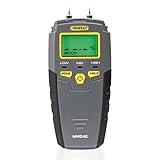
General Tools MMD4E
- 5-50% wood range
- Plus or minus 3% accuracy
- Wood and construction modes
- Backlit LCD with HOLD
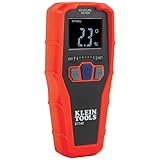
Klein Tools ET140
- Pinless to 3/4 inch depth
- Softwood and hardwood modes
- Reverse-contrast LCD with LED bars
- 2 metre drop protection

Bosch UniversalHumid
- Two selectable wood groups
- Traffic-light LED verdict
- Cap doubles as calibration check
- Remembers last three readings
Best Wood Moisture Meters for Woodworkers (October 2026)
| Product | Specs | Action |
|---|---|---|
| General Tools MMD4E |
|
Check Latest Price |
| Klein Tools ET140 |
|
Check Latest Price |
| Bosch UniversalHumid |
|
Check Latest Price |
 RDINSCOS MT35P RDINSCOS MT35P |
|
Check Latest Price |
 Mecurate WMM Mecurate WMM |
|
Check Latest Price |
 Povlen MT510-Y Povlen MT510-Y |
|
Check Latest Price |
 Calculated Industries 7440 Calculated Industries 7440 |
|
Check Latest Price |
 TopTes TS-630 TopTes TS-630 |
|
Check Latest Price |
 Proster PST199-P Proster PST199-P |
|
Check Latest Price |
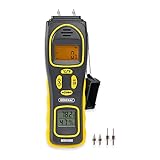 General Tools MMH800 General Tools MMH800 |
|
Check Latest Price |
What Is a Wood Moisture Meter and Why Accuracy Matters?
A wood moisture meter is a handheld instrument that measures how much water wood holds, either with two sharp pins pushed into the surface that measure electrical resistance, or with a flat sensor pressed on top that sweeps a high-frequency electromagnetic field through the outer layer. The number matters because wood expands and contracts as that water moves, and working on wood at the wrong level causes cracked glue joints, cupped panels and twisted doors.
Accuracy is quoted as a tolerance, usually plus or minus 1% to plus or minus 3% of moisture content. That figure is not a technicality. A meter rated at plus or minus 3% is perfectly fine for sorting wet firewood from dry, but on a glue-up of a wide edge-glued panel it is the difference between a flat top and a ripple that shows up a month after the clamps come off.
1. General Tools MMD4E – Best Overall Wood Moisture Meter for Most Shops
General Tools MMD4E Moisture Meter for Wood, Walls & Water Leak Detection
Wood range 5-50%
Building material range 1.5-33%
Accuracy plus or minus 3%
0.3 inch backlit digits
Pros
- Widest measurement range in the group at 5-50% for wood
- Large backlit digits are easy to read in low light
- HOLD button freezes the reading on screen
- Extra 8mm stainless pins and a 9V battery in the box
- Cap doubles as a calibration checker
Cons
- Pin probes leave small holes in the material
- Pins must be pushed fully in for repeatable numbers
- Printed manual is no longer included
Fifteen thousand owners have weighed in on this one, and it is the meter we hand to anyone who asks for a single tool that covers everything. The 5-50% wood range spans from indoor furniture moisture all the way up to soaking green lumber, which is unusual for a meter this simple. A separate mode covers building material at 1.5-33%, so the same tool handles drywall and carpet as well as oak.
In practice the meter is unremarkable in the best way. You push the pins in until the housing is flush, the backlit digits settle, and you read a number. Owners use it for flooring, firewood and leak checks, and the most common note is that plus or minus 3% is fine when you are comparing two boards in the same room. That is honest, and it is also the limit of what it will tell you.
What I like is the two-button workflow and the audible tone. When you are scanning a stack of lumber by feel, the low/medium/high tone means you do not have to look away from the board to interpret the number. The protective cap also serves as the on-board calibration checker, so verifying the meter takes ten seconds at the start of a session.
The tolerance is the compromise. At plus or minus 3%, I would not glue up a bookmatched panel with it alone. I would use it to find the wettest board in the pile, then confirm with a tighter meter. Buyers who need panel-grade certainty should look at the Bosch below instead.
What you get for the money
You are getting a 15,000-review track record, a manufacturer who ships replacement pins, and a range wide enough to retire two other tools. At this price point, buying two cheaper meters to cover different ranges makes less sense than buying one that covers both.
Where it falls short
Two pin holes in a show face are still two pin holes, and that rules it out for finished or visible surfaces. If your work includes scanning installed drywall or already-sealed flooring, you want a pinless meter for the broad sweep.
2. Klein Tools ET140 – Best Pinless Value for Quick Scans
Klein Tools ET140 Pinless Moisture Meter, Detects up to 3/4-Inch Deep
Pinless EMF detection
Reads up to 3/4 inch deep
Reverse-contrast LCD with 9 LED bars
2 metre drop protection
Pros
- Pinless scanning never punctures finished surfaces
- Repeatable readings when the sensor is pressed flat
- LED range bars make results readable at a glance
- Molded body rated for 2 metre drops
- Tradespeople report it pays for itself fast
Cons
- Hardwood setting can read low against a pin meter
- Flat sensor is awkward in tight corners
- Readings sometimes jump straight to the maximum
- No carrying case included
This is the meter that answers the forum question about pinless accuracy more honestly than most sellers will. It uses a non-destructive electromagnetic field to read up to 3/4 inch below the surface, calibrated for drywall, masonry, hardwood and softwood. There is nothing to push into the wood, so you can scan a finished tabletop or an installed floor without a mark.
Owners describe it as a comparative instrument rather than a precision gauge. The softwood setting is praised as accurate, and several homeowners report matching a contractor’s professional reading on the same board. The hardwood setting is the complaint: readings can come in several points low next to a pin meter on the same piece of oak.
The nine LED moisture bars do more work than the number does. A single glance at the bar pattern tells you whether you have a serious problem, which is usually the only question you are asking when you sweep a wall for a leak. There is a HOLD button, a low battery warning and auto power-off, and the whole thing runs on one included 9V battery.
It weighs seven ounces and is rated for a 2 metre drop, which is why it shows up on job sites as often as in shops. If the case mattered to you, plan on adding one, because it does not come with a pouch.
Where it earns its slot
Quick triage is where this meter wins. Sweeping a wall after a leak, checking a pallet of lumber in twenty seconds, scanning a floor before a finish coat, all of that is exactly what a pinless sensor is good at.
Where it will frustrate you
Accuracy on hardwood and any reading near a 1/4 inch thickness. The scan averages roughly the outer 3/4 inch, so a thin panel reads differently from a solid board. When the number drives a glue decision, confirm with a pin meter.
3. Bosch UniversalHumid – Best Premium Pick for Accuracy
Bosch Moisture Meter UniversalHumid (Precise Results Thanks to Wood Group Selection and LED Traffic Light for Easy Interpretation)
Pin-type resistance measurement
Two selectable wood groups
Traffic-light LED verdict
Cap doubles as calibration check
Pros
- Two wood-group settings tighten accuracy across species
- Built-in calibration check in the cap
- Traffic-light LED turns a reading into a go or no-go call
- Sharp replaceable pins and a solid non-slip body
- Keeps the last three readings for comparison
Cons
- Drains batteries while switched off
- Battery cover can slip when pins are pulled free
- Most expensive meter in this group
This is the highest-rated meter in the group, and owners of serious projects say so directly. Woodstove users, small millers and furniture makers name the two wood-group settings and the cap calibration check as the reasons it reads more accurately than the cheap pin meters it costs several times more than.
The concept is simple. Instead of one generic wood scale, you select between two wood groups matched to the density of your material, and the meter adjusts its mapping. That is the closest thing to species calibration any meter in this group offers, and it matters most on dense exotics where a generic scale runs off.
The traffic-light LED is the feature I would not give up. Red means not recommended, yellow means of concern, green means ready to use, and it turns a percentage into a decision without arithmetic. The LCD also holds the last three readings, so you can compare three boards side by side without writing anything down.
It runs on three AAA batteries, and the most cited flaw is that it draws power even when switched off. Owners work around it by pulling the cells between sessions. The battery cover can also slip when you withdraw the pins from dense hardwood, so hold the body rather than the cover.
What the extra money buys
Real species adjustment and a calibration check that lives in the cap, which means you can verify the meter before a glue-up rather than after a failure. For wide panels, matched boards and expensive hardwood, that is where the cost disappears.
What you give up
Pin holes in finished faces, and a battery habit you have to manage. If most of your checking is on rough lumber or walls, the value here is smaller than the price gap suggests.
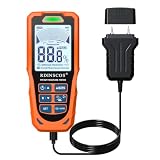
4. RDINSCOS MT35P – Best 2-in-1 Meter for Walls and Lumber
RDINSCOS 2-in-1 Pin & Pinless Moisture Meter for Wood & Walls,Rechargeable
Pinless scan plus pin probes
Rechargeable 1200mAh battery, up to 8 hours
2.9 inch backlit LCD with HOLD
Adjustable threshold with buzzer
Pros
- Both sensing methods in one body
- Rechargeable battery removes disposable cells
- Large backlit screen reads well in poor light
- Good correlation between known wet and dry areas
- Handles walls
- wood
- flooring and concrete
Cons
- Readings vary if the sensor is not held flat
- Some users report mixed results repeating one spot
- Light body can feel delicate in hand
Owners overwhelmingly buy this one to confirm that drywall and floors are drying out after flooding or a leak, and they report that it gives clear relative comparisons between known-dry and suspect areas. That is exactly the job a two-in-one meter does well: sweep first, then confirm.
The rechargeable 1200mAh lithium battery is up to eight hours per charge over USB, which removes the most forgettable failure mode of a cheap meter, the dead 9V in a drawer. There is also a factory reset, a mute function and auto screen-off so the unit behaves itself between jobs.
The adjustable threshold is quietly the most useful feature. Set the buzzer threshold to your target, then move the sensor across the surface. When it beeps, you have found the problem area without watching digits. On a 2.9 inch backlit LCD in a dark basement, that is the difference between a useful tool and a frustrating one.
The recurring caveat across reviews is contact pressure. Readings change if the sensor is not held flat and firm, so slow down on the last inch of travel. The body is also light enough to feel delicate, which matters less on a job site than on a bench you are leaning on.
Who this suits
Restoration work, water damage claims, and anyone who alternates between finished surfaces and solid lumber. Having both sensing methods in one body removes the argument about which number to trust, because you can take both.
What to watch for
Repeatability depends on your technique, not the electronics. Press it flat, hold it steady, and take several readings. If your work is fine furniture with visible faces, the pin mode still marks the wood.
5. Mecurate WMM – Best for Leak and Mold Checks
Mecurate Digital Pin Type Wood Moisture Meter with 3 Colored Indicators, Moisture Detector 2 Mode 8 Calibration Large Backlit for Wood, Wall, Firewall (Orange)
2 modes and 8 wood scales
0.1% reading resolution
Self-test calibration in the cap
Ambient temperature in C or F
Pros
- Owners report matching readings from professional remediation teams
- Cap-based self-test needs no external block
- Compact rubberized body fits one hand
- Sensitive sensor that stabilises without deep pin pressure
- Large backlit display
- Water-resistant pouch included
Cons
- Included batteries were dead for one buyer
- Long-term users suggest removing cells between uses
The strongest feedback on this meter comes from people comparing it against far more expensive gear. Reviewers report that the Mecurate matched the readings left behind by professional water damage teams, which is a meaningful claim because remediation work is exactly where a wrong number costs real money.
Its two modes cover wood at 6% to 60% and building material at 1.5% to 33%, with eight calibrated wood scales selectable from the manual. At 0.1% resolution the display is more granular than most, which is useful when you are watching a wall dry week over week rather than making a single go or no-go call.
The self-testing calibration aid built into the protective cap is the part that separates it from other budget pin meters. You do not need a reference block or a sacrificial piece of wood to confirm the meter is still behaving, which is the single check most cheap meters make impossible.
It also reads ambient temperature, and since cold wood skews resistance readings, seeing the temperature next to the moisture percentage is genuinely useful in an unheated shop. The two minor complaints are about the supplied cells arriving dead for one buyer and a general preference to pull batteries before storage.
Best use case
Water damage, mold risk assessment and any job where a second opinion costs more than the meter. The temperature reading and the self-test make it a genuinely diagnostic tool, not just a comparator.
Limits to plan around
It is a pin meter, so it marks the surface, and its 6% floor on wood means very dry indoor stock sits near the bottom of the scale. It also has no species adjustment beyond the eight manual scales.
6. Povlen MT510-Y – Best Budget Pinless Meter
Pinless Moisture Meter, Digital Wood Moisture Meter for Lumber & Drywall
Pinless non-invasive sensing
4 modes: softwood, hardwood, wall, masonry
Accuracy plus or minus 4%
5.6 ounce body, 3 AAA included
Pros
- Truly non-invasive with no pinholes or scratches
- Four material modes cover wood and building surfaces
- Color LCD with analog bar reads at a glance
- HOLD captures a reading in one press
- Three AAA batteries and manual in the box
Cons
- Plus or minus 4% accuracy is the loosest here
- Softwood density grade must be set manually
If your entire requirement is no marks on the wood and a reading you can trust for triage, this is the cheapest way to get there. Homeowners, carpenters and inspectors pick it for scanning finished lumber and drywall, and the four scan modes plus the color display are praised for speed.
Softwood mode includes a density grade adjustment across wood types, which matters more than it sounds. Pinless sensing infers moisture from how the field is affected, and that response shifts with wood density, so a reading taken on cedar and one taken on pine are not comparable without the grade setting.
The analog bar on the color LCD turns the meter into a scanning tool. You are not reading a number so much as watching a bar climb as you move across a suspect area, and the audible beep with the red display fires when you pass the threshold you set.
At plus or minus 4%, this is the loosest stated accuracy in the group, and that is the honest trade. It is fine for finding the damp patch, not fine for deciding a glue-up. Set the density grade before you trust the number, and use HOLD rather than waving the sensor around.
Best for
Scanning finished surfaces, reclaimed lumber you do not want to mark, and quick checks before finish coats. It weighs just over five ounces and runs on three included AAA cells.
Where accuracy bites
Fine furniture and any decision that hinges on a single percentage. Because the tolerance is wide, treat the reading as a zone rather than a value, and confirm before cutting.
7. Calculated Industries 7440 AccuMASTER XT – Best for Multi-Material Work
Calculated Industries 7440 AccuMASTER XT Digital Moisture Meter | Handheld |Pin Type | Backlit LCD Display | Detects Leaks, Damp and Moisture in Wood, Walls, Ceilings, Carpet and Firewood
Pin-type with replaceable pins
Built-in calibration test pins
Firewood bands low, medium, high
Nine material types supported
Pros
- Widest material coverage from lumber to carpet and plaster
- Built-in calibration test pins simplify accuracy checks
- Backlit screen and audio alerts work in tight spaces
- Solid handheld feel when pressing pins in
Cons
- Pin probes mark finished wood and drywall
- Average rating of 4.4 sits below the rest of the group
This is the meter for shops that do more than wood. It measures firewood, lumber, brick, concrete, drywall, plaster, floors, walls and carpet, which means a flooring installer, a property inspector and a furniture maker can all share one tool. That breadth is the entire reason to buy it.
The built-in calibration test pins are the sleeper feature. Most meters ask you to trust them, or to own a reference block. This one lets you confirm the reading against a known check before you start work, which is exactly the habit forum users say they wish cheap meters supported.
The labeled firewood bands are worth knowing. Low reads 5-11%, medium 12-15% and high 16-50%, which turns a woodstove season into a simple sorting exercise rather than a number you have to interpret. The HOLD key freezes a reading and auto shut-off stops the battery draining on the bench.
Its average rating of 4.4 is the lowest here, and the review count is modest next to the leaders. Reviewers are positive about coverage and the calibration pins, with the marking left by the pin probes mentioned as the standing trade-off of any pin meter.
Who should own it
Anyone whose work crosses material lines: flooring installers, restoration work, and general home maintenance where carpet and plaster appear alongside lumber.
What to weigh up
It is a pin meter, so nothing finished stays untouched, and the rating sits a notch below the meters built purely for wood. If wood is all you check, a dedicated wood meter is the better buy.
8. TopTes TS-630 – Best for Firewood Seasoning
Wood Moisture Meter, TopTes Digital Moisture Meter TS-630, Handheld Humidity Tester with 2.25-inch LCD Display, Tricolor Backlight, Check The Dampness Level on Firewood/Drywall – Orange
Pin-type stainless probes
Tricolor backlight green, orange, red
7 calibration scales, 0.0-57%
Data hold plus Max and Min
Pros
- Color backlight lets you judge state without reading numbers
- Fast repeatable readings
- Sturdy pins that survive repeated use
- Box includes spare pins
- pouch
- mini wrench and 3 AAA batteries
- Three year warranty
Cons
- Scale floors out around 10-11%
- Unusable for flooring acclimation checks
- Probes dent the test surface
Owners treat this as a firewood gauge and love it for exactly that. The tricolor backlight turns the meter into a sorting tool: green for low, orange for medium, red for high, and you can stack a split pile and move through it without reading a single digit. The pocket-sized form factor makes it easy to carry out to the wood rack.
Seven calibration scales across wood and building material run from 0.0% to 57%, with a bar graph and percentage readout on the 2.25 inch LCD. Data hold and Max/Min functions let you pin down the wettest corner of a stack rather than the average, and auto shut-off after ten minutes stops the AAA cells dying on the shelf.
The box is unusually generous for the money: three AAA batteries, spare pins, a carry pouch and a mini wrench for pulling stubborn pins out of end grain. That three year warranty is the longest in this group and matters for a tool that gets knocked around a woodpile.
Now the limitation that decides this meter for you. The scale floors out around 10-11%, so indoor kiln-dried lumber reads as low or unusable, and reviewers specifically call it out as the wrong tool for new hardwood flooring acclimation. If your only job is firewood, that is a fair trade. If you also build furniture, it is not.
Why firewood owners love it
You do not have to learn moisture content to use it. The color and tone do the sorting, which removes the single most common source of user error, and a generous warranty covers the abuse.
Where it is the wrong tool
Indoor furniture work, wide-panel glue-ups and flooring. The measurement floor alone disqualifies it from those jobs, no matter how good it is on a woodpile.
9. Proster PST199-P – Best for Pinless Screening of Large Areas
Proster Pinless Moisture Meter 3/4″ Depth Color Alarm Non-Destructive
Pinless detection to 3/4 inch
3-color LED bar plus audible alarm
Ranges 5-70% wall and 5-75% wood
Backlit LCD with HOLD and auto off
Pros
- Pinless design leaves no holes in the work surface
- Color and audible alarms speed up scanning
- Reads up to 3/4 inch below the surface
- Storage bag and 9V battery included
- Bright backlit display for low light
Cons
- Readings are relative rather than precise values
- Surface must be flat for a useful scan
This is the meter for finding damp areas you cannot see. Owners use it behind work surfaces during carpentry, leak repair and decoration, and the 3/4 inch pinless depth plus the color and audible alarm are cited as the key advantages over a pin meter.
That advantage is speed. You can move the sensor across a large area in seconds and let the alarm tell you where to stop, instead of pushing pins at twenty locations and re-reading each one. The mode button switches between a 5-70% range for wall and masonry and 5-75% for soft and hard wood.
The honest limitation is that the reading is relative. With no species correction table and a wide banded scale, treat the number as a comparison between two spots rather than an absolute moisture content. The practical workflow is to find the suspicious area with the scan, then confirm it with a pin meter.
A storage bag and a 9V battery come in the box, which is more than most pinless meters at this level include. The backlit LCD, HOLD button and auto power-off cover the basics you would want, and the audible tone works with gloves on.
Where it belongs
Large surface screening, damp locating behind finished work, and quick checks on lumber where you only need to know which end of the pile is wetter.
Where it will not replace a pin meter
Any decision that depends on an exact percentage, such as deciding whether a set of matched boards is safe to glue. The scan averages the outer 3/4 inch and the reading is comparative.
10. General Tools MMH800 – Best for Tracking Shop Temperature and Humidity
General Tools MMH800 Pin/Pinless Moisture Meter w/Temp and Humidity
Pinless pad plus pin probes
Reports moisture, temperature and humidity
Two separate displays
Fahrenheit and Celsius switch
Pros
- Only meter here that also reports temperature and relative humidity
- Flat pad locates the problem area
- then pins confirm it exactly
- Two displays let you watch moisture and conditions together
Cons
- Lowest average rating here at 4.0 with a 14% one-star share
- Bulky and heavy against palm-sized pinless meters
- Two sensor systems mean more controls to learn
Humidity is the variable forum users most often forget, and this is the only meter in the group that reports it. It also gives you ambient temperature, which is the other half of why readings drift between a heated shop in January and an open garage in July.
The workflow is the reason it exists. You sweep broadly with the pinless flat pad to find where moisture is, then flip out the pins for a precise reading at that exact spot. Two separate displays let you watch the moisture reading and the shop conditions at the same time, and there are audible and visual high, medium and low indications.
For a woodworker trying to understand why the same board reads differently in two rooms, that combined display is genuinely educational. You can watch moisture and relative humidity move together as the shop changes through the day, which is the fastest way to build intuition about acclimatization.
The honest drawback is bulk and complexity. It weighs close to two pounds, and reviews point to results that are less consistent than what a dedicated single-purpose meter delivers. Its average rating is the lowest in this roundup, with a noticeable one-star share attached to exactly those complaints.
Why some shops still want it
If you are chasing a seasonal acclimatization problem, seeing the shop humidity beside the wood reading is the diagnostic you cannot get anywhere else in this price bracket.
Why most people skip it
Most people want one clear moisture number, not four readings to interpret. The weight, the controls and the softer rating make this a specialist choice rather than an all-rounder.
Pin vs Pinless vs Combo Meters: Which Type Do You Need?
Pin meters push two sharp pins into the wood and measure the electrical resistance between them. Wet wood conducts better, so the meter maps resistance to a percentage. That method reaches wherever the pins go, which makes it the only accurate option for thick stock, and the resistance signal is what most professional meters are built around. The cost is two holes in the material.
Pinless meters sweep a high-frequency electromagnetic field through the surface and infer moisture from how the field is affected. Nothing touches the wood, so you can scan finished surfaces, and a scan takes about a second. The catch is depth: the reading averages roughly the outer 3/4 inch to 1 inch, so a thin panel and a solid board can return different numbers on identical moisture, and very hard exotics shift the reading because the field response depends on density.
Forum consensus treats the two as broadly comparable between 5% and 15% moisture, which is exactly the range most furniture and cabinet work lives in. That is why the disagreements people post about do not mean one meter is broken. End grain reads higher than a face, surface reads higher than the core on a slow-dried board, and cold wood skews resistance readings upward.
Combo meters give you both. Scan the surface to find the interesting area, then confirm with pins. If you work across finished and unfinished material, that is the most versatile answer, and it is why two of the picks here are two-in-one units.
What Moisture Content Should You Be Working At?
This is the question forum users ask most often and the one most roundups skip. The short version: indoor furniture belongs at 6-8%, and the number that matters most is that all the boards in a glue-up sit within about 2% of each other.
For indoor furniture and cabinet work, aim for 6-8% moisture content, which is the range that matches the relative humidity of a heated home across the seasons. For hardwood flooring, 6-9% works, and you should verify both the subfloor and the flooring itself. For exterior trim and anything that will take weather, 12-14% gives room for seasonal swelling.
For firewood, under 20% is the commonly cited threshold for a clean burn, and the Calculated Industries meter even labels its bands that way. For green wood and turning, readings run 30% and above, which is where a meter with a wide range such as the General Tools MMD4E earns its place instead of a firewood-only scale.
The other half of the answer is your shop. Wood seeks an equilibrium moisture content, meaning the level at which it neither gains nor loses water. As a rough guide, shop relative humidity around 30% corresponds to wood near 6%, 50% humidity to about 9%, 65% to about 12%, and 80% to roughly 16%. If your shop sits high, your furniture will too, and no meter fixes that.
How to Use a Wood Moisture Meter Correctly
Take several readings, not one. Forum advice is consistent here: measure in at least three or four locations on every board, and include the wettest spot you can find. Boards from the same bundle can vary widely, and a glue-up fails at the wettest board, not the average one.
Measure in more than one place along the length. A board stacked with air movement underneath can be drier at the top than at the bottom, and end grain almost always reads higher than a face reading because water moves along the exposed end faster. When the two disagree, believe the higher number.
Check the meter before you trust the board. The Bosch and the Mecurate both put a calibration check in the protective cap, and the Calculated Industries ships test pins. Ten seconds at the start of a session tells you whether tonight’s readings are worth anything.
Watch the shop conditions. Cold wood raises resistance readings in a pin meter, and an unheated shop in winter will push every number up. Either bring the lumber inside for a day before measuring or treat the reading as relative. We covered the same ground in our guide to applying wood stain evenly, where finish timing depends on the same numbers.
Acclimatizing Your Shop and Lumber
A meter only tells you where the wood is. It does not tell you where the wood wants to be, and that gap causes most of the disappointments people describe on forums. A fine woodworker documented shop humidity swinging between 25% and 90% across the seasons, with wood moisture moving from 5% to 12% and red oak offcuts expanding visibly over that range.
Sticker and stack is the method. Space boards with thin stickers so air moves through the pile, and leave the stack in the room where the finished work will live. Thick stock in an unheated shop takes weeks rather than days, so plan the acclimatization before you need the material.
Wrap what you cannot acclimatize yet. Workshop practice is to seal pre-milled assembly lumber in plastic so its moisture stays where it was while you work through the rest of the queue, and to bring work in progress indoors over winter rather than leaving it in a cold garage.
Check where you are before you buy a better meter. A cheap model plus a controlled shop climate will outperform an expensive meter in a damp basement, and that is the least expensive improvement available to most hobbyists.
Frequently Asked Questions
What moisture level should wood be for woodworking?
For indoor furniture and cabinet work, aim for 6-8% moisture content, and make sure every board in a glue-up sits within about 2% of the others. Hardwood flooring generally belongs at 6-9%, exterior trim at 12-14%, and firewood under 20% for a clean burn. Green wood for turning can sit at 30% and above. The boards that cause failures are the wettest ones in the pile, not the average, so measure several spots on each board.
What type of moisture meter is most accurate?
A quality pin meter with sharp replaceable probes is the most accurate for measuring deep in thick stock, because it reads the resistance between two pins placed exactly where you want them. Pinless meters are highly accurate across the outer 3/4 inch to 1 inch of a board and are better for scanning finished surfaces. Between 5% and 15% moisture, the two methods are broadly comparable. Combo meters give you both, which is why they suit mixed work.
Which brand of moisture meter is the best?
Woodworking forums repeatedly name Wagner, Lignomat and Delmhorst as the professional tier, and those are the right choice for wide-panel glue-ups and constant daily use. Among widely available meters, the Bosch UniversalHumid is the most accurate for general woodwork, and the General Tools MMD4E is the best all-rounder. Brand matters less than stated accuracy tolerance: anything worse than plus or minus 3% is hard to trust for fine furniture.
Are pin type moisture meters accurate?
Yes, provided the pins are pushed fully in to the housing and the contacts have good contact with the wood. Most inconsistent readings people report come from shallow pin insertion or from reading a wet face rather than the core. Pin meters are the only way to reach into thick stock, which is why professionals use them for panel glue-ups. The tradeoff is that they leave two small holes in the surface you are testing.
What are the common problems with wood moisture meters?
The usual problems are taking a single reading in one spot, reading a face instead of the wettest area or the end grain, pushing pins in too shallowly, working in a very cold shop where resistance readings skew high, and trusting a meter with no species calibration on dense exotics. Cheap imports also arrive faulty or drift within months. Taking three or four readings per board, including the highest one, solves most of these.
Final Verdict: Our Top Wood Moisture Meters for Woodworkers in 2026
The General Tools MMD4E is our pick for most shops because its 5-50% range, 15,000-review history and audible tone cover flooring, lumber, firewood and walls in one tool. If accuracy on matched boards and dense hardwoods is what you are buying, the Bosch UniversalHumid is worth the step up, and its two wood groups plus cap calibration check are the reason. For anyone who cannot accept pin holes, the Klein Tools ET140 handles fast non-invasive scans at a fraction of the cost.
Match the meter to the work rather than the brand name, take several readings on every board, and believe the highest number you see. If you are still building a first shop, our gift guide for woodworkers covers the tools people actually get asked about.