
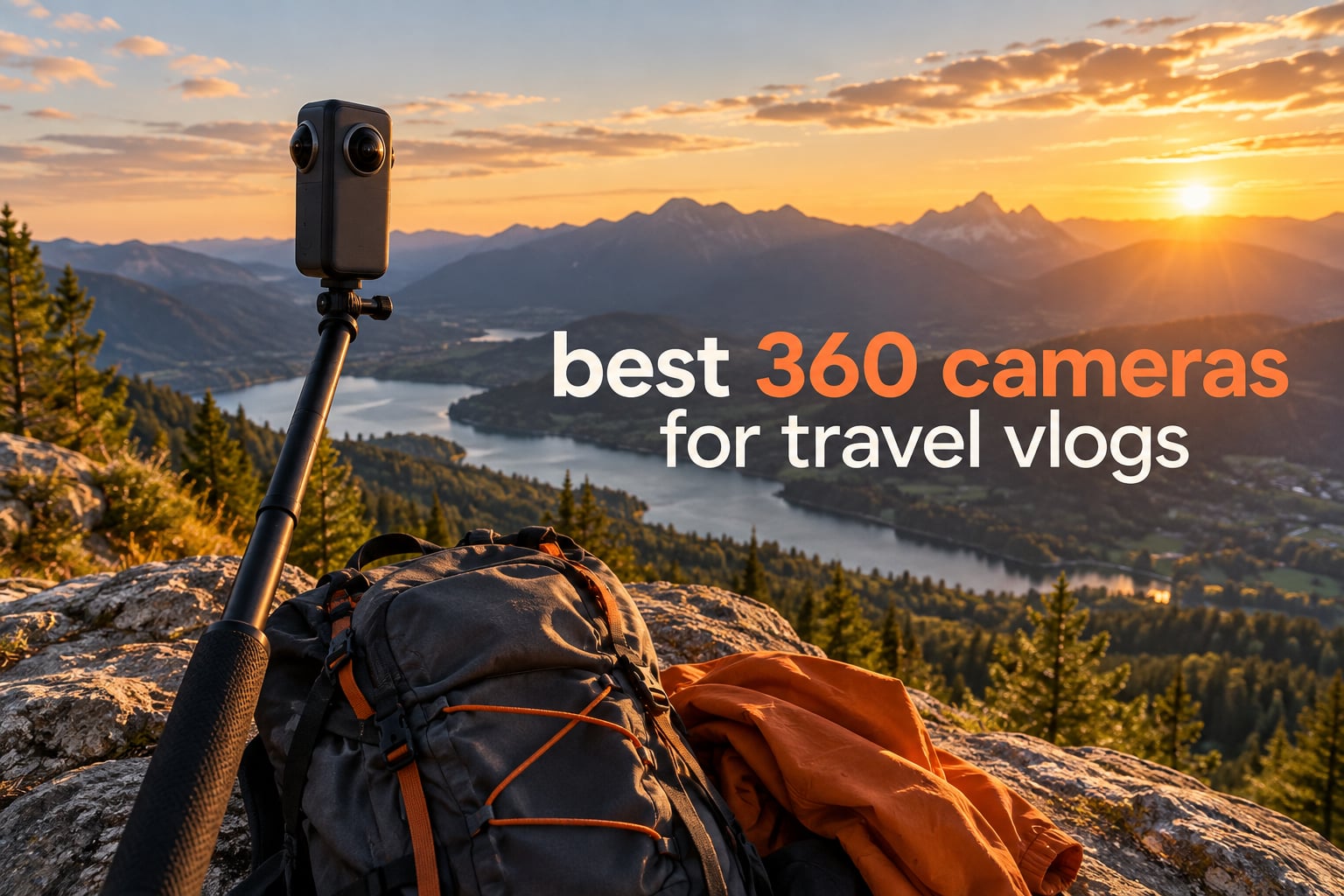
The Insta360 X3 is the best 360 camera for travel vlogs in 2026. It is the one body I keep recommending after weeks of walking tours, night markets and cold trail days, because it handles 5.7K 360 capture, 4K single-lens video and IPX8 waterproofing in something you can hold for a full day without your wrist complaining.
A 360 camera records two back-to-back fisheye lenses at once, which means you capture the whole scene and pick the framing later. For a travel vlog that is a genuine advantage: nobody has to hand the camera to a stranger, you never miss the moment, and you get drone-like footage in national parks and cities where drones are banned outright.
There is a catch, and we will be honest about it throughout. Reframing 360 footage takes longer in the edit than flat video, the on-board audio is only ever a backup for narration, and every one of these cameras depends on a phone app that you will be using a lot. We compared nine bodies across resolution, stabilization, battery, waterproofing, audio, weight and storage to work out which one actually suits the way you travel.
Table of Contents
- Top 3 Best 360 Cameras for Travel Vlogs (October 2026)
- The 9 Best 360 Cameras for Travel Vlogs at a Glance
- 1. Insta360 X3 — Best 360 Camera for Travel Vlogs Overall
- 2. Insta360 X4 Standard Bundle — Best for Long Shooting Days
- 3. Insta360 X4 Air — Best for Solo Travelers and Backpackers
- 4. GoPro MAX — Best for Durability and Live Streaming
- 5. DJI Osmo 360 — Best for Night Skies and Low Light
- 6. AKASO 360 — Best Value 360 Camera for Travel Vlogs
- 7. GoPro MAX2 — Best for Sand, Snow and Replaceable Lenses
- 8. Ricoh Theta Z1 — Best 360 Camera for Travel Photos
- 9. Xtra 360 — Best for 8K With Built-In Storage
- How to Choose a 360 Camera for Travel Vlogging in 2026
- 360 Camera or Pocket Camera? The Hybrid Travel Setup
- Frequently Asked Questions
- The Best 360 Cameras for Travel Vlogs: Final Verdict
Top 3 Best 360 Cameras for Travel Vlogs (October 2026)


The 9 Best 360 Cameras for Travel Vlogs at a Glance
Every camera below shoots 360 and flat video from one body. The differences that matter on a trip are resolution, endurance, waterproof depth, weight and how much of the edit you can do away from a desk.
| Product | Specs | Action |
|---|---|---|
| Insta360 X3 |
|
Check Latest Price |
| Insta360 X4 Standard Bundle |
|
Check Latest Price |
| Insta360 X4 Air |
|
Check Latest Price |
 GoPro MAX GoPro MAX |
|
Check Latest Price |
 DJI Osmo 360 DJI Osmo 360 |
|
Check Latest Price |
 AKASO 360 AKASO 360 |
|
Check Latest Price |
 GoPro MAX2 GoPro MAX2 |
|
Check Latest Price |
 Ricoh Theta Z1 Ricoh Theta Z1 |
|
Check Latest Price |
 Xtra 360 Xtra 360 |
|
Check Latest Price |
1. Insta360 X3 — Best 360 Camera for Travel Vlogs Overall
Insta360 X3, 360 Action Camera with 5.7K 360 Active HDR Video, 4K Single-Lens Camera, Waterproof, FlowState Stabilization, 2.29″ Touchscreen, AI Editing, for Motorcycle, Wintersports and Vlogging
5.7K 360 Active HDR
4K single-lens mode
200g
2.29-inch touchscreen
Waterproof to 10 m
Pros
- Combines 5.7K 360 and 4K single-lens capture in one body
- FlowState Stabilization with 360 Horizon Lock
- 2.29-inch touchscreen and IPX8 waterproofing for wet conditions
- AI reframing in the Insta360 app
- Largest review base of any camera in this group
Cons
- Invisible selfie stick effect needs an extension pole that is not included
- Modest still resolution against newer dual 1-inch sensors
- Editing depends on the Insta360 app so a phone is part of the kit
I packed the X3 for a two-week overland trip and it became the camera I reached for first. The 5.7K 360 mode records Active HDR, which means a bright sky above a shaded doorway does not blow out while your face goes black. That matters more than raw resolution when you are walking through a narrow old town at midday.
What sold me was switching to 4K single-lens mode for talking to camera. Instead of reframing 360 footage in post, I get a normal flat file straight out of the camera, which cuts my edit time dramatically for narration segments.
FlowState Stabilization and 360 Horizon Lock work together well. Walk-and-talk shots come out level and smooth without a gimbal, even on cobblestones. Owners on r/Insta360 still describe the X3 as the strongest value buy for city trips when they find one on a deal, and that matches what I saw.
The specs that matter: a 2.29-inch touchscreen, IPX8 waterproofing to 10 m without a case, Bluetooth and Wi-Fi connectivity, a 1-year warranty, and a body measuring 0.91 inch by 1.81 inch by 4.49 inch at 200 g. The camera handles MP4 capture with AAC audio and a max aperture of f/2.
Who the X3 suits
It suits vloggers who shoot a mixed format: 360 for the walk-through shots, single-lens for the narration. It also suits anyone filming in rain, on water or in a swimming pool, because the waterproofing is built in rather than dependent on a housing.
For beginners, the touchscreen plus the AI reframing tools in the app mean you can point at a person in a clip and have the software follow them. You are not learning keyframing on day one.
Where the X3 falls short
The headline invisible selfie stick effect needs an extension pole, and no pole is included. That is an extra accessory and an extra thing to lose out of a side pocket.
Still photos are the weak spot. Effective still resolution is modest next to bodies with dual 1-inch sensors, so if your travel blog leans on 360 photography rather than video, look at the AKASO 360 or the Ricoh Theta Z1. Low light is also softer than a 1-inch sensor can manage.
2. Insta360 X4 Standard Bundle — Best for Long Shooting Days
Insta360 X4 Standard Bundle – Waterproof 8K 360 Action Camera, 4K Wide-Angle Video, Invisible Selfie Stick Effect, Removable Lens Guards, 135 Min Battery Life, AI Editing, Stabilization
8K 360 video
135-minute battery
Removable lens guards
2.5-inch Gorilla Glass touchscreen
10 m waterproof
Pros
- 8K 360 video plus 5.7K60 and Active HDR
- 135-minute battery life is a large jump over earlier generations
- Removable lens guards cut the cost of a scratched lens
- Cold rated to minus 4F and waterproof to 10 m
- Bright 2.5-inch Gorilla Glass touchscreen
Cons
- Invisible selfie stick is not included with the Standard Bundle
- Bulkier than lighter 360 options for all-day handheld vlogging
- Reframing still depends on the Insta360 app
The X4 is the version of this camera that stops asking you to think about batteries. A quoted 135 minutes of recording changes how you plan a trip: you can shoot a full walking day in a dense city without hunting for a café outlet between locations.
Video quality steps up to 8K 360 with 5.7K60 and Active HDR available. Single-lens modes cover 4K60 wide-angle and 170 degree MaxView, which gives you a conventional action-camera file when you want one.
The removable lens guards are the upgrade I would defend hardest. On a hiking trip with sand, branches and pack straps, a scuffed lens guard is a two-minute swap instead of a repair, and owners consistently name this as the change that matters most in the field.
It is rated waterproof to 33 ft, which is 10 m, and cold resistant to minus 4 F. Screen size is 2.5 inches with Gorilla Glass. Shooting modes cover standard, HDR, timelapse, slow motion, Bullet Time and FreeCapture, and the body carries a 1-year warranty.
Who the X4 suits
It suits multi-day itineraries where you shoot long and often, and anyone visiting cold or wet environments. Ski trips, ferry crossings and rain-heavy city walks are all within its design limits without a case.
If you already own an Insta360 ecosystem, the 8K files and the 135-minute runtime make this the natural upgrade rather than a sideways move.
Where the X4 falls short
The invisible selfie stick effect is central to how most people use these cameras, yet the Standard Bundle does not include the pole. Budget for it, and pack it, because that effect is the reason to choose a 360 over a flat camera.
It is the heaviest of the Insta360 bodies we tested for continuous handheld work, and that adds up over a full day. Editing remains app-dependent, which is fine if you are organised and frustrating if you are somewhere with patchy connectivity. Our travel router picks for hotels cover that gap.
3. Insta360 X4 Air — Best for Solo Travelers and Backpackers
Insta360 X4 Air – Lightweight 165g 8K 360 Camera, Invisible Selfie Stick Effect, Replaceable Lenses, Shoot First & Frame Later, Built-in Wind Guard, FlowState Stabilization, AI-Powered App
165g body
8K30 360 with Active HDR
Replaceable lenses
Not water resistant
2.09-inch touchscreen
Pros
- 165g body is light enough to wear all day
- 8K30 360 capture with Active HDR
- Replaceable lenses let you swap a cracked cover instead of the camera
- Built-in wind guard helps on open-air and bike shoots
Cons
- Not water resistant so it needs a housing for rain surf or snow
- Model-specific small batteries do not fit X4 packs or chargers
- Low-light footage shows noise and lost clarity
- Setup needs the Insta360 app on a phone
Solo travel changes the weight math. When you have nobody to hold a camera for you, the body lives on your head, your chest or your backpack strap, and every gram registers by hour four. At 165 g, the X4 Air is the one I would wear all day.
It still records 8K30 360 video with 8K30 Active HDR, keeps FlowState Stabilization with 360 degree Horizon Lock, and adds replaceable lenses. That last feature is unusual at this weight and matters on sandy trails.
The built-in wind guard is a small detail that pays off constantly on travel vlogs. Walking footage is mostly wind, and a body that handles it means far less hiss in the mix than a bare microphone pointed at your collar.
Screen size drops to 2.09 inches, the maximum aperture is f/1.95, and cards need to be V60 speed class. Owners report clean pairing with third-party wireless microphones and quick connection to the phone app, which helps a lot for hands-free narration.
Who the X4 Air suits
It suits hikers, cyclists and anyone filming alone who wants a camera that disappears on the body. It suits warm, dry itineraries best, because that is the environment it was built for.
The wind guard and microphone pairing also make it a strong second camera for b-roll alongside whatever you record your narration on.
Where the X4 Air falls short
It is not water resistant. Rain, surf and snow all require a housing, which adds bulk to the exact kit you bought in order to travel lighter.
The batteries are smaller and model-specific, so X4 batteries and multi-battery chargers do not fit. That is an easy mistake to make when you already own the full-size X4. Low-light video shows noticeable noise and lost clarity compared with daylight shooting.
4. GoPro MAX — Best for Durability and Live Streaming
GoPro MAX — Waterproof 360 + Traditional Camera with Touch Screen Spherical 5.6K30 HD Video 16.6MP 360 Photos 1080p Live Streaming Stabilization
5.6K30 spherical 360
154g body
2-inch touchscreen
Max HyperSmooth
1080p live streaming
Pros
- Shoots 360 and traditional HERO-style video from one body
- Max HyperSmooth and horizon leveling handle walking and cycling well
- Six microphones for spatial 360 audio
- 1080p live streaming from HERO mode
Cons
- 5.6K30 360 resolution is well below current 8K rivals
- 360 export and editing has historically been painful on Windows
- Protective lens elements are not user replaceable
- Only a 2-inch touchscreen and older interface
The MAX is the older design in this group and it still earns a place. What it does better than almost anything here is live streaming: 1080p streaming from HERO mode, which no other camera in this list matches.
Max HyperSmooth stabilization with horizon leveling is genuinely class-leading for handheld walking footage, and at 154 g it is the second-lightest body here. Six microphones capture spatial 360 audio, which gives you usable ambience from any direction.
Thermal behaviour is the quiet strength. Owners report it never froze or overheated through long recordings, which is exactly the failure mode that ruins a trip when it happens on day six.
Specifications: 5.6K30 spherical 360 video, 16.6MP 360 photos, PowerPano 270 degree distortion-free panoramas, Max TimeWarp speed-ramped time lapse, waterproof to 10 m, a 2-inch touchscreen and a body of 1.6 inch by 2.5 inch by 2.7 inch. A 1-year manufacturer warranty applies.
Who the MAX suits
It suits vloggers who stream live from their travels and want a rugged body that records for a long time without cooking. It also suits anyone who values reliability over resolution.
The six-mic array makes it a good ambience recorder for establishing shots where no narration is needed.
Where the MAX falls short
5.6K-only 360 capture is well below the 8K bodies available now, and reframed detail suffers visibly when you crop in. If your edit leans heavily on tight reframes, that limitation shows up on a big screen.
Lens elements are not user replaceable, so a scratch is effectively a repair issue rather than a swap. Several reviewers also needed a Mac or Adobe software to convert files because the Windows workflow has historically been weak, and the 2-inch screen feels dated next to newer bodies.
5. DJI Osmo 360 — Best for Night Skies and Low Light
DJI Osmo 360 Standard Combo, 360 Action Camera
1-inch 360 sensor
190-minute battery
105GB built-in storage
120MP stills
183g
Pros
- 1-inch 360 sensor with strong low-light performance and 120MP stills
- 8K30 360 video plus 8K50 and 4K120 options
- 105GB built-in storage means you can shoot without a card
- Shares batteries with Osmo Action models
Cons
- Lenses are not user replaceable so a scratch is serious
- DJI Mimo has fewer reframing features than the Insta360 app
- Some users report battery door and seal defects
The Osmo 360 is the one to take when your itinerary runs past sunset. Its 1-inch 360 sensor is a genuine step up in low light, and owners describe a large image-quality jump over older 360 bodies along with better stitching and colour than a GoPro Max.
Battery life is the standout number in this roundup: up to 190 minutes of recording, using the same batteries as Osmo Action models. If you already carry that ecosystem, the batteries already come with you.
Audio is the best-supported here for narration work. Four microphones, and it connects directly to two DJI wireless mic transmitters with no receiver needed. For a travel vlog where you talk to camera constantly, that removes a real amount of friction.
Specs: 8K30 360 video with 8K50 and 4K120 high-frame-rate options, 120MP 360 photos, 105GB of built-in storage, a 1.2m invisible selfie stick, magnetic quick-release mounting with a 1/4 inch thread, S-log gamma curve, and a 2-inch screen. Weight is 183 g.
Who the Osmo 360 suits
It suits night markets, city walks after dark, star camps and any shoot where light is the constraint. It also suits vloggers who already own Osmo Action batteries and mounts, since the gear is shared.
The built-in storage makes it forgiving when you have forgotten your card, which happens more often than you would like on a long trip.
Where the Osmo 360 falls short
The lenses are not user replaceable. On a hike with sand and branches that is a meaningful risk for a body you are relying on all trip.
The DJI Mimo app is less mature than the Insta360 app and has fewer reframing features, which matters because reframing is the whole workflow for a 360. Some users have also reported battery door and seal defects and dissatisfaction with warranty handling.
6. AKASO 360 — Best Value 360 Camera for Travel Vlogs
AKASO 360 Action Camera Standard Combo- 5.7K 360 Video, 360-SuperSmooth
5.7K 360 video
Dual 1/2-inch 48MP sensors
72MP 360 photos
DNG8 RAW
180g
Pros
- Dual 1/2-inch 48MP sensors and 72MP 360 photos
- 360-SuperSmooth stabilization in the app removes the need for a gimbal
- DNG8 RAW photo mode improves dynamic range in dark scenes
- Invisible selfie stick effect works
Cons
- No HDR support which limits highlight and shadow recovery
- Low-light video is limited by the smaller sensors
- Invisible Selfie Stick is not included with the Standard Combo
- Editing relies on the smaller AKASO 360 Studio ecosystem
The AKASO 360 is the least expensive way into a genuine dual-lens 360, and for a first travel season that matters. It holds a strong sales rank in Sports and Action Video Cameras and a 4.4 average from 591 reviews.
The surprise is stills. Dual 1/2-inch 48MP sensors produce 72MP 360 photos with a DNG8 RAW mode, which is the kind of feature you normally pay a premium 360 for.
Video is 5.7K 360 with 360-SuperSmooth in-app stabilization and 360 degree Horizon Lock that keeps footage level through spins and flips. AI subject tracking keeps a moving subject centred, which is genuinely useful when you are filming yourself walking toward a camera.
Battery life is quoted at 2 hours, cards need V60 class, and the body is 180 g measuring 1.21 inch by 1.85 inch by 4.32 inch. There is a 1-year manufacturer warranty and a 2.29-inch screen.
Who the AKASO 360 suits
It suits first-time 360 buyers and travel vloggers who shoot a lot of stills alongside video. RAW capture gives you more latitude in dark scenes than most 360 bodies at this level.
It also suits anyone who wants the invisible selfie stick look without paying flagship money for the body.
Where the AKASO 360 falls short
There is no HDR support, which limits highlight and shadow recovery against Insta360 and DJI bodies. On a bright coastline or a snow field that is visible.
Low-light video is constrained by the smaller 1/2-inch sensors, and the editing ecosystem, AKASO 360 Studio, is smaller than the alternatives with fewer automated reframing options. The selfie stick is not bundled either.
7. GoPro MAX2 — Best for Sand, Snow and Replaceable Lenses
GoPro MAX2 – Waterproof 360 + Traditional Action Camera with Touch Screen, Spherical 8K Video, 29MP 360 Photos, Easy Replaceable Lenses, HyperSmooth Stabilization, 6 Microphones
True 8K 360 video
29MP 360 photos
Replaceable glass lenses
HyperSmooth with Horizon Lock
6 microphones
Pros
- True 8K spherical video with claimed higher resolution than competing 360 cameras
- Replaceable water-repelling optical glass lenses fix the older MAX weakness
- Six microphones for spatial 360 audio
- 1/4-20 base thread for invisible pole mounting
Cons
- Smallest touchscreen in the group at 1.82 inches
- Reframing runs through GoPro Quik which is less capable than the Insta360 app
- Only 256 reviews so far so long-term reliability is less proven
- No built-in storage so a microSD card is needed every shoot
The MAX2 answers the single biggest complaint about the original MAX: the lenses are now user replaceable. Water-repelling optical glass on a hiking trip means a scuffed cover is a swap rather than a repair.
Video is true 8K spherical with 29MP 360 photos, six microphones for spatial audio, and a 1/4-20 thread on the base for invisible pole mounting. That thread matters more than it sounds, because it lets you use a wider range of third-party sticks and mounts.
The GoPro Quik app reframes 360 into 4K traditional video with adjustable stabilization and Horizon Lock. If you already shoot on GoPro hardware, the ecosystem is familiar.
The box includes the camera, two protective lens caps, a 1960mAh Enduro battery, a curved adhesive mount, a buckle with thumb screw, a USB-C cable and a microfibre lens cloth. Cards need V60 class and there is a 1-year manufacturer warranty.
Who the MAX2 suits
It suits beach trips, ski trips and desert routes where lens damage is likely and replacement is cheap. It suits GoPro users who want true 8K without leaving their app ecosystem.
The invisible pole mounting makes it a good match for travel shots where you want the third-person follow framing.
Where the MAX2 falls short
The 1.82-inch screen is the smallest in this group, which is frustrating when you are setting a reframe on the camera itself rather than in the app.
GoPro Quik is less capable than the Insta360 app for reframing. With only 256 reviews on record, long-term reliability and thermal behaviour are less well documented than for the established bodies, and there is no built-in storage so you need a card from the first frame.
8. Ricoh Theta Z1 — Best 360 Camera for Travel Photos
Ricoh Theta Z1 51GB Black 360° Camera, Two 1.0-inch Back-Illuminated CMOS sensors, Increased 51GB Internal Memory, 23MP Images, 4K Video with Image stabilization, HDR, High-Speed Wireless Transfer
Two 1.0-inch CMOS sensors
23MP 360 stills
51GB internal storage
4K 360 video
182g
Pros
- Two 1-inch back-illuminated sensors give the best low-light and dynamic range stills here
- 23MP 360 photos with high-precision stitching and less ghosting and fringing
- 51GB internal storage holds roughly 110 minutes of 4K video
- RAW capture with Adobe Lightroom Classic support
Cons
- Weakest video feature set here limited to 4K with no high-frame-rate 360
- Battery life is short and the battery is not user replaceable
- Only a 1-inch non-touch display
- Not waterproof and no replaceable lenses
The Theta Z1 is a stills camera that happens to shoot video. Two 1.0-inch back-illuminated CMOS sensors produce 23MP 360 photos with high-precision stitching and less ghosting, flare and fringing than anything else here.
If your travel content leans on photography, virtual tours or listing imagery, this is the body that delivers. Owners describe the low light and HDR handling as unmatched in this group.
Internal storage of 51GB is unusual at this level and holds roughly 110 minutes of 4K video or thousands of stills. RAW capture works through Adobe Lightroom Classic and THETA Stitcher, and four-channel spatial microphones are built in.
The magnesium alloy body, USB 3.0 Type-C transfers, aperture priority and manual exposure modes, and 360 live streaming including YouTube all point at a professional tool. Weight is 182 g and there is a 1-year manufacture warranty.
Who the Theta Z1 suits
It suits real estate shooters, virtual tour creators and travel bloggers who publish photographs rather than daily vlogs. It also suits anyone who shoots dusk and night scenes, where 1-inch sensors and HDR pay off most.
The internal storage means you can shoot and hand files off without a card reader in the field.
Where the Theta Z1 falls short
The video feature set is the weakest in this roundup: 4K only, with no 8K and no high-frame-rate 360 modes. If your format is a vlog, this is the wrong emphasis.
Battery life is short and the battery is not user replaceable, which is a real constraint on a long trip. The 1-inch non-touch display is a screen people repeatedly ask to have upgraded, and there is no waterproofing or replaceable lens option.
9. Xtra 360 — Best for 8K With Built-In Storage
Xtra 360 Camera with Invisible Selfie Stick, 8K Panoramic Video, 1-Inch Sensor Equivalent, 100MP Photos, 105GB Built-in Storage, Waterproof Action Camera with Bullet Time for Travel and Vlogging
True 8K 360 video
1-inch equivalent sensor
105GB built-in storage
100MP panoramas
150g
Pros
- 1-inch equivalent sensor in an 8K 360 body
- 105GB built-in storage so you can shoot without a memory card
- Solid build owners describe as reliable
- Waterproof and light at 150g for travel and night work
Cons
- No desktop software so footage must be pulled off the phone
- Editing app is less mature especially on macOS
- Firmware cadence and long-term support are less certain
- 360 capture does not work underwater and there is no replaceable lens
The Xtra 360 combines a 1-inch equivalent sensor, true 8K 360 video and 105GB of built-in storage in a 150 g body. Owners frequently describe it as hardware-equivalent to a flagship 360 at a lower price, and highlight highlight and shadow detail in high-contrast scenes.
It also works with DJI batteries and mounts, which is a quiet bonus for anyone already carrying that gear.
The box includes a USB-C to USB-C PD cable, a 1900 cold-resistant battery, a carrying bag, a transparent lens protector and more. Cards are V60 class, and there is a Low Light shooting mode plus an X-log picture profile for grading.
Because there is no built-in card slot dependency, storage is a genuine advantage on a 7 to 14 day trip. You can keep shooting on internal memory while your cards are full.
Who the Xtra 360 suits
It suits vloggers who shoot 8K and travel with limited card capacity, and anyone who wants the flexibility of both internal memory and a V60 card.
The 150 g weight and waterproof body suit walking tours and night-lapse work where a larger body would be tiring.
Where the Xtra 360 falls short
There is no desktop software, so 360 footage must be pulled off the phone rather than a memory card. That is a real constraint if you edit on a laptop rather than on your phone.
The editing app is less mature than the alternatives, particularly on macOS. Firmware updates and long-term support are less certain than the big brands, 360 capture does not work underwater with no replaceable lens option, and image quality drops noticeably when you zoom beyond roughly a 150 degree field of view.
How to Choose a 360 Camera for Travel Vlogging in 2026
Resolution and what survives a reframe come first. An 8K 360 file gives you the latitude to crop a tight shot from the middle of the frame after the fact, which is the entire premise of shooting spherical. The Insta360 X4, the DJI Osmo 360, the GoPro MAX2 and the Xtra 360 all record true 8K. The X3 and AKASO 360 sit at 5.7K and the original GoPro MAX at 5.6K, which is fine for wide framings and tight for close reframe crops on a large screen.
Stabilization and horizon lock come next, and this is where 360 cameras beat flat cameras for walking footage. Every camera here offers some form of it. The X3 and X4 use FlowState Stabilization with 360 Horizon Lock, the AKASO 360 uses 360-SuperSmooth with 360 degree Horizon Lock, the Osmo 360 uses digital stabilization, and the GoPro bodies use HyperSmooth variants. In practice, all of them produce a level, smooth walk-and-talk clip without a gimbal.
Battery minutes and card planning matter more on a trip than in a lab. Quoted figures range from around 1.5 hours on the Xtra 360 to 190 minutes on the DJI Osmo 360, with the X4 at 135 minutes, the AKASO 360 at 2 hours and the X3 rated in minutes rather than hours. Treat those as best cases: 8K recording and cold weather both pull real numbers down.
For storage, plan on speed class rather than capacity alone. The Xtra 360, DJI Osmo 360, GoPro MAX2 and AKASO 360 call for V60 cards, while the X3 lists V90 and above alongside U3 or higher. On a 7 to 14 day trip, carry at least two cards so you can offload overnight, and check that your reader works before you leave.
Waterproof depth and lens durability are where trip plans change. The X3, X4, GoPro MAX, MAX2, Osmo 360 and Xtra 360 are all listed as waterproof to 10 m without a case. The X4 Air is explicitly not water resistant and needs a housing. The Theta Z1 is not water resistant either. Separately, only the X4, X4 Air and MAX2 offer user-replaceable lenses, which is the feature that protects a camera on a hike with sand, branches and pack straps.
Audio is the real weak point of 360 for vlogs, and the honest answer is that no camera here replaces a dedicated microphone for narration. Wind is the bigger problem than the built-in mics. The X4 Air has a built-in wind guard, the Osmo 360 connects directly to two DJI wireless mic transmitters, the X4 Air pairs with third-party wireless mics, and the GoPro MAX and MAX2 carry six microphones for spatial ambience. For narration, record voice separately and sync it in the edit.
App ecosystem and per-clip editing time decide whether you will actually publish. A 360 clip takes noticeably longer to reframe than a flat file, and on the road that compounds. The Insta360 app is the most capable of the group for reframing, keyframes and AI subject tracking. DJI Mimo and GoPro Quik cover the basics with fewer options, and the AKASO 360 Studio and the Xtra app are smaller still. Budget real time per clip rather than assuming one take is one edit.
Weight and packability decide whether a 360 camera comes out on day three. Bodies range from 150 g on the Xtra 360 and 154 g on the GoPro MAX up to 200 g on the X3. The X4 Air at 165 g is the pick for all-day wear. When you plan your carry, our travel tripod picks and packing cube guide both help you keep a fragile camera body protected in a small bag. If your itinerary is mostly flat and mild, the heavier weather-sealed bodies are the safer choice.
360 Camera or Pocket Camera? The Hybrid Travel Setup
Here is the honest answer that almost nobody in this category will write down. A 360 camera is not a replacement for a good flat vlogging camera. Community consensus across the 360 forums is consistent: 360 cameras shine for B-roll, drone-like shots and impossible angles, while plenty of vloggers still prefer a flat camera for narration.
Forum threads on r/ActionCam repeatedly recommend exactly this: a pocket camera for talking-head work plus a 360 for B-roll and point-of-view shots. That is the setup we would build. The 360 carries the walking tours, the impossible angles and the places drones cannot fly. The small flat camera records your narration and any scene where you need to control focus and framing precisely.
It also solves the conspicuousness problem. Reviewers on forums point out that a large 360 rig announces itself as gear in a tourist crowd, while a small pocket camera disappears. That matters in markets, on public transport and in places you would rather not attract attention. Our compact camera guide covers that second half of the kit.
There is also the leftover-file benefit. A single 8K 360 clip can be reframed into several vertical clips for TikTok, Reels and Shorts, plus a wide cinematic version for your main channel. That repurposing value is the strongest financial argument for owning a 360 even when you also carry a flat camera.
Frequently Asked Questions
What camera do most travel vloggers use?
Most travel vloggers use a small flat camera for narration and a 360 camera for B-roll. The 360 handles walking tours, drone-like angles and no-drone locations, while a pocket camera keeps talking-head footage simple and discreet in a tourist crowd.
What is the best 360 degree camera for vlogging?
The Insta360 X3 is the best all-round 360 camera for vlogging in 2026. It records 5.7K 360 Active HDR and 4K single-lens video, weighs 200 g, is waterproof to 10 m and has the largest review base in this group. If you want 8K and longer endurance, step up to the Insta360 X4.
Which 360 camera is best for travel?
For most travel itineraries the Insta360 X4 wins on resolution and battery life, recording 8K 360 video with a quoted 135-minute runtime, removable lens guards and cold rating. For backpacking and solo hiking, the 165 g Insta360 X4 Air is lighter. For night travel, the DJI Osmo 360 wins on its 1-inch sensor.
Can you go live with a 360 camera?
Yes. The GoPro MAX streams live in 1080p from HERO mode, and the Ricoh Theta Z1 supports 360 live streaming including YouTube. For the other cameras, live streaming usually means streaming a reframed flat feed from the phone app rather than the full spherical file.
What are some good budget 360 cameras?
The AKASO 360 is the strongest budget pick, with 5.7K 360 video, dual 1/2-inch 48MP sensors, 72MP 360 photos, DNG8 RAW capture, 360-SuperSmooth stabilization and 360 degree Horizon Lock. The Insta360 X3 is the better budget buy if you can find it on a deal, given its larger app ecosystem and proven reliability.
Is Insta360 better than GoPro for 360 cameras?
Insta360 generally leads on editing software and reframing options, which is the part of a 360 workflow you use most. GoPro leads on rugged build and, with the MAX2, on user-replaceable glass lenses. The newer GoPro MAX2 records true 8K but runs on GoPro Quik, which is less capable than the Insta360 app for reframing.
How do you edit 360 video for vlogs?
You shoot the full spherical file, then reframe it in the camera app or desktop software by keyframing the view, using AI subject tracking, or letting auto-reframe pick the angle. Export a flat 4K or 8K file. Allow more time per clip than you would on flat footage, since every 360 clip needs the reframe step.
The Best 360 Cameras for Travel Vlogs: Final Verdict
The Insta360 X3 remains our pick for the best 360 cameras for travel vlogs in 2026. It is the most proven body in the group, it handles rain without a case, it shoots 5.7K 360 and a clean 4K single-lens mode from the same body, and its 200 g weight is manageable for a full walking day.
Step up to the Insta360 X4 for 8K and 135 minutes of recording, drop to the X4 Air at 165 g when every gram counts, and look at the DJI Osmo 360 if your trip runs after dark. The AKASO 360 is the value entry, the GoPro MAX2 suits trips where lenses get damaged, and the Ricoh Theta Z1 is the one to buy if your travel content is mostly photography.
Whichever you choose, buy an extension pole. Every invisible selfie stick effect needs one, and none of these cameras includes it in the standard bundle.